
Most low Step applicants lose interviews before they ever lose the Match.
They panic, scatter, and waste their few chances with sloppy prep and desperate behavior. You are not going to do that.
This is your interview-season playbook—built specifically for low Step scorers—from the moment the first invite hits your inbox to the moment you certify your rank list.
Big Picture: Your Season at a Glance
Here’s the reality: with a low Step score, interview season is the make-or-break stretch. The paper deficits are already there. The only thing left is your performance and your strategy.
Use this timeline as your spine:
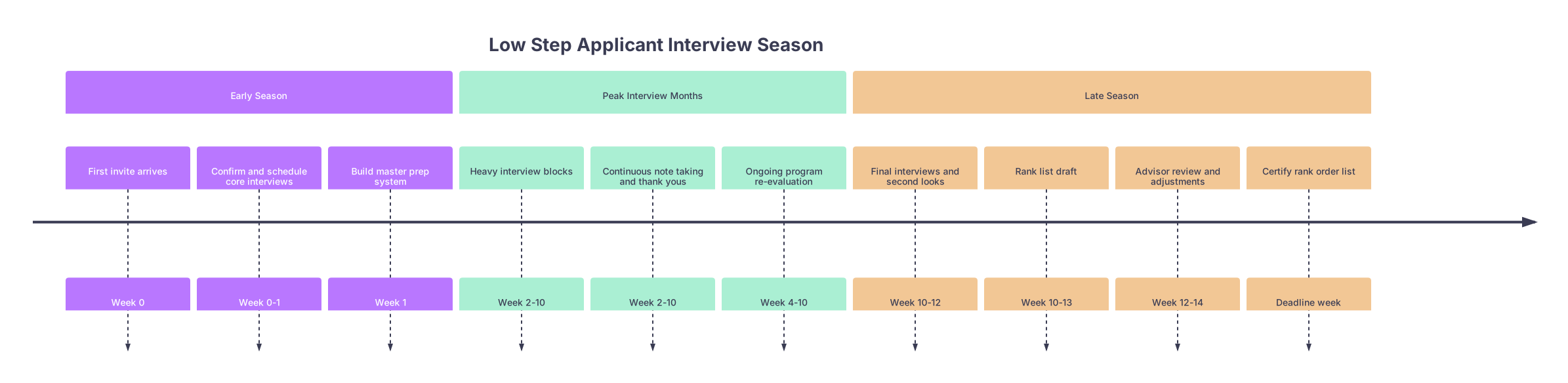
| Period | Event |
|---|---|
| Early Season - First invite arrives | Week 0 |
| Early Season - Confirm and schedule core interviews | Week 0-1 |
| Early Season - Build master prep system | Week 1 |
| Peak Interview Months - Heavy interview blocks | Week 2-10 |
| Peak Interview Months - Continuous note taking and thank yous | Week 2-10 |
| Peak Interview Months - Ongoing program re-evaluation | Week 4-10 |
| Late Season - Final interviews and second looks | Week 10-12 |
| Late Season - Rank list draft | Week 10-13 |
| Late Season - Advisor review and adjustments | Week 12-14 |
| Late Season - Certify rank order list | Deadline week |
At each phase I’ll tell you exactly: at this point you should…
Let’s start at the first email.
Phase 1: First Invite Hits – Week 0 to Week 1
The first invite is where many low Step applicants self-sabotage. They treat it like proof they’re “safe” and relax. You’re not safe. You’re on the board.
Day 0–1: The Minute You Get That First Invite
At this point you should:
Respond within hours, not days.
- Same day if at all possible.
- If there’s a scheduler link, book immediately.
- Avoid “wait and see what else I get” thinking. You don’t have that luxury with a low Step.
Lock down logistics.
- If virtual:
- Confirm you have a quiet space, stable internet, and a decent camera and mic.
- Block the time on your calendar plus 30 minutes before and after.
- If in-person:
- Check flights/hotels the same day.
- Set a “book by” deadline (usually 24–48 hours) so prices do not explode while you ponder.
- If virtual:
Start a Program Tracker. Do not try to keep this in your head. Minimum spreadsheet columns:
| Column | Purpose |
|---|---|
| Program Name | Identify program |
| City/State | Location snapshot |
| Specialty | Track across fields if needed |
| Interview Date/Time | Schedule anchor |
| Format (Virtual/IP) | Plan logistics |
| Step Score Culture | Friendly/Unknown/Harsh |
| Vibe After Interview | Quick 1–10 rating |
| Rank Tier (A/B/C) | Early sense of ranking |
You’ll refine this as the season goes on.
Day 1–3: Build Your Core Interview System
At this point you should:
Write your “Low Step Narrative” once.
You must control this story. Something like:- Brief, factual context (no drama).
- Ownership of what went wrong (not the test’s fault).
- Concrete evidence of improvement (shelf scores, Step 2, letters, clinical comments).
- How it’s shaped you as a resident: resilience, work ethic, feedback response.
Example skeleton:
“My Step 1 score is below the average for many applicants, and that’s something I’ve taken very seriously. During pre-clinicals I struggled with [specific issue], and I underestimated how early I needed to start board-style questions. After that score, I changed how I study—dedicated daily QBank time, met weekly with an academic coach, and my subsequent performance reflects that: [Step 2 / shelves / evaluations]. It pushed me to build more disciplined, sustainable habits, which is exactly what I rely on on busy rotations.”
You’ll adapt length based on how they ask, but the core story should be stable.
Create your “Program Fit” bullets for each interview.
- 3–5 bullets per program:
- One about training structure (e.g., “strong community exposure,” “early operative responsibility”).
- One about geography/family ties.
- One about career goals support (fellowships, research, global health).
- Keep them in your tracker.
- 3–5 bullets per program:
Build a 30–40 question bank of common questions. Group them:
- Tell me about yourself / Why this specialty / Why our program
- Strengths/weaknesses
- Conflict / feedback / failure (this is where your Step story may show up)
- Patient stories
- Team dynamics
Do not script answers word-for-word. Outline bullet structures.
Phase 2: Early Interview Season – Weeks 1 to 4
You’ve got 1–3 interviews scheduled. This is your skill-building window. Messy now = expensive later.
Weekly Structure: Weeks 1–4
At this point you should, each week:
Block two 60-minute mock interview sessions.
- One fully focused on “tell me about yourself / why this specialty / low Step” questions.
- One mixed behavioral and patient scenarios.
- Record at least one session every other week. Watch yourself. It’s painful. Do it anyway.
Schedule program-specific prep 2–3 days before each interview. 30–45 minutes per program:
- Scan their website: rotation sites, call schedule, fellowships.
- Note specifics that matter to you (not generic nonsense about “collaboration”).
- Update your tracker with:
- 3 program-specific questions
- 1–2 faculty names or program features you can reference naturally
Refine your low Step narrative based on real questions you get. After each interview:
- Write down exact wording they used when asking about scores.
- Note what seemed to land well in your answer—where heads nodded, where the interviewer relaxed.
48 Hours Before Each Interview
At this point you should:
Finalize your “story set.” Have 5–7 go-to stories ready:
- Difficult patient
- Team conflict
- Mistake you made
- Going above and beyond
- Learning from feedback
- Time you were overwhelmed
Each story:
- Situation
- Your specific actions
- Outcome
- What you learned (and how it shows up now on busy service)
Thread in your resilience after Step when appropriate—subtly, not as a pity arc.
Review your application.
- Do not get caught blank on a research project from three years ago.
- Re-read personal statement and major activities.
- Highlight anything that could lead to:
- “Tell me more about…”
- “What did you learn from…?”
Test your tech (for virtual).
- Log into the platform.
- Check lighting, audio, background.
- Practice looking at the camera, not your own face.
Phase 3: Peak Interview Block – Weeks 4 to 10
This is where people burn out and start phoning it in. With a low Step score, you cannot have “throwaway” interviews.
Let’s be blunt: during peak season, you are managing energy and execution. Not just content.
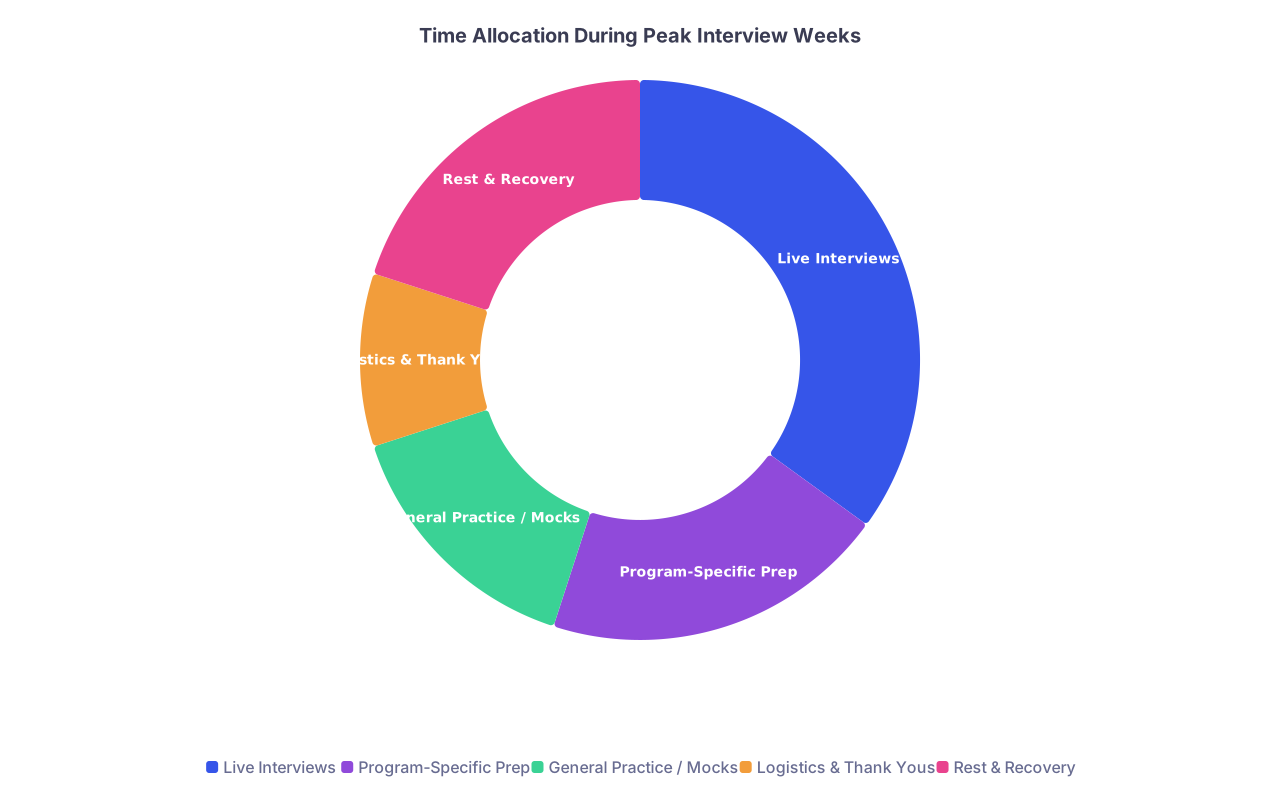
| Category | Value |
|---|---|
| Live Interviews | 35 |
| Program-Specific Prep | 20 |
| General Practice / Mocks | 15 |
| Logistics & Thank Yous | 10 |
| Rest & Recovery | 20 |
Each Interview Week: Default Rhythm
At this point you should aim for:
1–3 interviews per week if possible. More than 4 regularly and your performance drops.
Night before each interview (30–45 minutes):
- Skim your notes on:
- Their program (training sites, call, unique features).
- Your tailored “Why this program.”
- 3 questions you’ll ask them.
- Review your low Step narrative once. Not 10 times. You don’t want to sound rehearsed.
- Skim your notes on:
Post-interview same day (15–20 minutes):
- Immediately:
- Write down:
- Who you met (names and roles).
- What you liked.
- Any red flags.
- Gut rank tier (A/B/C) before overthinking.
- Add to tracker: a quick 1–10 “vibe score.”
- Write down:
- Immediately:
Within 24 hours:
- Send concise thank-you emails.
- 3–5 sentences max.
- Reference something specific from your conversation.
- Reaffirm genuine interest only if true. Do not tell every program they’re your top choice.
- Send concise thank-you emails.
Managing the Low Step in Real Time
At this point, you should stop being surprised when they bring it up. Assume:
- Academic-heavy programs will ask directly.
- Community programs may not mention it but have already screened you through that lens.
When it comes up:
Do not open with an apology.
Do not over-explain.
30–60 seconds is the sweet spot.Translate it to residency:
End with a line like:“The same system I built to recover from that score is what I use on service now—structured feedback, deliberate practice, and not shying away from weaknesses.”
You’re showing them you won’t crumble when intern year hits.
Phase 4: Late Interviews, Second Looks, and Prioritization – Weeks 10 to 12
The season’s almost over. This is where low Step applicants often make their next big mistake: chasing prestige instead of probability.
As Interviews Wind Down
At this point you should:
Update your program tiers weekly.
- Tier A: “I’d be happy and would thrive here.”
- Tier B: “Solid. I’d go and be fine.”
- Tier C: “Only if unmatched elsewhere / strong red flags.”
Be honest with yourself. This is your life, not your Instagram bio.
Start your preliminary rank logic. For each program, rate from 1–5 on:
| Factor | Description |
|---|---|
| Training Quality | Breadth, autonomy, case volume |
| Culture | How they treat residents, vibe |
| Geography/Life | Family, partner, cost, support |
| Step Friendliness | History with lower scores, support |
| Career Fit | Fellowships, research, niche goals |
You’re aiming for a composite picture, not a single score.
Consider second looks only when they matter.
- Good reasons:
- You truly could see yourself there but need clarification.
- You didn’t see residents much on interview day.
- Major questions about support for remediation/academics.
- Bad reasons:
- You think showing your face will “erase” your Step score.
- Everyone in your group chat is doing second looks at big-name programs.
With a low Step, second looks are best used at:
- Programs that showed genuine interest.
- Places you’d actually rank highly if concerns are resolved.
- Good reasons:
Phase 5: Rank List Construction – Weeks 12 to Rank Deadline
This is where panic narratives show up: “With my score, should I rank by safety instead of preference?”
No. That’s not how the algorithm works. You rank by where you would actually want to train, in honest order. The programs do the same. The algorithm favors your preferences, not your guesses about theirs.
Week 12–13: Draft Rank List v1
At this point you should:
Sort purely by where you’d go if all offered you a spot. Ignore:
- What your classmates are doing.
- Perceived prestige.
- Your insecurity about Step.
Just answer: If all of these called me with an offer today, what order would I accept them in?
Overlay rational checks. For each program ask:
- Did I see evidence they support residents academically, including those who struggle?
- Did they seem Step-obsessed or focused on whole resident performance?
- Is there any program where I truly would not go, even if it’s my only option?
If so, do not rank it.
Mark “risk-benefit outliers.”
- High prestige but marginal vibe? Be careful.
- Very supportive, slightly less “fancy” program excited about you? Those often become your best training environments, especially with a low Step background.
Week 13–14: Advisor Reality Check
At this point you should:
Schedule a 30-minute meeting with someone who knows your whole file.
- Home program advisor
- Specialty mentor
- PD or APD you trust (if they’re willing)
Bring:
- Your interview list with quick impressions.
- Your draft rank order.
Ask three very direct questions:
- “Given my Step scores and interviews, do any of these look unrealistically high or low?”
- “Are there programs here known to be less supportive of residents who need academic remediation?”
- “If you were me, would you change anything in this order?”
Listen, but remember: you live this residency, not them. Their input is data, not orders.
Final Week: Certifying the List
At this point you should:
Log into NRMP and enter your list early.
- Do not wait until the last 24 hours.
- Double-check:
- Program names and codes
- Correct tracks (categorical vs prelim, etc.)
Do a last-pass “regret test.” For each adjacent pair on your list:
- If you matched at Program B instead of Program A because you swapped them, would you regret it?
If yes, switch them.
- If you matched at Program B instead of Program A because you swapped them, would you regret it?
Certify the list. Once certified:
- Stop touching it.
- Stop crowdsourcing anxiety in group chats.
- Focus on being a good student/rotator where you are.
Micro-Timeline: Day-Before / Day-Of Interview Checklist
You like specifics. Here you go.
Day Before (Evening – 45 Minutes Total)
At this point you should:
- Spend 15 minutes:
- Reviewing program notes
- Refreshing names (PD, APD, chief residents)
- Spend 15 minutes:
- Running through “Tell me about yourself”
- Reviewing low Step narrative out loud once
- Spend 10–15 minutes:
- Setting out clothes
- Checking tech or travel plan
- Confirming time zones (people mess this up constantly)
Then stop. Sleep is more important than one more run-through.
Interview Morning
At this point you should:
Eat something. Low blood sugar = rambling.
Do a 5–10 minute vocal warmup / reading out loud. You’ll sound sharper.
Remind yourself:
“They already know my score. I am here because something in my file made them say yes anyway. My job is to show them they were right.”
Post-Interview Same Day
At this point you should:
Capture:
- 3 things you liked
- 1–2 concerns
- A single sentence gut reaction: “If I matched here, I’d feel ___.”
Send targeted thank-yous:
- PD
- Anyone you had a substantive conversation with
- Coordinator if they went above and beyond
FAQs
1. With a low Step score, should I change my interview answers to sound more “grateful” or humble?
No. Grateful is fine; apologetic is not. You’re not begging for charity. You’re showing that you understand the concern, have addressed it concretely, and are ready to work. Overdoing the “thank you for considering me even with my score” routine just reminds them of the number and makes you sound unsure of your own value.
2. Is it ever smart to rank a program higher just because they seemed less concerned about my Step score?
Only if you’d actually be willing to train there over other options. Step-friendliness is a factor, not the entire equation. A program that never mentions scores but has terrible support, toxic culture, or weak training is still a bad fit. Use Step-friendliness as a tiebreaker between programs you already like, not the sole driver.
Open your program tracker (or create one) right now and list every place you’ve interviewed or have scheduled. For each, write a one-sentence gut reaction and a 1–10 vibe score—do it before your memory blurs and your rank list becomes guesswork.