
The obsession with Step scores is overrated—but the consequences of a low one are not.
You cannot change the number on that score report. You can absolutely change what program directors think when they look at the rest of your file. That’s what this roadmap is for.
This is a time-specific, MS3–MS4 plan for students with:
- Step 1: pass only (with concerns about preclinical performance), or
- Step 2 CK: below their target or below average for their desired specialty.
I’m going to walk you month-by-month and then into week-level and day-of tactics for the critical windows.
Big-Picture Strategy: What Changes When Your Step Is Low
Before we zoom into the calendar, you need your operating rules. With a low Step score:
You cannot be average anywhere else.
You need clear strengths: clinical performance, letters, fit, or mission alignment.You must control what’s still movable:
- Clerkship grades
- Away rotations
- Letters of recommendation
- Program list strategy
- Application timing
- Interview performance
You may need to adjust specialty or program tier.
Hanging onto “Derm at top-10 only” with a 215–220 Step 2 equivalent is fantasy. Internal medicine at a strong academic or community program? Very possible with work.
Here’s how the timeline plays out.
MS3: Month‑by‑Month Roadmap
MS3: January–February – Reality Check and Targeting
At this point you should:
Clarify your actual numbers and risk profile
- Step 1: Pass only? Any failures?
- Step 2 (if taken early): score vs specialty averages
- Class rank or quartile? Any remediation?
Roughly sort specialties into three buckets
Specialty Competitiveness Buckets Bucket Examples Typical Step 2 CK expectation High risk Derm, Ortho, ENT, PRS, Urology 245+ Moderate EM, Anes, OB/GYN, Psych, Rads 235–245 More flexible IM, Peds, FM, Neuro, Path 225–235 Have 1–2 blunt conversations
- Meet with: dean of students, specialty advisor, or trusted faculty.
- Ask directly:
- “With my current scores, what’s the realistic range of specialties and program types?”
- “If I insist on [X specialty], what backup plan do you recommend?”
At this stage, do not lock in a specialty because it’s what you told your parents at 16. Lock it in after you see how you perform on core clerkships.
MS3: March–April – Clerkship Performance as Damage Control
At this point you should be mid‑core rotations or just starting them. With a low Step, your clinical narrative must be strong.
Your priorities:
Aim for Honors/High Pass on at least 2–3 core rotations
- IM, Surgery, Pediatrics, OB/GYN, Psych, FM – these are your proof that “I’m better than my test score.”
- Day-to-day:
- Show up 10–15 minutes early
- Volunteer for admits and procedures
- Read 15–30 minutes every night on your actual patients
- Ask for mid-rotation feedback and actually adjust
Identify your letter writers
- You’re looking for attendings who:
- Saw you handle complicated patients
- Commented on your work ethic or growth
- Have some weight in the department
- Say: “I’m very interested in [specialty/IM/Peds/etc.]. I’d like to work toward earning a strong letter from you. What would that look like from your perspective?”
- You’re looking for attendings who:
Start reality-based specialty thinking
- If you’re pulling:
- Mostly Pass with low Step → shift toward less competitive specialties early.
- Mostly HP/Honors → you can still aim at moderate-competitive fields with a smart backup.
- If you’re pulling:
MS3: May–June – Locking Specialty + Early Planning
By late MS3, you should be close to declaring a specialty—especially with a low Step, because your strategy has to be sharper.
At this point you should:
Decide your primary specialty and your backup structure
- Example:
- Primary: Anesthesiology, Backup: Categorical IM (broad program list)
- Primary: EM, Backup: FM with strong EM exposure/electives
- If your dream is ultra-competitive (Derm, Ortho, ENT, etc.) with a low score, you have two choices:
- Apply broadly to a more realistic specialty now
- Or commit to a research year / delay graduation strategy (different roadmap entirely)
- Example:
Plan your MS4 schedule with intention You want:
- 1–2 home sub‑I’s in your chosen specialty or in IM (if it’s your backbone)
- 1–2 away rotations if:
- Your home program is weak or nonexistent
- You have geographic priorities
- Your specialty values aways (EM, Ortho, etc.)
Prepare Step 2 CK (if not yet taken) With a low Step 1, Step 2 CK is your last standardized chance to show improvement.
At this point:
- Book a realistic test date: ideally June–August of MS3 summer
- Map out 6–8 weeks of deliberate prep wrapped around rotations
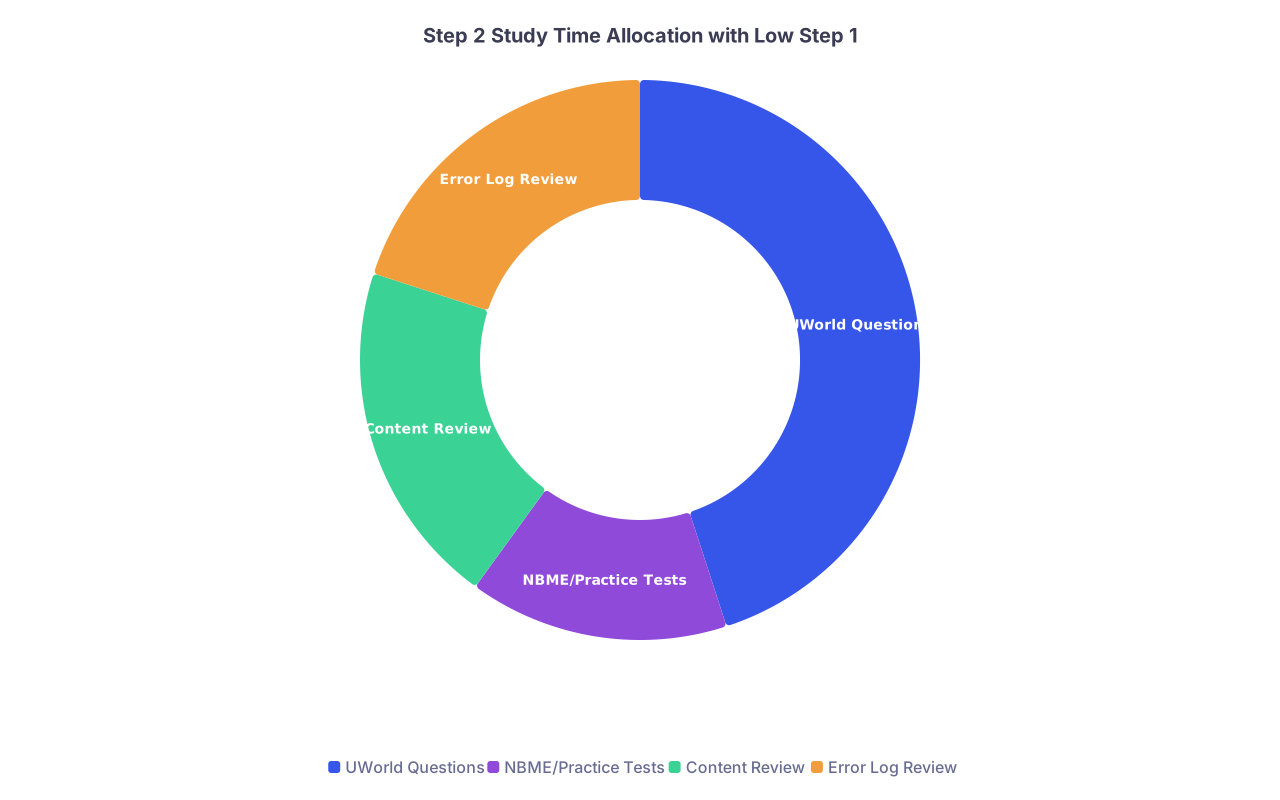
| Category | Value |
|---|---|
| UWorld Questions | 45 |
| NBME/Practice Tests | 15 |
| Content Review | 20 |
| Error Log Review | 20 |
If you don’t have at least 4 dedicated weeks (even if “half-dedicated” around lighter rotations), fix that now by adjusting your schedule.
MS3: July–August – Step 2 CK and Sub‑I Prep
This is a high-leverage window.
At this point you should:
Take Step 2 CK early enough to be in your ERAS by application
- Ideal: Score back by early–mid September
- That means testing by mid–August at the latest.
Study with a ruthless error-focus mindset Weekly structure (6–8 weeks before exam):
- 5 days/week:
- 40–80 UWorld questions/day, timed, random
- Immediate review + error log
- 1 day/week:
- NBME or practice test
- 1 lighter day:
- Review weak systems, Anki/flashcards
- 5 days/week:
Prep for sub‑I’s like these are month-long auditions
- Review core management algorithms for:
- Sepsis, chest pain, SOB, DKA, COPD exacerbation, GI bleed, etc.
- Practice presenting tight, 3–4 minute presentations.
- Know the basics of orders and cross-cover issues if it’s an IM/Surgery sub‑I.
- Review core management algorithms for:
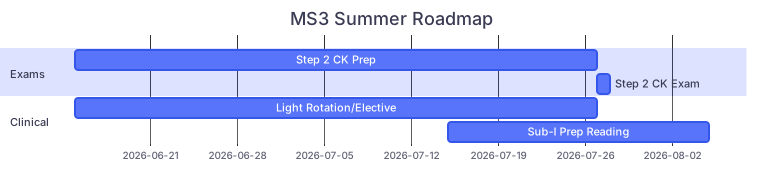
| Task | Details |
|---|---|
| Exams: Step 2 CK Prep | a1, 2026-06-15, 6w |
| Exams: Step 2 CK Exam | a2, after a1, 1d |
| Clinical: Light Rotation/Elective | b1, 2026-06-15, 6w |
| Clinical: Sub-I Prep Reading | b2, 2026-07-15, 3w |
With a low Step 1, your goal is clear upward trajectory on Step 2. Even a 230–235 can reset the conversation if Step 1 was just a pass with question marks.
Early MS4: Turning Your File into a “Yes” Despite the Score
MS4: July–August – Sub‑I Execution and LOR Harvesting
At this point you should be on your first sub‑I or acting internship. This month writes your letters.
You must:
Behave like the most reliable intern on the team Daily checklist:
- Arrive before everyone else
- Pre-round efficiently with focused notes
- Know every lab / imaging result on your patients
- Anticipate: “What problem will the cross-cover get called about?”
Ask explicitly for letters—early
- Ask in the last 3–7 days of the rotation if things are going well.
- Use language like:
- “I’ve really valued working with you. I’m applying in [X specialty] and would be honored to have a strong letter from you. Do you feel you know my work well enough to write a supportive letter?”
- If they hesitate or waffle? Thank them and don’t use them. You cannot afford a lukewarm LOR with a low Step.
Start drafting ERAS personal statement and experiences
- Your theme: clinical reliability, work ethic, growth
- Do not whine about your score. If you address it, it’s 1–2 lines max:
- “My Step 1 performance was below my expectations. Since then, I’ve focused on strengthening my clinical skills and knowledge base, reflected in [clerkship performance, Step 2 improvement, specific responsibilities].”
MS4: August – Building a Program List that Actually Matches You
This is where people with low scores often sabotage themselves. They under‑ or over‑reach.
At this point you should:
Segment programs into tiers by your competitiveness:
- Data sources:
- NRMP Charting Outcomes
- Residency Explorer
- Program websites (minimum cutoffs)
- Your dean’s office match data
- Data sources:
Build a deliberate mix (for one specialty; adjust if dual-applying):
| Tier | Type | Count (example) |
|---|---|---|
| Reach | Big-name academic, high research | 5–8 |
| Realistic core | Mid-tier academic, strong community | 25–35 |
| Safety | Community, newer programs, less competitive regions | 15–20 |
With a low Step 2 (<225) aiming at IM, I’d want 45–60 programs minimum, skewed heavily to realistic and safety.
- Identify score-cutoff landmines
- Many programs quietly or openly filter by Step 1/2.
- If your score is below their average by 10–15+ points, they’re probably not worth the fee unless you have:
- Strong geographic ties
- A home rotation / away rotation there
- Direct advocacy from faculty
MS4: Early September – Application Assembly Week‑by‑Week
ERAS opens in early September (dates vary, but the pattern is stable). With a low score, being early and complete is non-negotiable.
At this point you should:
4 weeks before submission:
- Finalize:
- Personal statement (have 2–3 people review: one content, one grammar, one “knows you”)
- ERAS activities descriptions (show impact and ownership)
- Confirm:
- All USMLE scores released and visible
- Letters requested and uploaded (or in process; ping letter writers kindly)
2 weeks before submission:
- Lock your program list.
- Tailor personal statement slightly for:
- Special program interests (rural, underserved, academic)
- Dual-application scenarios
1 week before submission:
- Do a full ERAS audit:
- No typos on scores, dates, or names
- No glaring red flags in wording (“failed” vs “repeated,” etc.)
- Ensure every gap in your education or timeline is explained succinctly if asked in the app.
Interview Season: Converting Invites into Matches
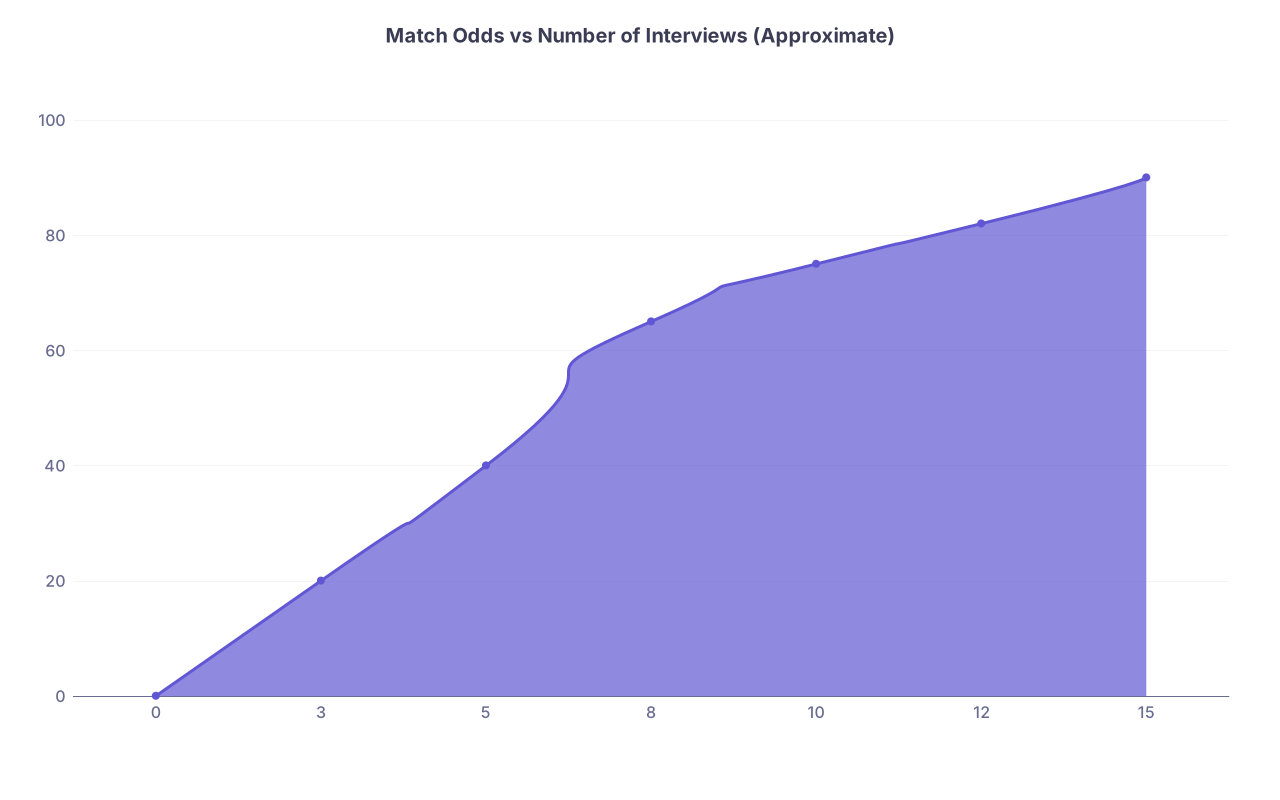
| Category | Value |
|---|---|
| 0 | 0 |
| 3 | 20 |
| 5 | 40 |
| 8 | 65 |
| 10 | 75 |
| 12 | 82 |
| 15 | 90 |
With low Step scores, you might get fewer interviews, but each one is more precious. You cannot phone any of them in.
October–January – When Invites Start (and Don’t Start)
At this point you should:
Track invites, rejections, and radio silence
- Use a simple spreadsheet:
- Program
- Date applied
- Date of invite/rejection
- Status
- If no invites by late October:
- Talk to your dean quickly about:
- Expanding your program list
- Adding community programs
- Considering SOAP backup early
- Talk to your dean quickly about:
- Use a simple spreadsheet:
Prepare a tight Step‑score narrative for interviews You will be asked. Don’t ramble. Don’t sound defensive.
Use a 3‑part pattern:
- Brief acknowledgment:
- “My Step 2 score is lower than I hoped.”
- Accountability + growth:
- “I didn’t structure my early studying effectively and underestimated how fast content builds. I changed my approach on the wards—more consistent daily reading, problem-based learning, and feedback-seeking.”
- Evidence:
- “You can see that in my later clerkship evaluations and sub‑I performance.”
- Brief acknowledgment:
Show you’re a safe, teachable, low-drama resident During interviews:
- Emphasize:
- Teamwork
- Reliability
- Handling stress without melting down or blaming others
- Have 3–4 specific stories ready:
- A time you made a mistake and fixed it
- A time you helped the team under pressure
- A time you handled a knowledge gap correctly (asked for help, followed up)
- Emphasize:
Rank List & Safety Net: January–March MS4
By this phase, the score conversation is mostly behind you. Now it’s risk management.
January–February – Ranking with a Low Step History
At this point you should:
Rank all acceptable programs where you interviewed
- Do not play games by leaving “lower” programs off your list if you’d rather match there than go unmatched.
- With low Step scores, you don’t have the margin for that kind of bravado.
Lean into fit over prestige Criteria that matter more than name brand when you’re already in the door:
- Supportive culture and PD
- Program stability and accreditation
- Reasonable workload (so you can thrive and not drown)
- Location where you can realistically live without burnout
Have a SOAP contingency plan ready Before rank list submission:
- Talk to your dean about:
- Which SOAP specialties and programs they’d support you for
- How they’ll advocate during SOAP
- Update a shorter, SOAP-ready personal statement (often more general or tailored to FM/IM/Peds).
- Talk to your dean about:
Micro‑Level: Day‑to‑Day Behaviors That Offset a Low Step
Sprinkled across MS3–MS4, these habits quietly change how faculty talk about you.
At any point you should:
- Ask for feedback early and specifically
- “What’s one thing I can do this week to function more like an intern?”
- Document extra responsibilities
- QI projects, extra calls taken, teaching juniors—these become lines in your letters and ERAS.
- Be visibly coachable
- When corrected, next day: “I tried doing X the way you suggested; can you let me know if that’s closer to what you were looking for?”

Common Bad Moves (Don’t Do These)
I’ve watched students with low scores sink themselves more with strategy than with the actual number.
At this point you should avoid:
Applying to 15 reach programs and 5 realistic ones “to save money.”
That’s how you end up unmatched with a low Step. Breadth in realistic programs matters.Ignoring faculty advice because “I know someone who matched Derm with a 225.”
You are not a miracle anecdote. You’re playing probabilities.Writing a personal statement that centers your test score trauma.
Programs want to know how you function at 2 a.m. on call, not how long you cried after your score report.Waiting to take Step 2 until after applications submit when Step 1 is already weak.
You’re basically asking them to judge you off your worst metric.

Quick Timeline Snapshot
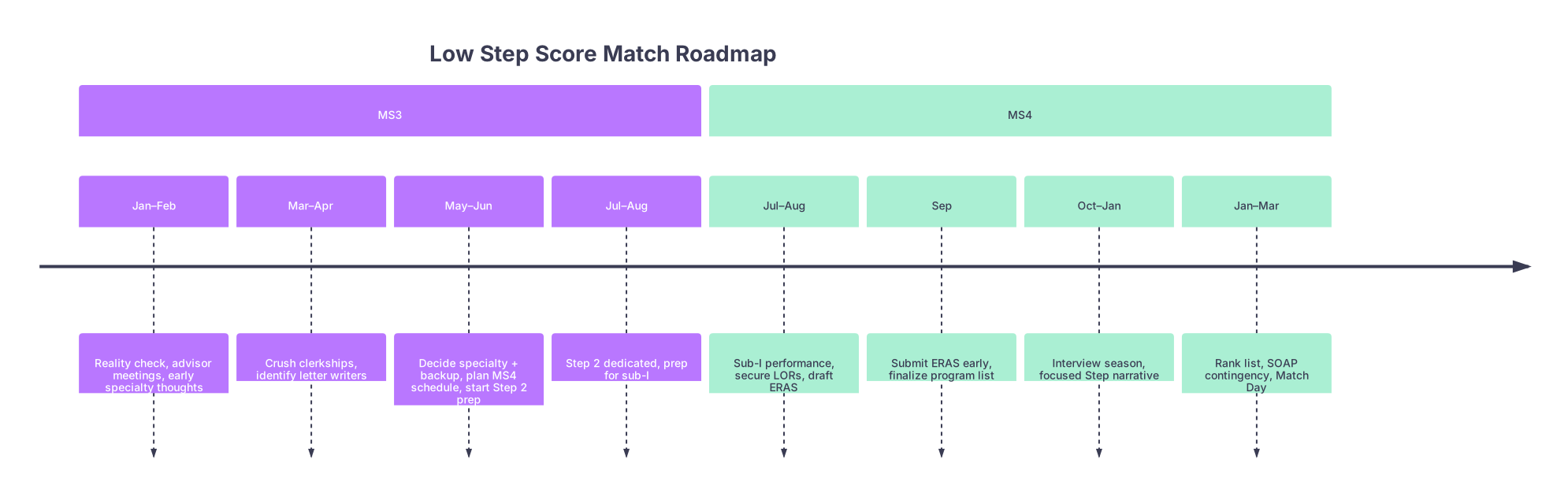
| Period | Event |
|---|---|
| MS3 - Jan–Feb | Reality check, advisor meetings, early specialty thoughts |
| MS3 - Mar–Apr | Crush clerkships, identify letter writers |
| MS3 - May–Jun | Decide specialty + backup, plan MS4 schedule, start Step 2 prep |
| MS3 - Jul–Aug | Step 2 dedicated, prep for sub-I |
| MS4 - Jul–Aug | Sub-I performance, secure LORs, draft ERAS |
| MS4 - Sep | Submit ERAS early, finalize program list |
| MS4 - Oct–Jan | Interview season, focused Step narrative |
| MS4 - Jan–Mar | Rank list, SOAP contingency, Match Day |

FAQ (Exactly 2 Questions)
1. Should I ever delay graduation or take a research year because of a low Step score?
Sometimes, yes—but only for specific scenarios. If you’re dead set on a highly competitive specialty (Derm, Ortho, ENT, PRS, IR) and your Step 2 is far below their typical range, a targeted research year at a strong department can help, if it comes with heavy mentorship, publications, and real integration with the residency program. If you’re aiming at IM, Peds, FM, Psych, or even Anesthesia, a research year just to “hide” a low score is usually not worth the extra debt and time. In those fields, you’re better off doubling down on clinical performance, letters, Step 2 timing, and applying broadly.
2. Is it better to retake Step exams or just move on and strengthen the rest of my application?
Retaking is almost never the right play unless there was a clear testing anomaly (documented illness, technical failure) and your school and advisors believe you can realistically jump significantly (not 5 points—more like 15–20+). A fail followed by a modest pass does not impress anyone. For most students with one low score but a pass, it’s far more effective to focus on a stronger Step 2 (if still pending), excellent clinical performance, high-impact letters, smart program selection, and a confident, accountable narrative.
Key takeaways:
- You can’t fix the score, but you can outwork its consequences with early planning, strong clerkships, and deliberate sub‑I performance.
- Timing and breadth—early Step 2, early ERAS, and a broad, realistic program list—matter more when your numbers are weaker.
- Programs will forgive a low Step if they’re convinced you’re a reliable, teachable, low‑drama resident; your entire MS3–MS4 timeline should be engineered to prove exactly that.