
Most students with low Step scores ruin their Sub‑I sequence by being “polite” instead of strategic.
You do not have that luxury.
If your Step scores are below average, your Sub‑Is and aways are not just “auditions.” They are damage control, narrative repair, and your best shot at convincing programs to look beyond a weak test history. That means timing, order, and choice of rotations matter more for you than for your 260‑scorers classmates.
Here’s a concrete, chronological plan—month by month, then week by week—so at each point you know exactly what you should be doing.
Big Picture: Your Goals With Low Step Scores
At this point you should define the only three things your Sub‑Is and aways need to accomplish:
Prove you can function like an intern.
Strong clinical performance + specific comments in your letters that counter the “bad test taker = weak resident” assumption.Lock in 2–3 dynamite home institution letters early.
You want them in hand before ERAS opens or shortly after.Use aways surgically, not emotionally.
Not “dream school tourism.” Target realistic programs likely to rank you if you show up and crush it.
To make smart choices, you need to be honest about where you stand.
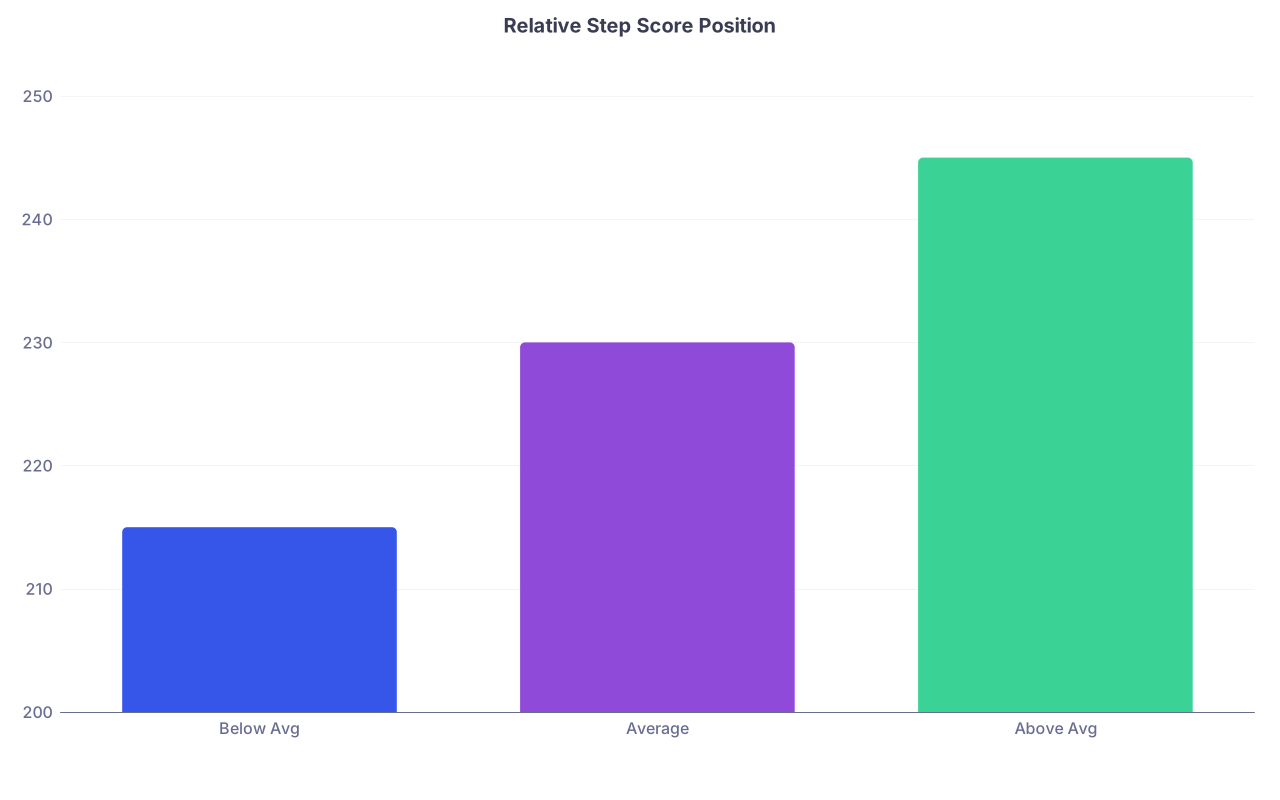
| Category | Value |
|---|---|
| Below Avg | 215 |
| Average | 230 |
| Above Avg | 245 |
If you're sitting below that middle bar, you’re who I’m talking to.
6–9 Months Before Sub‑Is: Reality Check & Strategy (Nov–Jan MS3)
At this point you should:
- Know your Step 1 status (pass vs fail vs low pass).
- Have a pretty clear idea of specialty tier (e.g., community IM vs academic IM vs Derm).
Step 1: Brutal specialty risk assessment
If your scores are low and you’re still clinging to a hyper‑competitive specialty with no backup, fix that first.
- Ultra‑competitive (Derm, Ortho, ENT, Plastics, Neurosurg, Rad Onc):
Low Step = major red flag. You must:- Talk with your home PD early.
- Consider dual‑apply or re‑target to something realistic.
- Moderate (EM, Anesth, OB/Gyn, Gen Surg, Radiology):
Low Step hurts, but strong third‑year evals + away rotations can patch some of this. - Less competitive (FM, Psych, Peds, most IM, Neuro):
You can recover more easily with strong clinical work and timing.
Do this with a mentor who knows match data, not just your optimistic friend on nights.
Step 2: Map your academic calendar
You need to know:
- When MS3 ends and MS4 starts.
- Which blocks your school allows Sub‑Is.
- When your institution expects you to do a required acting internship (AI).
At this point you should open a calendar and block:
- ERAS open / submission: usually early June / mid‑September.
- Typical away rotation windows: late May through October.
4–6 Months Before Sub‑Is: Decide Your Sequence Logic (Feb–Mar MS3)
This is where sequencing really starts.
Core principle
You cannot afford:
- A weak early Sub‑I that becomes your main letter.
- Your best Sub‑I letter arriving after programs already screened you out.
So the guiding rule:
Early blocks = safest home rotations where you’re most likely to shine.
Mid blocks = strategically chosen aways at realistic programs.
Late blocks = optional “nice to have,” not essential letters.
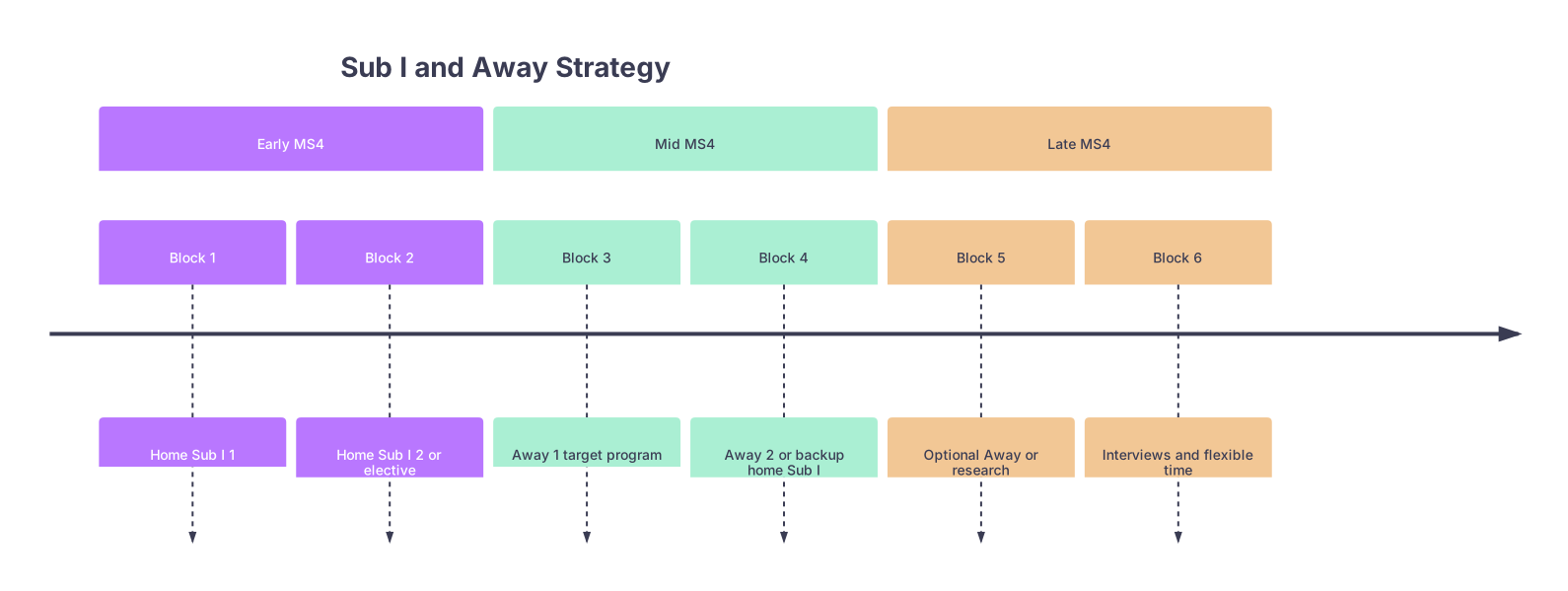
| Period | Event |
|---|---|
| Early MS4 - Block 1 | Home Sub I 1 |
| Early MS4 - Block 2 | Home Sub I 2 or elective |
| Mid MS4 - Block 3 | Away 1 target program |
| Mid MS4 - Block 4 | Away 2 or backup home Sub I |
| Late MS4 - Block 5 | Optional Away or research |
| Late MS4 - Block 6 | Interviews and flexible time |
Month‑by‑Month Plan
March MS3: Information Gathering
At this point you should:
- Meet 2–3 key people:
- Your home program director (or clerkship director) in your target specialty.
- A recent grad who matched with a similar Step profile.
- Your academic advisor.
Ask directly:
“With a Step 1 of ___ and Step 2 practice scores around ___, what program tiers make sense?”
“Which attendings write the strongest letters here?”
“Which outside programs actually rank our students after aways?” (There’s often an unofficial list.)
Pull program data:
- Look at recent match lists from your school.
- Check program websites for:
- Step 2 cutoffs.
- Whether they say they value away rotations.
April MS3: Draft Your Rotation Map
At this point you should sketch a block‑by‑block plan for July–January of MS4.
For each 4‑week block, pencil in:
- Home Sub‑I vs Away vs Elective vs Research vs Interview time.
For a typical August ERAS submission, a good baseline for low‑Step students in a moderately competitive specialty looks like:
| Block (Approx) | Priority Goal | Rotation Type |
|---|---|---|
| Jun–Jul | Strong letter #1 | Home Sub-I (Target) |
| Jul–Aug | Strong letter #2 | Home Sub-I / Elective |
| Aug–Sep | Target program #1 | Away 1 |
| Sep–Oct | Target program #2 | Away 2 / Backup home |
| Oct–Nov | Flex / Interviews start | Light elective |
You’ll tweak this by specialty, but the pattern holds: home first, aways after you’re “warmed up.”
May–June MS3: Secure Sub‑Is and Aways
At this point you should be:
- Submitting VSLO/VSAS applications as soon as they open for your specialty.
- Locking in home Sub‑Is in the first 1–2 MS4 blocks.
Priority order:
Book your best home Sub‑I in Block 1 of MS4.
This is where you aim for Letter #1 from a known strong letter writer.Book a second home Sub‑I (or heavy clinical elective) in Block 2.
This can be:- Same specialty, different team.
- A closely related specialty that still impresses (e.g., ICU for IM; Trauma for Gen Surg).
Apply for away rotations in Blocks 3–4 (sometimes 4–5).
Avoid Block 1 away with low scores. You want reps at home first.
Week‑by‑Week: Early MS4 (Home Sub‑Is)
Block 1 MS4 (June–July): Your Anchor Sub‑I
At this point you should:
- Be on a home Sub‑I in your chosen specialty at a site that:
- Has residents (so attendings are used to writing residency‑style evals).
- Has attendings known to support students.
Week 1:
- Learn the system fast:
- EMR shortcuts.
- Order sets.
- How sign‑out is structured.
- Tell your senior: “I’m applying this specialty. My Step scores are not my strength, so I’m working hard to show I can function like an intern. I’d really appreciate feedback early and often.”
Week 2:
- Start functioning like a pseudo‑intern:
- Pre‑round independently.
- Write full notes on your patients.
- Volunteer for extra admits.
Week 3:
- Ask for mid‑rotation feedback.
- If it’s lukewarm, you do not ask that attending for your main letter.
- Adjust behavior based on specific critiques.
Week 4:
- Ask 1–2 attendings who’ve seen you work most:
“Would you feel comfortable writing a strong letter of recommendation for me for residency?”
You want that letter requested and ideally drafted before Block 2 starts.
Block 2 MS4 (July–Aug): Second Home Sub‑I / Heavy Elective
At this point you should already have:
- One letter requested from Block 1.
- A sense of how much your low Step scores came up (if at all).
Block 2 can be:
- Another Sub‑I in the same specialty at a different site.
- A high‑acuity related service (ICU, ED, trauma, inpatient consults) depending on specialty.
Week 1–2:
- Repeat the “I’m here to prove I can be an intern” talk with seniors.
- Be more proactive this time since you already know the EMR and workflows.
Week 3:
- Identify 1 attending and 1 senior/fellow who are clearly impressed.
- Ask for letter commitments now, not after the block ends.
By the end of Block 2 you should:
- Have 2 solid letters requested, with a high likelihood of them being uploaded by early September.
- Know whether you’re a strong clinician despite low boards. Attendings will say this outright when they like you. “Ignore your Step score, you’re one of the strongest students we’ve had this year.” That’s gold.
Mid MS4: When to Do Aways with Low Step Scores
Here’s where poor sequencing kills people.
General Rule for Low Step Scores
Do not put your very first Sub‑I‑level performance at an away.
You’ll be slower, less confident, and under more scrutiny.Do not schedule aways so late that letters arrive after screening.
Many programs build their interview list early.
Ideal window for aways with low scores:
- Away 1: Aug–Sep block (Block 3)
- Away 2 (if needed): Sep–Oct block (Block 4)
You now hit interview committees with:
- Strong home letters already in ERAS.
- A fresh away rotation performance that generates “this student is better than their boards” comments.
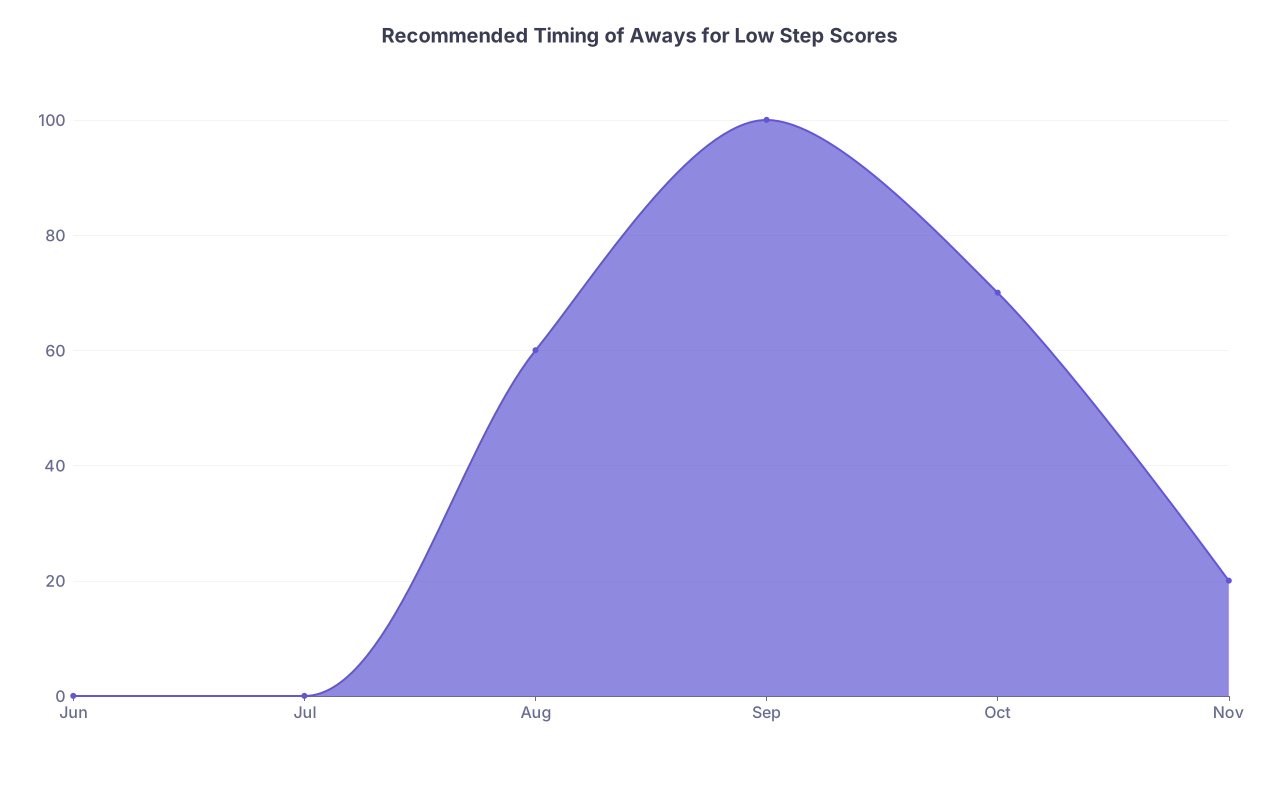
| Category | Value |
|---|---|
| Jun | 0 |
| Jul | 0 |
| Aug | 60 |
| Sep | 100 |
| Oct | 70 |
| Nov | 20 |
Peak value (Aug–Sep) = peak usefulness of aways.
Choosing WHERE to Do Aways
At this point you should be ruthless about fit vs fantasy.
Rules for low Step scores:
Avoid programs with known hard cutoffs above your score.
If they publicly state Step 2 ≥ 240 and you’re at 225, your away there is charity work—for them.Prioritize:
- Places that regularly take students from your school.
- Mid‑tier academic or strong community programs where:
- Residents stick around as faculty.
- They say they “value clinical performance over test scores” (yes, read between the lines, but it’s a clue).
Use “regional interest” smartly.
If you’re from the Midwest with low scores and want to match in the West at a competitive academic center? One away there is fine. Three is delusional.
I’ve watched students with low 220s Step 2 match at solid programs because they did aways at realistic mid‑tier places that were thrilled to have a hard‑working, low‑ego Sub‑I. Meanwhile, their classmates with similar scores burned all their aways at “dream” top‑10s and walked away with polite rejections.
Week‑by‑Week: Away Rotation Strategy
Week Before the Away
At this point you should:
- Email your chief or site coordinator:
- Ask for:
- Typical daily schedule.
- Expectations for Sub‑Is.
- Any pre‑reading or protocols you should know.
- Ask for:
- Review:
- Common admission diagnoses for that service.
- Order sets and local guidelines if available.
Week 1 of Away
Your job is not to impress them with brilliance yet. Your job is to be:
- On time.
- Prepared.
- Low maintenance.
Day 1–2:
- Learn their EMR quirks.
- Watch how interns and seniors structure notes.
- Ask a senior, “What do Sub‑Is do here when they’re really helpful vs when they’re annoying?”
Day 3–5:
- Pick up a small stable list of patients and manage them end‑to‑end:
- Pre‑round.
- Write notes.
- Call consults with supervision.
- Know everything about them.
Week 2–3
At this point you should start pushing your capacity:
- Offer to take extra admits (within reason).
- Volunteer for:
- Procedures.
- Late‑day tasks others are avoiding.
Mid‑rotation:
- Ask your main attending: “How am I doing compared with your usual Sub‑Is? Any specific areas that would make a difference for a residency spot here?”
You want constructive criticism now, not in their final eval.
Week 4
Your goal now is to convert performance into an actual interview AND a usable letter.
Ask your main attending:
“I’d love to train here. Based on how I’ve done this month—despite my lower Step scores—do you think I’d be competitive for an interview? Is there anything I should do to strengthen my application specifically for this program?”If the vibe is good, ask for a letter. If they hedge, don’t push; rely on your strong home letters instead.
What If You Only Get 1 Away?
That’s fine. With low Step scores, 1 surgically chosen away can be better than 3 random ones.
At this point you should:
- Use Block 3 for the away.
- Use Block 4 for:
- Another home Sub‑I, or
- A lighter clinical elective that gives you space to start interviews.
Late MS4: Do Late Aways Help?
October–November aways for low Step students are mostly about regional ties and backup plans, not primary rescue.
They can help if:
- You’re targeting a community‑heavy specialty and the program tends to take their rotators.
- You’re moving to a new region and need proof you’re serious.
They do not help much with:
- Raising your overall “screening” profile. Most interview decisions are already made.
So at this point you should only schedule a late away if:
- You still need a “safety” region or program.
- You’ve already secured 2–3 strong letters and sufficient interviews.
Otherwise: protect that time for interviews and sanity.
Common Sequencing Mistakes (Do Not Do These)
At this point, here’s what you must avoid:
First Sub‑I = Prestigious Away.
You’re slow, anxious, and trying to prove yourself with a handicap. Terrible combo.All aways, no home letters.
Committees look for what your home faculty say about you. If your home program wouldn’t rank you, that’s a problem.Late letters.
If your key letter comes from a November away, many programs never read it before screening.Ignoring program cutoffs.
Doing an away where your score auto‑screens you out is a vanity project.
Quick Specialty‑Specific Nuances
Very brief, because this could be its own book.
Internal Medicine / Psych / Peds:
2 home Sub‑Is > 1 home + 2 aways. Use aways only if you have geographic needs or a genuine target program.Gen Surg / OB‑Gyn / EM / Anesthesia:
1–2 aways at realistic academic or high‑volume community places help. Do them after 1–2 home Sub‑Is.Ultra‑competitive fields:
Low Step scores mean:- You either accept a long‑shot strategy.
- Or re‑target. If you stay in, do very targeted aways with brutally honest mentorship.

Putting It All Together: A Model Timeline
Assume MS4 starts in June, ERAS submission in September, low Step scores, moderately competitive specialty.
- June (Block 1) – Home Sub‑I #1
- Goal: Strong letter #1, show intern‑level function.
- July (Block 2) – Home Sub‑I #2 / ICU / heavy elective
- Goal: Strong letter #2, build confidence and speed.
- August (Block 3) – Away #1 at realistic target
- Goal: Prove you’re better than your boards; aim for interview.
- September (Block 4) – Away #2 or backup home Sub‑I
- Goal: Second region or backup program; additional letter if needed.
- October (Block 5) – Light elective
- Goal: Start interviews, finish any late letters.
- November–January
- Interviews + flexible electives, no high‑stakes Sub‑Is needed.
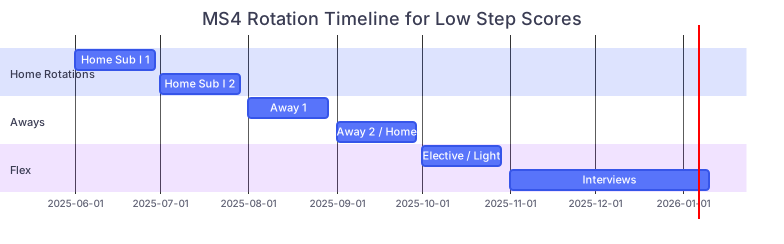
| Task | Details |
|---|---|
| Home Rotations: Home Sub I 1 | a1, 2025-06, 4w |
| Home Rotations: Home Sub I 2 | a2, 2025-07, 4w |
| Aways: Away 1 | b1, 2025-08, 4w |
| Aways: Away 2 / Home | b2, 2025-09, 4w |
| Flex: Elective / Light | c1, 2025-10, 4w |
| Flex: Interviews | c2, 2025-11, 10w |

FAQ (Exactly 4 Questions)
1. Should I delay Step 2 to avoid another low score before aways?
Generally no. Programs lean heavily on Step 2 now, and a missing score can be worse than a mediocre one. If your practice exams are catastrophic and you’re within the allowed window, a short strategic delay might make sense—but that’s a conversation with your dean and PD, not a solo decision.
2. Is it ever smart to do an away BEFORE any home Sub‑I with low scores?
Only if your school literally cannot give you an early Sub‑I in your specialty, or if your home program doesn’t exist in that field. In that rare case, do an intensive inpatient clerkship or ICU month right before the away to simulate Sub‑I expectations, and go in absurdly prepared.
3. How many aways do I actually need with low Step scores?
Most of the time: one well‑chosen away is enough if you have 2–3 strong home letters and a realistic target list. Two aways are reasonable if you need coverage in two different regions or program tiers. More than two usually means you’re chasing prestige instead of strategy.
4. What if my first Sub‑I goes badly—should I still ask for a letter?
No. If feedback is lukewarm or negative, do another home Sub‑I with a different team and rebuild. The whole point of early home rotations is to fail privately if you’re going to fail. Do not immortalize a mediocre month in a permanent letter if you have any alternative.
Key points:
- Front‑load home Sub‑Is so your first mistakes aren’t on an away, and get strong letters in the bank early.
- Schedule aways in the mid MS4 blocks (Aug–Oct), at realistic programs that actually might rank a low‑Step applicant who performs well.
- Treat every Sub‑I like an extended interview: ask for feedback early, correct fast, and only convert your best rotations into letters.