
Panicking about a low Step 1 score is a waste of 48 hours you do not have. You cannot fix the past. But you can absolutely build a 12–18 month timeline that protects your residency options.
I am going to walk you month by month through what to do after a low Step 1, assuming you are aiming for the next Match (or the one after, if you are earlier). The exact calendar months will vary by school, so I will anchor this to phases relative to:
- When you receive your Step 1 score
- When you plan to take Step 2 CK
- When you submit ERAS / go through Match
Adjust the months to your actual situation. The sequence stays the same.
Month 0: Week You Receive Your Low Step 1 Score
At this point you should stop doomscrolling forums and get clinical, data-driven clarity in 7 days.
Days 1–3: Reality check and boundaries
- Get your exact score and percentile. Not “bad,” not “disappointing.” A number.
- Compare it to national means and your target specialties.
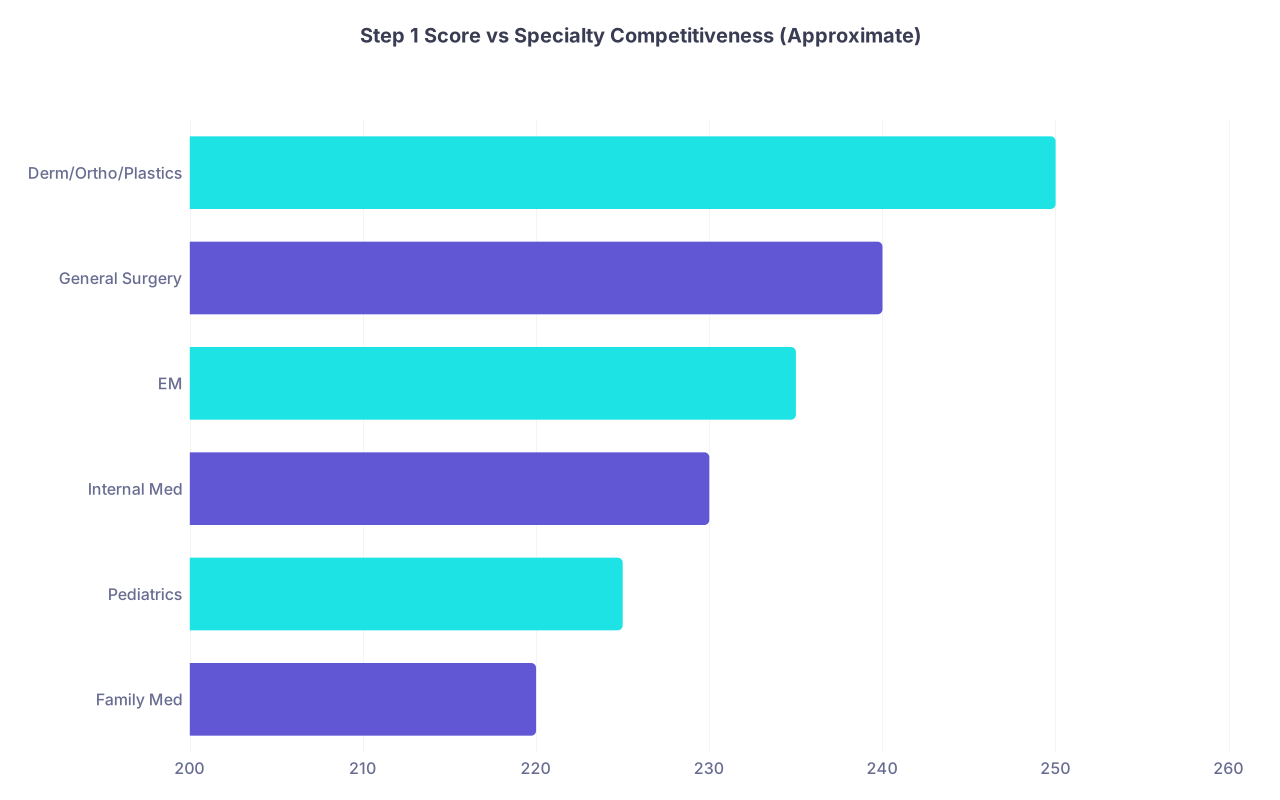
| Category | Value |
|---|---|
| Family Med | 220 |
| Pediatrics | 225 |
| Internal Med | 230 |
| EM | 235 |
| General Surgery | 240 |
| Derm/Ortho/Plastics | 250 |
- Make a hard decision:
- Keep all options open for moderately competitive and below
- Or, if you are aiming for ultra-competitive, decide now if you will:
- Accept a backup specialty, or
- Commit to a multi-year, research-heavy redemption arc
Days 3–7: Meet people who actually matter
At this point you should have three meetings scheduled:
- Academic advisor / Dean’s office
- Ask:
- “Where do students with a Step 1 of X from our school typically match?”
- “Who here has the best track record of advising low Step 1 students into solid matches?”
- Ask:
- Specialty advisor for your most realistic specialty
- Go in with a draft list of:
- Your Step 1 score
- Clinical grades so far
- Research, leadership, notable experiences
- Ask for blunt honesty:
- “With this profile, what are my realistic specialty tiers?”
- Go in with a draft list of:
- If possible: a recent alum who matched with a similar score
- Ask what actually mattered: Step 2, rotations, away rotations, networking, letters.
Deliverable by the end of Week 1:
- A written one-page plan:
- Target specialty (primary and backup)
- Target Step 2 CK test window
- Whether you need a research year or can proceed straight through
Print it. Put it on the wall. You are now in execution mode.
Months 1–3: Damage Control and Step 2 CK Setup
These months are usually late pre-clinical or early clerkships, depending on your curriculum. At this point you should build a Step 2 CK–centered redemption plan.
Month 1: Turn Step 2 CK into your lifeline
Step 2 CK is now your primary objective metric. Programs will look at it and decide whether to forgive Step 1.
Week 1–2: Baseline and schedule
- Schedule Step 2 CK 6–9 months before ERAS submission, if possible.
- That usually means taking it by June–July of the application year.
- Take a baseline practice exam (NBME or UWorld self-assessment) if you are within 6–8 months.
- Map your clerkship schedule and identify:
- Lighter rotations = Step 2 heavy study
- Heavier rotations = bare-minimum maintenance
Week 3–4: Resource and time commitments
At this point you should:
- Commit to 1–2 primary resources, not 7:
- UWorld (non-negotiable)
- One structured text or video series (OnlineMedEd, Boards & Beyond, etc.)
- Set a realistic weekly question goal:
- Light rotation: 40–60 questions/day, 5 days/week
- Heavy rotation: 20–30 questions/day, 5 days/week
Create a simple weekly tracker (paper or spreadsheet) with:
- QBank blocks completed
- Percent correct
- Key weak topics
Months 2–3: Build clinical narrative and shore up weaknesses
You cannot just “study harder.” You need to improve how you perform clinically as well.
On rotations, at this point you should:
- Aim for Honors / top evaluations in:
- Internal Medicine
- Surgery
- Target specialty rotation (if early)
- Signal maturity and resilience: faculty will know about your Step 1.
- Do not make excuses.
- “I underperformed, learned from it, and am now on track for a stronger Step 2” is enough.
Academically, months 2–3 goals:
- Complete 25–30% of UWorld Step 2 by the end of Month 3.
- Identify and list your bottom 3 systems and bottom 3 skills (e.g., acid–base, cardiology, statistics).
You are building proof that the low Step 1 was a blip, not your ceiling.
Months 4–6: Step 2 Push + Specialty Positioning
This is usually mid-clerkships. At this point you should start aligning everything toward your future ERAS application.
Month 4: Intensify Step 2 and seek early mentors
Step 2 CK is now < 4–6 months away in an ideal timeline.
Step 2 goals by end of Month 4:
- 50–60% of UWorld Step 2 completed
- One NBME or UWSA completed to check trajectory
- A specific target score set:
- Low Step 1 (e.g., <220): I tell students to aim for 240+ on Step 2 CK to soften the hit.
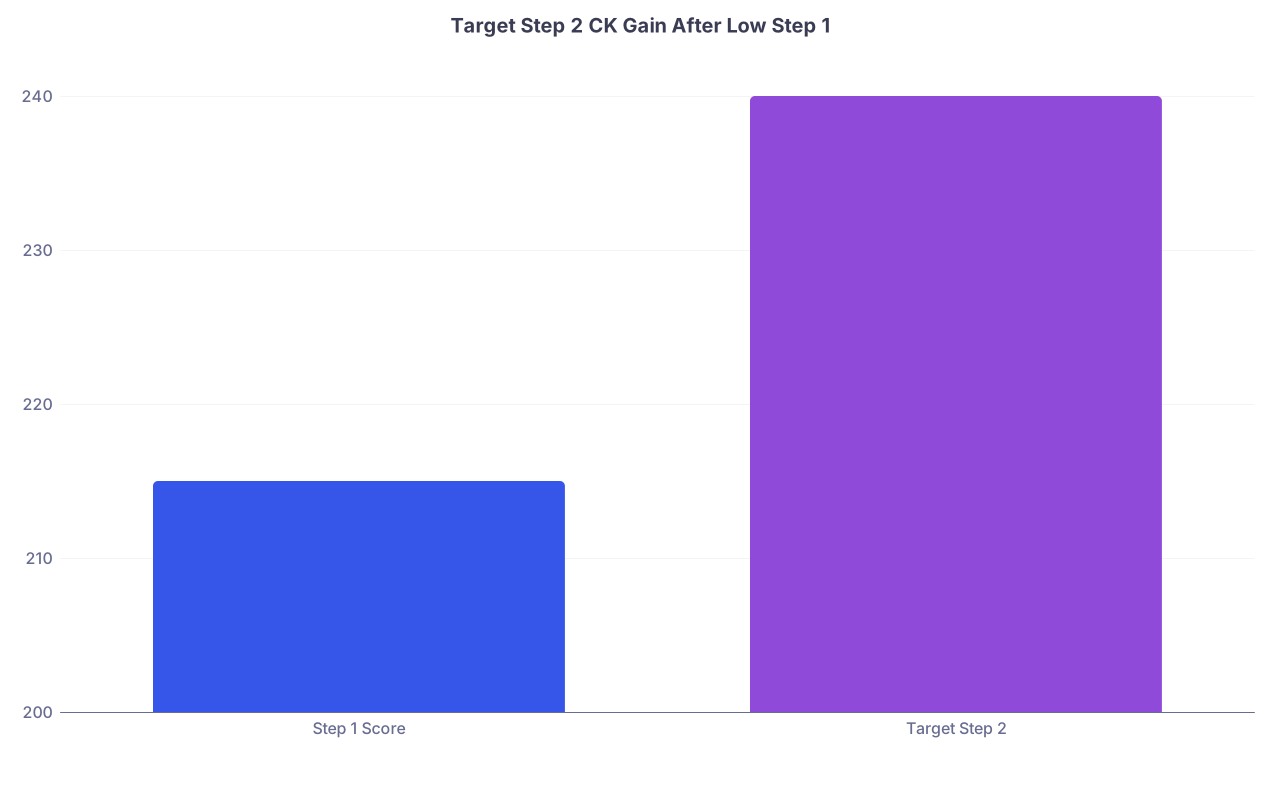
| Category | Value |
|---|---|
| Step 1 Score | 215 |
| Target Step 2 | 240 |
Mentorship / networking at this point:
- Identify 2–3 faculty in your target specialty or in Internal Medicine with:
- Academic rank
- Strong reputations for teaching
- A track record of writing letters
- Work with them clinically, then ask directly:
- “If I continue to perform at this level, would you feel comfortable writing a strong letter for residency?”
Get on at least one small project (case report, QI, chart review) with someone who could be a letter writer.
Month 5: Decide on backup specialty and application breadth
This is where students with low Step 1 scores either protect themselves or roll the dice and regret it.
At this point you should:
- Make a written list of specialties in three tiers:
| Tier | Example Specialties | Strategy |
|---|---|---|
| Reach | Derm, Ortho, Plastics, ENT | Only if strong research + high Step 2 |
| Realistic | IM, Peds, EM, Psych, Anesthesia | Main focus for most |
| Safety | FM, Path, Neuro, PM&R | Apply broadly if Step 2 still modest |
- Decide now:
- Will you dual apply (e.g., EM + IM, IM + FM)?
- Are you willing to pivot completely if Step 2 is not a major jump?
Talk with advisors again. Do not do this in isolation.
Step 2 progress by end of Month 5:
- 75–80% of UWorld complete
- 2–3 practice tests total
- Score trend moving in the right direction (not necessarily perfect, but improving)
Month 6: Final Step 2 CK preparation and test
Ideally, Month 6 = Step 2 CK test month, which should be no later than July before a September ERAS submission.
4–6 weeks before your exam:
- At this point you should:
- Finish UWorld (or close to it)
- Switch to intensive review of weak areas
- Take 1 practice exam every 1–2 weeks and adjust
When to postpone Step 2:
If your practice exams are significantly below your target (for example: ≤230 when you need 240+ and your ERAS year allows some flexibility), you may consider:
- Pushing Step 2 CK 4–6 weeks later
- Accepting that you may need to adjust your Match year or specialty choices
Do not take Step 2 unprepared. Programs will care more about it than Step 1 once they see both.
Months 7–9: Post–Step 2, ERAS Construction, and Letters
Assume you tested in Month 6. Your score arrives during Month 7.
Month 7: Step 2 score reaction and contingency plan
Score just came in. No spiraling. At this point you should immediately:
- Compare Step 2 to Step 1:
- Big jump (≥15–20 points or clear percentile gain)
- Great. This changes your narrative significantly.
- Flat or worse than Step 1
- You are now in pure damage-control mode and must lean hard on clinical performance, letters, and application breadth.
- Big jump (≥15–20 points or clear percentile gain)
Re-meet advisors this month:
Bring:
- Step 1 and Step 2 scores
- Updated CV
- Clerkship grades and comments
- Research / projects in progress
Ask specific questions:
- “With this Step 2, should I still apply to [specialty]?”
- “How many programs should I apply to at each competitiveness tier?”
- “Should I dual-apply, and if yes, how do I present that honestly?”
Month 8: Letters and personal statement groundwork
At this point you should:
Secure letters of recommendation
- Priority:
- 1 from your target specialty
- 1–2 from core rotations (IM, Surgery, Peds)
- 1 from research or longitudinal mentor (optional but helpful)
- Ask early. Faculty are slow.
- Give them:
- Your CV
- Draft personal statement
- Step scores (yes, they should know)
- Bullet list of 3–4 strengths you hope they highlight
- Priority:
Draft your personal statement
- Your low Step 1 does not need a full confession.
- A single, firm paragraph is enough:
- Acknowledge underperformance
- Very briefly describe what changed
- Emphasize sustained improvement (Step 2, clinical honors, feedback)
You are not selling the score. You are selling the rebound.
Month 9: ERAS detailing and program list
This month usually overlaps with ERAS opening / submission (September).
At this point you should be:
Finalizing your program list:
- Heavy emphasis on mid and lower-tier academic + strong community programs
- Generous geographic spread
- A realistic mix based on your scores
Polishing ERAS content:
- Experience descriptions with impact, not fluff
- A cohesive story: “Clinically strong, resilient, improved over time.”
Program count reality for low Step 1 applicants:
- Competitive specialties: sometimes 60–80+ programs
- Mid-competitive (IM, Peds, EM): 40–60 programs
- Safety-heavy strategy (with weaker Step 2): 60+ in mixed tiers
Months 10–12: Interview Season and Narrative Management
Assume ERAS is submitted. Now the focus shifts.
Month 10: Early interview invites and gaps
At this point you should:
- Track invites in a simple spreadsheet:
- Program
- Date of invite
- Interview date
- Categorical vs preliminary
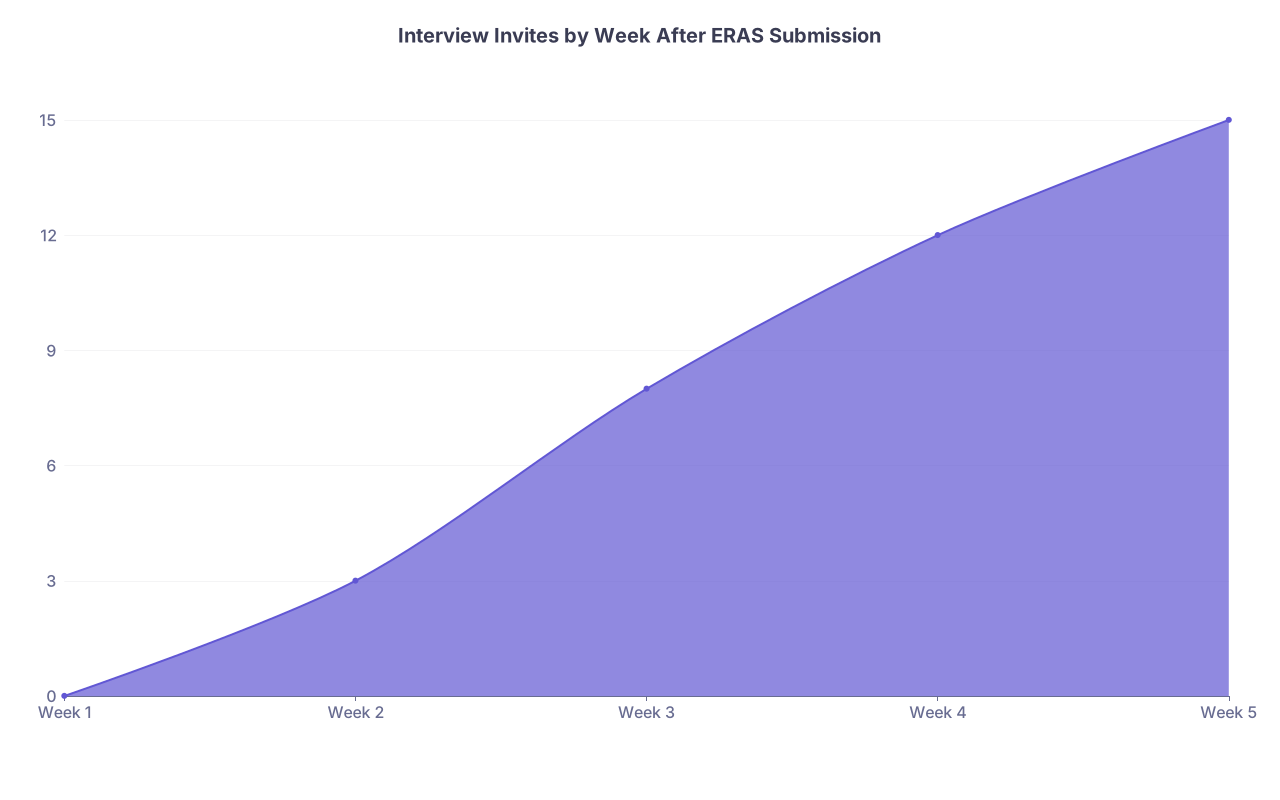
| Category | Value |
|---|---|
| Week 1 | 0 |
| Week 2 | 3 |
| Week 3 | 8 |
| Week 4 | 12 |
| Week 5 | 15 |
- If invites are very sparse after 4–6 weeks:
- Email programs where you have a genuine connection (home rotations, faculty connections, research).
- Ask faculty advocates to reach out on your behalf. Quietly, professionally.
Month 11: Interview performance and Step 1 narrative
You will get asked—subtly or directly—about your Step 1.
At this point you should have a rehearsed but genuine 60–90 second answer:
- Own the score:
- “My Step 1 was below my expectations. I underestimated [specific factor—test format, timing, or life event], and the result reflects that.”
- Show the change:
- “Afterward, I changed my approach by [structured study, seeking help, deliberate practice], which is reflected in my Step 2 and consistent clinical performance.”
- Pivot:
- “More importantly, on rotations I have shown I can [insert concrete strengths: manage patient loads, work in teams, handle call, etc.].”
Then move on. Do not dwell.
Month 12: Rank list construction
By late winter, you are ranking.
At this point you should:
- Rank every program where you would be willing to train.
- Do not play games trying to “one-up” or guess program behavior.
- Put your true #1 first, regardless of perceived likelihood.
If your application is weaker on paper, your best defense is to create a generous, honest rank list.
If You Learn About Your Low Step 1 Very Early (Pre-clinical)
Quick note for MS1–early MS2 students who stumble on Step 1 before clerkships:
At this point you should:
- Delay Step 2 CK until:
- You have finished key clinical rotations
- You have built real clinical judgment
- You can commit to 2–3 months of true preparation
- Crush your core clerkships:
- Honors in IM + Surgery will matter more than you think.
- Start light, early research or QI related to likely target specialties.
In other words, do not rush into another big exam. Build the foundation first.
Common Pitfalls to Avoid in This Timeline
You do not have time to make all the usual mistakes.
At every phase, avoid:
- Silence. Not talking to advisors early. Bad idea.
- Score chasing without reflection. Same exact study habits from Step 1 → Step 2 = repeat underperformance.
- Magical thinking about competitive specialties. “But I really love derm” is not a strategy.
- Under-applying. Low Step 1 + narrow, prestige-heavy list = disaster.
- Overexplaining in personal statements. One focused paragraph, then move on.
FAQ (Exactly 3 Questions)
1. Should I do a research year after a low Step 1?
Do a research year only if three things are true:
- You are committed to a competitive specialty that essentially demands it (derm, ortho, plastics, ENT, neurosurgery).
- You can secure a high-yield, mentored position at a place with strong name recognition and real output (posters, papers, letters).
- You can simultaneously fix your test-taking approach and set yourself up for a strong Step 2 CK.
If you are aiming for IM, Peds, FM, Psych, EM, or Anesthesia, a forced research year is rarely necessary just for a low Step 1. Step 2, clinical grades, and letters will do more for you.
2. How bad is “too bad” for certain specialties, no matter what I do later?
For the ultra-competitive fields (derm, plastics, ortho, ENT), a very low Step 1 (for example, <210 in the old numeric era) plus modest Step 2 is usually a hard wall, even with research. Could exceptions exist? Sure. But building a life plan on exceptions is reckless.
For IM, Peds, FM, Psych, and many Anesthesia and Pathology programs, a low Step 1 can be offset by a clear upward trajectory: strong Step 2 (ideally ≥235–240), strong clinical performance, and convincing letters.
3. How many programs should I apply to if both Step 1 and Step 2 are below average?
If both scores are below the national mean, you protect yourself with volume and breadth. Ballpark ranges (not gospel, but realistic):
- Internal Medicine: 60–80 programs, academic + community, wide geography.
- Family Medicine / Psychiatry / Pediatrics: 40–60, again with wide geographic range.
- Dual-apply strategy (e.g., EM + IM or IM + FM): ≥70–90 total across both specialties.
You supplement this with:
- Early ERAS submission
- Strong, specific letters
- A clear, honest narrative that shows growth instead of excuse-making.
Key points:
- After a low Step 1, Step 2 CK and your clinical performance become your lifeline; your timeline must revolve around them.
- Month by month, you should be either improving an objective metric (scores, grades, research output) or securing subjective advocates (mentors, letter writers).
- Breadth of applications and realistic specialty choices will protect your Match outcome far more than wishful thinking about prestige.