
A low Step 2 CK score is not a death sentence—but it is a deadline.
You are not dealing with a “minor weakness.” You are dealing with the one number most residency programs still use as a fast filter. That means your rotations, letters, and application timing cannot be casual anymore. Every month has a job. Every rotation has a purpose.
I am going to walk you through a concrete, time-based plan: what to do in the next week, month-by-month through application season, and how to use every rotation to rebuild your file.
Assumptions:
- You already took Step 2 CK and the score is back.
- You are an M4 (or late M3 on an early schedule) heading into an upcoming ERAS cycle.
- Score is meaningfully below your target specialty’s average (e.g., <230 for IM, <240 for surgery, etc.), or below your school’s usual match numbers.
If any of that sounds like you, then you do not have the luxury of vague goals. You need a timeline.
First 7 Days After Receiving a Low Step 2 CK Score
At this point you should stop spiraling and start triaging. One week. That is all I am giving you for shock, denial, and doomscrolling forum posts.
Day 1–2: Reality check and data
You sit down with:
- Your Step 1 status (Pass/Fail, old numeric score)
- Your Step 2 CK score
- Your transcript (pre-clinical + clerkships)
- Any class rank or quartile data
- Your specialty interest list (even if it is just 2–3 ideas)
Tasks in these two days:
Quantify how “low” your score is.
Use recent NRMP Charting Outcomes or specialty society data.Approximate Step 2 CK Ranges by Competitiveness Specialty Type Typical Matched Range “Flag” Territory (Approx.) Very Competitive (Derm, Ortho, ENT) 250+ <240 Competitive (EM, Anesthesia, Gen Surg) 240–250 <235 Moderate (IM, Peds, OB-GYN) 230–245 <225 Less Competitive (FM, Psych, Neuro) 220–235 <215 Do not obsess over a few points. You are looking for: “Am I clearly below the mean for my target field?”
Book a meeting with someone who knows the match at your school.
Dean of Students. Career advising. A trusted PD or APD in your field. Not just another stressed classmate.Pull program-specific filters where you can.
Many programs quietly filter at:- 220+ for less competitive fields
- 230–240+ for competitive fields
You want rough thresholds, not perfection.
Day 3–4: Specialty decision and risk stratification
Now you decide on your lane. Not in theory. In practice.
At this point you should:
Categorize your situation:
- Green-ish: Score is a bit low but still within one SD of your specialty’s mean.
- Yellow: Score below most matched applicants but not catastrophic.
- Red: Score likely below many program filters.
Decide which of these you are doing:
- Stay the course in your original specialty but apply broadly and realistically.
- Dual-apply (e.g., Gen Surg + IM, EM + IM, OB-GYN + FM).
- Pivot fully to a less competitive specialty.
If you are “red” and aiming for Derm, Ortho, ENT, or similarly brutal fields without serious research or connections, I will be blunt: you probably need a strategic pivot or dual-apply. Hoping the score will “matter less” is fantasy.
Day 5–7: Core planning and messaging
By the end of this first week you should have:
A written plan covering:
- Target specialty (and backup if any)
- Target program tiers (community vs academic, region)
- Upcoming rotations and how you will use each one
- Who your likely letter writers are
A core narrative you can later use in your personal statement and interviews:
- One or two sentences explaining the score in context (if there is a legitimate reason).
- Clear evidence of improvement (shelf scores, strong clerkship grades, upward trend).
- Emphasis on clinical performance, reliability, and work ethic.
You are not writing the full personal statement yet. You are defining the story arc.
6–3 Months Before ERAS Submission: Rotation Strategy Phase
This is your rebuild window. At this point you should be treating every rotation as an audition. Whether you are late M3 or early M4, this phase is where you prove the test did not define you.
Let us assume ERAS opens in June and submissions start mid-September. Count backward.
6–5 Months Before ERAS: Core Rotations and Shelf Redemption
Primary objective: Demonstrate clinical strength and knowledge that contradict the weak score.
On rotations (especially in your chosen specialty or adjacent ones):
Be the early, reliable, prepared student.
Residents talk. Attendings remember the student who printed the rounding list and knew every potassium.Aim for Honors or high pass on every remaining clerkship or sub-I.
- High shelf exam scores become part of your evidence that the Step result was an outlier.
- If your school reports shelf percentiles, even better.
Start quietly identifying letter writers.
- You want 1–2 letters from people who can say:
“This student’s clinical reasoning, reliability, and patient care are significantly stronger than what their Step 2 CK score might suggest.”
- You want 1–2 letters from people who can say:
Practical checklist for this window:
- Ask residents for feedback halfway through each rotation.
- Meet at least once with each attending you might want a letter from.
- Keep a running list of strong patient encounters and mini “wins” for future personal statement content.
5–4 Months Before ERAS: First Sub-I / Acting Internship
At this point you should be on a sub-I in your target specialty or a close cousin.
Goals:
- Crush it. No drama. No missed pages. No late notes.
- Show you can work at intern level:
- Pre-round independently.
- Write full notes before attending rounds.
- Propose reasonable plans.
This is also your prime letter window. Before you finish the rotation:
- Ask directly:
“Dr. X, I am applying to [specialty]. Would you feel comfortable writing me a strong letter of recommendation?” - If they hesitate at all, that is a no. Move on.
3 Months Before ERAS: Building the Application Skeleton
ERAS opens around June. By this point you should stop thinking “later” and start filling boxes.
Early June: ERAS opens
At this point you should:
Draft your experiences section.
Especially important with a low score—you must look three-dimensional:- List meaningful clinical experiences, leadership, research, teaching, service.
- For each, write impact-focused bullet descriptions (not job descriptions).
Clarify your program list structure.
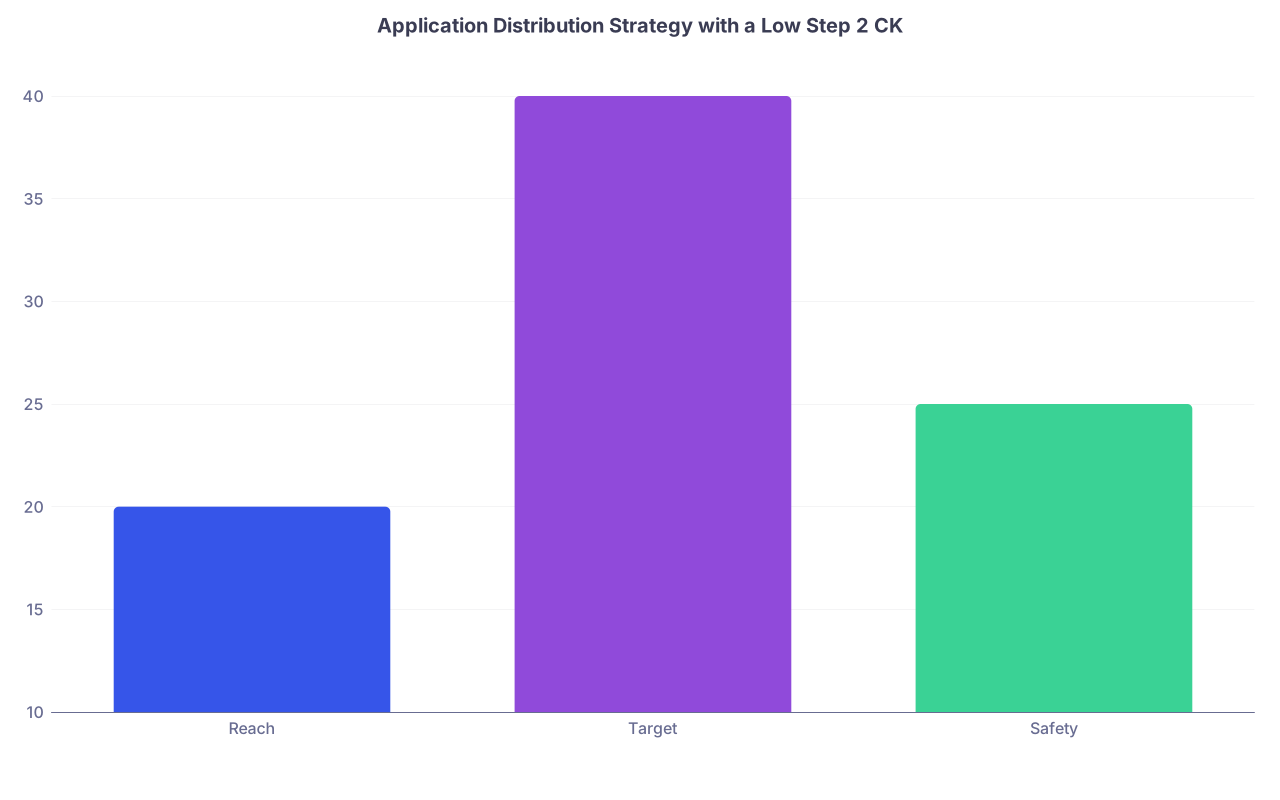
Application Distribution Strategy with a Low Step 2 CK Category Value Reach 20 Target 40 Safety 25 For a low Step 2 CK, that might translate to:
- 15–25 “reach” programs (upper-mid academic, slightly above your range)
- 35–50 realistic “target” programs (mid-tier academic + solid community)
- 20–30 “safety” programs (smaller community, less competitive regions)
Begin personal statement drafts.
Two versions if you are dual-applying. Your score is part of the context, not the headline.- You do not lead with your test score.
- If you explain it, do it briefly and factually:
- Example: “During the period surrounding my Step 2 CK, a family health crisis affected my ability to maintain my usual study routine. That experience has since stabilized, and my clinical evaluations and shelf exam performance more accurately reflect my capabilities.”
2 Months Before ERAS Submission: Letters, Aways, and Fine-Tuning
You are now in July-ish. At this point you should be locking in letters and finishing the heaviest rotations.
Rotations now: Aways / Auditions (if applicable)
If you have an away rotation in your specialty:
- Treat it as a month-long interview. Programs will sometimes overlook a low score if:
- You were clearly excellent in person.
- Their residents and attendings advocate for you.
- Aim for:
- One strong away rotation at a realistic target program.
- Do not overdo aways if your application is already fragile; every away is a risk.
Letters of recommendation
By the end of this month, you should have:
- 3–4 letters uploaded or promised, including:
- 1–2 from within your chosen specialty.
- 1 non-specialty letter from someone who can speak to your work ethic and reliability.
At this point you should:
- Confirm with your letter writers that they know your Step score situation.
You want them to consciously address your strengths beyond the test.
1 Month Before ERAS Submission: Final Application Build
You are in August, with ERAS submission mid-September. This is where you stop adding and start sharpening.
At this point you should:
Finalize your personal statement.
- Tight, specific, and forward-looking.
- If low Step 2 CK is addressed, it is a short paragraph, not the centerpiece.
- Emphasize:
- Cases where you showed solid clinical judgment.
- Feedback that contradicts the “weak test taker” narrative.
Polish your experiences and meaningful activities.
- Remove fluff like “responsible for helping doctors” and “assisted with various tasks.”
- Replace with outcomes:
- “Led a QI project that reduced medication reconciliation errors by 15% over 3 months.”
- “Pre-rounded and wrote daily notes on 6–8 patients under attending supervision during sub-I, with feedback highlighting thoroughness and organization.”
Build your final program list.
Cross-check:- Good geographic spread.
- Mixture of academic and community programs.
- Reasonable alignment with your metrics and story.
ERAS Submission Month: September
The application opens for submission mid-September. Programs see it shortly after.
At this point you should be ready on day 1. With a low Step 2, you do not benefit from “waiting to add one more thing.”
Week Before Submission
- Final review of ERAS for typos, inconsistent dates, or gaps.
- Confirm USMLE transcript release box is checked.
- Confirm all letters are assigned appropriately.
- Have an advisor or recent resident review your application for red flags.
Submission Week
On the first possible submission day:
- Submit in the first 24 hours.
You cannot afford to be late in a year where programs might auto-screen on Step scores.
Immediately after submission:
- Prepare for the possibility of fewer interview invites than peers. This is not panic time. This is expected.
Interview Season: October–January
Your low Step 2 CK will come up. Maybe explicitly, maybe just in their minds when they glance at your score.
At this point you should be ready with a calm, rehearsed answer.
Interview Prep: 2–3 weeks before first invite
Build your answer to:
- “Can you tell me about your Step scores?” or “Is there anything in your application you would like to address?”
Structure:
- Brief context (only if you have a legitimate explanation; no long sob story).
- Ownership.
“I was disappointed by the score. I reviewed what went wrong and adjusted my approach.” - Evidence of growth.
- Strong sub-I evaluations.
- Shelf exam improvements.
- Specific feedback from attendings.
- Forward focus.
Confidence about handling in-training exams and board prep going forward.
On rotations during interview season:
- Do not mentally check out. Ongoing strong performance:
- Can generate last-minute letters.
- Gives you real-time stories to share in interviews.
Post-Interview and Rank List Phase: January–March
By this time, the score is fixed and the applications are out. The only lever left is how you handle your rank list and backup plans.
At this point you should:
Rank every program where you could see yourself functioning and learning.
- Do not “punt” safe programs to the bottom just because they are not shiny.
Coordinate with your school about SOAP risk.
- If your advisor thinks your odds are borderline, have a SOAP specialty backup plan before Match Week.
If you do not match (I hope you do, but let us be adult about it):
- Use SOAP aggressively and strategically.
- After SOAP, debrief:
- Consider a research year, prelim spot, or full pivot for next cycle.
- Map exactly how you will strengthen your file (more clinical time, research, formal remediation of test-taking).
Big-Picture Timeline Overview
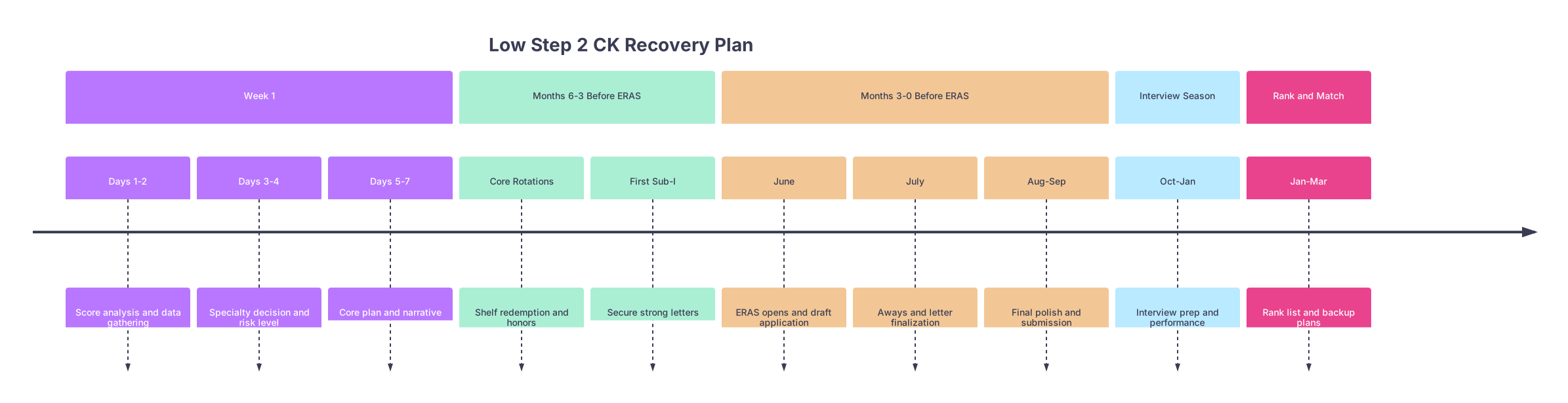
| Period | Event |
|---|---|
| Week 1 - Days 1-2 | Score analysis and data gathering |
| Week 1 - Days 3-4 | Specialty decision and risk level |
| Week 1 - Days 5-7 | Core plan and narrative |
| Months 6-3 Before ERAS - Core Rotations | Shelf redemption and honors |
| Months 6-3 Before ERAS - First Sub-I | Secure strong letters |
| Months 3-0 Before ERAS - June | ERAS opens and draft application |
| Months 3-0 Before ERAS - July | Aways and letter finalization |
| Months 3-0 Before ERAS - Aug-Sep | Final polish and submission |
| Interview Season - Oct-Jan | Interview prep and performance |
| Rank and Match - Jan-Mar | Rank list and backup plans |
Quick Reference: Priority Checklist by Phase
| Phase | Top Priority |
|---|---|
| Week 1 | Decide specialty strategy and narrative |
| 6–3 months pre-ERAS | Earn outstanding clinical evaluations |
| 3–1 months pre-ERAS | Secure strong letters, refine ERAS |
| Submission month | Apply early and broadly |
| Interview season | Own the score, highlight growth |
| Rank and Match | Build smart rank list, plan backup |
FAQs
1. Should I delay my graduation or take a research year because of a low Step 2 CK?
Only if three things are true:
- You are targeting a highly competitive specialty,
- Your application is weak in multiple domains (not just the score), and
- You have access to a meaningful research or clinical opportunity that will clearly upgrade your application (publications, strong mentorship, new letters).
If you are applying to less competitive fields and have solid clinical evaluations and decent letters, a forced “research year” can sometimes just delay the inevitable without changing outcomes much.
2. Do I need to explain my low score in my personal statement?
Not always. If you are only slightly below average and the rest of your application is strong, you can let your letters and evaluations speak for you and address the score only if asked during interviews. If your score is substantially low or you had a real, time-limited circumstance (illness, family crisis), a brief, factual mention showing responsibility and recovery is reasonable. Never turn your personal statement into a Step score apology letter.
3. How many programs should I apply to with a low Step 2 CK?
More than your classmates with average or strong scores—within reason. For many core specialties, that often means:
- 60–80 programs for moderately competitive fields,
- 80–100+ if you are aiming a bit above your metrics or dual-applying,
- Heavily weighting toward mid-tier and community programs that historically interview applicants in your score range.
The right number depends on your specialty, region, and the strength of your non-test-profile. Your advisor should help you sanity-check your list.
Open your Step 2 CK score report and your upcoming rotation schedule side by side. For each remaining month before ERAS, write one clear objective on a sticky note—“Honor sub-I,” “Secure 2 strong letters,” “Finish ERAS draft”—and put those notes directly on your calendar. Your rebuild starts with that concrete, time-stamped plan.