
The biggest mistake low Step score applicants make is pretending SOAP is a backup plan. It is not. It is a parallel process you prepare for months in advance.
You are in a risk category, whether you like that phrase or not. Low Step scores change your entire residency application strategy. That includes how you plan for the Supplemental Offer and Acceptance Program (SOAP). If you wait until the Monday of Match Week to “see what happens,” you are already behind the applicants who started building their SOAP strategy in August.
Here is the timeline you actually need.
6–9 Months Before Match Week (July–September): Admit You Are High-Risk
At this point you should stop pretending your application is “just like everyone else’s with a small blemish.” It is not.
You are in this bucket if:
- Step 1: fail, or pass with a borderline performance and clear red flags in discipline-specific areas
- Step 2 CK: ≤ 220–225 for competitive specialties, or a prior fail, or large score drop from Step 1
- You are applying to a competitive specialty with an average matched score far above yours (e.g., Anesthesiology with 245+ averages while you sit at 218)
Step one is brutal honesty. Then planning.
July–August: Risk Classification and Primary Strategy
At this point you should:
Classify your true risk level
Make a simple grid. No emotion, just data.
SOAP Risk Snapshot for Low Step Scores Factor Low Risk Moderate Risk High Risk Step 1 status Pass, no concerns Pass, borderline Fail or multiple attempts Step 2 CK score ≥ 235 220–234 < 220 or fail Specialty category Primary care Mid-competitiveness Highly competitive Number of applications ≥ 80 50–79 < 50 Home / strong letter Yes Maybe None If you hit “High Risk” in any two cells, you plan aggressively for SOAP starting now.
Decide on your SOAP specialty lanes
- Primary care–friendly SOAP options: Internal Medicine, Family Medicine, Pediatrics, Psychiatry, Transitional/Prelim years.
- Stop pretending you will SOAP into Dermatology. You will not.
- Identify 2–3 realistic SOAP lanes based on:
- Visa needs
- Geographic flexibility
- Prior rotations / letters
Build a SOAP-specific CV and ERAS draft
At this point you should:
- Draft alternate personal statements for:
- Internal Medicine
- Family Medicine
- Pediatrics or Psychiatry (if relevant)
- Keep them short, focused, and honest about your clinical strengths, not your test scores.
You are not submitting anything yet. You are building templates you can deploy fast.
- Draft alternate personal statements for:
Start relationships early
Target programs that:
- Have historically unfilled positions in NRMP data
- Are community-based, non-university, or less “name-brand”
- Have larger class sizes (more likely to have movement)
Email program coordinators after doing away rotations or virtual rotations. Simple message: you are interested, you recognize you are not a 260, but you work hard, and you would be thrilled to match there. I have seen those early touches matter in SOAP week.
3–5 Months Before Match Week (October–December): Build the SOAP Infrastructure
At this point you should be quietly building all the things you will not have time to create during Match Week.
October: Audit your application for SOAP readiness
Re-read your ERAS with SOAP in mind
Ask blunt questions:
- Does my current personal statement scream “Dermatology or bust”?
- Do my experiences highlight primary care, continuity, bread-and-butter hospital medicine?
If not, revise now. Programs that did not rank you initially may still see your application for SOAP. You want an ERAS file that makes sense for your SOAP specialties.
Create SOAP-ready documents
Prepare:
- 2–3 SOAP-specific personal statements saved as separate files:
- IM-focused PS
- FM-focused PS
- Psych or Peds PS if applicable
- A one-page SOAP “pitch” sheet for yourself:
- Your metrics (Step scores, class rank)
- 3–4 strengths
- 1–2 clear explanations for low scores (short, factual)
- 2–3 geographic areas you will accept without hesitation
This is for you and for anyone advising you. It sharpens your story.
- 2–3 SOAP-specific personal statements saved as separate files:
Talk to your dean’s office now
At this point you should schedule:
- A meeting with your dean or advisor about “if I do not match, here is our plan.”
- Ask:
- Who signs off on SOAP participation?
- Who will be available that week (names, direct lines)?
- How fast can they update your MSPE, if needed?
You want to know how your school actually behaves during SOAP week, not how they say they behave.
2 Months Before Match Week (January): Lock in Plans and Tools
This is when people get lazy. You should not.
Early January: Scenario planning
At this point you should outline three scenarios:
- You match – great. SOAP prep was an insurance policy.
- You partially match (e.g., prelim only when you needed an advanced spot).
- You do not match at all.
For each, write:
- Where you will apply in SOAP (specialty, geography).
- Who you will email or call immediately.
- Which personal statement you will use.
No more “I’ll figure it out then.” You will not. You will be panicking.
Mid–Late January: Build your logistics kit
At this point you should:
- Ensure you have:
- Updated CV in PDF and Word.
- A list of 5–7 faculty who:
- Know you,
- Are willing to vouch for you quickly,
- Understand that you have low scores and still believe in you.
- Confirm your contact info:
- Phone number that you will actually answer.
- Professional voicemail greeting.
- Email that goes to your phone with notifications ON during Match Week.
Create a simple spreadsheet (yes, a basic one) with:
- Program name
- ACGME ID
- Specialty
- Contact email / phone
- Notes column (prior interactions, alumni, etc.)
You will be living in this spreadsheet during SOAP.
4–6 Weeks Before Match Week (Early–Mid February): Targeting and Reality Check
At this point you should stop guessing and start using real data.
Early February: Use unfilled trends data
Study prior NRMP “Results and Data” PDFs.
Look at:
- Which specialties historically have many SOAP positions.
- Which states frequently have unfilled IM/FM/Peds programs.
- Which types of programs (community, rural, new) show up every year.
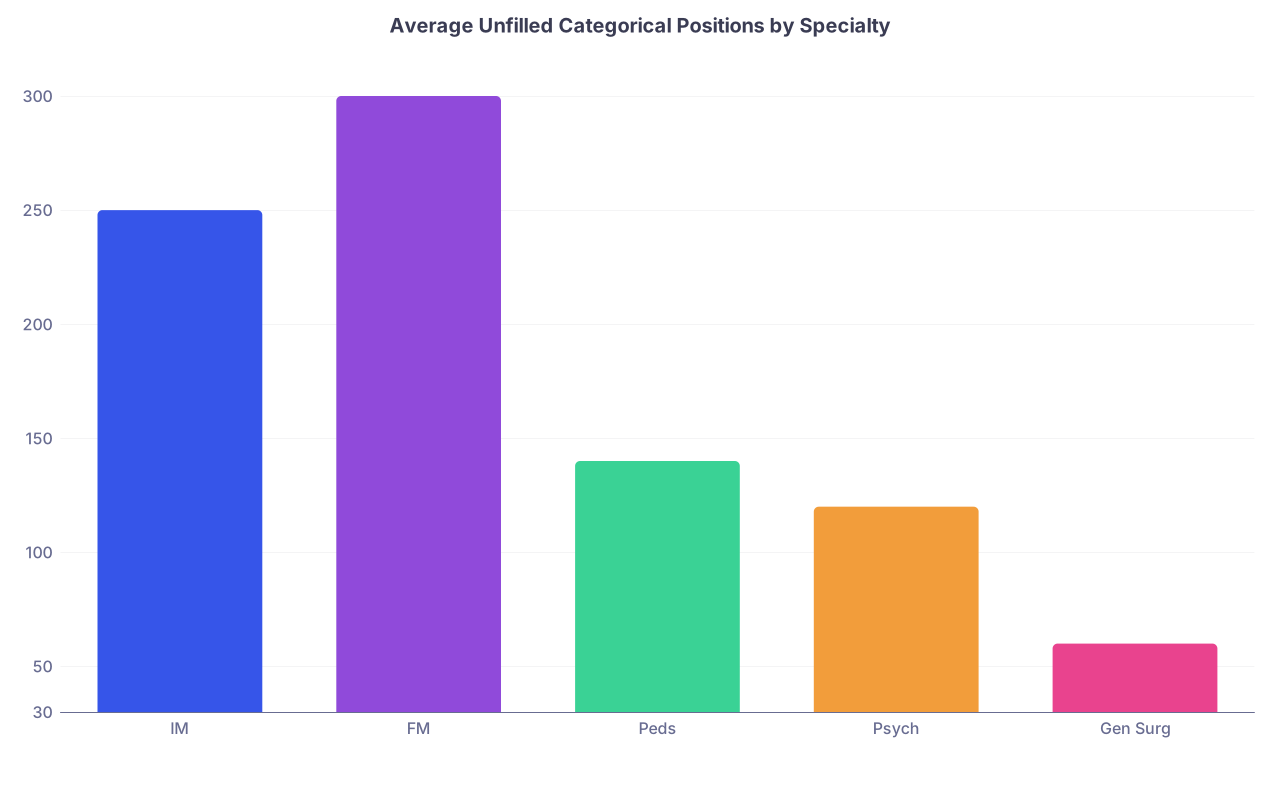
| Category | Value |
|---|---|
| IM | 250 |
| FM | 300 |
| Peds | 140 |
| Psych | 120 |
| Gen Surg | 60 |
Build a priority list of 30–40 programs by type, not name:
- Rural community IM in Midwest / South
- FM programs in smaller cities
- Psych in non-coastal regions
These will be your first-pass SOAP targets if your specialty plans collapse.
Mid February: Rehearse the conversation about your scores
At this point you should be able to answer, smoothly:
- “Can you tell me about your Step scores?”
- “Why do you think you struggled on standardized exams?”
- “What have you done since then to address that?”
Write a 30–45 second answer:
- Acknowledge the number, do not hide it.
- Give 1 concrete factor (not an excuse; explanation).
- Follow with 2 concrete improvements (shelf scores, Step 2 improvement, extra practice, tutoring others, etc.).
- End with reassurance that clinical performance has been solid (backed by evals).
Practice out loud. You will absolutely get this question during SOAP calls.
2 Weeks Before Match Week: Final Prep and Communications
At this point you should behave as if you will need SOAP, even if you are optimistic.
T−14 to T−10 Days: Clean up everything
Make sure:
- ERAS photo is professional.
- All experiences are accurate and up to date.
- LoRs are in and assigned correctly.
-
- Who specifically will help you submit SOAP applications if needed.
- What their internal deadlines are during Match Week.
T−10 to T−7 Days: Line up emergency advocates
At this point you should:
Email or talk to your 3–5 key faculty:
“If I end up in SOAP, would you be comfortable:
- Taking a brief call from a program director?
- Sending a quick support email on my behalf that week?”
Get explicit yes’s. Get preferred contact numbers and email addresses. Add them to your spreadsheet.
Match Week: Day-by-Day SOAP Execution
Now the timeline gets tight. This is where having everything pre-built matters.
Monday of Match Week: 11:00 AM ET – You Learn You Are Unmatched or Partially Matched
If your email says “We are sorry, you did not match…”, you have two jobs in the first 2 hours.
At this point you should:
Control your immediate reaction
You get 15–30 minutes to crash emotionally. Then you switch to operational mode. I have seen people waste half of Monday in shock. Do not be that person.
Contact your dean/advisor immediately
- Forward the “did not match” email (if requested).
- Ask when they will be available to:
- Help you review the SOAP list.
- Approve your applications.
11:00 AM–3:00 PM ET: Review SOAP-Participating Programs List
NRMP releases the list via the R3 system.
At this point you should:
Filter by:
- Specialty (start with your realistic SOAP lanes, not your dream specialty).
- Visa status, if relevant.
- State/geography flexibility.
Populate your spreadsheet:
- Program name
- ACGME ID
- Number of positions
- Notes on any red flags or positives
You do not contact programs yet. You are collecting data.
Monday Afternoon: Build and Prioritize Your 45 Programs
You can apply to a maximum of 45 programs total across all SOAP rounds.
At this point you should:
Allocate your 45 slots rationally
Example for a low Step score applicant:
- 25–30: Internal Medicine categorical
- 10–15: Family Medicine
- 5–10: Prelim IM or Transitional if you have an advanced specialty plan still alive
Do not waste all 45 on one highly competitive field. That is how people remain unmatched after SOAP.
Customize documents minimally but intelligently
You do not have time for 45 unique personal statements. You do have time to:
- Use your IM personal statement for all IM programs.
- Use FM PS for all FM programs.
- Quickly edit the first paragraph or last paragraph for:
- Region-specific interests
- Prior ties (“I grew up in X state…”)
Submit as early as your school allows
Once ERAS SOAP opens for submissions (usually Monday afternoon), your goal is to have:
- 45 programs selected and assigned
- Appropriate personal statement assigned by specialty
Get this done before Monday evening. Programs start reviewing right away.
Tuesday–Thursday: SOAP Rounds and Interviews
This is the sprint. The schedule is rigid. Your time is not yours.
Overall SOAP Offer Structure
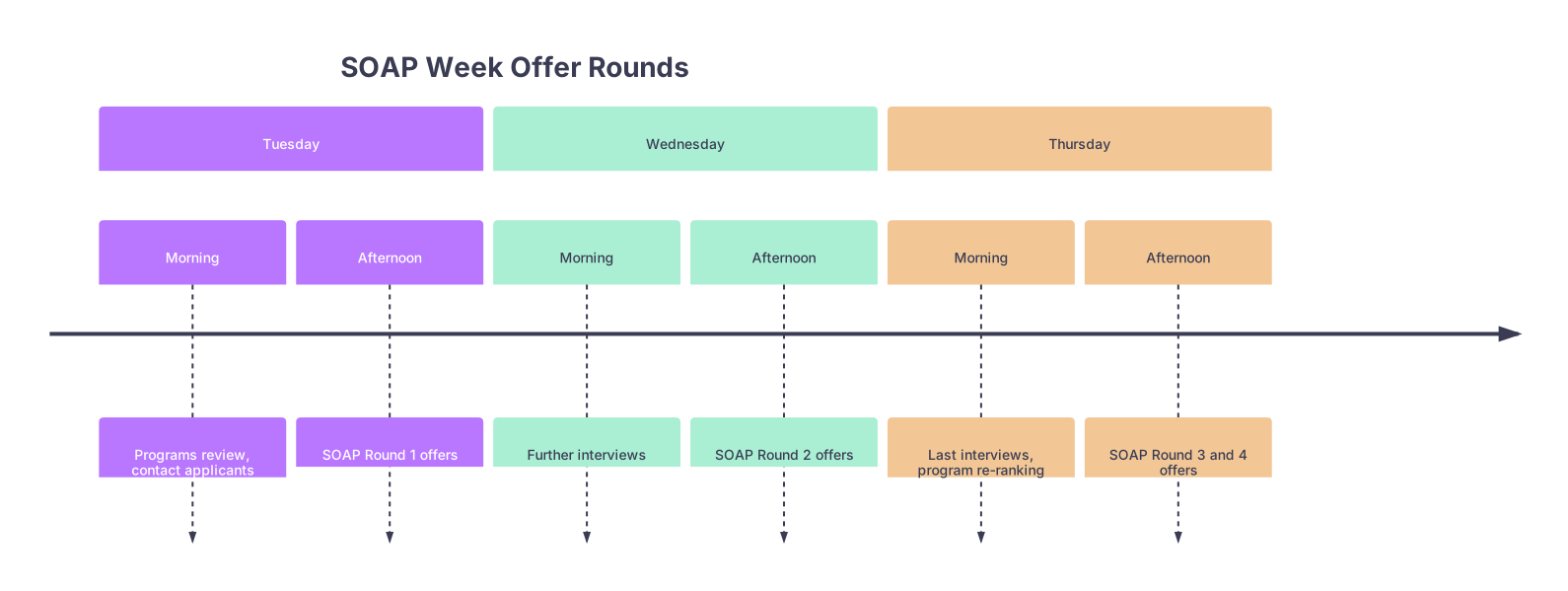
| Period | Event |
|---|---|
| Tuesday - Morning | Programs review, contact applicants |
| Tuesday - Afternoon | SOAP Round 1 offers |
| Wednesday - Morning | Further interviews |
| Wednesday - Afternoon | SOAP Round 2 offers |
| Thursday - Morning | Last interviews, program re-ranking |
| Thursday - Afternoon | SOAP Round 3 and 4 offers |
Check NRMP each year for exact times, but the pattern is stable: multiple offer rounds from Tuesday to Thursday.
Tuesday Morning: Be Glued to Your Phone
At this point you should:
- Keep your phone on loud and with you at all times.
- Have Zoom/Teams/phone ready for quick interviews.
Programs may:
- Email you to schedule a short video call.
- Directly call you for a 5–15 minute “informal” interview.
- Ask you rapid questions about:
- Why their program?
- How you handle stress or failure?
- Your low Step scores.
Your practiced answer about your scores gets used here. Exactly as you rehearsed.
Tuesday Afternoon: Round 1 Offers
If you receive an offer, you usually have a very short window (often 2 hours) to accept or reject.
At this point you should:
- Have pre-decided tiers in your head:
- Tier 1: Absolutely accept if offered.
- Tier 2: Consider carefully, compare.
- Tier 3: Only accept if nothing else.
This should be pre-written in your spreadsheet. You should not be ranking programs for the first time while the timer is running.
If you get no offers in Round 1:
- Do not panic. Many low Step applicants match in Round 2 or 3.
- Ask your dean/residency office if they received any feedback from programs that passed on you.
Wednesday: Adjusting Strategy Between Rounds
At this point you should:
Review which programs:
- Contacted you but did not offer.
- Never reached out.
If allowed, you may:
- Update your program preferences.
- Ask faculty advocates to reach out to specific PDs where you had good conversations.
If you get an offer in Round 2:
- Use your tier list.
- Accept something realistic and safe over holding out for something glamorous that probably will not materialize.
Thursday: Last Chance Rounds
By Thursday, things are brutally simple.
At this point you should:
- Tell your dean and advocates your shortlist of acceptable offers.
- Stay hyper-responsive to calls, emails, and messages.
If you receive an offer at this stage, you almost always accept unless it is truly unsafe or impossible for your life circumstances.
After SOAP: 24–72 Hours Post-Outcome
Whichever way this goes, you still have work.
If You Matched in SOAP
At this point you should:
Send thank-you emails to:
- Program director and coordinator
- Faculty who advocated for you
- Your dean/advisors
Clean up:
- Any other applications or interviews you had scheduled post-Match.
- Your mental story: you matched. You are going to residency. Stop obsessing over the rankings.
If You Did Not Match Even After SOAP
This is harsh. It is also real.
At this point you should:
- Schedule a post-SOAP debrief with:
- Dean / advising office
- One brutally honest faculty mentor
Ask:
- Were my target specialties realistic given my scores?
- Did programs provide any consistent feedback?
- Would reapplying with:
- One more year of clinical work or research,
- Improved Step 2 or Step 3 score (if eligible),
- Different specialty choice,
change the probability in any meaningful way?
You then build a 12-month improvement plan, not a 2-week patch.
Key Takeaways
- SOAP preparation for low Step score cases starts 6–9 months earlier, not on Monday of Match Week.
- You must have pre-built documents, target specialties, and a clear story about your scores before offers ever exist.
- During Match Week, speed and decisiveness—driven by planning, not panic—are what turn a risky profile into a residency spot.