
The worst advice after you do not match is “just reapply next year and hope for the best.” Hope is not a strategy. A timeline is.
You are not done. You are on a different track now—with less margin for error and more need for structure. Especially with low Step scores, every month between Match Week and the next application cycle has a job. Miss those jobs and you carry the same weak file into another brutal year.
Here is what you do, step-by-step, from Match Week through the next Match, with specific actions and deadlines.
Match Week: Days 1–7 – Stabilize and Triage
At this point you should not be making big career decisions. You should be gathering data and putting out fires.
Monday–Wednesday (SOAP / Immediate Aftermath)
Day 1–2 (SOAP start):
If you are SOAP-eligible and it’s still active:
- Finish SOAP applications with discipline, not panic:
- Prioritize prelim IM, prelim surgery, transitional year, FM, psych—wherever your Step profile is least toxic.
- Apply broadly within reason, but customize a short paragraph in each application about immediate availability and willingness to work hard.
- Get real-time help:
- Email or text your dean’s office / career advisor the same day:
“I am unmatched and SOAPing. Can we review my application and discuss contingency plans this week?”
- Email or text your dean’s office / career advisor the same day:
- Keep a running list:
- Programs contacted
- Any responses
- Any faculty who offered help
If SOAP has ended or you were ineligible, skip to Thursday actions.
Non-negotiables this week:
- Do not send angry emails to programs that did not rank you.
- Do not post your Step scores and rage on social media.
- Do not decide in 24 hours that you are changing specialties forever.
You are in shock. You’re not thinking clearly yet. That’s normal.
Thursday–Sunday: Hard Autopsy of the Application
By the end of Match Week, you should have a blunt and detailed understanding of why you did not match.
Sit down with:
- Your dean / student affairs
- A trusted attending or PD you know
- If you have one: a mentor in your target specialty
Ask them to go line-by-line through your application.
Make a written deficit list with three columns:
- Non-fixable by next cycle
- Step 1 fail / very low pass
- Step 2 score significantly below specialty norms
- Gap years already present
- Fixable by next cycle (6–12 months)
- No recent clinical letters
- Weak personal statement
- Generic experiences section
- Unexplained leaves or red flags without context
- Strategic choices that hurt you
- Applied to too few programs
- Chose overly competitive specialty with weak stats
- Limited geography to 1–2 regions
- Late ERAS submission or late Step 2
Put numbers and details on it:
- “Step 1: 205 (pass on second attempt)”
- “Step 2: 215, no improvement trend”
- “Applied: 45 categorical surgery programs only”
- “Letters: 2 from pre-clinical faculty, 1 generic IM letter”
This list drives the rest of your year.
Late March–April: Decide on Your Strategic Path
At this point you should stop asking “why me” and start choosing a deliberate path.
Week 2–4 after Match: Big Fork in the Road
You have three main options, and with low scores you cannot pretend all three are equally realistic.
| Path | Time to Next Match | Best For | Main Risk |
|---|---|---|---|
| Reapply Same Specialty | 1 year | Borderline but not hopeless | Repeat non-match |
| Switch to Less Competitive | 1 year | Strong clinical skills, low Steps | Regret, loss of specialty |
| Non-clinical / Long Gap | 2+ years or never | Severe score / multiple fails | Hard to return to clinical |
With clearly low scores (e.g., Step 1 fail, Step 2 < 220), you should strongly consider:
- Switching to:
- Family Medicine
- Internal Medicine (community programs)
- Psychiatry
- Pediatrics (community-heavy)
- Or planning a structured “bridge” year:
- Research + observerships + strong letters
Do not let pride lock you into a specialty that has essentially slammed the door. I’ve seen students spend three cycles chasing categorical surgery with 210 scores and end up with no residency at all.
Concrete tasks by end of April:
Clarify next-cycle target specialty
- Talk to at least two PDs or APDs (even informally) in the potential specialty:
“With my scores (Step 1 X, Step 2 Y), if I complete a year of [research/observership], do I have a realistic chance at your type of program?” - If three honest humans say “probably not,” believe them.
- Talk to at least two PDs or APDs (even informally) in the potential specialty:
Decide on your geographic flexibility
- Are you willing to go anywhere? You should be. “Anywhere in the US” is the default answer for someone reapplying with low scores.
Outline your “gap year job”
- Research fellow
- Clinical observer / assistant
- Home country residency (for IMGs)
- MPH / other degree (low yield alone, better when combined with clinical/research work)
May–June: Lock in Positions and Fix Application Components
At this point you should be building the version of yourself programs will see in September.
Weeks 1–2 of May: Secure a Role for the Coming Year
Do not drift into June without something concrete.
Goals by May 15:
- One of:
- Signed research position (full-time or near full-time)
- Confirmed clinical observer / non-ACGME role with meaningful patient exposure
- Plan to start home-country clinical work with documentation potential
- An explicit understanding with a supervisor:
- That you are reapplying to residency
- That you will need letters by August/September
How to find roles quickly:
- Email targeted faculty, not generic departments:
- Subject: “Prospective research assistant – reapplying to [IM/FM/Psych] residency”
- Keep it short: 2–3 paragraphs max, CV attached.
- Lean on alumni networks:
- Ask, “Do you know any program or hospital where an unmatched graduate can do research or clinical work this year?”
Mid-May–June: Rehab the Core Application Pieces
You are not just re-uploading last year’s ERAS.
By June 30 you should:
Have a first-draft personal statement
- Explicitly address low scores once, briefly and with a forward-looking tone.
- Emphasize:
- Clinical strengths
- Reliability
- What you learned from the setback
- Avoid long emotional narratives about disappointment.
Rewrite your experiences section
- Turn vague bullets like “assisted in patient care” into specific impact:
- “Managed daily progress notes and medication reconciliation for 8–10 inpatients under attending supervision.”
- Add upcoming role:
- “Incoming research fellow in [lab] (start July 202X). Focus: [brief area].”
- Turn vague bullets like “assisted in patient care” into specific impact:
Create your program list rough draft
- Use last year’s list plus:
- More community programs
- More regions
- Remove:
- Programs that explicitly told you your scores are below their cut-off.
- Use last year’s list plus:
July–August: Build Concrete Value and Letters
At this point you should be actively doing something every workday that will appear in your next application.
July: Start Strong in New Role
First 2 weeks on the job:
- Show up early. Stay a little late. You are being evaluated.
- Make your intentions clear:
- “I am reapplying to residency, and I’m hoping to earn a strong letter based on my work here.”
- Ask for responsibility:
- Draft notes
- Present patients
- Take ownership of data collection / analysis if research
You’re trying to create stories your letter writers can tell:
- “She routinely stayed late to ensure discharge summaries were complete.”
- “He took the lead on our QI project and presented at the department meeting.”
By July 31 you should:
- Identify 2 potential strong letter writers
- Schedule a feedback meeting with each:
- “How am I doing so far? What could I improve to be as competitive as possible for residency?”
August: ERAS Finalization and Letters
ERAS opens mid-August. This month is about polishing and formalizing.
Week 1–2 of August:
- Finalize:
- Personal statement
- Experiences
- CV
- Confirm exams:
- If Step 3 is in your plan, schedule it realistically (more on timing below).
Week 3–4 of August:
- Ask for letters formally:
- Email + in-person ask if possible.
- Provide:
- CV
- Draft personal statement
- Bullet points about cases or projects you worked on with them.
- Set deadlines:
- “Would you be able to upload by September 10 so my application is complete early?”
If someone hesitates or sounds lukewarm, do not force a letter from them.
September: Submit a Targeted but Aggressive Application
At this point you should be acting like a returning applicant with something new to offer, not like last year’s version.
Early September (Before ERAS Submission Opening)
Program list reality check:
For low scores, raw program volume matters—but only if they’re plausible targets.
- Typical ranges I’ve seen that give people a real shot:
- FM / Psych / Peds: 80–120 programs
- Community IM: 100–150 programs
- Prioritize:
- Programs that have:
- IMGs or US grads with lower scores in their current residents (check websites)
- History of taking reapplicants
- Community or hybrid hospitals rather than big-name academic flags
- Programs that have:
By ERAS submission day you should have:
- All letters uploaded or at least promised with specific dates
- Program list in ERAS, not on scraps of paper
- Personal statements tailored if you’re dual-applying (e.g., FM + IM)
ERAS Submission Week
Submit on the first possible day. Do not wait to “improve” something minor.
Right after submitting:
- Send short, professional emails to:
- PDs or faculty who know you
- Mentors at your current job
- Sample:
“I wanted to let you know I’ve submitted my ERAS application for Internal Medicine for the 202X–202Y cycle. I greatly value the opportunity to work with you at [institution]. If you feel comfortable supporting my application to [specific programs or regions], I’d be very grateful.”
Keep it under 5–6 sentences.
October–January: Interview Season – Active Damage Control
At this point you should be tracking data obsessively and adjusting in real-time.
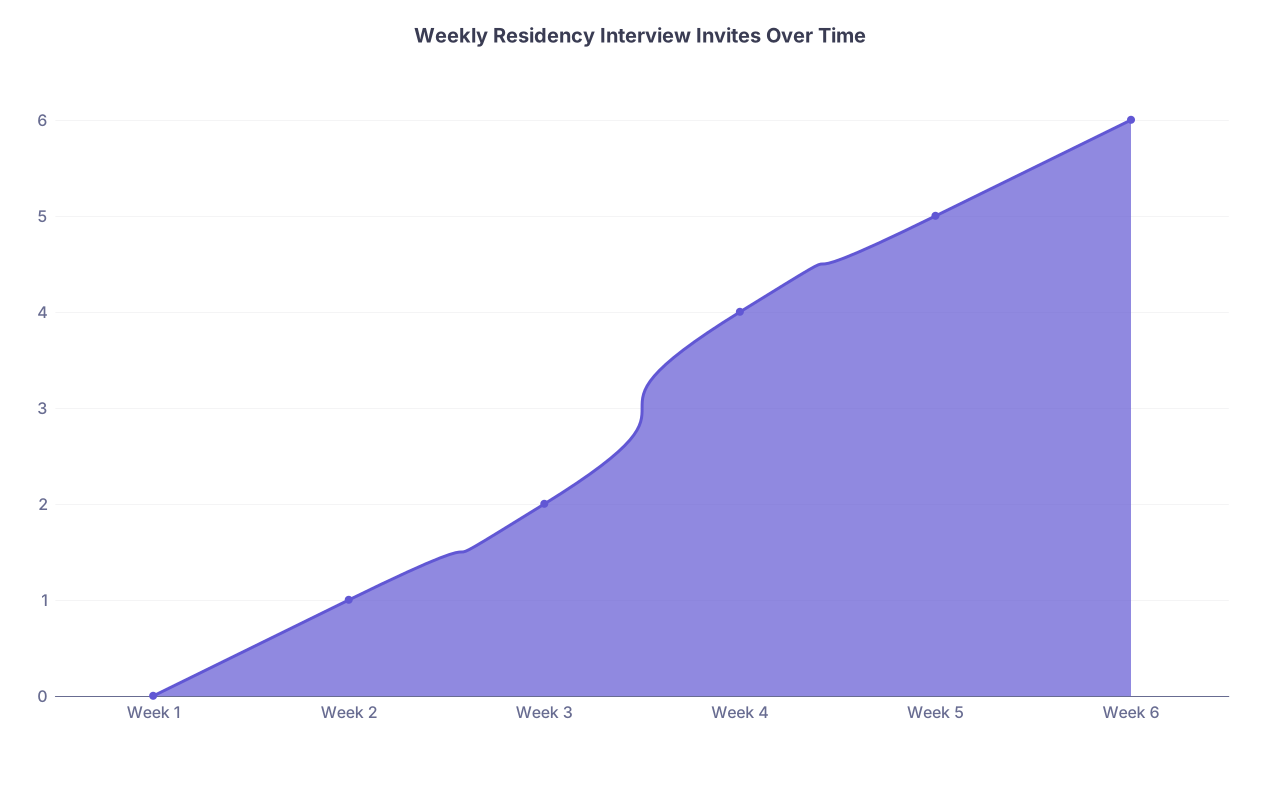
| Category | Value |
|---|---|
| Week 1 | 0 |
| Week 2 | 1 |
| Week 3 | 2 |
| Week 4 | 4 |
| Week 5 | 5 |
| Week 6 | 6 |
October: Monitor Response and Escalate Early
By October 31 you should:
- Have some interviews, or a plan to push harder.
If by late October you have 0–2 invites:
- Meet immediately with:
- Your current supervisor
- Your dean / advisor
- Ask them directly:
- “Is there anyone you can email or call on my behalf at programs that may consider an applicant with my scores?”
Start polite signal emails to selected programs:
- Brief, focused, not needy:
- “I recently applied to your [specialty] program. I’m particularly interested in [concrete reason: patient population, community setting, X rotation] and would be honored to be considered for an interview.”
Limit this to programs that are realistic and where you have some connection or geographic tie.
November–January: Make Every Interview Count
You are not going to get 30 interviews. You do not need 30.
At each interview:
- Be ready with a clear, concise explanation for:
- Low scores
- Gap year
- Being a reapplicant
Something like:
“My Step scores are not where I wanted them to be. During that time, I was still developing my test-taking approach. Since then, I’ve focused on strengthening my clinical skills and reliability, which is reflected in my work at [current place]. I’ve received strong feedback on my clinical judgment and teamwork, and I’m confident I’ll bring that same work ethic to residency.”
Say it once. Calmly. Then pivot to your strengths.
Immediately after each interview:
- Write down:
- Who you spoke with
- Specific things they emphasized (resident autonomy, underserved care, etc.)
- Send customized thank-you emails within 24–48 hours.
February–Match Week (Year 2): Rank List and Contingency Planning
At this point you should be brutally honest about your odds while still fighting for every inch.
February: Rank List Strategy
You do not play games with rank lists when you have low scores and are a reapplicant.
- Rank every program where you’d be willing to train.
- Do not rank:
- Programs where you’d be truly miserable or unable to move.
- Do not overthink:
- “Will they see where I ranked them?” No. They will not.
Have a second, quieter track running:
- Start collecting:
- Updated CV
- New PDF of publications or abstracts during the year
- Documentation of ongoing work that will matter if you need to re-reapply (worst-case).
Match Week (Year 2)
Have two documents ready before NRMP emails go out:
If you match:
- Great. The plan worked. You shift to “success despite low scores” territory.
- Archive:
- What helped
- Who helped (so you can pay it forward later).
If you do not match again:
- Open your plan B document, not a blank page.
- You should already know:
- Whether you’re willing to try a third time
- Whether you’re ready to leave clinical medicine
- Which mentors you’re contacting that week
This is harsh, but I’ve seen people salvage a second non-match year only when they treated it like a known risk, not a shock.
What About Step 3?
You were probably wondering when I’d mention it. On purpose, I did not put “Step 3” at the top of this list.
When Step 3 helps:
- You have:
- Step 1: Fail / low pass
- Step 2: Below average but passing
- And you can:
- Realistically score >220–230 on Step 3.
Then Step 3 can act as a “proof of concept” that your exam performance has matured.
When Step 3 hurts or wastes time:
- You rush to take it in June–July, score 205, and now you’ve added another low number.
- You delay your research / clinical start to cram for Step 3 but then do not crush it.
Reasonable timing with low scores:
- Start studying lightly in June–July while working.
- Register for an exam date after your new role is stable (e.g., late September–November).
- Only take it if:
- Practice scores are consistently in a safe range.
- You can honestly say this will likely be your best board score.
Visual Timeline: One-Year Plan After Not Matching
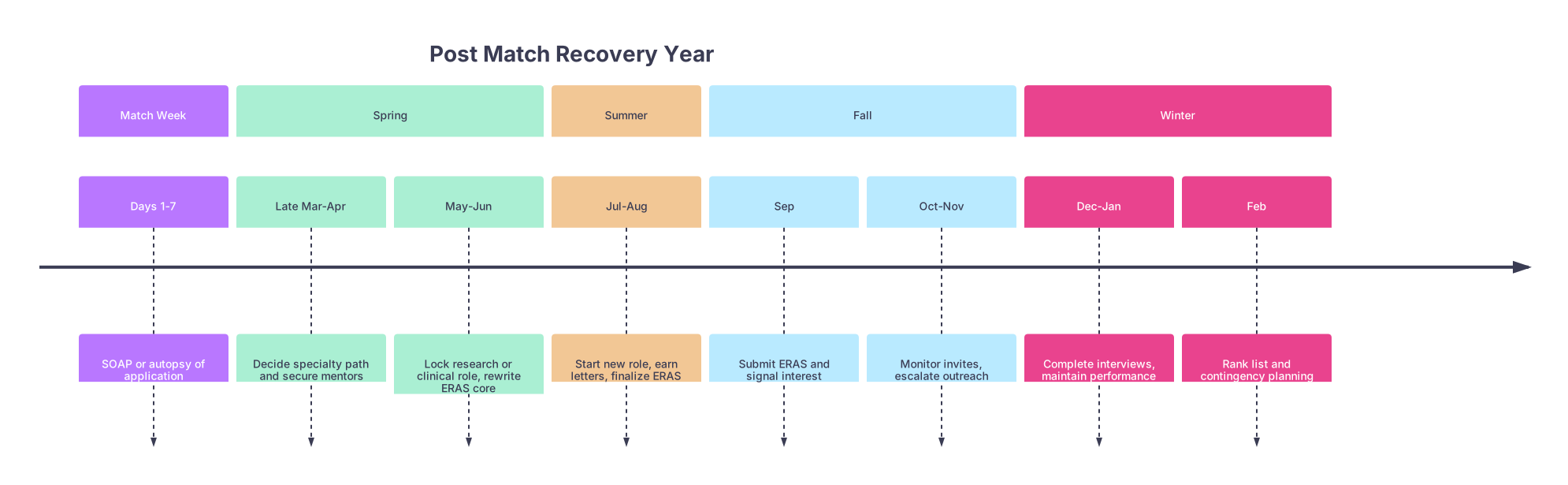
| Period | Event |
|---|---|
| Match Week - Days 1-7 | SOAP or autopsy of application |
| Spring - Late Mar-Apr | Decide specialty path and secure mentors |
| Spring - May-Jun | Lock research or clinical role, rewrite ERAS core |
| Summer - Jul-Aug | Start new role, earn letters, finalize ERAS |
| Fall - Sep | Submit ERAS and signal interest |
| Fall - Oct-Nov | Monitor invites, escalate outreach |
| Winter - Dec-Jan | Complete interviews, maintain performance |
| Winter - Feb | Rank list and contingency planning |
Key Points to Remember
- Every month after a non-match has a job. If your calendar is empty, you’re losing ground.
- Low scores are a permanent part of your file, but not a life sentence. Your job for the next year is to build enough current, concrete strength—work ethic, letters, clinical performance—that programs are willing to look past those numbers.