
The belief that mediocre Step scores automatically kill your residency chances is lazy thinking. They do not—unless you also have mediocre letters.
You’re not going to fix a 215 or a failed Step attempt. But you can absolutely build the kind of letters that make programs say, “Okay, the score is low, but I trust this attending’s judgment.” That is your entire game now.
Here’s the timeline for doing exactly that—month by month, then week by week on key rotations, then down to what you should say the day you ask for a letter.
12–9 Months Before ERAS Submission: Set Up Your “Letter Year” On Purpose
At this point you should stop thinking “How do I hide my Step score?” and start thinking “How do I put myself in front of people who will go to bat for me?”
Month 12: Choose Rotations Strategically
If you’re a rising M3 or early M4 (or an IMG planning U.S. rotations), this month is about engineering your schedule around letter opportunities.
Your priorities:
- Maximize time with potential letter writers in your target specialty.
- Include at least one rotation where you can show redemption after low scores.
- Build in a home sub‑I and at least one away (if financially possible) in your specialty.
Target this mix:
- 1–2 sub‑internships (home and/or away) in your chosen specialty
- 1–2 rotations with “known name” attendings (locally or nationally recognized)
- 1 rotation where you expect day‑to‑day close supervision (small teams, clinic‑heavy)
Make a short list of potential letter writers categories:
- Home program PD or APD
- Strong clinical teachers (attending or senior faculty)
- Away rotation faculty (especially if from respected programs)
- Research mentor (only if they know you well and can comment on work ethic and reliability, not just “smart student” fluff)
You’re not picking names yet. You’re designing exposure.
Month 11: Be Honest With Your Advisor About Your Step Scores
At this point you should stop hiding your score from people who can help.
Meet with:
- Your dean’s office / advising office
- A trusted faculty mentor
- If possible, someone in your target specialty who has sat on residency selection committees
Bring:
- Your Step scores (including failures)
- Transcript
- Draft specialty list
Say something like:
“My Step 1 was a fail on first attempt and a pass on second; Step 2 is 223. I know this hurts my application. I want to aggressively build strong letters to offset this. Which rotations and attendings are best for that here?”
You want:
- Names of attendings who write detailed, strong letters
- Warnings about “damning with faint praise” letter writers to avoid
- Strategic advice on which away rotations carry weight for your profile
Write down specific names and months. Then adjust your schedule.
8–6 Months Before ERAS: Start Acting Like a “Letter Person,” Not a “Score Person”
At this point you should accept that programs will see the low number. Your job is to give them a compelling counter‑story from credible voices.
Month 8: Build Your “Letter Dossier” Framework
You’re going to make it stupidly easy for attendings to write powerful letters about you.
Set up:
- A simple CV (1–2 pages max, bullet‑style, no fluff)
- A running “Strengths and Stories” document where you track:
- Times you handled a complex patient independently
- Positive feedback quotes from residents/attendings
- Examples of resilience and improvement after mistakes
- Anything showing growth after your Step struggles
Create a basic one‑pager explaining your trajectory—this is for you, not for programs yet:
- One line on Step history
- 3–4 bullets on what you changed (study habits, clinical performance, feedback‑seeking)
- 3–4 bullets on your strongest clinical traits now
You’ll later adapt this into the short “context” paragraph you give to letter writers.
Month 7–6: Start Telling the Narrative Out Loud
On rotations and in meetings, stop pretending your Step score never happened. Instead, learn to own it cleanly and move on.
You’re aiming for something like:
“My Step 1 was a fail on the first attempt. I was dealing with poor study structure and burnout. I addressed that with regular practice tests, group accountability, and faculty coaching, and passed on the second attempt. Since then I’ve leaned heavily into building strong clinical skills—taking more responsibility on the wards, asking for feedback, and working on reliability. I’d like my application to show that growth clearly.”
You’re not oversharing. You’re giving the future letter writer the language you want them to use:
- Recognized a problem
- Changed behavior
- Demonstrated improvement in real clinical work
5–3 Months Before ERAS: High‑Yield Rotations = Letter Hunting Season
This is where most students blow it. They work hard but never convert work into letters.
Before a Key Rotation Starts (1–2 Weeks Before)
At this point you should be planning the rotation as if it were a month‑long interview for a letter.
Do this:
- Identify 1–3 realistic target attendings on this rotation
- Learn their basic background (academic rank, specialty niche, any leadership roles)
- Email or tell the chief resident:
“I’m very interested in [specialty] and hope to get a strong letter from this rotation. I’d really appreciate any feedback along the way so I can improve.”
You are signaling seriousness. Residents talk. Attendings notice.
Set three personal goals for the rotation:
- Clinical: e.g., be primary on at least X admissions or Y consults
- Professionalism: no late notes, pre‑round on time, follow up every lab you order
- Growth: ask for specific feedback by week 2 and week 3
Week‑By‑Week During a Letter‑Critical Rotation
Here’s how your internal checklist should look.
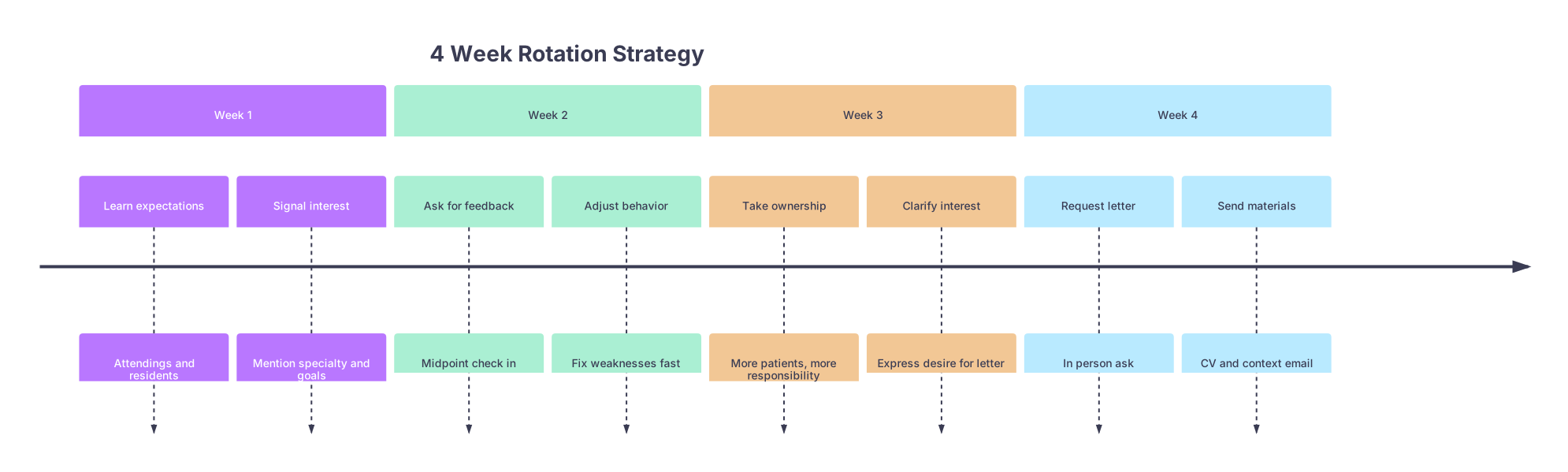
| Period | Event |
|---|---|
| Week 1 - Learn expectations | Attendings and residents |
| Week 1 - Signal interest | Mention specialty and goals |
| Week 2 - Ask for feedback | Midpoint check in |
| Week 2 - Adjust behavior | Fix weaknesses fast |
| Week 3 - Take ownership | More patients, more responsibility |
| Week 3 - Clarify interest | Express desire for letter |
| Week 4 - Request letter | In person ask |
| Week 4 - Send materials | CV and context email |
Week 1: Make It Obvious You’re “That Student”
At this point you should be:
- Early. Always.
- Prepared on your patients cold.
- Asking smart, targeted questions (not playing “pimp me less” games).
On day 2–3, say to your attending:
“I’m very interested in [specialty], especially [area]. I also know my Step scores aren’t my strength, so I’m putting a lot of weight on becoming a strong, reliable team member and hopefully earning strong letters. Please feel free to give me any direct feedback; I really want to improve.”
That line does a few things:
- Acknowledges the elephant once, without drama
- Signals maturity and insight
- Invites them to see themselves as part of your “redemption arc”
Week 2: Mid‑Rotation Feedback and Course Correction
At this point you should force a midpoint check‑in if they don’t offer one.
Say:
“We’re about halfway through. Could I get quick feedback on how I’m doing and what I should focus on to function more like an intern?”
You want specific comments you can fix in real time:
- “Your presentations are too long.” → Shorten, get sharper.
- “You seem hesitant on plans.” → Start proposing full plans, then ask for adjustment.
- “Follow‑through on tasks is slow.” → Create a personal task list, update residents frequently.
Why this matters for letters:
Attendings remember improvement curves. A student who is “good then slightly better” is forgettable. A student who goes from “okay” to “wow, they really listened and leveled up” gets mentioned in letters.
Week 3–4: Converting Performance Into a Letter
Late Week 3: Soft Check for Letter Strength
At this point you should pre‑screen whether this person will actually write you a strong letter. You do not want lukewarm letters with subtext like “within expectations.”
Ask in person:
“I’m applying to [specialty] and this rotation has been really important to me. Based on how I’ve done so far, do you feel you’ve seen me enough to write a strong letter of recommendation?”
Key word: strong. If they hesitate, hedge, or say something vague like “I can write you a letter,” thank them and do not use it as a primary letter. Keep looking.
If they say “Yes, definitely” or “I’d be happy to,” proceed.
Week 4: The Actual Ask
Do this 3–5 days before the rotation ends, not at 4:58 p.m. on the last day.
In person:
“I’m very grateful for this rotation and everything I’ve learned. As I mentioned, I’m applying to [specialty] this cycle, and I would be honored if you’d write a strong letter of recommendation for my residency application. I’m especially hoping your perspective can help programs see the kind of resident I’d be beyond just my Step scores.”
If they agree, follow up within 24 hours with an email.
Subject: “LOR for [Your Name] – [Specialty] Residency Application”
Content:
- Thank them again
- Include:
- CV
- Personal statement draft (even if rough)
- USMLE transcript
- Unofficial transcript
- Bullet list of 4–6 specific clinical examples from their rotation
- One short paragraph giving context on your Step scores and growth
Example language for the context paragraph:
“You’ll see on my USMLE transcript that I failed Step 1 on the first attempt and passed on the second. That period was a turning point for me. Since then I’ve focused on building strong clinical habits—consistent preparation, asking for feedback, and taking responsibility for my patients. If appropriate, I’d be grateful if you could comment on the reliability and growth you observed on this rotation, especially compared with my test scores.”
You’re not asking them to lie. You’re telling them how to frame what they already saw.
3–1 Months Before ERAS: Locking Letters, Filling Gaps, and Nudging
At this point you should have a rough idea of:
- Who’s agreed to write
- How many letters you’ll have
- Where the gaps are (no home PD? No away rotation letter? No non‑specialty letter?)
3 Months Before ERAS Opens: Letter Portfolio Check
You want a mix like this (for competitive or moderate specialties):
| Letter Type | Target Count |
|---|---|
| Home specialty faculty | 1–2 |
| Away rotation faculty | 1 |
| Program Director or APD | 1 |
| Non‑specialty clinical | 0–1 |
If your Step scores are low, I’d prioritize:
- At least two letters explicitly commenting on your clinical strength, reliability, and growth
- At least one letter from someone with a title that catches attention (PD, APD, Clerkship Director, Chief of Service)
If you’re missing one of these, use any remaining rotations aggressively:
- Tell attendings on day 1 that you’re hoping to secure a letter to strengthen your application in light of lower Step scores.
- Work like an intern.
- Ask directly in Week 3–4 as above.
2 Months Before ERAS: Gentle Reminders and Backup Options
At this point you should start tracking letter status like a project manager.
Make a simple tracking sheet:
- Name
- Role (PD, faculty, away, etc.)
- Date asked
- Date sent materials
- ERAS status (not requested / requested / uploaded)
Send a polite reminder if it’s been 3–4 weeks and ERAS still shows “Not Received.”
Template:
Dear Dr. [Name],
I hope you’re doing well. I wanted to follow up regarding the letter of recommendation for my [specialty] residency application. ERAS is now open for letter uploads, and I’m planning to submit my application on [date].
I know your schedule is very busy and truly appreciate your willingness to support my application, especially as I’m working to highlight my clinical strengths alongside my lower Step scores. Please let me know if I can provide any additional information.
Thank you again,
[Name]
If someone ultimately cannot submit, do not panic. Better no letter than a rushed, lukewarm one. Ask another attending who knew you well, even from a different specialty, provided they can write about your work ethic and growth.
ERAS Submission Month: Letter Handling and Targeted Use
At this point you should be making your letters work strategically for different programs.
Choose Which Letters Go to Which Programs
ERAS lets you assign up to four letters per program. You do not need to send the same set to every program.
For more competitive programs:
- Always include:
- Best “prestige” letter (PD, APD, or big‑name away faculty)
- Best “growth/overcoming” letter that mentions your improvement and reliability
- Then add:
- Another specialty letter that highlights clinical independence
- Research or non‑specialty letter only if it’s truly strong and personal
For community or less competitive programs:
- Prioritize letters that:
- Emphasize work ethic
- Emphasize being low‑maintenance, team‑oriented
- Explicitly say you function at or near intern level
Where possible, ask at least one writer (ideally PD or equivalent) to explicitly address the score in a positive frame. Something like:
“While [Name]’s Step scores are below our program’s usual average, they have consistently demonstrated clinical performance and maturity that I trust far more than a test score. I would not hesitate to have [Name] as an intern in our program.”
They may or may not include it, but you’ve planted the seed.
How Strong Letters Can Offset Scores (Realistically)
Programs are not sentimental. But they are human. Here’s what usually happens:
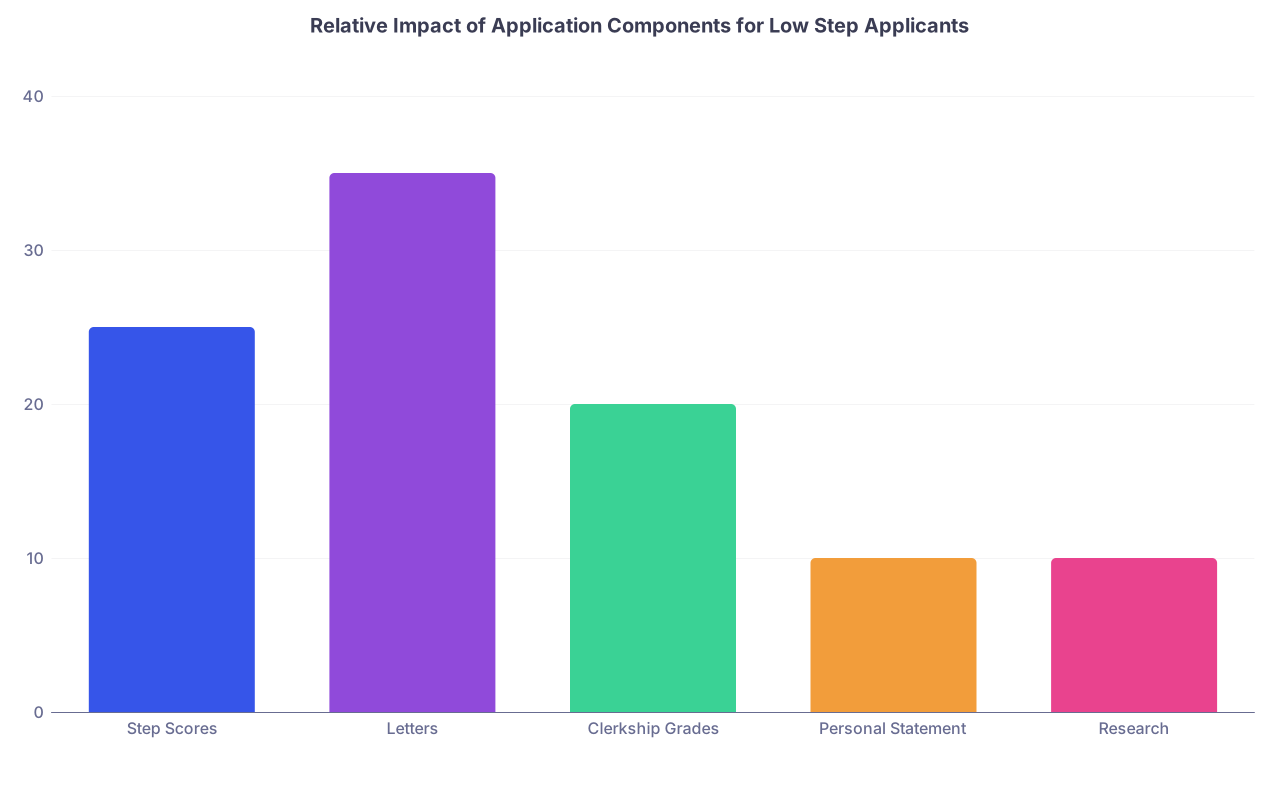
| Category | Value |
|---|---|
| Step Scores | 25 |
| Letters | 35 |
| Clerkship Grades | 20 |
| Personal Statement | 10 |
| Research | 10 |
For applicants with low Step scores, letters often carry more weight than for high scorers because they’re the main evidence you’re not a future problem.
I’ve seen marginal Step applicants pulled into interview lists purely because a trusted PD or well‑known faculty member wrote a 2‑page, specific, enthusiastic letter.
Generic praise won’t do it. Specific, story‑rich endorsement from respected people might.
Interview Season: Reinforcing What Your Letters Say
At this point you should make sure your interview story matches your letters.
When asked about your Step scores:
- Acknowledge briefly
- Own the mistake without excuses
- Emphasize what changed
- Tie it back to what letter writers have seen
Example:
“My Step scores are lower than I’d like, and I take responsibility for that. The experience forced me to overhaul how I prepare and how I ask for feedback. Since then, my attendings—like Dr. X and Dr. Y who wrote my letters—have seen me function at a much higher level clinically. They can probably describe that growth better than I can, but I’ve tried to live up to intern‑level expectations on every rotation.”
You’re essentially pointing the interviewer back to your letters as your real score report.
If You’re Late in the Cycle or Already Matched Unfavorably
If you’re reading this with ERAS already submitted or after a bad match, it’s not over. Your timeline just shifts:
- Use your current intern year (or preliminary year, or research year) to earn killer supervisor letters
- Ask chiefs and attendings explicitly:
“I’m planning to reapply in [specialty]. My scores are on the low side, so I’m relying heavily on strong letters reflecting my performance here. Can I check in periodically to get feedback on what I can improve to be at the level of your best interns?”
Then repeat everything above, just in a different setting.
Open your email drafts right now and write one message: to a current or recent attending who liked working with you. Ask to schedule a 10‑minute meeting about your residency plans and potential for a strong letter. That single email starts the timeline you’ve been putting off.