
The worst ERAS mistake with a low Step score is pretending you’re a “normal” applicant. You are not. From ERAS opening to rank list deadline, you’re playing a different game with different rules. If you follow the standard timeline, you get standard results: screening filters, auto-rejects, and a long, quiet winter.
You do not have that luxury.
Below is a ruthless, time-anchored plan from ERAS opening through rank list certification, built specifically for low Step 1/Step 2 scores. I’ll walk you month by month, then week by week in the crunch periods, with “at this point you should…” marching orders.
Big Picture: Your Low-Score Match Strategy Map
Before we zoom into dates, you need the global structure. With a low score, your strategy has three pillars:
- Volume and fit – More applications, highly targeted to realistic programs.
- Narrative control – PD letter, personal statement, MSPE, emails: all coordinated to explain and offset your score.
- Active hustle – You don’t “wait” for interviews; you push, update, and signal interest all season.
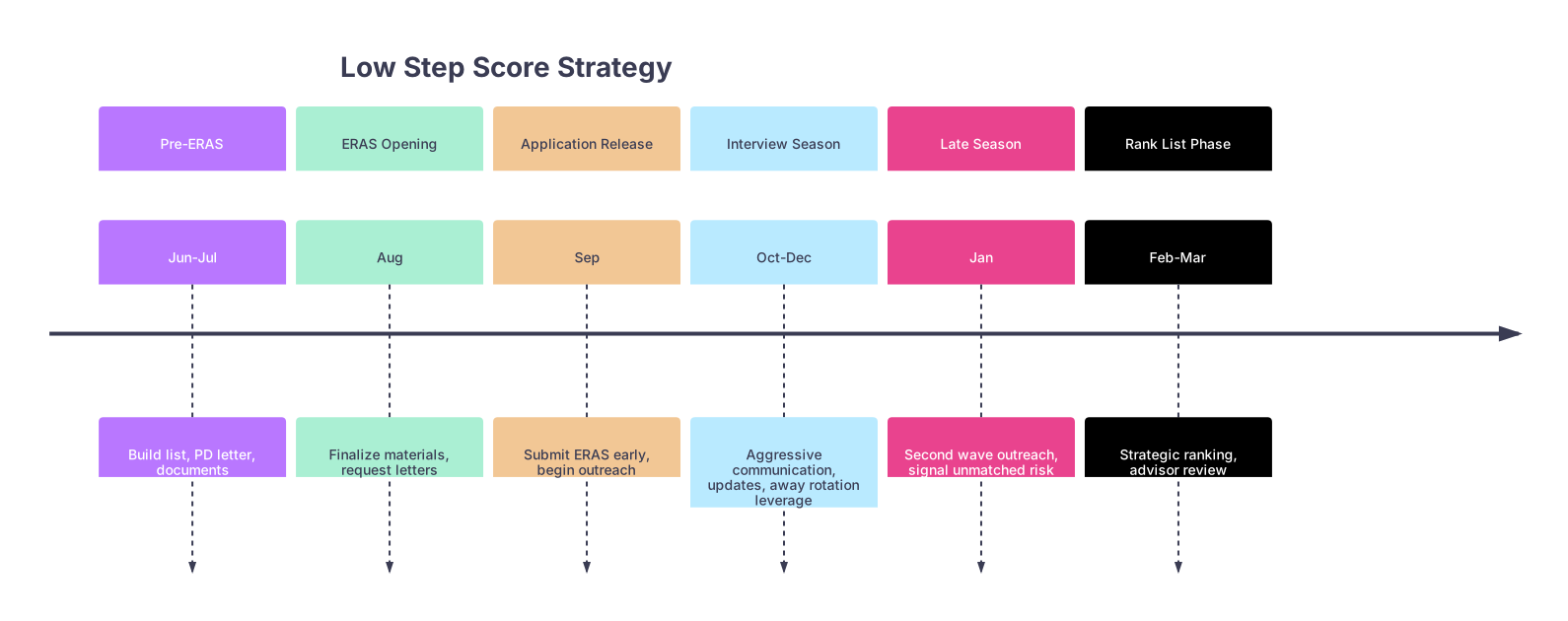
Here’s the backbone of your timeline:
| Period | Event |
|---|---|
| Pre-ERAS - Jun-Jul | Build list, PD letter, documents |
| ERAS Opening - Aug | Finalize materials, request letters |
| Application Release - Sep | Submit ERAS early, begin outreach |
| Interview Season - Oct-Dec | Aggressive communication, updates, away rotation leverage |
| Late Season - Jan | Second wave outreach, signal unmatched risk |
| Rank List Phase - Feb-Mar | Strategic ranking, advisor review |
At every phase, you’ll be doing what higher-score applicants skip as “overkill”. For you, it’s baseline.
June–July: Pre-ERAS Groundwork (Quiet Prep, Loud Strategy)
If it’s already August or later for you, skim this and jump ahead. But if you’re reading before ERAS officially opens, this is where you stack the deck.
June: Reality Check and Program Tiering
At this point you should:
Know your numbers cold
- Step 1: pass / fail.
- Step 2 CK: what it is, how far below typical matched scores for your specialty.
- Class rank, any failed rotations, remediation.
Define your realistic specialty and backup
If you’re sitting on:- Step 2 CK < 220 for core competitive fields (Derm, Ortho, ENT)? Do not waste your cycle there.
- For IM/FM/psychiatry/peds: still workable with 205–215, but you must be strategic.
Create a three-tier program list draft
Use FREIDA, program websites, and NRMP Charting Outcomes.
| Tier | Target Programs | Typical Criteria |
|---|---|---|
| Tier A | Safety | Community, lower fill rates, no explicit score cutoffs |
| Tier B | Reasonable | Mix of community and lower-mid academic, holistic language |
| Tier C | Reach | Academic, some prior IMGs/DOs, historically higher scores |
You should end June with:
- 80–120 total programs identified for IM/FM/psych (more for IMGs).
- Clear drop-dead list of places you will not waste an application on (strict 230+ filters stated, zero IMGs/DOs if you’re one, etc.).
July: Fix the File You Can Control
At this point you should:
Secure a strong PD or chair letter
Especially if your program has an internal residency:- Have a blunt meeting: “My Step is X. I want to match realistically. Where do you see me fitting?”
- Ask explicitly: “Are you comfortable writing a strong, supportive letter addressing my performance and potential?”
If they hesitate, that’s a no. Find someone else who knows your clinical work well.
Craft the “Score Narrative”
You get one coherent explanation for your low score. It must:- Be short (2–4 sentences).
- Take responsibility.
- Point to clear improvement (later clerkships, shelf exams, research, Step 2 if higher than Step 1).
Example:
Early in medical school I struggled with test anxiety and time management, which contributed to my lower Step score. Since then, I’ve worked closely with our learning specialist, improved my testing strategies, and have scored above the 75th percentile on recent shelf exams. My clinical evaluations consistently highlight my preparation and reliability, which is where I believe I bring the most value as a resident.
Finish a targeted personal statement
Not generic. For low scores, your statement should:- Front-load clinical strengths.
- Slip in the score narrative once, then move on.
- Make you look like a workhorse who will not create problems on the floor.
Line up all letters
By end of July:- 3–4 letters uploaded or promised with specific dates.
- At least 1 from your specialty.
- If you’re doing an away in August/September, plan to add an extra late letter from that rotation.
August: ERAS Opens – Precision, Not Panic
ERAS typically opens early August; programs can’t see your application until mid-September, but you cannot treat August as a draft month. With a low score, any delay just kills you further.
At this point you should:
Lock in your program list by mid-August
- 60–80 programs minimum for lower-competitiveness specialties if you’re at a significant score disadvantage and are US MD.
- 100–150+ if DO/IMG with low scores.
Finalize your ERAS content
- Experiences: Emphasize concrete responsibility (night float sub-I, team leader, QI project you actually finished).
- Don’t list 15 tiny clubs to “look busy”. That reads as fluff.
- Put strongest clinical and longitudinal commitments at the top.
Align your MSPE draft (if your school lets you review)
- Ask to ensure Step score context is fair and accurate.
- Push for strong statements about work ethic, reliability, patient care.
Complete ERAS application at 90–95% by last week of August
- The only acceptable “pending” items are late letters or a still-in-progress away rotation description.
You should end August with:
- ERAS application essentially ready to submit.
- Personal statement(s) uploaded.
- Letters either uploaded or with hard promises and dates.
September: Application Release and Early Hustle
This is where most low-score applicants blow it. They submit late, they hide, they “see what happens”. You will not.
Early September (Days 1–7): Submit Early, Not Perfect
At this point you should:
Submit ERAS on or immediately after the first day you’re allowed
Being early matters. Screening often starts as files flood in.Targeted personal statements by program type
- Slightly different PS for community-heavy vs academic-heavy programs is fine.
- Do not obsess over micro-customization; it wastes time and gains nothing.
Check that USMLE transcripts released correctly
Low score or not, errors here get you auto-binned.
Mid–Late September (Days 8–30): Start Smart Outreach
Once applications are released to programs (usually mid-September), you shift to proactive mode.
At this point you should:
Send very selective initial emails (1–2 weeks after release)
You are not spamming. You are choosing:- Programs where you have a tie (home state, rotation, alumni, mentor connection).
- Programs that historically interview some lower-scoring or IMG/DO candidates.
Email template skeleton:
- Subject: “Application to [Program Name] – [Your Name], [School]”
- 3–5 sentences total:
- Who you are.
- One specific reason you’re genuinely interested.
- 1–2 clinical strengths.
- Short nod to your score narrative and how you’ve grown.
- Thank you and ERAS AAMC ID.
Coordinate with your PD or mentor for advocacy
Quiet but powerful move:- Ask them to call or email 3–5 realistic programs on your behalf.
- Programs respect direct, honest advocacy much more than another applicant self-promotion email.
October–December: Interview Season – Aggressive, Not Desperate
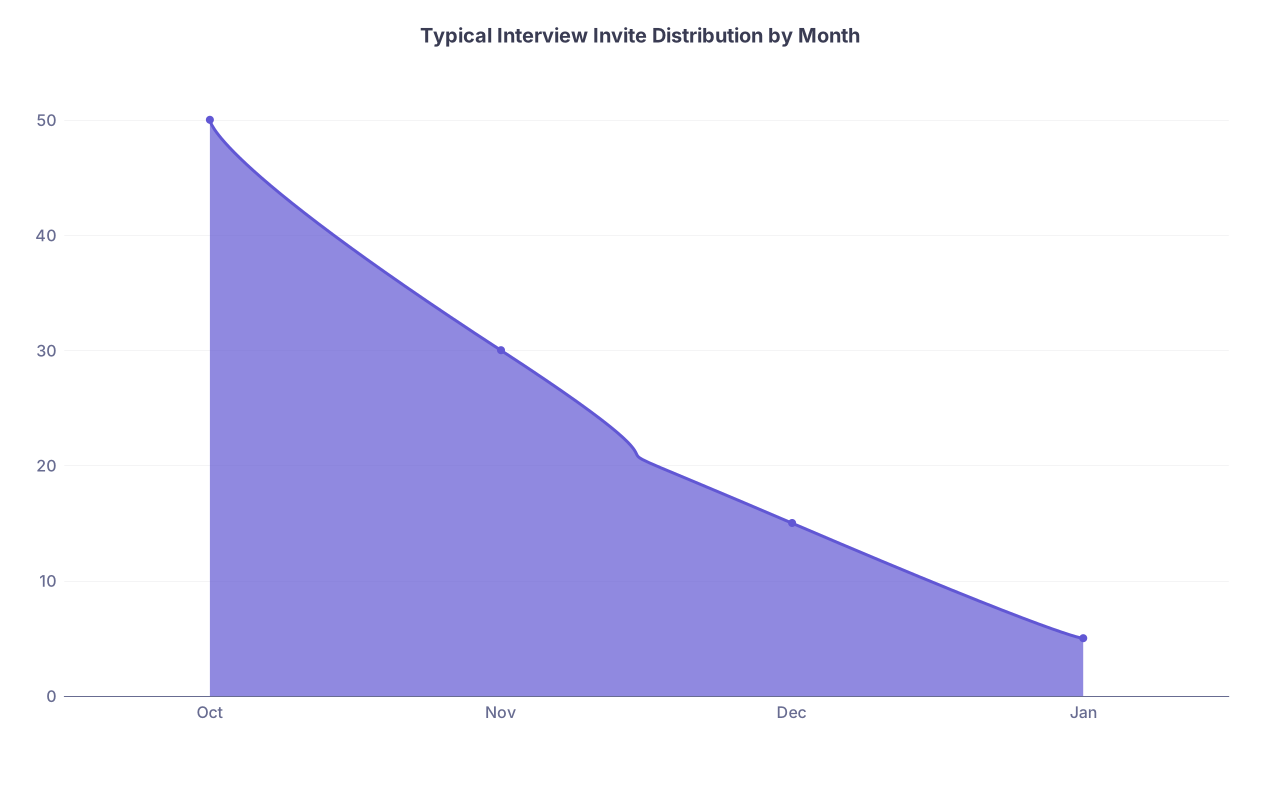
Interview invites for most core specialties cluster October–December. With a low Step score, your goal is to:
- Get enough interviews (not perfection; survival).
- Convert every single one into a strong impression.
- Keep pushing for late-cycle opportunities.
| Category | Value |
|---|---|
| Oct | 50 |
| Nov | 30 |
| Dec | 15 |
| Jan | 5 |
October: Track Invites and Adjust
At this point you should:
Have some response signal by late October
- If you have 3–5+ invites by late October for IM/FM/psych with a low score, you’re on track.
- If you have 0–1 invites: you are in trouble and need to escalate.
Week-by-week if invites are low (≤2 by Oct 25)
Week of Oct 15:- Ask PD/mentor to re-advocate for you to another batch of programs.
- Consider adding a few additional lower-tier/safety programs if ERAS allows (SOAP-friendly community programs, prelim years, etc.).
Week of Oct 22:
- Send a second, more direct email to 10–15 programs you’re genuinely willing to join:
- Briefly acknowledge you understand you are a borderline applicant.
- Emphasize your willingness to work hard, your fit for community settings, or underserved focus if true.
- Attach an updated CV if you’ve added anything meaningful.
On every actual interview
With a low score, the in-person impression is your main weapon:- Be very clear, verbally, that you know your score is not your strength but your bedside manner, team orientation, and reliability are.
- Ask grounded, program-specific questions to show you care about fit, not just a match anywhere.
November: Consolidate and Nudge
At this point you should:
Keep a running spreadsheet with:
- Programs applied.
- Status: silence / rejected / interview offered / interview completed.
- Connections used: PD call, faculty email, alumni, etc.
Mid-November update emails
Send short updates to:- Programs where you interviewed and are genuinely interested.
- A small set of programs that haven’t responded but are high on your list.
Content ideas:
- New rotation evaluations (strong comments, honors).
- New poster, abstract, or research submission.
- Step 2 score if it is a meaningful improvement over your Step 1 narrative.
Avoid the “I’ll rank you highly” trap
You can say:- “Your program remains one of my top choices.”
- Do not lie with “You are my number one” to five places; PDs talk.
December: Last Wave and Backup Planning
By mid-December, patterns are clear.
At this point you should:
Count your interviews honestly
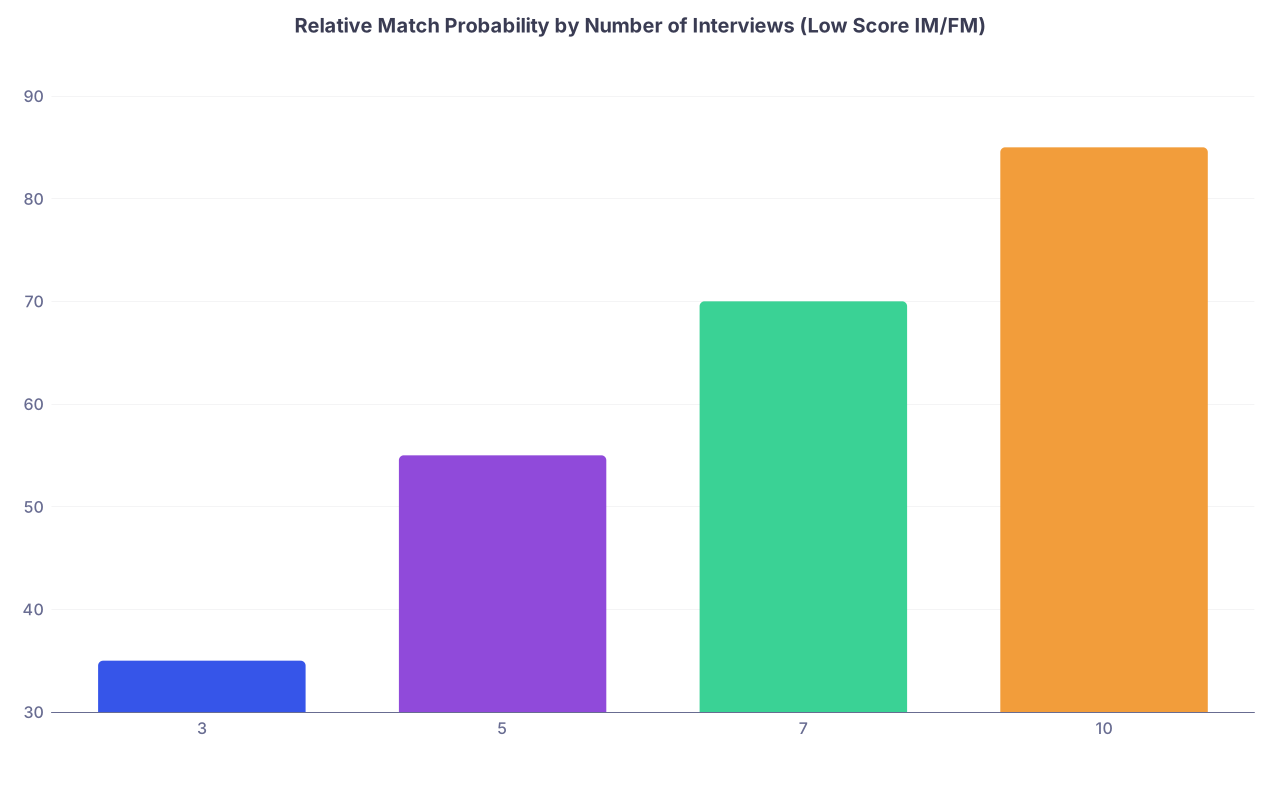
Rough ballpark (not guarantees):- IM/FM/psych with low score, US MD:
- 8–10+ interviews – cautiously optimistic.
- 5–7 – possible but risky.
- ≤4 – high risk of not matching.
- IM/FM/psych with low score, US MD:
If you’re under 6 interviews by mid-Dec: build explicit backup
- Consider ranking prelim IM or transitional year programs.
- Discuss with your school’s advisor:
- Possibility of a research year, extra clinical year, or re-application plan.
- What you need to change if this cycle fails (Step 3, new letters, different specialty).
Send one last wave of “continued interest” emails to:
- Community programs that tend to interview late or fill gaps in January.
- Places where you have a realistic geographic tie.

January: Late Interviews, Reality, and Early Rank Thoughts
January is mop-up time. Programs fill holes. You may get random late invites. You also need to mentally prepare for SOAP risk without spiraling.
At this point you should:
Respond instantly to any late invites
- Same day, ideally same hour.
- Low-scoring applicants are often filling cancellations and last-minute needs; hesitation kills chances.
Have the SOAP conversation with your dean or advisor
Even if you end up matching, you’ll be glad you planned:- What specialties you’d SOAP into.
- Whether prelims are acceptable.
- Which geographic areas you’d prioritize in SOAP.
Start your internal rank-ordering framework
Not the final list yet, but ask:- Where did I feel treated as a genuine candidate, not a pity interview?
- Which programs clearly handle a range of resident strengths and weaknesses well?
- Where did I see residents who look like me (background, trajectory, non-perfect scores)?
February: Rank List Construction – Strategy Over Ego
This is where low-score applicants sometimes self-sabotage. They create aspirational lists that do not match reality. You cannot afford that.
Early February: Drafting the List
At this point you should:
- List every program that interviewed you in genuine preference order, ignoring:
- What you think they thought of you.
- Who seemed “too good” for your score.
Match rules are clear: you should rank programs in the order you’d actually want to go, period. The algorithm favors your preferences, not the program’s.
Then, with a low score, apply three filters:
Delete programs where you would truly rather SOAP or go unmatched than attend.
Rare, but they exist: toxic cultures, illegal questions, clear red flags.Elevate programs that showed particular warmth or advocacy.
Any place where:- PD explicitly acknowledged your non-ideal score and still seemed enthusiastic.
- Residents told you they successfully trained people coming in with weaknesses.
Mark safety vs reach among your interview list.
- Community-heavy, IMG/DO-friendly, lower fill rates last year → more likely to rank you high.
- Elite academic with 10 interview days and a packed zoom schedule → less likely.
Mid–Late February: Finalizing and Gut-Check
At this point you should:
Review the list with a brutally honest advisor
Not your best friend. Someone who places residents every year:- Show them your scores and list.
- Ask bluntly: “Does this list give me the best chance to match at a place where I can grow?”
Resist the temptation to sandbag yourself
Common low-score mistake:- “They were too nice; they must be playing me.”
- “I should rank the ‘easier’ program higher even though I liked it less.”
Correct principle:
- Rank by your true preference, after you’ve made sure every program on the list is realistic and not a fantasy.
Certify your list early, then adjust only if absolutely needed
Do not wait until the last hour. Systems crash, people panic, you make dumb changes.
| Category | Value |
|---|---|
| 3 | 35 |
| 5 | 55 |
| 7 | 70 |
| 10 | 85 |
March: Final Weeks Before Rank List Deadline
The last days before the rank list deadline are for small adjustments and emotional control, not desperate tactics.
At this point you should:
Double-check:
- All programs on your list are ones where you interviewed.
- You did not accidentally leave off a strong fit because of some minor annoyance.
- You did not include prelim-only programs among categoricals by mistake.
Send at most one genuine “I will rank you number one” letter
Only if:- You truly intend to rank them first.
- You believe they might actually care.
- Your advisor doesn’t warn you they ignore such letters.
Keep it short, concrete, and honest.
Stop tinkering
Endless micro-adjustments often reflect anxiety, not strategy. Once:- You’ve ranked according to true preference.
- You’ve removed any fantasy or no-way programs.
- You’ve had an advisor gut-check it.
You’re done. Do not recertify five more times.

How This Timeline Changes If You’re Really On Fire Late
If, somehow, you get your Step 2 back mid-season and it’s a big jump (e.g., Step 1 fail, Step 2 = 235+), then:
- Immediately:
- Update ERAS.
- Email every program you applied to with the new score and a brief note.
- Ask mentors to resend advocacy messages with the updated info.
- You may pull in a small second wave of interviews December–January. It’s not magical, but it helps.
If your Step 2 is also low, though, don’t pretend you’re in this scenario. Your value proposition is: stable, hardworking, low-drama resident who won’t scare attendings on call. That sells in more places than you think.
Last Word: What Actually Moves the Needle
You’ve just walked the full season from ERAS opening to rank list deadline with a low Step score. If you remember nothing else:
- Early, realistic strategy beats late, hopeful scrambling. Build your list and narrative before ERAS opens; do not improvise in October.
- Proactive communication matters more when your score is weak. Thoughtful emails, mentor advocacy, and timely updates are not optional extras for you.
- Rank with your head and your gut, not your ego or your fear. Only realistic programs on the list, then true preference order. That’s how the algorithm can still work in your favor, even when your score does not.