
The week you receive a low Step score is the week your Match strategy either hardens or collapses. What you do in the next 14 days will matter more than the score itself.
I’ve watched students with ugly numbers walk into solid matches because they moved fast, got honest, and adjusted. I’ve also seen people stall for three weeks staring at the score report, then try to “wing it” with applications. Those are usually the SOAP stories.
Here’s the 14‑day response plan. By day, almost by hour. Follow it and you give yourself a real shot.
Day 0–1: Shock Control and Reality Check
Hour 0–4: Immediate aftermath
You open the score. It’s bad. For context, “low” usually means:
- Below your specialty’s average (often < 220–225 for competitive fields if Step 1 is still numeric, or a near-pass/fail for pass/fail schools)
- Clearly below your own practice exam range
- Below posted “preferred” or “average” scores on program websites
At this point you should not:
- Email program directors in a panic
- Rewrite your whole specialty plan in 10 minutes
- Open ERAS and start deleting programs randomly
At this point you should:
Take a controlled 2–4 hour break
- Leave the house. Walk. Call one trusted person who won’t catastrophize.
- No Reddit. No SDN “what are my chances” doom scrolling.
Capture the score and context
- Screenshot the report. Save it to a “Residency 20XX” folder. You’ll need details later.
- Note:
- Your test date
- Score breakdown (if provided)
- Any exam-day issues (illness, disruptions, etc.) — write them down while fresh.
Evening of Day 0: First pass reality check
At this point you should get a basic read on how bad this is for your goals.
- Pull up a quick score vs specialty reality snapshot:
| Specialty | Very Competitive Range | Average Match Range | “Red Flag” Zone* |
|---|---|---|---|
| Dermatology | 245+ | 235–245 | < 230 |
| Orthopedics | 245+ | 235–245 | < 230 |
| General Surgery | 235+ | 225–235 | < 220 |
| Internal Med | 225+ | 215–225 | < 210 |
| Family Med | 215+ | 205–215 | < 205 |
*Red flag zone ≠ impossible. It means you need a plan, not vibes.
- Ask yourself 3 questions:
- Is my current target specialty one of the top 3 most competitive?
- Is my score clearly below the average for that specialty?
- Is there another specialty I’d be genuinely willing to pursue?
Do not make final decisions yet. Just get oriented.
Day 1: Data Gathering and Confidential Reality Check
Day 1 is not for feelings. It’s for data.
Morning: Get honest numbers
At this point you should:
- Pull objective data:
- Latest NRMP “Charting Outcomes in the Match”
- FREIDA or program websites for your target specialties
- Your school’s internal match data if available
Look specifically at:
- Step score ranges for matched vs unmatched
- How much your score deviates from:
- Your chosen specialty average
- Your school’s typical matched applicants in that specialty
- List your compensating strengths:
- Class rank / clerkship grades (Honors vs Pass)
- Research output (number of pubs/posters, especially in specialty)
- Strong home program or away rotations with good feedback
- Leadership, unique background, prior career
Write these in one place. You’re building your “application counterweight” list.
Afternoon: Talk to two real humans (not 20)
At this point you should schedule two conversations:
Specialty mentor (if you have one in your field)
- Ask directly:
- “With a Step score of X, at [Our School], realistic paths in [Specialty]?”
- “What profiles have you seen match with similar numbers?”
- You want unfiltered examples, not platitudes.
- Ask directly:
Dean / advising office / learning specialist
- They’ve seen this before. Ask:
- “Where did students with similar scores match?”
- “What immediate steps did the successful ones take within 2 weeks?”
- They’ve seen this before. Ask:
Do not crowdsource this to 10 different people. You’ll just get contradictory noise and freeze.
Day 2–3: Decide Your Path A vs B (Specialty Strategy)
These two days are decision days. No endless “we’ll see how it goes.”
Day 2: Map your two-track options
At this point you should sketch two honest paths:
- Path A: Stay with target specialty (if at least plausible)
- Path B: Shift to a less competitive but acceptable specialty
Be blunt. For each path, list:
- Competitiveness of the specialty
- Number of programs you could reasonably apply to
- Strength of your story for that specialty
Then categorize your current score vs target specialty:
| Score vs Specialty | Interpretation | Default Plan |
|---|---|---|
| Within 5–10 pts | Weak but salvageable | Stay in specialty, apply broadly |
| 10–15 pts below | Very high risk | Dual apply or adjust specialty |
| >15 pts below | Extremely high risk | Strongly consider specialty change |
Day 3: Commit to one of three strategies
By the end of Day 3, you must choose:
Strategy 1: Stay the course, single specialty
You choose this if:- Score is low but not catastrophic for that field
- You have strong grades, strong letters, real interest
- You’re willing to apply very broadly and maybe include community programs
Strategy 2: Dual application
You choose this if:- Your dream field is now “reach-only” but not impossible
- You’re genuinely ok matching into backup field
- You can tailor separate personal statements and letters
Strategy 3: Pivot specialty
You choose this if:- Your score is way below realistic for original field
- You have or can quickly build a coherent story for another field
- You’d rather match in a different specialty than SOAP in your dream
Write your choice down. Tell at least one advisor. Decision time is over.
Day 4–5: Immediate Application Strategy Overhaul
Now you adjust the actual mechanics: programs, geography, ERAS content, timing.
Day 4: Program list triage
At this point you should:
Audit your preliminary program list (if you have one)
- Mark each program as:
- Green – Your score is at or near their posted / typical range
- Yellow – You’re below but have a strong hook (home rotation, strong connection, research there)
- Red – You are far below with no hook
- Mark each program as:
Expand or restructure based on your strategy:
If staying same specialty:
- Add community and mid-tier university programs
- Target places with:
- No explicit score cutoffs on website
- Mission-driven or IMG-friendly (they often look holistically)
If dual applying:
- Build two complete lists:
- Reach specialty (lean heavier on places you have any tie to)
- Safety/medium specialty (broad list, no ego)
- Build two complete lists:
If pivoting:
- Ask advisors for a starter list of realistic programs
- Look for:
- Programs that have matched prior students like you
- Locations you have geographic ties to (matter more with a weaker score)
Set target application volumes:
| Scenario | Programs in Main Specialty | Programs in Backup Specialty |
|---|---|---|
| Single, less competitive field | 35–60 | N/A |
| Single, moderately competitive | 60–80 | N/A |
| Dual apply (competitive+backup) | 25–40 competitive | 40–60 backup |
These are not rules, but they’re closer to reality than “I’ll apply to 20 derm programs and manifest it.”
Day 5: Rewrite your story (personal statements + ERAS)
At this point you should begin rewriting application content with your score in mind.
No, you don’t write “I know my Step score is low” in your personal statement. You do:
Emphasize non-score strengths:
- Specific clinical moments that show maturity and judgment
- Long-term commitment to the specialty
- Resilience, but framed through action (what you did next), not just suffering
Clean up ERAS:
- Make your experiences and leadership obvious and readable
- Push your strongest, most specialty-relevant work to the top
- Clarify continuity: if you’ve been consistent in your field for years, highlight it
Start thinking about a separate personal statement if dual applying:
- One that reads as 100% authentic for each field
- No generic “I love patients and procedures and continuity and surgery and clinic” mush
Day 6–7: Letters, Remediation, and Step 2 (If Applicable)
This is where you stabilize your academic profile and set up your “counterpunch”: strong letters and, if relevant, a Step 2 showing.
Day 6: Letters and advocates
At this point you should:
Identify 3–4 strongest potential letter writers:
- At least one in your chosen specialty
- People who actually know you clinically, not just “he did fine on my service”
- Ideally someone with program leadership weight (PD, APD, clerkship director)
Reach out with a focused ask:
- Explain briefly:
- You received your Step score
- You’re still committed to X specialty (or dual applying)
- You’d be grateful for a strong letter supporting your application
- Provide:
- Your CV
- A short paragraph on why that specialty/what you did on their service
- Any specific strengths you hope they’ll mention (work ethic, clinical reasoning, etc.)
- Explain briefly:
You want letters that actively counterbalance the test performance: “Despite a lower Step score, this student consistently performed at the level of our top residents.”
Day 7: Step 2 strategy (if still in play)
If you haven’t taken Step 2 yet, this day is crucial.
At this point you should decide:
- Do you need to delay, advance, or keep your planned Step 2 date?
General rules:
- If your Step 1 is low and Step 2 is in 10–14 days and your practice scores are weak → strongly consider delaying.
- If programs in your desired specialty now routinely require Step 2 before ranking → you want a solid Step 2 in before interview season.
You should:
Look at last 2–3 practice NBME/CCSSA scores:
- Are they at least 10–15 points higher than your Step 1 equivalent?
- If yes, you can plan on Step 2 being a weapons-grade repair tool.
- If no, you may need a longer timeline and a separate remediation plan, even if it pushes close to application.
Decide on one of three Step 2 timelines:
- Aggressive fix: Take Step 2 early with focused prep to show clear improvement by ERAS submission
- Stabilize then test: Take extra weeks to get practice scores up, even if Step 2 score comes later in season
- Already done: If Step 2 is already better than Step 1, you highlight it everywhere. Great, one less fire.
Day 8–10: Targeted Outreach and Application Polishing
Now you’ve decided your path. Time to make yourself visible and coherent.
Day 8: Strategic networking (not spam)
At this point you should:
Map out 5–10 priority programs:
- Home program
- Places you rotated
- Places with strong geographic ties (grew up there, family there, med school there)
- Programs known for taking a chance on applicants with non-perfect metrics
For each priority program, decide if outreach is appropriate:
- If you’ve rotated there / know faculty → yes, reach out
- If you have zero connection → usually let ERAS do its job first; don’t cold email every PD on earth
Example outreach (to someone who knows you):
- Brief update about your plan and specialty commitment
- Acknowledgment that your Step score doesn’t fully reflect your clinical performance
- Ask if they have any advice for how best to present yourself to their program
Do not send an email whose subtext is: “Will you overlook my score and interview me?” That’s not how this works.
Day 9: Draft your “score explanation” narrative
Some of you will need to explain the score somewhere:
- Dean’s letter/MSPE addendum
- Personal statement addendum (not the main body)
- Interview responses
At this point you should write a 3–4 sentence version of your story:
- 1 sentence: Acknowledge the result factually, no drama
- 1–2 sentences: Brief context (only if legitimate: illness, major life event, documented learning condition)
- 1–2 sentences: Concrete actions taken since (Step 2 prep, study strategy overhaul, strong clinical performance)
What you do not say:
- “The test was unfair”
- “I’m just not a good test taker” full stop
- A long emotional saga
Short. Mature. Focused on growth.
Day 10: Polish ERAS and finalize program tiers
At this point you should:
- Finish personal statements (one or two, depending on strategy)
- Tighten your experience descriptions:
- Use specific outcomes and responsibilities
- Front-load specialty-relevant tasks and accomplishments
- Finalize your Green/Yellow/Red program categorizations and make sure:
- You have enough Green and Yellow to generate interviews
- You’re not wasting half your applications on fantasy Red programs that never invite someone with your numbers
Day 11–12: Interview Mindset and Contingency Planning
The score is not going away. You need to be ready to face it in conversation and mentally.
Day 11: Build your interview response scripts
At this point you should assume you’ll be asked some version of:
- “Can you tell me about your Step score?”
- “Is this score reflective of your abilities?”
- “What did you learn from that experience?”
You should prepare:
Your Score Story (60–90 seconds max):
- Acknowledge
- Brief context (if any)
- Emphasize what you changed and how that shows up now (clinical performance, Step 2, feedback from attendings)
Your Resilience Example:
- A story of bouncing back from a setback in clinicals, research, or life
- Not melodrama, just proof you don’t fold under pressure
Practice these out loud with a friend or advisor. Rambling here kills you.
Day 12: Hard backup thinking
No one likes this part, but ignoring it doesn’t make it less real.
At this point you should sketch:
- If I don’t match:
- Am I willing to do a research year?
- Would I reapply, and in what specialty?
- Are there prelim / transitional year options I’d consider?
You are not manifesting failure. You are insulating your future self against panic.
Day 13–14: Final Checks and Psychological Reset
Application strategy is now set. The last 48 hours are about control and stability.
Day 13: Final application audit
At this point you should:
Re-read every major component once with your score in mind:
- Does your personal statement implicitly support why someone with your metrics is still a strong pick?
- Do your experiences show real responsibility and growth?
- Are there glaring contradictions or fluff?
Confirm logistical details:
- Letters actually requested from the right people and assigned correctly
- Program list saved and backed up
- Step 2 date (if upcoming) confirmed and on your calendar with a realistic study plan
Show your complete application to one savvy reviewer:
- Faculty advisor, PD, or experienced mentor
- Ask specifically: “Given my Step score, does this application make the strongest case possible?”
Day 14: Mental reset and forward focus
The last day of this 14‑day sprint is not for more tinkering. It’s for resetting your head.
At this point you should:
- Accept that your score is part of your story, not the whole thing
- Commit to:
- Showing up maximally on rotations
- Crushing Step 2 if still pending
- Being the most prepared version of yourself on interview day
You stop letting this one number dictate your self-worth and start treating it like any other problem in medicine: assess, plan, execute, adjust.
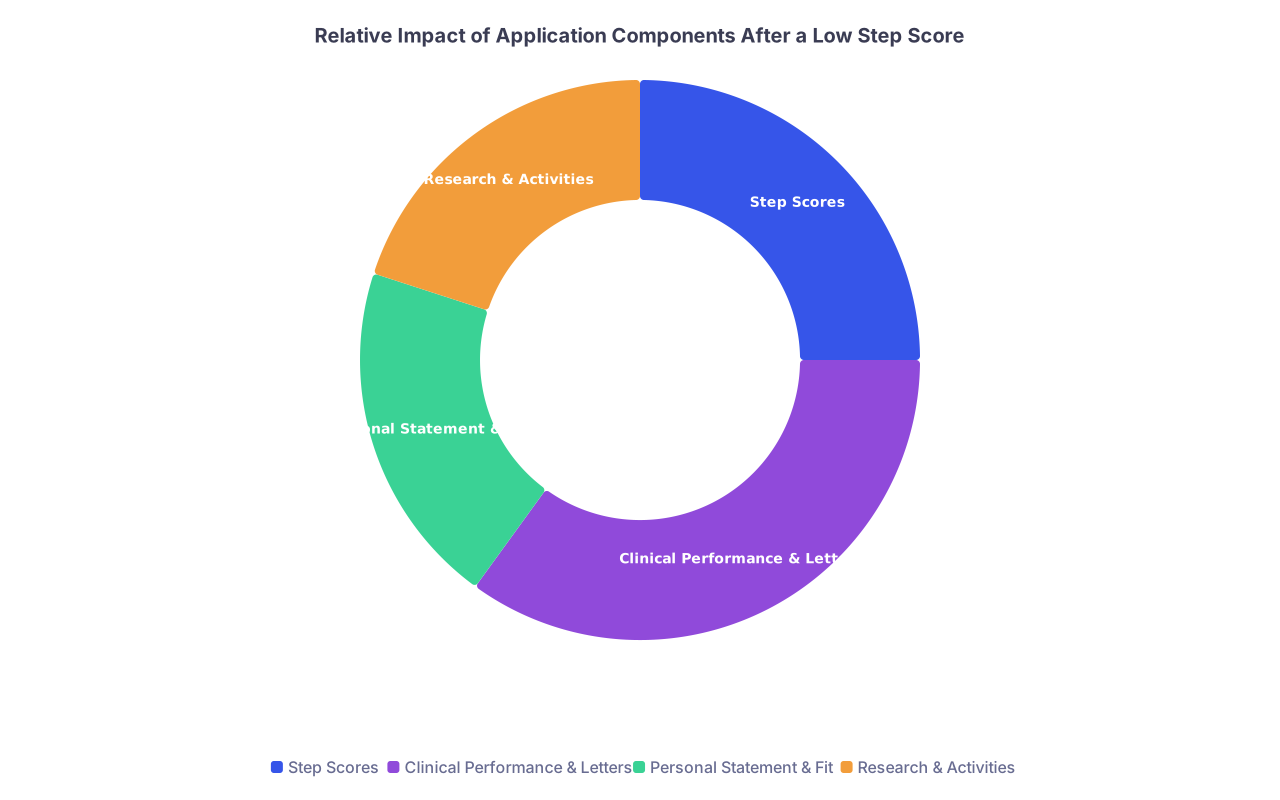
| Category | Value |
|---|---|
| Step Scores | 25 |
| Clinical Performance & Letters | 35 |
| Personal Statement & Fit | 20 |
| Research & Activities | 20 |
Quick Timeline Recap: 14-Day Response Plan
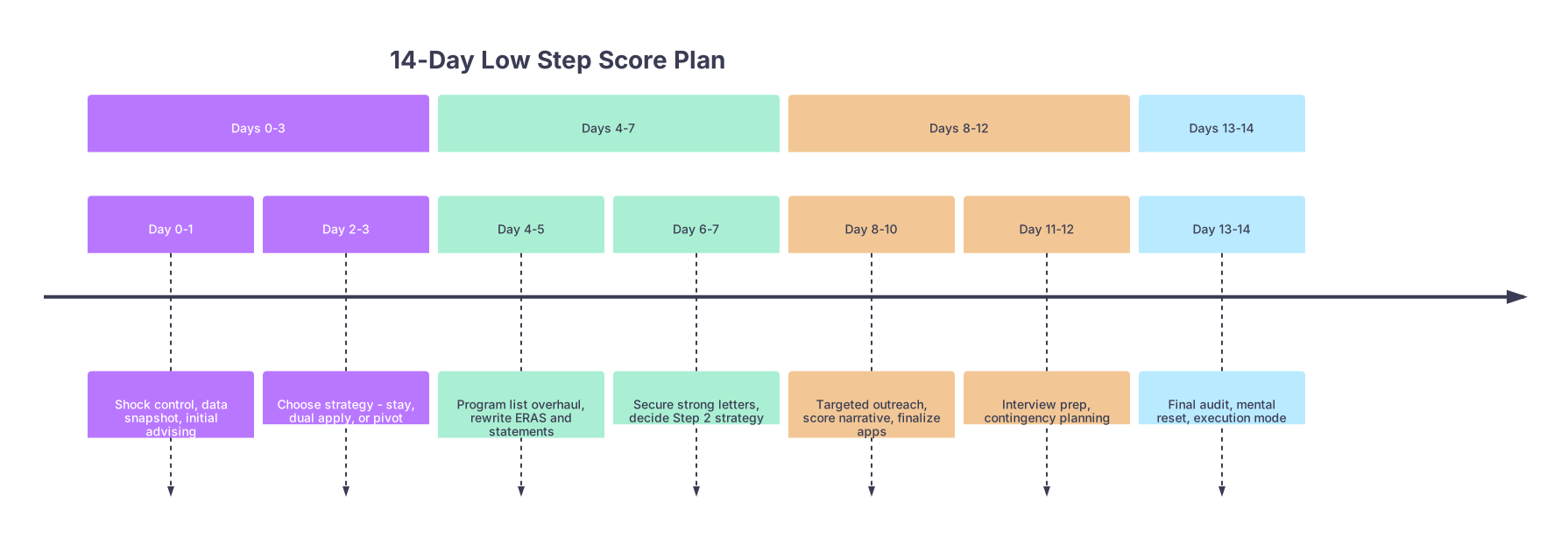
| Period | Event |
|---|---|
| Days 0-3 - Day 0-1 | Shock control, data snapshot, initial advising |
| Days 0-3 - Day 2-3 | Choose strategy - stay, dual apply, or pivot |
| Days 4-7 - Day 4-5 | Program list overhaul, rewrite ERAS and statements |
| Days 4-7 - Day 6-7 | Secure strong letters, decide Step 2 strategy |
| Days 8-12 - Day 8-10 | Targeted outreach, score narrative, finalize apps |
| Days 8-12 - Day 11-12 | Interview prep, contingency planning |
| Days 13-14 - Day 13-14 | Final audit, mental reset, execution mode |
Final Takeaways
- The score is fixed; your response is not. The first 14 days determine whether this number defines you or just complicates your story.
- Decide quickly, then act methodically: specialty strategy by Day 3, program list and letters by Day 7, polished application and interview narrative by Day 14.
- Programs will forgive a low score much faster than they’ll forgive a scattered, reactive, or incoherent application. Your job in these two weeks is to be the opposite of that.