
The worst advice low Step score applicants get is “just hope Step 2 goes better and apply broadly.” That is how you end up unmatched.
You do not need hope. You need a fourth‑year schedule that is weaponized for your situation—built month by month, then week by week, with zero wasted moves.
I am going to walk you through that.
Big Picture: What Fourth Year Must Do For A Low Step Applicant
At this point you should be brutally clear about your priorities. With a low Step 1 and/or Step 2, your fourth‑year schedule is not about “exploration” or “broad exposure.” It has three jobs:
- Give programs a new data point that proves you are not your Step score (Step 2 if not taken, strong clinical grades, honored sub‑Is).
- Put you physically in front of programs that might rank you (audition/sub‑I rotations).
- Protect you from catastrophic errors: late Step 2, no home rotation in your chosen specialty, or a schedule that screams “this person is not serious.”
Here is how the time generally breaks down, assuming a traditional July–June M4 year and a low Step score (Step 1 or 2).
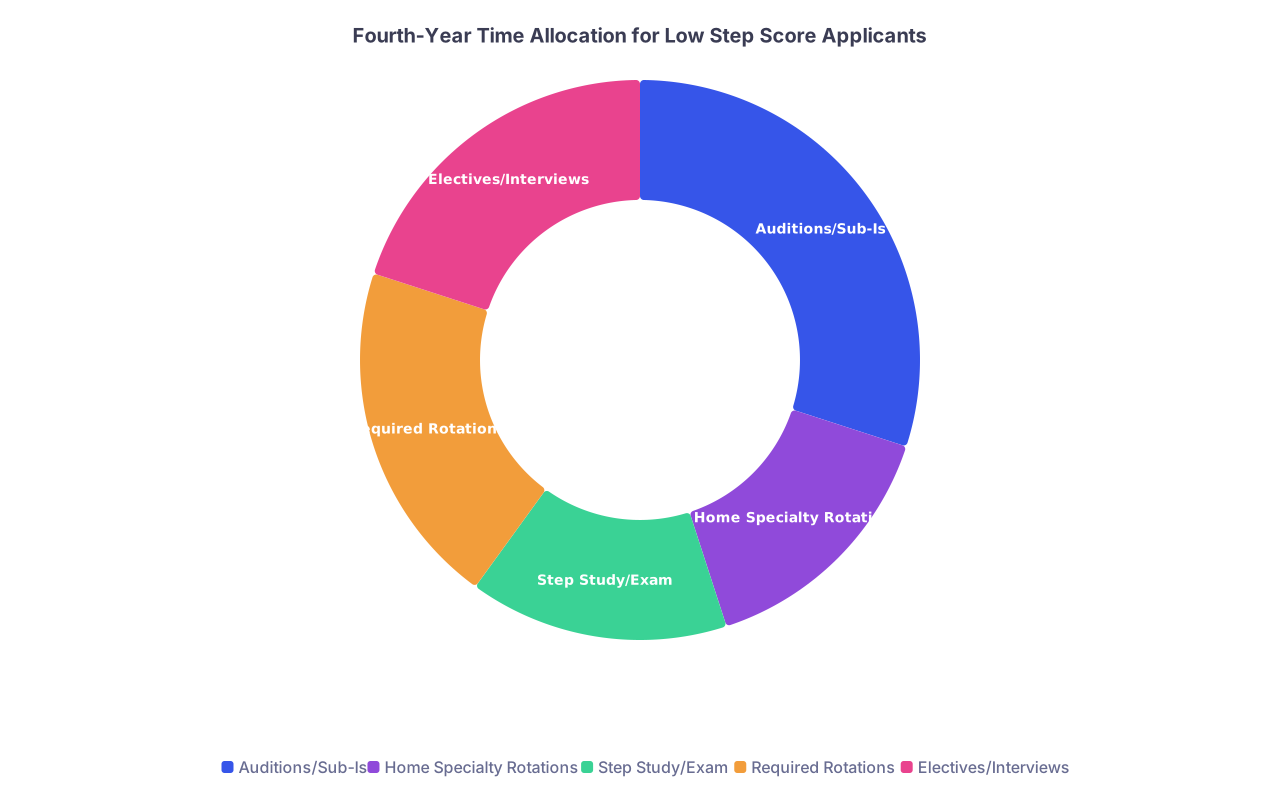
| Category | Value |
|---|---|
| Auditions/Sub-Is | 30 |
| Home Specialty Rotations | 15 |
| Step Study/Exam | 15 |
| Required Rotations | 20 |
| Electives/Interviews | 20 |
If you are already in the middle of fourth year, fine. Start from the current month and compress what you can. But do not skip the early planning logic; it still applies.
12–9 Months Before ERAS Opens (Oct–Dec MS3): Choosing Specialty + Mapping Risk
At this point you should not be “seeing what feels right.” You should be deciding where you are competitive given your score.
Step 1: Reality check your competitiveness
Pull your Step scores, class rank, and clinical performance so far. Then sit down with an advisor who actually matches people in your target specialty (not a generic faculty mentor who says “you’ll be fine”).
You want a table like this on paper:
| Specialty Type | Step 1/2 Expectation | With Low Step You Should… |
|---|---|---|
| Hyper-competitive (Derm, Ortho, Plastics) | 240+ or 245+ historically | Seriously consider backup or dual apply |
| Mid-competitive (EM, Anesthesia, Radiology) | ~230–240 range | Target lower-tier, community, dual apply |
| Broad fields (FM, IM, Peds, Psych) | Flexible, program dependent | Still need smart scheduling and Step 2 |
If your Step score is clearly below the median for your dream specialty, you have two choices:
- Build a two-lane plan (primary specialty + realistic backup).
- Or radically upgrade the rest of your application: Step 2, sub‑Is, letters, and program list discipline.
Doing nothing and “seeing what happens” is how unmatched stories start.
Step 2: Identify “must‑have” rotations
By December of MS3, you should have a draft list of:
- 1–2 sub‑internships (sub‑Is) / audition rotations in your chosen specialty.
- 1 home rotation in that specialty if your school has it (non‑negotiable).
- Required rotations you still owe (ICU, EM, ambulatory, etc.).
- A Step 2 window that gives you a score before ERAS submission and ideally before most programs screen.
Write these on a blank July–June calendar. This becomes your master plan.
8–6 Months Before ERAS Opens (Jan–Mar MS3): Slotting Rotations + Step 2 Plan
At this point you should be converting wishful thinking into an actual fourth‑year schedule request.
Step 3: Decide when you will take Step 2
With a low Step 1, Step 2 is not an afterthought. It is damage control.
You want Step 2:
- Taken by late June or July.
- Score back before or near ERAS opening (September).
This means:
- Dedicated study: 4–6 weeks, or 2–3 lighter rotations with intense evenings if you learn well that way.
- No heavy sub‑I or demanding ICU during your final Step 2 push.
A sane pattern for many low‑Step applicants:
- April–May: lighter MS3 rotations, start Step 2 question banks.
- June: dedicated Step 2 + scheduled exam.
- Early July: test at the latest if absolutely necessary.
Step 4: Lock in home sub‑I timing
Home sub‑Is (or advanced rotations) matter because:
- They generate your strongest letters.
- They show your own department you are serious.
- They are a “safety net” if you need your home program to rank you highly.
For a low score, the sweet spot for your home sub‑I is usually:
- One block July–September of MS4.
Too early (May–June) and your letter may be written before your Step 2 score or before you have matured. Too late (after October) and the letter may not make it into your initial ERAS file.
Step 5: Identify 1–2 away/audition rotations
You do not need 4 auditions. You need 1–2 carefully chosen away rotations where:
- Your Step score is still within striking distance of their usual range.
- They have a track record of interviewing or ranking rotators.
- The culture is actually tolerable; you cannot hide on a month‑long audition.
Target timing:
- Away #1: August–September (sweet spot).
- Optional Away #2: September–October.
And yes, for very low Step scores, a strong impression on an away can rescue an application at that program. I’ve seen a 215 Step 1 applicant match EM off the strength of a phenomenal July away and top 5% SLOE.
6–3 Months Before ERAS Opens (Apr–Jun MS3): Submitting Requests + Step 2 Prep
At this point you should have formalized rotation requests and be moving aggressively toward Step 2.
Step 6: Submit VSLO / away applications early
For specialties that use VSLO (VSAS), aim to:
- Have materials ready by the day applications open for your specialty (often spring).
- Apply to more aways than you actually need (3–5 to land 1–2).
You will prioritize:
- Programs in geographic regions you truly would attend.
- Mid‑tier and community programs more likely to look past scores.
- Places where your school or advisor has connections.
Step 7: Map Step 2 study weeks
Your calendar from May–July should look something like this:
- May: lighter clinical rotation + 40–60 Step 2 questions per day.
- June: dedicated 3–4 weeks, NBME practice exams each weekend.
- Late June / early July: Step 2 exam.
Do not schedule:
- A sub‑I.
- An ICU month.
- A key required rotation you may fail or barely pass due to burnout.
You are buying a single chance to show programs a better number. Treat it as such.
Month‑by‑Month Fourth‑Year Schedule Blueprint (Low Step Version)
Now the part you wanted: what each month of MS4 should look like.
Assume you start MS4 in July and you are applying to a moderately competitive specialty with a low Step score.
July (MS4 Month 1): Step 2 Score + Warm‑Up Rotation
At this point you should be:
- Either taking Step 2 this month or just finished it end of June.
- Starting an easier or non‑audition clinical rotation (e.g., outpatient, consult service, non‑home elective).
Goals:
- Avoid burning your first month as a sub‑I while you are still mentally fried from Step 2.
- Be available to fix any Step 2 scheduling disasters.
- Start lining up letter writers from MS3 who have not yet written.
Do:
- Email prior attendings: “I am applying in X. Would you be comfortable writing a strong letter?”
- Update CV and draft your personal statement skeleton now; do not wait for September chaos.
August: Home Sub‑I or First Audition
At this point you should be laser‑focused on your most important clinical month.
Options:
- Home sub‑I in your chosen specialty, or
- Away/audition #1 if you are required or strongly encouraged to do one early.
Goals:
- Perform at the level of an intern or near it.
- Ask 1–2 attendings or faculty you work closely with for letters before the month ends.
- Get explicit, actionable feedback halfway through the month and adjust.
You want your August attending saying, “I would be happy to have you as an intern here,” not “You improved by the end.”
September: Away #1 (or Home Sub‑I) + ERAS Submission
At this point you should be balancing two lives: full‑tilt audition rotation and application submission.
Clinical work:
- If August was home, make September your first away.
- If August was away, September can be a home sub‑I or ICU / required heavy rotation only if you already banked a strong letter.
Application work:
- By early September: ERAS ready to submit (personal statement, experiences, program list).
- When your Step 2 score comes back:
- If improved: submit immediately and consider signaling that in communications.
- If not improved: you lean even harder on rotations and realistic program list.
Letters:
- Make sure you have:
- 1–2 letters from your specialty (home + away if possible).
- 1 strong medicine/surgery letter if required.
- Total of 3–4 letters uploaded.
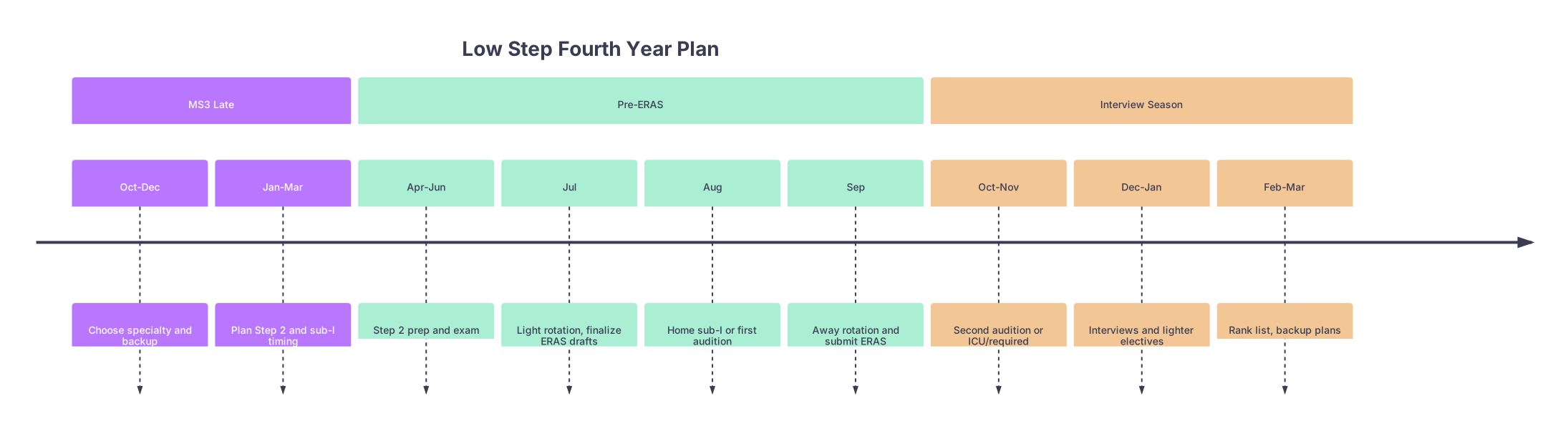
| Period | Event |
|---|---|
| MS3 Late - Oct-Dec | Choose specialty and backup |
| MS3 Late - Jan-Mar | Plan Step 2 and sub-I timing |
| Pre-ERAS - Apr-Jun | Step 2 prep and exam |
| Pre-ERAS - Jul | Light rotation, finalize ERAS drafts |
| Pre-ERAS - Aug | Home sub-I or first audition |
| Pre-ERAS - Sep | Away rotation and submit ERAS |
| Interview Season - Oct-Nov | Second audition or ICU/required |
| Interview Season - Dec-Jan | Interviews and lighter electives |
| Interview Season - Feb-Mar | Rank list, backup plans |
October: Away #2 or High‑Yield Backup Rotation
At this point you should be consolidating your position, not experimenting.
Option A – Second Audition (for some specialties):
- Good if:
- You are dual applying and want exposure in both fields.
- Your first away was at a reach program; this one is more realistic.
- Bad if:
- You are already exhausted and your first away did not go well.
- You still do not have strong letters.
Option B – Required ICU / EM / Ward Month:
- Do this if you still need core requirements.
- Protect your grade (no unforced B/C because you tried to schedule ICU + interviews).
Letters:
- By the end of October, your letter portfolio should be complete or very close.
November: Cleanup Requirements + Start Interviews
At this point you should be entering interview season and avoiding schedule disasters.
Pick rotations that are:
- Local.
- Reasonably chill.
- Flexible with days off for interviews (outpatient, research, non‑critical electives).
Do not schedule:
- A sub‑I.
- ICU.
- Anything where missing 4–6 days for interviews will destroy your eval.
Most low Step applicants will have fewer interviews and more variability in timing. You need the flexibility.
Week‑By‑Week Focus During Key Months
Let’s zoom in on the two highest‑leverage periods: Step 2 month and your main audition month.
Step 2 Dedicated Month (Example: June)
Week 1: Baseline and Plan
- NBME practice exam.
- Daily target: 80–120 questions with full review.
- Fix weak areas, do not chase perfection in topics you already dominate.
Week 2–3: Volume and Discipline
- 100+ questions most days.
- Alternate systems: medicine heavy one day, surgery/peds/OB another.
- One NBME each weekend to track progress.
Week 4: Peak and Taper
- Final NBME 5–7 days before test.
- Identify last‑minute weak spots; do targeted review.
- Do not reschedule impulsively unless scores are catastrophically below your goal and you still have test date flexibility.
Your north star here: show a clear improvement from Step 1, or at least avoid a drop that seals your fate.
Audition/Sub‑I Month (Example: August)
Week 1: First Impressions
- Show up early, know your patients cold.
- Ask residents: “How do evaluations work here? What does a strong student look like?”
- Be aggressively helpful with scut that matters (notes, follow‑up, calling consults with supervision).
Week 2: Establish Reliability
- Present organized, concise plans on rounds.
- Start reading nightly on your patients’ problems.
- Ask once: “If there is anything keeping me from being a top student on this rotation, please tell me early so I can fix it.”
Week 3: Distinguish Yourself
- Take ownership: pre‑round, know labs and imaging before anyone asks.
- Offer short teaching moments: “I read a bit on X; may I share a quick 1‑minute summary?”
- Start identifying 1–2 attendings for letters.
Week 4: Lock In Letters and Reputation
- End‑of‑month meetings: “I am applying in X. Would you feel comfortable writing me a strong letter?”
- Explicitly state your interest in the program if genuine.
- Do not fade at the end. The last week sticks in memory more than you think.
3–1 Months Before Rank List (Dec–Feb): Interview Season Strategy
At this point you should be in pure application‑maintenance mode.
December–January: Interviews + Safe Electives
Your rotations should now be:
- Light (radiology, outpatient, research, non‑intense consults).
- Local (no flights during heavy snow season if you can help it).
- Flexible (they will not fail you for missing 5 days).
On interviews:
- For low Step applicants, every interview is gold. You cannot assume you will get 20.
- Show evidence of:
- Growth since the test.
- Concrete clinical strengths (from sub‑Is).
- Fit for the program’s patient population and setting.
February: Ranking + Backup Contingencies
At this point you should be brutally honest about your list.
- Rank every program where you would actually show up.
- Do not play games with rank order based on gut feelings from residents’ gossip.
- If you get a sense you may have fewer than ~8–10 solid interviews in a competitive specialty, be ready with:
- A SOAP strategy.
- A plan to expand or pivot next year.
Common Fourth‑Year Scheduling Mistakes For Low Step Applicants
I see the same errors repeatedly. You are going to avoid them.
Taking Step 2 too late
Testing in August or September with a low Step 1 and hoping programs “wait for your score” is delusional. Many will not.No home rotation in your specialty
Departments do not go to war for a student they have not seen on their own turf.Four audition rotations “to show interest”
You do not have the stamina, and it robs you of Step 2 time and recovery. Two is usually enough; three max in very audition‑heavy fields.Packing ICU + interviews together
That is how you end up with weak evals and missed interviews. Separate hard months from your peak interview window.Electives that do nothing for your story
A random dermatology elective when you are applying FM with a 212 Step 1 does not help you. Use electives to reinforce your narrative: underserved care, hospitalist interest, primary care, etc.
Sample Fourth‑Year Schedules (Low Step Scenarios)
| Month | IM with Low Step (230) | EM with Low Step (220) | FM with Very Low Step (205) |
|---|---|---|---|
| Jun MS3 | Step 2 dedicated | Step 2 dedicated | Step 2 dedicated |
| Jul | Light elective | EM elective home | FM clinic elective |
| Aug | IM home sub-I | EM away #1 | FM home sub-I |
| Sep | IM away #1 + ERAS | EM home sub-I + ERAS | FM away (community) + ERAS |
| Oct | ICU | EM away #2 | Inpatient FM |
| Nov | Outpatient elective | Outpatient elective | Outpatient elective |
| Dec | Interviews + easy rad | Interviews + easy rad | Interviews + easy rad |
You do not need this exact pattern, but you do need the logic behind it.
Final Focus
At this point, if you take nothing else from this, remember:
- Your low Step score is a fixed liability, so your fourth year must produce new, stronger data: Step 2, sub‑I performance, and letters.
- Timing is not optional. Step 2 by June/July, home sub‑I by August/September, and auditions before October give you the best odds.
- Every month of M4 should have a job. If you cannot state that month’s strategic purpose in one sentence, your schedule is wasting time you do not have.