
What if your low Step score means you’re stuck doing a specialty you hate for the rest of your life?
Because that’s the nightmare loop, right? You miss your target score by 10–20 points, everyone keeps saying “fit matters more than numbers,” but then you look at charts and see competitive specialties with insane averages and you spiral:
“Am I about to spend the next 30 years in a field I never wanted because of one bad exam?”
Let’s walk straight into that fear instead of pretending it’s not there.
First: Can Your Score Actually “Force” You Into a Specialty?
Short answer: not exactly. But it can make some doors harder to open, and that feels the same.
Here’s the uncomfortable truth I’ve seen play out over and over:
- Yes, some specialties are brutally score-driven (derm, ortho, plastics, ENT, ophtho, neurosurg, rad onc).
- Yes, a low Step score can absolutely knock you out of contention for a chunk of those programs, especially the big academic ones.
- No, that does not mean you’re automatically exiled to one specific “backup” specialty forever.
- And no, you’re not locked into a lifetime prison sentence from one 8-hour exam.
Reality is messier than the horror story in your head. Some people with borderline scores match into “reach” specialties with smart strategy. Some pivot specialties and end up genuinely happier. Some do a prelim year or research year and reapply.
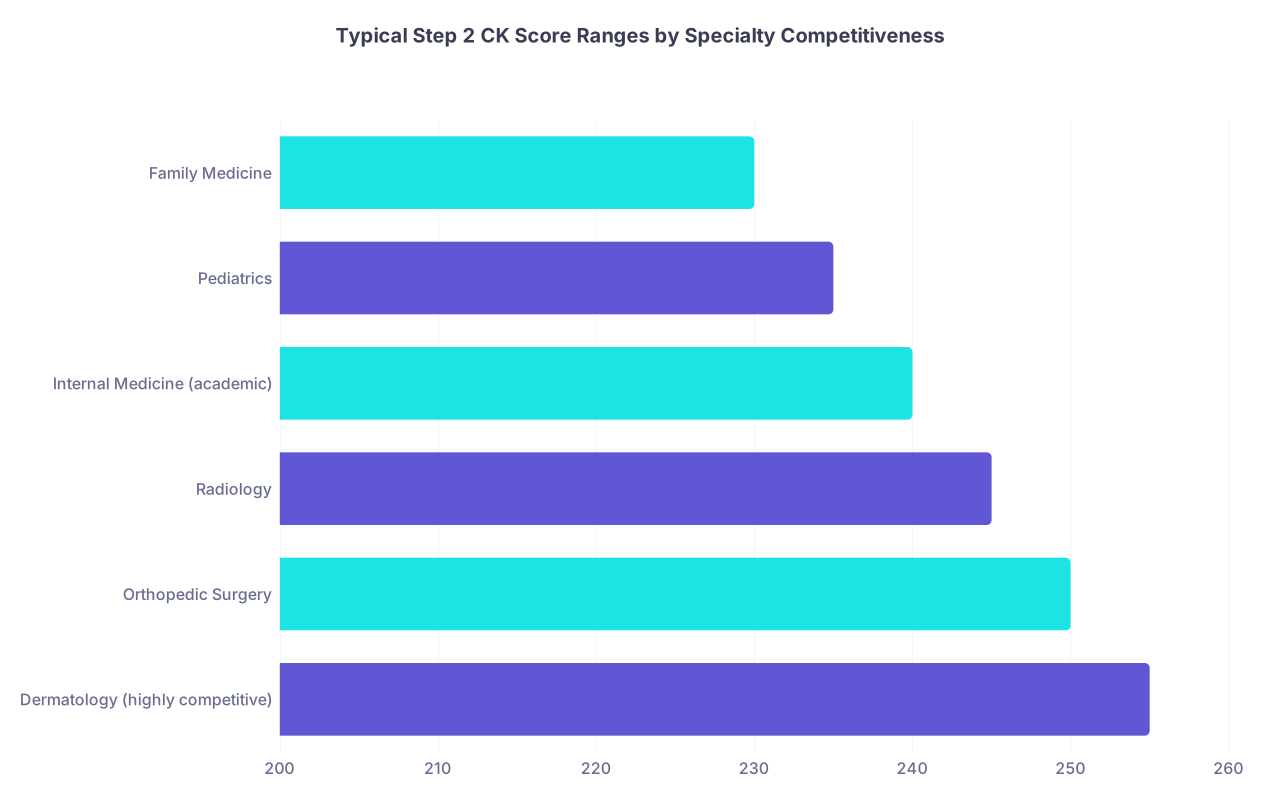
To ground this in something real:
| Category | Value |
|---|---|
| Dermatology (highly competitive) | 255 |
| Orthopedic Surgery | 250 |
| Radiology | 245 |
| Internal Medicine (academic) | 240 |
| Pediatrics | 235 |
| Family Medicine | 230 |
You don’t have to memorize these numbers. Just notice the pattern: yes, some fields skew high. But there’s a range, and there are always people below those medians who still match.
So no, your score doesn’t assign you a specialty like a Hogwarts house. But if you pretend scores don’t matter at all, you’re going to hurt yourself.
Step Back: What Do You Actually Want, Versus What You’re Afraid Of?
Let’s sort your brain out a bit. There are a few different fears tangled together here:
- “I won’t match my dream specialty.”
- “I’ll be forced into a backup I hate.”
- “I’ll be miserable forever because I settled.”
- “Everyone will know I ‘wasn’t good enough’ for the thing I wanted.”
I’ve watched classmates go through all of those. Some ended up in their original dream field after a detour. Some switched specialties during residency. Some discovered that the “backup” specialty they were ashamed to list on their rank list quietly became the thing they loved.
Here’s the part no one tells you: your idea of what you want is often based on tiny exposure + reputation + ego. You see the ortho residents looking confident, the derm lifestyle memes, the CT surgeons with dramatic stories, and you build an identity around that.
But then you actually rotate and realize:
- You hate the surgeries but love the consults.
- Or you thought you needed procedures but actually crave long-term relationships.
- Or you love kids but hate rounding.
- Or the “prestigious” thing makes you miserable.
I’m not going to do the fake-positive “it’s all meant to be” thing. Sometimes a low score is a loss. Sometimes it does close doors you desperately wanted open. That sucks.
But forced misery in a random unwanted specialty for life? That’s not how this usually plays out.
What Low Scores Actually Change in Your Options
Let’s be blunt and specific.
If your Step 2CK score is, say, 220–225, and you’re aiming for:
- Derm at a big coastal academic center
- Ortho at a top-20 program
- ENT or plastics basically anywhere
Then yes, your odds are low. Not impossible in a one-in-a-thousand way, but “you are fighting gravity” level.
Where low scores absolutely matter more:
- Highly competitive specialties
- Highly desirable locations (NYC, SF, LA, Boston, etc.)
- Big-name academic programs
- Programs with heavy applicant volume and lazy filters
Where low scores hurt less than everyone online makes it seem:
- Community programs
- Less saturated geographic regions (Midwest, South, some parts of the Northeast)
- Primary care–leaning fields
- Programs that really know you from rotations / aways
Here’s a very rough mental model:
| Program Type | Impact of Low Step Score |
|---|---|
| Top academic, big city | Very high |
| Mid-tier academic | High |
| Community, desirable area | Moderate |
| Community, less popular area | Lower |
| Home program where known | Sometimes surprisingly low |
So no, you aren’t “forced” into one specialty by your score. But you are pushed toward:
- Broader-acceptance specialties
- Less glamorous locations
- Programs that actually read the rest of your application
If you cling to “prestige or nothing,” then yes, you’ll feel trapped. Because the score has already happened, and the score doesn’t care what you wanted.
Strategy 1: Decide If You’re Adjusting or Letting Go
You don’t need to answer this today. But you do need to ask yourself honestly:
“Do I want this specific specialty badly enough to:
- Move anywhere?
- Do a research year or prelim year?
- Apply very broadly?
- Risk not matching the first try?”
Or do you actually want a certain kind of day-to-day life (procedures vs clinic vs ICU vs continuity) and you could see yourself getting that through multiple specialties?
Example: You wanted ortho because:
- You like procedures
- You like tangible outcomes
- You want to work with athletes
- You like team-based environments
You could get versions of that through:
- PM&R with sports emphasis
- Interventional pain
- Sports medicine via FM or EM
- Even radiology with MSK focus (not the same, but still very much in that ecosystem)
Is it the same as being an orthopedic surgeon? No. But is it “I’m doomed to a specialty I hate forever?” Also no.
If you decide, “I will only be happy as X,” then your strategy becomes high-risk, high-effort, long-game. Lots of research, networking, maybe SOAP-ing into a prelim year, reapplying. That’s valid—but call it what it is.
If you decide, “I need a career that fits my values more than this exact title,” your path widens.
Strategy 2: If You Still Want a Tough Specialty, You Need a Ruthless Plan
If you’re not ready to let go of the dream yet, you can’t just “hope they’ll see past my score.” That’s fantasy.
Here’s what I’ve seen actually move the needle for low-score applicants in tough fields:
Crush clinical performance. Honors on rotations in that specialty and core rotations matter way more when your exam isn’t a selling point. You need attendings to say, “This student works like a resident already.”
Away rotations where they meet you in person. Programs are more willing to overlook a score when they’ve seen that you’re the first to arrive, last to leave, and not a jerk. One lazy or weird day on an away can tank that.
Research with someone respected in that field. Not generic research. Specialty-specific, ideally with outputs (posters, abstracts, anything). Persuading a PD is easier when their colleague says, “This student is the real deal.”
Letters that explicitly confront your score. I’ve read letters where attendings literally wrote, “Ignore the Step score. On our team they outperformed many residents.” That kind of line matters.
Realistic rank list and application spread. You still apply to the reach programs, but you don’t only apply there. You include smaller, less competitive programs and less popular regions.
You’re fighting uphill. But it’s an actual fight. Not a death sentence.
Strategy 3: If You Pivot, How Do You Not Hate Yourself for It?
This is the part no one talks about: the shame.
People pivot to IM, Peds, Psych, FM, Path, etc. and feel like they need to explain: “I wanted X but my Step score…” It becomes this constant whisper.
You’re not crazy for worrying: “Will I just resent this forever?”
Here’s what tends to help people I’ve seen go through it:
Get real exposure to the “backup” specialties. Not just a rushed 2-week rotation. Ask yourself: What kind of patients? What kind of problems? What’s the worst part of the day? Can I live with that?
Look for specialty-adjacent routes.
Missed ENT? What about Pulm/CC, sleep, allergy, intensivist?
Missed ortho? PM&R sports, pain, radiology MSK.
Missed derm? Allergy, rheum, immunology, complex med consults.Focus on what stays the same across specialties. Good colleagues vs toxic ones. Stable schedule vs chaos. Patient population you don’t hate. Autonomy. That stuff often matters more to your quality of life than the exact procedures you do.
Allow grief. You are allowed to be sad about a path you lost. But if you stay stuck in “I settled” mode forever, you’re poisoning your future self. Process it, don’t live in it.
You’d be shocked how many cardiologists originally wanted ortho. How many psychiatrists initially chased neurology or neurosurg. People rewrite their stories. That’s not lying; it’s adapting.
Strategy 4: Worst-Case Scenario Planning (Yes, Let’s Actually Do It)
Your brain is already doing worst-case. Let’s drag it into the light.
Absolute worst common-case scenario with a low score + ambitious specialty:
- You apply to your dream specialty.
- You don’t match.
- You SOAP into a prelim or backup.
- You either:
- Reapply with stronger letters / research / networking, or
- Discover you don’t hate the backup as much as you thought and you stay.
Is it stressful? Yes. Embarrassing at times? Yes. Career-ending? No.
The much rarer disaster scenario:
- You don’t match at all.
- You don’t SOAP into anything meaningful.
- You take a gap year for research or an MPH or something related.
- You reapply to a more realistic specialty with a very heavy safety-net list.
I’ve watched people go through this exact sequence. They were wrecked for a while. Then they matched on the second attempt into something solid. Their day-to-day now? Basically indistinguishable from classmates who “got it right” the first time.
Is the path smooth? No. But are you “forced into a specialty you don’t want” with no agency? Not really. You’re making choices at every step, just with constraints you didn’t ask for.
A Hard Truth You Probably Don’t Want to Hear
Some of this isn’t about specialties at all. It’s about identity.
“So what specialty are you going into?” becomes your personality for a year. People treat derm, ortho, neurosurg, plastics, ENT like Olympic medals. And if your score knocks you out of those circles, you feel…less.
That’s the poison. Not the actual work you’ll do in residency.
Here’s my opinion: chasing a prestige specialty you secretly don’t like—just to feel “enough” again—is way more dangerous than pivoting to something you actually enjoy.
You know what really “forces” people into careers they hate?
- Refusing to give up the image they had of themselves as a certain kind of doctor.
- Ignoring every red flag about their actual preferences because “I already told everyone I’m going into X.”
Your score didn’t choose your specialty. It just changed the menu a bit. You still have to pick something you can stand waking up to.
What You Can Do This Week (Not Someday, Not Vaguely)
Here’s how you stop letting this fear eat you alive and start doing something:

| Step | Description |
|---|---|
| Step 1 | Low Step score anxiety |
| Step 2 | Talk to PD or mentor in that field |
| Step 3 | Explore alternative specialties seriously |
| Step 4 | Plan - research, aways, broad applications |
| Step 5 | Schedule rotations in 2-3 realistic fields |
| Step 6 | Apply with high-risk focused strategy |
| Step 7 | Choose best fit and apply broadly |
| Step 8 | Still want high-competitiveness specialty |
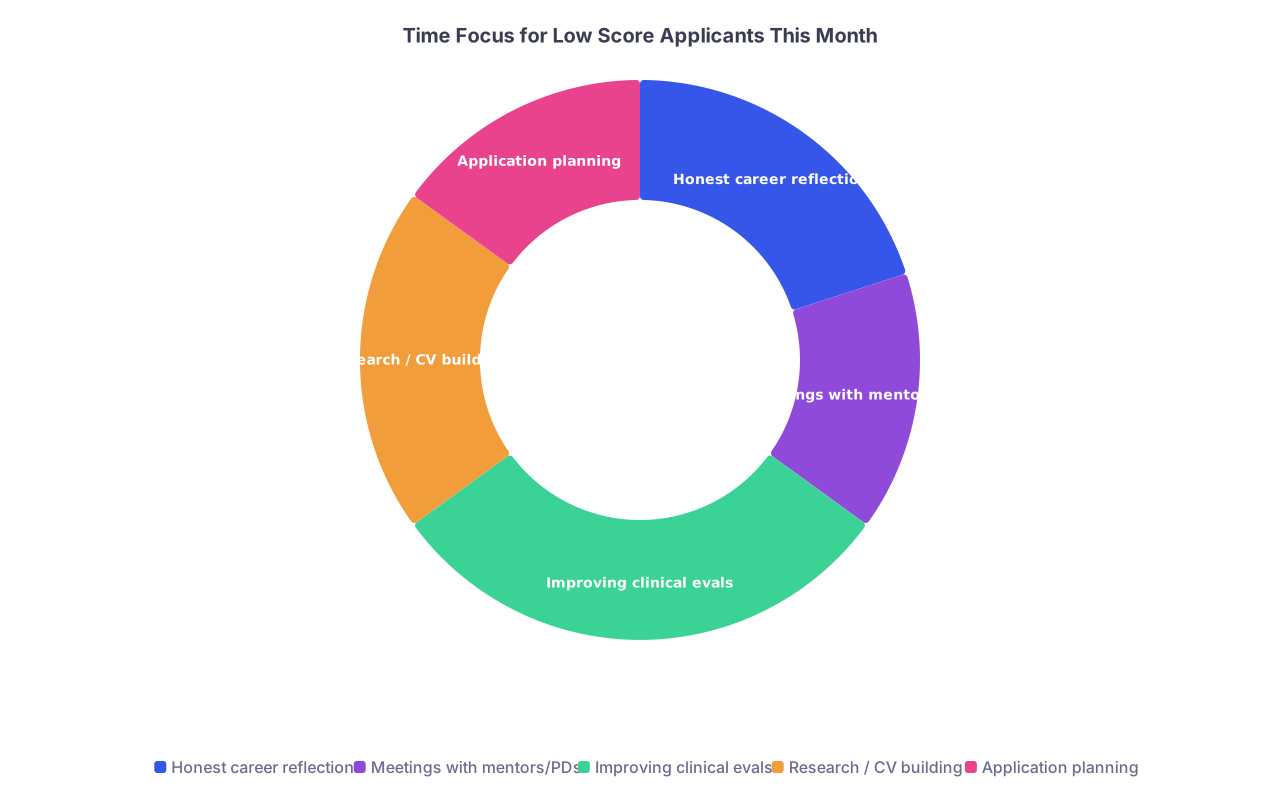
And here’s an action breakdown:
| Category | Value |
|---|---|
| Honest career reflection | 20 |
| Meetings with mentors/PDs | 15 |
| Improving clinical evals | 30 |
| Research / CV building | 20 |
| Application planning | 15 |
Today, you can do at least one of these:
- Email one attending or PD and ask: “Can I get 15 minutes to talk honestly about my Step score and realistic options in your specialty?”
- Pull out your rotation schedule and see where you can add or request time in a potentially realistic specialty.
- Open your CV and start a running list of “Things I offer that my score doesn’t show” so you don’t forget them.
- Look up 5 community or mid-tier programs in your region and actually read their websites, not just the score ranges on forums.
You need information, not more doomscrolling.
FAQ: Low Step Scores and “Being Forced” into a Specialty
1. Is there a specific Step 2CK score that completely kills my chances for certain specialties?
Yes and no. No program will publish “below X means automatic rejection,” but practically:
- Scores under ~220 make things like derm, plastics, ENT, neurosurg, and high-end ortho extremely unlikely at most academic places.
- Between 220–235, you’re on the fringe for many competitive fields, but not universally doomed—especially at smaller or community programs if the rest of your app is very strong.
- Above ~240, your score stops being the main problem; other parts of your app take over.
These are ballparks, not rules. People get in below those numbers. But they’re rare, and almost always have big compensating strengths (research, connections, stellar letters, being known at that program).
2. Should I delay graduation or take a research year because of my low score?
Maybe—but that’s a tactical decision, not an automatic one. A research year makes the most sense if:
- You’re targeting a very competitive field (derm, ortho, ENT, etc.).
- You can actually get meaningful, specialty-specific research with someone known in the field.
- You’re emotionally willing to do an extra year of uncertainty.
If you’re pivoting to something like IM, Peds, FM, Psych, or Path, a research year is less critical unless your whole application is weak. Talk to PDs in the field you’re targeting before making that call. Don’t burn a year just to feel like you’re “doing something.”
3. Will programs automatically filter me out because of my score so no one even reads my application?
Some will, yes. That’s the ugly part. A lot of busy programs use score filters to cut down their piles. But:
- Not every program does this to the same degree.
- Home programs and places where you’ve rotated are more likely to look past the number.
- Community and smaller programs are often more flexible, especially if they’re not getting 1000+ apps.
This is where targeted strategy matters. You can’t brute-force your way into programs that don’t read below a cutoff. But you can focus on the ones with a track record of looking at the whole person.
4. Is it better to apply broadly to my dream specialty or pivot early to a safer one?
If your score is significantly below the usual range for your dream specialty, the “apply only there and hope” strategy is reckless. A more rational path:
- If you’re dead set: apply broadly to the dream specialty and have a parallel backup plan (prelim year, TY, or a more realistic second specialty).
- If you’re ambivalent: seriously explore other specialties now and apply primarily to those, with maybe a small side batch of reach applications.
You’re not proving anything by going all-in and then not matching. You’re just giving yourself fewer options later.
5. Can I switch specialties after starting residency if I hate what I matched into?
Sometimes. People do it every year. But it’s not guaranteed, and it’s usually easier to move from:
- A general field → another general field (IM → Neuro, FM → Psych, etc.)
- A prelim year → another categorical spot
Harder: jumping from something like FM into derm or from pathology into surgery. Programs want evidence you’re suited for the target specialty, and switching can raise questions. It’s doable but messy. Plan as if you’ll be in what you match into, not as if you can easily escape it.
6. How do I stop obsessing over the “what if I’m stuck forever” thought?
You probably won’t completely stop. But you can shrink it by:
- Getting real, specialty-specific information from PDs and residents instead of from Reddit panic posts.
- Shadowing or rotating in at least 2–3 realistic specialties, not just the one you idealized.
- Building a concrete plan (A: aim for dream with specific steps, B: defined backup specialty and programs).
- Remembering that a lot of attendings didn’t end up in the field they first declared in MS2—and they’re not walking around miserable.
The thought “I might be stuck forever” is a story your brain is telling you. Today, right now, you still have choices. Start by making one: email one person, schedule one meeting, or line up one rotation that brings you closer to facts and farther from fear.
Open a blank note on your phone or laptop right now and write down the names of three attendings or residents—any specialty—you trust. Under each name, write one specific question about your score and your options. Then actually send one of those emails today. Not tomorrow. Today.