That 3 AM Panic: Why You're Worrying About Nothing (and Everything)
It's 3:17 AM. You've been staring at your MCAT score report for forty minutes. The cursor blinks. Your roommate is asleep. And that one question won't leave your head: Did I just destroy my chances of becoming a doctor?
Here's the thing, I get it. I've been the person refreshing Student Doctor Network at midnight, convinced that one decision (one test, one score, one retake) had nuked an entire career. The catastrophizing is real. The what-ifs multiply like bacteria in a petri dish. What if they think I'm weak? What if they think I can't handle pressure? What if this is the thing that separates me from the 4,000 other applicants with higher numbers?
So let me give you what I wish someone had handed me at 3 AM: actual insight into what's happening inside that admissions committee meeting room when they flip to your file and see that second MCAT date. Not vague reassurance. Not "it'll be fine." The real psychology. The actual framework they use. Because once you understand how they're processing your retake, the panic gets quieter. Not gone, but quieter.
We're going to walk through seven things admissions committees genuinely think when they see a retake. Some will surprise you. Some will validate the anxiety. All of it will be the truth.
Thing #1: "Is This Their Best Score?", The Score Context Matters
First thing you need to know: admissions committees don't average your attempts. They look at your highest score. That's it. That's the number that goes into their initial screen.
But here's where your brain will spiral, so let me cut it off: committees aren't just looking at the number itself. They're asking what that number represents in context. A 507 from someone whose first attempt was a 495? That's a meaningful jump. A 510 from someone whose first attempt was a 509? Still useful, it tells them you've reached your ceiling. Either way, you're moving forward.
Notice the pattern. Diminishing returns. If you're already at 515, that one-point bump to a 516 barely changes anything in the committee's eyes. If you jumped from 498 to 505? That's a story. That's the difference between filtering out and getting an interview invite.
The percentile comparison matters more than raw points. A move from the 65th to the 78th percentile is the kind of shift that moves files from the rejection pile to the maybe pile. Stop obsessing over the absolute number. Start thinking in percentiles and trajectories.
Thing #2: "What's the Story Behind the Retake?", Narrative Matters
Admissions committees are professional storytellers. They read hundreds of applications where every line has been workshopped by advisors, mentors, and pre-med friends. They've seen the polished version of everything. So when they hit your application and see two MCAT dates, they're doing what any good reader does: constructing a narrative.
A single retake with improvement? The story writes itself. This person underperformed the first time, figured out why, and came back stronger. That's not a red flag. That's a protagonist arc.
Multiple retakes? The story gets murkier. Not impossible, just murkier. They'll start wondering about test anxiety, preparation gaps, or whether you're chasing a number that doesn't match your actual performance level.
Here's the part that should ease your 3 AM spiral: they've seen this before. Thousands of times. You're not a special case of failure. You're a normal applicant navigating a brutally hard exam. The narrative isn't "they failed." The narrative is "they persisted." Make sure your application supports that interpretation.
Thing #3: "Will They Think I Can't Handle Medical School Pressure?"
This is the hidden fear. The one underneath all the other fears. Because if they think you can't handle one standardized test, how are you going to survive Step 1, residency, and an 80-hour week in the ICU?
Here's my take, and I'm going to commit to it: that fear is overblown. Admissions committees aren't looking for people who never failed. They're looking for people who failed and figured it out. Medical school is four years of controlled failure, exams you barely pass, patients who don't respond, procedures that go sideways. The physician who never learned to recover from a setback is a dangerous physician.

I've seen applicants with one retake get into top-20 schools. I've also seen applicants with perfect 528s get rejected because their application showed no capacity for growth or self-reflection. The committee is not subtweeting you when they see two MCAT dates. They're asking a specific question: did this person learn something?
Your job is to make the answer obvious. Show them what you changed. Show them how you approached the second attempt differently. Show them that the retake was a decision, not a panic.
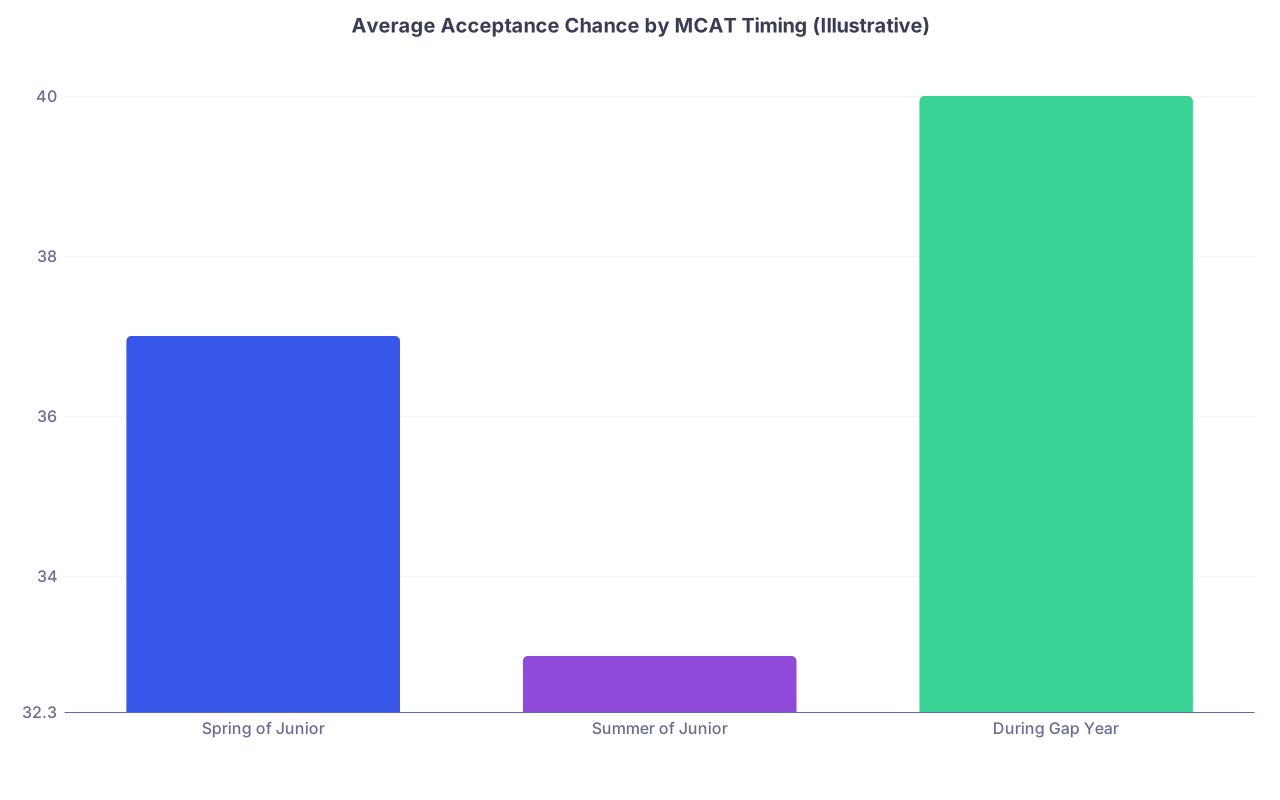
Thing #4: "Does Timing Matter? When I Took It"
Yes. Timing matters. But not in the way you think.
A score from six months ago carries more weight than a score from four years ago. That's just cognitive reality, committees assume you've forgotten content, that your study skills have atrophied, that the score is less predictive of your current ability. If your MCAT is more than three years old, many schools will explicitly ask you to consider retaking it.
But here's the retake-specific trap: if you retake too quickly, it looks reactive. Like you panicked after seeing your first score and immediately signed up for another date. If you wait too long, say, a year, it can look like you couldn't commit to the work needed to improve.
The sweet spot for a retake is usually 2-4 months after your first attempt. Long enough to show deliberate preparation. Short enough to show you didn't waste time. Long enough to actually study. Short enough that the content stays fresh.
Thing #5: "How Many Times Is Too Many?", The Retake Threshold
Okay. This is where I have to be direct with you, because you're asking and you deserve a straight answer.
One retake: Generally viewed positively. Especially with improvement. Most committees don't even blink. They might not even mention it in your file review.
Two retakes: Yellow flag. Not a dealbreaker, but it requires context. They'll want to see what was different about the third attempt. They'll look closely at your application narrative to understand the pattern.
Three or more retakes: Red flag territory. Not impossible to overcome, but you're now writing an uphill story. The committee will need a legitimate, documented reason. Chronic illness. Family emergency. Severe test anxiety that you've formally addressed. "I kept hoping for a better score" won't cut it.
The rule is brutal and simple: quality over quantity. One thoughtful, well-prepared retake beats three panicked ones. Every single time.
Thing #6: "What About My Other Stats? Do They Matter More?"
Your MCAT doesn't exist in a vacuum. I know it feels like the only thing that matters at 3 AM, but it's actually one-fifth of a much larger picture.
Admissions committees do holistic review. They're weighing your GPA, your extracurriculars, your personal statement, your letters of recommendation, your research, your clinical hours, your work experience, your background, your identity, your mission fit, and yes, your MCAT.
Here's what this means for you specifically: a slightly lower MCAT can absolutely be offset by a strong GPA, compelling clinical experience, and a personal statement that makes the committee want to meet you. I've watched applicants with 508s get into schools that rejected 515s because the 508 came with a story and the 515 came with nothing else.
The reverse is also true. A perfect MCAT won't save a 3.2 GPA or a generic personal statement. Use this. Let your retake be one piece of a much stronger application. Don't put all your worth into that one number.
Thing #7: "Can I Explain This in Interviews?", The Opportunity Angle
If you get an interview invitation with a retake on your record, congratulations, that's the committee saying they're interested despite the retake. Now your job is to frame it.
Don't apologize. Don't over-explain. Don't lead with the retake. Wait for it to come up naturally, and then deliver a clean, confident two-sentence explanation.
Try something like: "I took the MCAT twice because I wanted to make sure my score reflected my actual capability. The first attempt was a learning experience, I identified gaps in my content review and my test-taking strategy. The second attempt showed what I can do when I'm fully prepared."

Notice the language. Learning experience. Identified gaps. Reflected my actual capability. Every phrase reframes the retake as evidence of growth, not evidence of failure. That's not spin. That's the truth told well.
Avoid defensive framing. Never say "I had a bad day." Never blame the test, your professor, or your ex. Take ownership of the process and the outcome. Committees want to see that you can own a setback without collapsing into excuses. That's the trait that matters in medicine.
The Bottom Line: What You Can Control (and What You Can't)
Here's the brutal, liberating truth: you cannot control what admissions committees think of your retake. You cannot control their mood that day, their applicant pool, their school-specific priorities, or whether the committee member reading your file had a bad morning.
What you can control: your study strategy, your preparation timeline, your score improvement, your application narrative, your interview framing, and your overall application strength.
Focus on the high-control variables. Let go of the low-control ones. Stop refreshing your email. Stop reading old SDN threads. Put your energy into the next concrete action that moves you forward.
Admissions committees see retakes every single cycle. You're not an outlier. You're not a cautionary tale. You're an applicant who showed up, learned, and tried again. That's the kind of person they want treating patients in twenty years.
Now close the laptop. Get some sleep. And when morning comes, get back to work.