
Most students misuse the h‑index before they even understand what it measures.
For premeds and medical students, bibliometrics can feel like an opaque numbers game used by faculty and program directors to gatekeep opportunities. Yet the data show something very different: h‑index and impact metrics are blunt instruments, often misapplied, but still useful if you know where they fail.
This is not about memorizing definitions. It is about learning to read research “numbers” the way you will read labs and imaging: in context, with skepticism, and with clear thresholds in mind.
(See also: Premed Research and Acceptance Odds for more details.)
1. What the h‑Index Actually Measures (and What It Does Not)
The h‑index was designed to answer a narrow question:
How many papers has a researcher published that are consistently cited?
Formally:
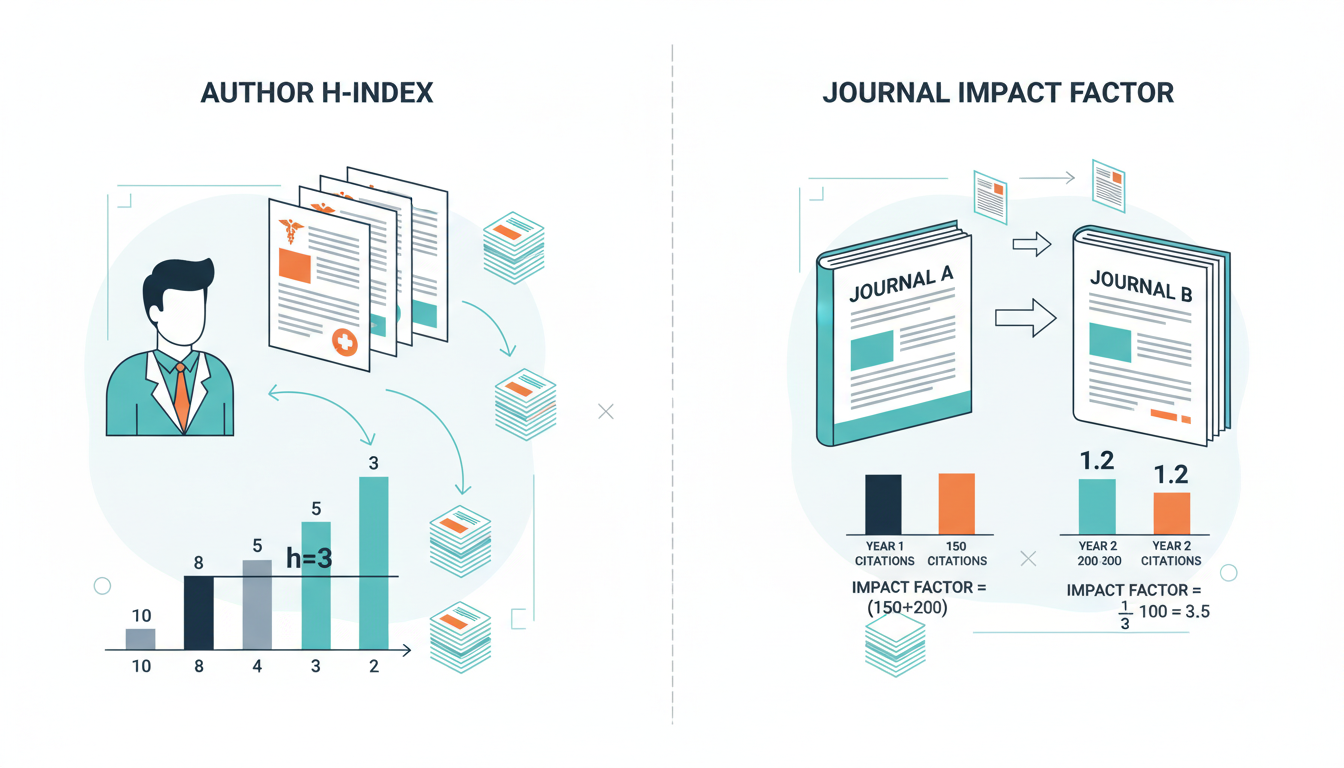
- A researcher has an h‑index of h if they have h papers that have each been cited at least h times.
So:
- If you have 10 papers, and 7 of them have ≥7 citations each, but only 6 have ≥8 citations → your h‑index = 7.
- A single paper with 1,000 citations does not make your h‑index 1,000. It contributes at most “1” to the count if it is among the top‑cited papers.
Think of it as a “balanced productivity” score: quantity and citation impact must grow together.
Simple numeric examples
Imagine three hypothetical students:
Student A
- Papers: 1
- Citations: [120]
- h‑index: 1 (only one paper, ≥1 citation)
Student B
- Papers: 4
- Citations: [8, 5, 3, 1]
- Sort descending: [8, 5, 3, 1]
- Check thresholds:
- ≥1 citation? 4 papers → pass
- ≥2? 3 papers (8, 5, 3) → pass
- ≥3? 3 papers → pass
- ≥4? 2 papers → fail
- h‑index: 3
Student C
- Papers: 7
- Citations: [45, 20, 18, 15, 12, 11, 5]
- All seven papers have ≥5 citations, but not all have ≥7 citations
- h lies between 5 and 7; check:
- ≥6 citations? 6 papers (all except the last) → pass
- ≥7 citations? 5 papers → pass
- ≥8 citations? 4 papers → fail
- h‑index: 6
Already you can see a key property from the data:
- A few “blockbuster” papers inflate total citations, but they do not necessarily increase the h‑index much.
- Steady, mid‑level impact across multiple papers typically drives h‑index upward.
What the h‑index does not tell you
The metric completely ignores:
- Authorship position (first vs middle vs last)
- Field size (oncology vs medical education vs radiology)
- Age / career stage (a PGY‑1 cannot be compared numerically to a chair)
- Citation quality (are they positive citations or criticisms?)
- Contribution (you might have done the statistics, or you might have just edited the abstract)
From an analytical standpoint, the h‑index collapses all nuance into a single number. That is its strength and its biggest flaw.
2. Data Sources: Why h‑Index Values Do Not Match
Students are often surprised when they see three different h‑indices for the same person depending on the database. The discrepancy is not a bug; it is a function of what each system indexes.
The main sources:
- Google Scholar:
- Very inclusive; indexes journal articles, preprints, conference abstracts, theses, occasionally slides or PDFs.
- Tends to give the highest h‑index.
- Scopus (Elsevier):
- Indexes a curated set of journals, some conference proceedings.
- Coverage is strong from ~1996 onward; earlier work may be incomplete.
- Web of Science (Clarivate):
- Historically the most selective; focuses on established journals.
- Often gives the lowest h‑index.
For a single mid‑career cardiologist you might see:
- Google Scholar: h‑index = 42
- Scopus: h‑index = 35
- Web of Science: h‑index = 30
Which one is “right”? From a measurement perspective, all of them. They are measuring the same concept with different sampling frames.
For students:
- Residency selection committees often use Scopus or Web of Science for consistency across applicants.
- Mentors and departments sometimes prefer Google Scholar for visibility and ease of use.
- You should know which platform your institution leans on and interpret numbers accordingly.
If your own h‑index is 2 on Google Scholar and 1 on Scopus, the difference reflects coverage, not a judgment on your ability.
3. Impact Factor vs h‑Index: Journal vs Author Metrics
Students frequently conflate:
- Journal impact factor (JIF) – a property of journals
- h‑index – a property of authors
They measure related but distinct things.
Journal Impact Factor (JIF): the 2‑year citation snapshot
The classic Journal Impact Factor for year Y is:
[ \text{JIF}_Y = \frac{\text{Citations in year Y to items published in years Y-1 and Y-2}}{\text{Number of citable items in years Y-1 and Y-2}} ]
If Journal X had:
- 1,000 citations in 2024 to items published in 2022–2023
- 200 “citable items” in 2022–2023 (articles and reviews)
Then:
- JIF_2024 = 1,000 / 200 = 5.0
Key properties:
- It is field‑dependent. A JIF of 3 in medical education is strong; in oncology it may be modest.
- It is sensitive to a few highly cited papers in a short time window.
How h‑index and impact factor interact
The data often show a weak‑to‑moderate positive correlation between author h‑index and the average JIF of journals they publish in, but it is far from perfect.
Consider two residents:
Resident A
- 4 papers, all in journals with JIF 25+ (e.g., NEJM, JAMA)
- Citations so far: [120, 30, 18, 10]
- h‑index: 4
Resident B
- 12 papers, all in journals with JIF 2–4
- Citations: [22, 18, 17, 15, 10, 8, 7, 6, 5, 4, 3, 2]
- h‑index: 8
Who looks “stronger” on paper? Purely by h‑index, Resident B. By journal prestige, Resident A.
This illustrates a core analytic point: single metrics bias evaluation depending on how they are constructed. Program directors know this, even if they do not always articulate it.
4. What the Data Say About h‑Index in Medicine
You probably care about one question: Do these numbers actually matter for medical students and residency?
The answer is nuanced.
Typical h‑Index by career stage
Empirical studies across specialties show:
- Medical students / premeds: h‑index commonly 0–2
- Residents / fellows: typical range 1–6, with research‑track residents often higher
- Junior faculty (assist. professor): commonly 5–15
- Senior faculty / chairs: often 20–60, highly variable by field
Exact numbers differ by discipline:
- Fields with large collaborative trials (e.g., cardiology, oncology) see higher h‑indices relative to, say, medical education or ethics.
- Surgical subspecialties often have lower average h‑index at similar career stages, partly due to different publishing patterns.
So if you are a premed with an h‑index of 1, you are not “behind”; you are statistically very typical.
h‑Index and residency matching
Research output and bibliometrics do correlate with match outcomes, but the effect sizes are moderate and specialty‑specific.
From analyses of NRMP and supplemental studies (data vary by year but patterns are stable):
- Competitive specialties (dermatology, plastics, neurosurgery, radiation oncology) see:
- Higher average number of publications in matched applicants.
- More frequent presence of an h‑index ≥2–3 even at the student level.
- Less competitive fields or those with large applicant pools (internal medicine, family medicine):
- Focus more on total experiences and letters. h‑index is rarely used explicitly.
Importantly, program directors care about:
- Evidence of sustained engagement (multiple projects, not one-off poster padding)
- Quality and relevance of work (e.g., orthopedics research for an ortho applicant)
- Role (first‑author or significant contribution)
h‑Index indirectly captures some of this because:
- Multiple cited papers → likely ongoing collaboration.
- Citations → others are finding the work useful or important.
However, the predictive value of a student‑level h‑index for clinical performance is weak. The metric is at best a signal of research environment and mentorship, not necessarily of future diagnostic skill or bedside manner.
5. How Students Should Interpret Their Own h‑Index
You are not a senior investigator. Comparing your h‑index to your department chair’s number is as meaningless as comparing your 5K time to an Olympic marathoner.
Instead, anchor interpretation to career stage and opportunity access.
Reasonable numerical expectations
For most premeds and medical students applying to residency:
- h‑index 0–1
- Very common. Especially for students at schools without a strong research infrastructure.
- h‑index 2–3
- Signals one or more papers that have started to accumulate citations.
- Often seen in students with 2–5 publications in reasonably visible journals.
- h‑index ≥4 as a student
- Uncommon but not rare, usually in:
- MD‑PhD candidates
- Students in strong research tracks
- Students who started research early (high school/college) in productive labs
- Uncommon but not rare, usually in:
Instead of obsessing over the raw number, ask:
Does my publication record align with my target specialty’s norms?
- For dermatology or neurosurgery, a higher research footprint is typical.
- For family medicine, meaningful projects matter more than counts.
Is my citation profile growing over time?
- A paper with 0 citations 6 months after publication is normal.
- A paper with 0 citations 4–5 years later may indicate limited reach, but this reflects many factors including topic niche and journal exposure.
Am I publishing in places where my work is likely to be found?
- Indexing in PubMed and major databases typically increases citation potential.
When your h‑index looks “low”
If your h‑index is 0 even with several posters or abstracts:
- Posters and meeting abstracts are rarely cited in the same way as full papers.
- Many conference items are not indexed in major databases.
If you have 3–4 papers and still an h‑index of 1:
- Check time since publication. Citations often lag 1–2 years, especially in slower fields.
- Check database coverage. Some journals take time to appear fully indexed in Scopus or Google Scholar.
The data pattern you care about is trajectory, not a single snapshot.
6. Evaluating Mentors and Projects Using Bibliometrics
Where h‑index becomes powerful for you is not as a self‑score, but as a way to evaluate mentors and projects before you commit time.
Using h‑index to assess mentors
For a potential research mentor, consider:
- Total h‑index
- A faculty h‑index of 10 vs 40 tells you about historical productivity and impact.
- Extremely low h‑index (e.g., 1–3 for a late‑career faculty member) may suggest limited research activity. That is not always bad (they might focus on teaching), but it affects publication probability.
- Recent h‑index growth
- Check publication dates and whether most of their citations come from the last 5–10 years.
- A faculty member with h‑index 25 but last paper in 2013 may be semi‑retired from research.
However, do not over‑optimize on the largest number. Some high‑h‑index faculty run enormous, high‑output labs where a medical student’s project is a tiny fraction of the work and may take years to publish.
A more useful combined analysis:
- h‑index: moderate to high (e.g., 8–25 for mid‑career)
- Consistent publications in the last 3–5 years
- Visible record of student co‑authorships (scan their papers for medical student names)
That pattern strongly predicts a lab or mentor where your effort is likely to translate into a paper.
Evaluating specific projects quantitatively
When offered a project, try to estimate:
Probability of publication
- Retrospective chart review in a PI’s main area of research vs a one‑off side idea?
- Systematic review with well‑defined protocol vs vague “maybe we can write something”.
Citation potential
- Hot area with active debate (e.g., AI in radiology) tends to generate more citations.
- Highly niche case reports often remain low‑cited, though they still have educational value.
Time horizon
- Multi‑center RCT → high impact potential, but results may be 5+ years away.
- Small retrospective or educational project → lower citation ceiling, but often faster to publish.
From a data‑driven standpoint, a mix is optimal:
- 1–2 “long‑horizon, high potential” projects
- Several “short‑horizon, realistic” projects that can turn into first‑author papers

7. Common Misinterpretations and Statistical Pitfalls
Metrics invite misuse. Students, faculty, and even administrators fall into predictable traps.
Pitfall 1: Cross‑field comparisons
Comparing h‑index of:
- A cardiologist (h = 50) to a medical education researcher (h = 20) tells you almost nothing about relative quality. Citation density per paper is vastly different across fields.
Better comparisons:
- Within the same discipline
- At similar career stages
- Using percentiles (e.g., “upper quartile for associate professors in rheumatology”)
Pitfall 2: Age bias
The h‑index is cumulative. A 60‑year‑old professor has had 30+ years for citations to accrue; a 28‑year‑old resident has not.
There are age‑adjusted variants (e.g., m‑index = h‑index divided by number of years since first publication), but they are rarely used in daily mentoring conversations.
For your purposes, assume:
- Direct numerical comparison to senior faculty is statistically meaningless.
- Use h‑index as a relative marker to compare opportunities and mentors, not to judge yourself.
Pitfall 3: Gaming through co‑authorship
Large multicenter trials often list 30–50 authors. Early‑career researchers can technically accumulate citations and increase their h‑index by being peripheral contributors.
The data show:
- Being on many multicenter papers accelerates h‑index growth.
- However, program directors and promotions committees increasingly inspect:
- Authorship order
- Consistency of topic (are you building an expertise area?)
- First/last author proportion over time
For you, a small number of first‑author or co‑first‑author papers can be more meaningful than a long list of middle‑authored mega‑trial publications, even if the latter contribute more to raw h‑index.
Pitfall 4: Overvaluing impact factor
Students frequently aim only for the highest impact factor journals. The numbers show a few downsides:
- High rejection rates (90–95% in elite journals) cause long delays.
- A paper in a mid‑tier, field‑specific journal that is actually read by your peers may accumulate more citations than a paper in a broad, high‑IF general journal that nobody in your niche pays attention to.
Quantitatively:
- A solid oncology methods paper in a JIF 4–5 specialized journal might reach 30–40 citations.
- A very narrow case description in a JIF 20+ journal might see <10 citations.
Impact factor is a journal‑level average, not a guarantee for every article.
8. Practical, Data‑Driven Strategy for Students
Bringing this together, how should a premed or medical student actually use bibliometric basics?
1. Set stage‑appropriate goals
Instead of “I want an h‑index of 5,” frame goals like:
- “I want at least 1–2 first‑author papers in my area of interest before residency applications.”
- “I want to work with a mentor whose publication record suggests a high probability of seeing my work published.”
If you achieve that, your h‑index will take care of itself.
2. Track your metrics, but do not obsess
Create a simple tracking sheet:
- Each project
- Journal (with rough impact factor or quartile)
- Status (idea → data collection → manuscript → accepted)
- Authorship rank
- Date of publication
Once or twice a year, check:
- Your h‑index in Google Scholar and/or Scopus
- Citation counts for your main papers
Trend and trajectory matter more than precise values.
3. Optimize for learning and signal, not just counts
From the data on selection committees:
- A coherent narrative (“I worked on health disparities in cardiology across several related projects”) is more valued than a random scatter of unrelated abstracts.
- Deep involvement in one area leads to:
- Higher quality output
- Better letters of recommendation
- More meaningful conversations during interviews
Quantitatively, this often results in:
- Fewer total projects, but higher citation probability per project.
- h‑Index growth that looks slower early, but more stable later.
4. Use bibliometrics to ask better questions
When meeting a potential mentor, you might say:
- “I noticed you have several recent papers on X in journals like Y and Z. Do students typically get first‑author roles on similar projects?”
- “I saw that many of your works are highly cited in the last 5 years. What do you think made those studies particularly impactful?”
This shows that you understand the metrics and, more importantly, care about impact, not just line items on a CV.
Key Takeaways
- The h‑index is a simple count of how many of your papers have at least that many citations; it reflects cumulative, consistent impact, but ignores authorship position, field, and age.
- For premeds and medical students, typical h‑indices are low (0–3); what matters far more is project quality, authorship role, and alignment with your career goals.
- Use bibliometrics strategically: to choose mentors, evaluate project potential, and understand the landscape—without letting a single number define your trajectory in medicine.