
You’re a premed sitting in the back of a big-name university’s “Introduction to Research” session. The PowerPoint is recycling the same generic lines: get involved early, email faculty, check the website. You look around. Half the room is already scrolling through Reddit. The other half is pretending this is helpful.
What nobody on that stage is going to tell you is this: the most valuable research tracks in medicine are not on any website, not in any email blast, and definitely not in that premed advising packet.
They’re hidden. On purpose.
Faculty call them “informal scholar pathways,” “pilot mentorship pods,” “select opportunities.” Behind closed doors? They’re pipelines. Direct lines into top labs, early authorship, and letters that program directors actually remember.
(See also: The Unspoken Rules of Authorship Medical Students Never Hear for more.)
Let me walk you through how those tracks actually work, why you never hear about them, and how students quietly get in long before the mass emails ever go out.
Why the Best Research Tracks Are Never Advertised
Let me tell you what faculty will not say in public meetings.
Every department has limited bandwidth. A PI can only meaningfully mentor a handful of students. So when the chair leans on them to “support medical student research,” they nod, smile, and then quietly build a two-tier system:
- Public-facing “opportunities” for everyone
- Private pipelines for the students they actually invest in
The public version:
A vague Google form. A list of faculty “willing to mentor students.” Maybe a summer program with 60 participants, 40 of whom will never see a publication out of it.
The hidden version:
Three second-year students who get pulled into weekly lab meetings, get the first shot at pilot data, and end up on three abstracts, two manuscripts, and a glowing departmental letter by the time they apply for residency.
You think I’m exaggerating? Here’s how it actually gets set up behind the scenes.
The department research committee meets. Someone says, “We need better representation of our work in the match.” Another faculty member adds, “We should start an early scholars track, but I don’t want 40 random students emailing me.”
So they do this instead:
- They identify “reliable” students: ones who rotated in clinic, asked good questions, or came recommended by a trusted resident.
- They invite 3–6 of them for a “pilot mentorship group” or “research breakfast series.”
- Those students get early access to projects long before anything hits an official channel.
On paper, everybody has “access to research.” In practice, 10% of students get 90% of the opportunities that matter.
The Quiet Pipelines: What They Really Look Like

You won’t see “hidden research track” on a website. It shows up under other names. Let me decode a few of the most common structures.
1. The Unpublished “Scholars” Cohort
Some schools have official “research scholars” programs. You see them on brochures. That’s not what I’m talking about.
There’s a second layer: the cohort nobody formally names.
Example: At one East Coast medical school, the neurology department quietly runs what amounts to a mini-HHMI inside their normal structure. They don’t advertise it. Here’s what it looks like from the inside:
They identify 4–5 first-years each year based on:
— prior research experience
— personality fit (do you seem low-maintenance and serious?)
— resident or faculty recommendationsThey invite them to “come to lab meetings if you’re interested,” which sounds casual, but is actually an audition. Stay engaged for 3 months and you’ll be handed first-authorship territory on retrospective chart reviews, database analyses, or case series.
These students get priority access to:
— departmental data registries
— protected time with biostats support
— internal funding for conference travel
Watch what happens 2–3 years later. When match lists come out, the names that appear repeatedly with multiple publications and “department chair letters” disproportionately come from this unnamed group.
And no, there’s no link on the website to apply. You get in because somebody says, “You should come to our Monday lab meeting, I think you’d be a great fit.”
2. The Shadow Track Inside Funded Centers
Big academic centers have NIH-funded units: cancer centers, cardiovascular institutes, transplant centers, aging centers. Publicly, they run summer programs and post flier-level opportunities.
Privately, they’re running something else.
The center leadership has one priority: productivity. Papers, grants, visibility. Everyone in that ecosystem learns quickly that bringing in reliable students who actually generate analyzable data is gold.
So they set up:
- A small, recurring “student research breakfast/roundtable”
- A list of “trusted” students who get sent project ideas first
- Early invite to join center-wide data projects and database access
At one Midwestern institution, the GI division maintains a standing spreadsheet of “productive students.” These students get emailed first anytime:
- The division has a multi-center trial needing chart abstraction
- A PI needs a last-minute abstract to submit to DDW
- Someone has a data set ready to be written up but no time
The premeds and early med students see the noise: bulletin board postings, big-group summer events. The insiders see: targeted one-on-one emails that never hit public lists.
3. Specialty “Pipeline” Tracks for Future Applicants
Some departments deliberately build research tracks as recruitment tools for their own residency or fellowship programs.
This is very common in:
- Dermatology
- Orthopedics
- ENT
- Radiation oncology
- Plastic surgery
- Neurosurgery
Here’s how they quietly design it.
The department decides they want to “grow their own.” So they create an unofficial internal track that looks like:
- One or two “chosen” premeds or early med students who start with simple review projects.
- If you perform well, you’re invited to join bigger, more visible projects.
- Come residency application season, you’re no longer just “a student who did a rotation.” You’re “that student who’s been with us for three years, who helped with our multi-center outcomes project and presented at the national meeting.”
These are not posted as “matching advantage” tracks, because that’s politically messy. But inside faculty meetings, they openly talk about, “We should really take care of [student name]; they’re basically one of us already.”
How Students Actually Get Pulled Into Hidden Tracks
Let me spell out something brutal: the gateway isn’t your GPA or MCAT once you clear the basic threshold. It’s whether someone in the department trusts you enough to stake their name on you.
Here are the mechanisms nobody advertises.
1. The Clinic Performance Referral
You think clinic is just where you learn medicine. Department heads think clinic is where they scout talent.
A resident comes back from clinic and says to their attending:
“Hey, that first-year student was actually really sharp, asked good follow-up questions, and stayed late to help with notes.”
The attending files the name away. Two months later when the department is quietly pulling students into a research stream, who do you think gets mentioned?
“Remember that first-year in your clinic you liked? Maybe loop them in.”
So when you’re in clinic as a premed observer or early medical student, you’re not just “shadowing.” They’re deciding if you’re the type they want to bring into their inner research circle.
2. The Behind-the-Scenes Faculty Email
Another pipeline most students never see:
Faculty email each other:
“Hey, I’ve got a database project and need a reliable student. Anyone have someone they trust?”
If your name is on someone’s mental shortlist, you suddenly get an email from a PI you’ve never met:
“Dr. X suggested you might be interested in joining a project we’re starting…”
The less glamorous reality: there was no “open call.” You didn’t beat 50 applicants. Your name showed up in the right inbox at the right time.
3. The “Show Up Repeatedly” Filter
Faculty won’t advertise this, but they’re watching for something quite basic: do you show up more than once without being chased?
Many hidden tracks start not with a formal invitation but with a soft one:
“You’re welcome to come to our lab meetings anytime.”
Most students come once. Maybe twice. Then vanish.
The ones who show up every week for two months, ask a few focused questions, follow-up on what they said they’d do? Those are the ones who suddenly find themselves:
- Added to an IRB
- Given a dataset
- Invited to be first author on “something small to start with”
No selection committee. Just a quiet attrition filter based entirely on persistence and follow-through.
Where to Look: The Places Faculty Don’t Think You’ll Check
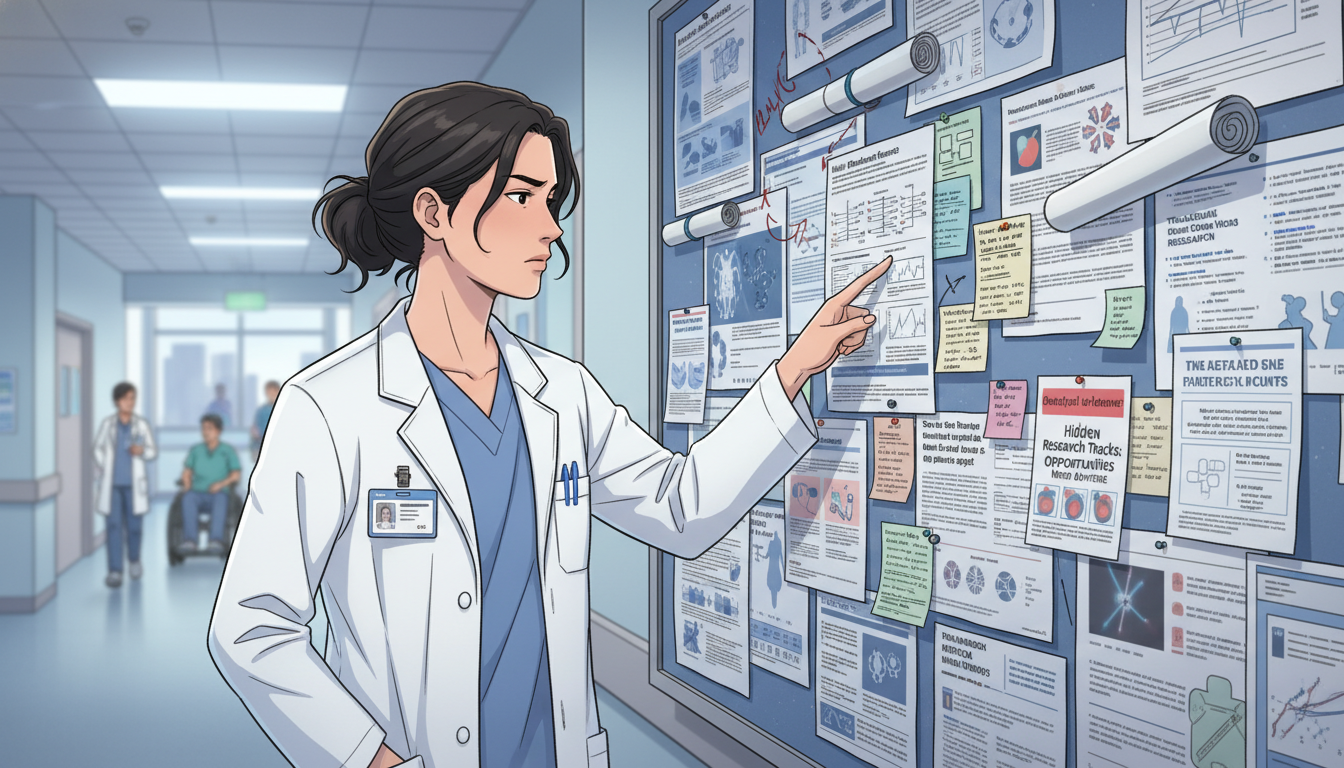
Everyone tells you: look at the department website, formal summer programs, and the med school research office.
Those are the loud channels. You want the quiet ones. Here’s where the real tracks hide.
The Grand Rounds Regulars
Pay attention at grand rounds. Who are the three or four faculty who present repeatedly, always “on behalf of our group,” or “our registry,” or “our center”?
Those are your entry points.
They are often running:
- Ongoing registries
- Longitudinal cohorts
- Multi-year QI projects
These are ideal for students because:
- The data already exists
- IRBs are already in place
- There’s a constant backlog of “write-ups we need to get to”
They don’t advertise “student tracks.” They assume the serious students will find their way into their orbit by:
- Attending grand rounds
- Staying after briefly to ask a focused question
- Following up by email with a specific offer: “I’d be happy to help with data abstraction or manuscript drafting for any of your registry projects if that’s useful.”
That’s how you get the reply that starts with:
“We actually have a registry that could use a student…”
You’ve just stumbled into a quiet internal track.
The Residents Who Always Present Posters
There’s always that one resident who seems to have a poster at every conference. They’re the ones faculty trust. They are also informal gatekeepers.
Ask them, directly but respectfully:
“I’ve noticed you’re really active in research with the [X] group. Are there ongoing projects where a student helping with the grunt work would actually be useful to you all?”
Behind their work, there’s almost always a PI running a pseudo-track:
- Residents at the core
- One or two med students pulled in for manpower
- A steady stream of posters and publications
That med student spot is rarely advertised. It’s handed down informally from one resident to “someone I’ve worked with who’s good” or “this premed/first-year who seems solid.”
You want to be that person.
The Office Door Clues
This sounds embarrassingly simple, but I’ve watched it work.
Walk the research floors. Look at office doors. Notice:
- Who has 10+ posters taped up with the same small set of names
- Who lists “Center/Registry/Program Director” on their nameplate
- Who has fellows’ and residents’ names repeating across different topics
Those are not casual researchers. Those are factory lines.
If you see the same attending name on every poster in a niche (say, “outcomes in heart failure readmissions”), that’s a production lab. Production labs usually have hidden student tracks because they need people to keep the machine running.
Those people are rarely recruited via public calls.
How to Position Yourself Before You Ever Email
Students do this backwards. They fire off a dozen generic emails, get no response, and assume there are no opportunities.
What you actually want is to make yourself an easy “yes” before they ever see your name in their inbox.
Build a Minimal Research Skill Stack Early
No one’s expecting a premed or first-year to run a randomized trial. They are expecting not to babysit.
Quietly build:
- Basic statistics literacy (yes, that boring biostats MOOC matters)
- Intro to R, Python, or at least spreadsheet competence
- Experience with one citation manager (Zotero, EndNote, Mendeley)
Then signal this specifically when you introduce yourself:
“I’m comfortable with basic data cleaning in Excel and R, and I’ve gone through an intro course on logistic regression and survival analysis. I’m very happy to start with chart review, data abstraction, or reference management.”
Readable subtext to a PI:
“I will not create chaos in your dataset and I understand this is grunt work.”
Have a Micro-Portfolio Ready
Students underestimate how much easier it is to bring you into a hidden track if they can show something tangible to a skeptical colleague.
You want 2–3 things you can link in a single line near the bottom of your email:
- A poster from an undergrad lab (PDF)
- A short abstract you wrote
- A preprint, or even a well-done final paper from a research-focused course hosted online
Then you make it easy:
“I’ve attached (or linked) a poster and brief abstract from my undergrad work so you have a sense of my writing and follow-through.”
Now when that PI forwards your email to a co-PI or stat person with, “What do you think about this student?” there’s something to show other than your self-description.
Exactly What to Say When You Reach Out

Since you’re chasing hidden tracks, you can’t rely on application portals. You need targeted, surgical outreach that makes it easy for faculty to plug you into their existing pipeline.
You do not send:
“Dear Professor, I’m interested in any research opportunity you have…”
That screams work.
You send something like this (adapt as context demands):
Dr. Patel,
I’m a first-year medical student with prior experience in outcomes research in cardiology, and I’ve noticed your work with the heart failure readmissions registry and multi-center outcomes studies. I’m particularly interested in clinical outcomes and health services research, and I’d like to contribute in a way that’s actually useful to your group.
Concretely, I’m comfortable with chart review, database abstraction, basic data cleaning in Excel/R, and reference management (Zotero). I’m very happy to start with supportive work on an ongoing registry or manuscript.
If there’s a resident or fellow in your group who could use a reliable student for the more time-consuming parts of a project, I’d be grateful to be connected. I’d also be glad to quietly attend your group’s meetings for a month or two just to better understand the ongoing work and see where I might fit.
I’ve attached a poster and abstract from my undergrad work so you have a sense of my follow-through on projects.
Thank you for considering this,
[Name]
[Year, Institution]
Notice what you’re really doing:
- You’re aiming at a group, not a single project
- You’re explicitly offering to support a resident or fellow (faculty love this)
- You’re volunteering to observe their workflow before demanding a role
- You’re signaling that you will not require hand-holding
You’re not asking to be put into a posted slot. You’re inviting them to quietly slide you into their unadvertised internal structure.
The Hard Truth About Who Gets Kept in the Inner Circle
Here’s the part nobody says on info panels.
Hidden tracks are not meritocracies. They’re trustocracies.
Once you get even a toe in, faculty are watching:
- Do you answer emails within 24–48 hours?
- If you say, “I’ll have this done by Friday,” is it actually done by Friday?
- When something goes wrong, do you cover it up or flag it early?
Two missteps that will get you quietly frozen out:
Vanishing after initial enthusiasm.
Faculty will forgive inexperience. They will not forgive disappearing without a word. That’s how you end up on the “do not recommend” list that gets silently circulated in conversations.Overclaiming your role.
If you start introducing yourself to others as “working on Dr. X’s big outcomes study” after attending two meetings, word gets back. Hidden tracks survive because the students in them don’t broadcast and inflate.
You want the opposite reputation:
- Understate your involvement publicly
- Overdeliver quietly
- Be boringly reliable
Those are the students who get:
- The “second, more interesting project”
- Introductions to other PIs
- Early heads-up about internal funding or year-out research fellowships
If You’re at a Non-Research Heavy School
You might be thinking, “My school isn’t Harvard or Hopkins. Do we even have hidden tracks?”
Yes. They’re just smaller and often centered around a few productive people instead of entire centers.
At community-heavy or newer schools:
- Look for the 2–3 attendings with multiple PubMed hits
- Track down regional collaborations (multi-center QI, registries)
- Don’t ignore hospital-based research offices; they sometimes have more going than the school itself
You may not have an NIH-funded cancer center, but you absolutely have:
- Quality improvement committees
- Readmission reduction teams
- Infection control task forces
- EMR optimization groups
These groups often have unadvertised, ongoing projects begging for someone to own the “annoying” part: chart review, survey follow-up, data cleaning.
Do that reliably, and you’re suddenly the default student for anything remotely scholarly that group touches.
The Bottom Line: How You Actually Get Into Hidden Research Tracks
Three things matter more than anything else:
You have to stop waiting for public announcements.
The real tracks live in recurring meetings, registries, and centers that never send mass emails. You find them by following the same names, the same posters, the same centers, and then showing up in those spaces.You have to be easy to plug in.
Come with basic skills, a clear offer of grunt work, and tangible proof of follow-through. Make your first ask small and specific: “Can I support one of your residents on something that already exists?”Once inside, you guard your reputation aggressively.
Quiet reliability, fast response times, and finishing what you start will do more for you than any single project. Hidden tracks run on trust; become the student whose name faculty are comfortable dropping in that behind-closed-doors email:
“I’ve got someone who can help. They won’t make us regret it.”