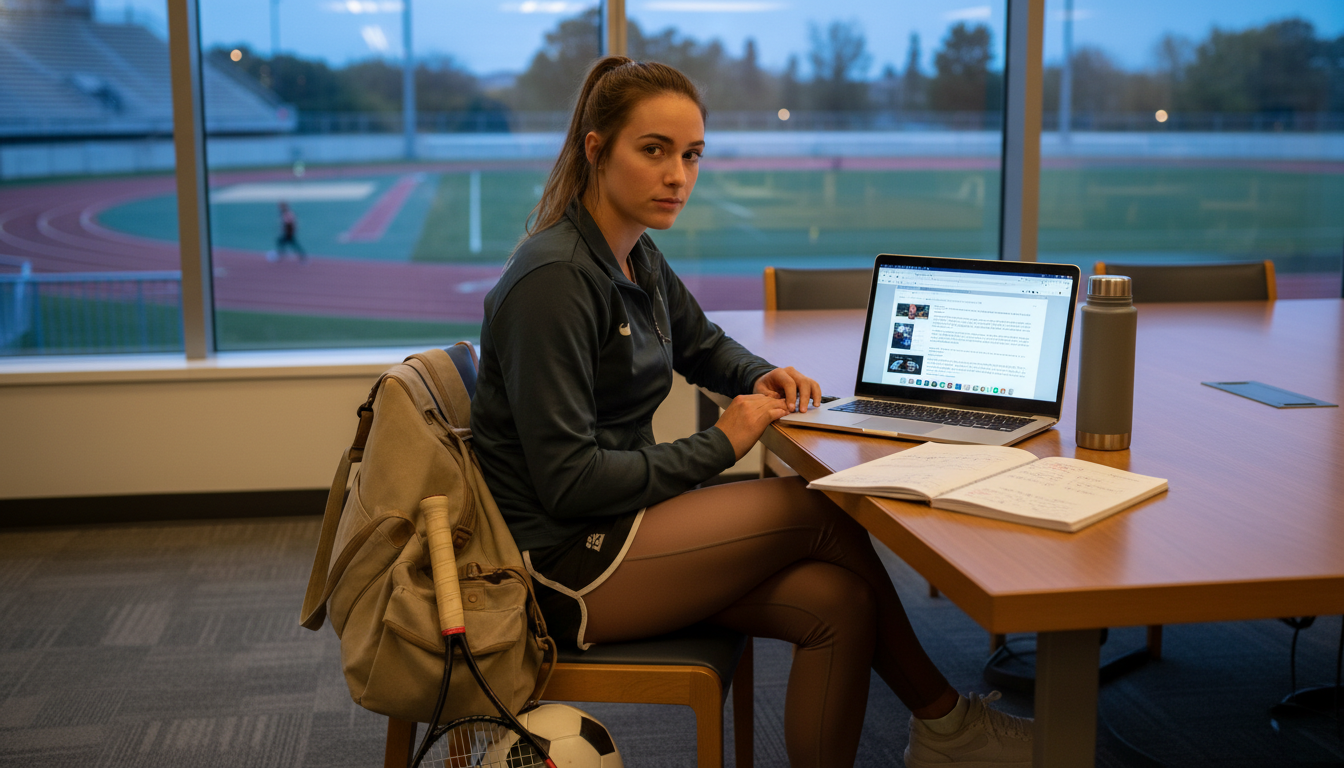
The usual research advice falls apart the moment you add 20+ hours of varsity athletics to your week.
If you’re a premed varsity athlete, you don’t need generic “get involved in research” tips. You need “here’s how to realistically pull off 5–10 hours of research when your life is already built around practice, lifting, travel, and classes.”
This is that guide.
Step 1: Get Real About Your Actual Time (Not Your Ideal Week)
Before you even think about emailing a PI, you need a brutally honest picture of your week.
Do this as a one-time, 30–40 minute exercise. It will dictate what type of research you can handle.
1. Map your non-negotiables
Write out a typical in-season week:
- Class times
- Practice (including warm-up and cool-down)
- Lifts/strength & conditioning
- Treatment/rehab/trainer visits
- Commuting to class, practice, gym, research sites
- Sleep (aim for your true minimum, not fantasy numbers)
- Meals
Example:
You’re a D1 swimmer.
- Practice: 6–8 am and 3–5 pm, Mon–Fri
- Lift: Tu/Th 5–6:15 pm
- Classes: 10–2 most days
- Travel: Thurs evening–Sun afternoon some weeks
On paper, you “have evenings free.” In reality, you’re exhausted, hungry, and sometimes traveling.
2. Find your true weekly research capacity
Once everything’s mapped, look for realistic research blocks:
- 1–2 hour chunks between classes
- 2–3 hour block on a lighter day
- Weekend mornings when not traveling
- Study hall/quiet hours if your team has them
Be honest: For most in-season varsity athletes, realistic research capacity is:
- In-season: 3–8 hours/week
- Off-season/summer: 10–20 hours/week (sometimes more)
That’s enough for meaningful research if you pick the right setup.
If you cannot find at least one recurring 2–3 hour block and two 1–2 hour blocks, you need to prioritize sleep and grades first, then revisit research later or during off-season/summer. Medical schools will not be impressed by research that tanks your GPA.
Step 2: Choose Research That Fits an Athlete’s Life
Not all research is compatible with varsity sports. The biggest mistake athletes make is chasing whatever “sounds prestigious” rather than what fits their constraints.
Best-fit research setups for varsity athletes
1. Flexible, computer-based projects
Ideal if you’re on a heavy travel schedule.
Examples:
- Retrospective chart review (after IRB approval)
- Database research (e.g., using SEER, NSQIP, large sports injury databases)
- Systematic review or meta-analysis
- Survey-based projects you can analyze remotely
Why they work:
- Can be done from laptop in hotel rooms, buses, or during off-days
- Asynchronous — less dependent on fixed lab hours
- Pauses for midterms, tournaments, or conference meets are easier to accommodate
2. Work with a clinically oriented PI who “gets” athletes
Look for:
- Sports medicine, orthopedics, physical medicine & rehab (PM&R), cardiology with athlete focus, concussion clinics
- Faculty who’ve previously worked with athletes or who are former athletes themselves
- Physician–scientists in departments that run on clinic schedules rather than strict bench time
You want someone who hears “I have away meets 1–2 weekends/month” and doesn’t immediately check out.
3. Projects that can ramp up in off-season
If your sport has a distinct off-season, choose projects where you can:
- Do minimal but consistent work in-season (e.g., weekly data collection or article screening)
- Then scale up analysis, writing, or abstract prep off-season or in summer
You’re not looking for “9 hours every week forever.” You’re looking for research that flexes with your training cycle.
Research setups that usually do not work for varsity athletes
There are exceptions, but typically avoid:
- Wet lab projects requiring fixed daily bench hours
- Animal work that needs exact timing for dosing/surgeries
- Labs that insist on 10–15+ hours/week regardless of your schedule
- “Drop by whenever” labs with no structure (chaos + no mentorship = wasted time)
You don’t have the margin to waste a semester on a lab that never gives you a role beyond dishwashing or data entry with no learning.
Step 3: How to Approach PIs When You’re an Athlete
You have to pitch yourself differently. Your schedule is a liability and a strength. Use both.
1. Be radically transparent about your constraints
You’ll gain trust if you’re upfront.
In your email or first meeting, say something like:
“I’m a varsity [sport] athlete, so my practice schedule is locked in:
• Mon–Fri: 3–6 pm practice, lifts Tu/Th 6–7:15 pm
• Travel 1–2 weekends/month during seasonBased on that, I can commit:
• 5–6 hours/week in-season (mostly mornings and mid-day),
• 12–15 hours/week off-season and in summer.I’m specifically looking for a flexible, data or chart-based project where I can contribute consistently over at least 1 year.”
That level of specificity is rare. It signals you’re serious and not casually “trying research.”
2. Sell your athletic background as an asset
Don’t just apologize for your time limits. Frame your strengths.
You can say:
- “As an athlete, I’m used to following structured plans and executing consistently, even when I’m tired or traveling.”
- “I’m familiar with injuries, rehab, performance metrics — I’d especially love to contribute to projects involving athletes, musculoskeletal injuries, or exercise physiology.”
- “Balancing sport and academics has forced me to become very efficient; if we can set clear expectations and timelines, I’ll meet them.”
You’re used to long games, not short sprints. Research is the same.
3. Sample outreach email tailored for varsity athletes
You can adapt this:
Subject: Premed varsity athlete interested in [specific research area]
Dear Dr. [Name],
My name is [Name], and I’m a [year] at [University], majoring in [Major] and a varsity [Sport] athlete. I’m very interested in [specific area: e.g., sports medicine outcomes, concussion in athletes, cardiovascular adaptations in endurance training].
I’ve taken [relevant coursework: stats, research methods, physiology, etc.], and I’m comfortable with [skills: Excel, basic coding, literature review, etc.]. I’m hoping to contribute to a project that allows for flexible, computer-based work (such as chart review, database analysis, or systematic review), as my practice schedule is fairly rigid during the competitive season.
My current availability is:
• In-season: ~5–7 hours/week, primarily [list times]
• Off-season/summer: ~12–15 hours/week with more scheduling flexibilityIf you anticipate any upcoming projects that match these constraints, I would greatly appreciate the chance to meet briefly (even via Zoom) to see whether I could be helpful to your team.
Thank you for your time and consideration.
Best regards,
[Name]
[Major], Class of [Year]
Varsity [Sport], [University]
[Contact info]
Notice you:
- Clearly state limitations
- Offer specific skills
- Signal seriousness over time (minimum 1 year)
Step 4: Fitting Research Into Each Day (Not On Top Of It)
This is where most athletes either sink or swim. You can’t run your life on “I’ll do research whenever I have time.” You must pre-decide.
1. Use “anchor points” in your schedule
Anchor research to things already fixed:
- After your earliest class
- Before afternoon practice
- Right after mandatory study hall
- Morning block on off days
Example schedule for a M/W/F heavy class day (track athlete):
- 7–8 am: Breakfast + light review
- 8–12 pm: Classes
- 12–1 pm: Lunch
- 1–3 pm: Research block (library, noise-canceling headphones, no phone)
- 3–6 pm: Practice
- Evening: Coursework + recovery
The key: research lives in that 1–3 pm slot like a class. It is not optional.
2. Think in “minimum effective dose”
You’re not aiming for 20-hour lab weeks. You’re aiming for consistent smaller inputs that aggregate.
Set weekly non-negotiables:
- 1 dedicated 2–3 hour deep work block (data analysis, learning methods, writing sections)
- 1–2 shorter 60–90 minute blocks (literature review, cleaning data, responding to messages)
- 10–15 minute micro-blocks (respond to PI, set goals, log progress) on 2–3 other days
This structure lets you stay engaged even during peak season.
3. Use travel time strategically (if your project is remote-friendly)
On buses, planes, or in hotels, you can:
- Read and annotate 2–3 papers
- Draft parts of an introduction or methods section
- Clean data in Excel or R if Wi-Fi permits
- Watch short stats or coding videos to build skills
Bring: laptop, tablet, or even printed PDFs + highlighter. Do not expect to do deep stats on a moving bus, but lit review? Perfect.
4. Set clear “off-limits” zones
To avoid burnout:
- No research during 24–48 hours before major competitions if it hurts performance
- Protect one weekly block for total non-academic time
- Keep sleep as non-negotiable as practice
If research starts eating your recovery, your sport (and probably GPA) will pay for it.
Step 5: Managing Expectations with Your PI
Varsity athletes get burned when they overpromise in August and are buried by October.
You have to lead with expectation management.
1. Define “seasons” of productivity with your PI
In your first meeting, say something like:
“My year has clear phases. I’m realistic that my in-season capacity will be 5–7 hours/week, but I can scale up significantly off-season and summer. Could we plan tasks so that lower-intensity work falls during competition season and heavier analysis/writing falls in the off-season?”
Then sketch:
- In-season: data entry, basic screening, small self-contained tasks
- Off-season: learning new software, heavier analysis, drafting manuscripts
- Summer: intensive work, abstract submission, polishing posters
PIs respect students who think this systematically.
2. Use a simple weekly update system
To work efficiently with limited time:
- Send a short weekly or biweekly email or shared doc update:
- What you planned to do
- What you actually did
- Any blockers/questions
- What you’ll do next week
Example:
This week: screened 45/100 articles, updated tracking sheet, flagged 3 uncertain inclusions.
Blocker: unclear whether to exclude non-English trials.
Next week: finish screening remainder, start data extraction for 10 included articles.
This lets your PI guide you without constant meetings.
3. Be upfront before crunch times
Before midterms, championships, or major travel blocks, send a proactive note:
“I’ll be traveling for conference championships from [dates]. I’ll front-load as much as I can this week, but my hours will be closer to 2–3 next week. The following week I’ll be back to 6–7.”
That’s the difference between “unreliable” and “highly professional but realistically constrained.”
Step 6: What If You Truly Can’t Fit Research Right Now?
Sometimes the answer is: not now — later.
If your current semester looks like:
- 18 credits of heavy STEM
- Peak competitive season
- New leadership role on your team
- Possibly MCAT on the horizon
…then forcing research can be the mistake that breaks everything.
Here’s how to handle it without damaging your med school trajectory.
1. Use summers aggressively
Summer is often where athletes can finally breathe.
Options:
- Full-time research position on campus
- Research internships at academic medical centers
- Remote research with your home institution’s PI
- Structured summer research programs (e.g., SURF, REU-type programs, though some are more for basic science)
A single intense, well-structured summer can equal or exceed the impact of a year of 3–5 hour/week dabbling.
2. Start with a tiny, well-defined project
If you truly only have 2–3 hours/week:
- Join a systematic review where your role is limited but clear (screening articles, simple extraction)
- Help with a small quality improvement (QI) project in an outpatient clinic
- Contribute to data cleaning or chart abstraction on a single outcomes project
You won’t be first author, but you’ll get exposure, mentorship, and maybe a poster or middle authorship. That’s still meaningful.
3. Remember: being a varsity athlete is a major EC
Admissions committees know that D1 or serious D2/D3 athletics are a huge time commitment. They do not expect you to have the same research volume as a student with no major extracurriculars.
They do expect:
- A story that makes sense (athletics, academics, some clinical exposure, and hopefully at least some research or scholarly engagement by the time you apply)
- Evidence that you’ve engaged with the scientific side of medicine in some way, even if modestly
Strategic, limited research can absolutely be enough.
Step 7: Making It Count on Your Application
You don’t just need to do research. You need to make your limited research visible and coherent.
1. Prioritize depth over quantity
You’re better off with:
- 1–2 projects where you:
- Stayed for 1–2 years
- Took on increasing responsibility
- Maybe presented a poster or earned authorship
- Can explain the question, methods, and what the results meant
…than 4–5 random “I was in a lab” lines.
2. Link your research to your identity as an athlete
Example ways to frame it in secondaries and interviews:
- “As a distance runner who’s dealt with stress fractures, working on an outcomes study of bone stress injuries in female athletes helped me understand how research translates to better prevention strategies.”
- “My experience balancing structured training plans with data-driven performance analysis made it natural to engage with outcomes research in sports cardiology.”
- “Research taught me to look at injuries and rehab not as isolated events but as data points in a larger system — that perspective changed how I thought about my own training and my future role as a physician.”
You’re telling one coherent story: “I’m someone who understands performance, discipline, and data — and I’ve applied that thinking in a research context.”
Concrete Example Schedules
To make this less abstract, here are two sample scenarios.
Example 1: D3 soccer player, in-season
Constraints:
- Practice: 4–6 pm Mon–Fri
- Games: Sat + occasional Wed nights
- Classes: Mostly mornings
- Travel some weekends
Possible weekly research plan:
- Mon: 9–11 am — research block (data entry, article screening)
- Wed: 1–2:30 pm — lit review at library
- Fri: 9–10 am — progress check, email PI, plan next week
- Travel: 1–2 hours total reading PDFs on bus
Total: 5–7 hours/week, with one “core” deep block.
Example 2: D1 swimmer, peak season, heavy credit load
Constraints:
- Two-a-day practices most weekdays
- Lifts mixed in
- 16 credit STEM schedule
- Weekend meets every other week
Realistic decision: No new research during peak 8–10 week stretch.
Instead:
- Maintain existing research with:
- 1.5 hour/week lit review or simple data tasks
- 15‑minute weekly progress/update note to PI
- Tell PI upfront this is a “maintenance phase,” and plan for:
- Big push in winter/summer break
- Specific goal (e.g., abstract submission for next year’s conference)
No new projects. No extra hours. Just continuity with minimal bandwidth.
Key Takeaways
- Your schedule is not the enemy; your lack of specificity is. Map your actual week and find a realistic 3–8 hours before you commit to anything.
- Choose research that fits an athlete’s life: flexible, data-heavy, remote-capable when possible, with a PI who understands seasonality.
- Overcommunicate with your PI, protect your sleep and grades, and remember: a few well-chosen, consistent research experiences can absolutely be enough — especially when you’re already competing at a high level in varsity sports.
FAQ
1. Will medical schools judge me for having less research because I was a varsity athlete?
They’ll consider context. Being a serious varsity athlete signals major time demands and discipline. You may not match the research hours of a non-athlete, but if you can show at least some sustained, thoughtful engagement with research or scholarly work — and clearly articulate what you learned — that’s usually enough, especially for most MD and many DO programs. Ultra research-heavy institutions may still prefer applicants with more extensive research, but your athletic background can be a strong compensating strength.
2. Is it better to wait and do a big research push after I’m done with college sports?
Not necessarily. If you totally cannot fit research now without harming grades or health, waiting is reasonable. But often you can do a “minimum” during college (small project, lit review, chart work), then expand during summers or post-grad. Admissions like to see some continuity over time, even if it’s light during peak athletic years.
3. What if I start in a lab and realize it clashes badly with my training schedule?
Address it early. Talk to your PI, explain the specific conflicts, and propose concrete modifications (switching to more remote tasks, adjusting hours, focusing work during off-season). If it’s still incompatible and rigid, it’s better to exit professionally — with notice and a clear handoff — than to disappear or burn out. Then look for a more flexible, project-based opportunity that respects your constraints.