
The average pre‑med massively underestimates how different orgo and biochem are from every class they took before. That is why they get blindsided.
Let me break this down specifically: success in organic chemistry and biochemistry is less about raw intelligence and more about having a professional‑grade study system that matches how these subjects actually work. If you study them like General Chemistry or Intro Bio, you will cap your performance early and wonder why your exam scores never match your effort.
We are going to architect a system that would hold up in a top‑tier pre‑med environment (think: Johns Hopkins, UCLA, Michigan) where the exams are designed to separate people who “kind of know it” from those who can use it under pressure.
1. Rethinking What It Means to “Know” Orgo and Biochem
Organic chemistry and biochemistry are skills, not just content domains.
Most students approach them as:
- Read notes / slides
- Do a few practice problems
- Try to memorize the rest
That is the undergrad default. It fails here.
For these subjects, “knowing” a topic means you can:
- Predict: Given a new substrate/condition, reasonably guess the outcome.
- Generate: Given a product, design plausible routes.
- Diagnose: Given a failed reaction or pathway block, identify where and why.
- Translate: Move between symbolic representations (mechanisms) and conceptual explanations (electrons, energy, structure–function).
On exams, you are not rewarded for recognition. You are rewarded for transfer – using familiar tools in unfamiliar settings.
So your study plan has to train:
- Pattern recognition
- Mechanistic reasoning
- Visual–spatial memory of structures
- Rapid retrieval under time pressure
Think like this: you are not “learning chapters,” you are training competencies.
2. Building an Orgo Study System That Actually Scales
2.1 The Three Skill Layers of Organic Chemistry
Treat orgo as three interlocking skill layers:
Foundational Micro‑skills
- Drawing clear Lewis structures
- Formal charges
- Resonance (real structures, not just pushing arrows mindlessly)
- Acid–base concepts (pKa logic, not just tables)
- Recognizing functional groups quickly
- Sterics vs electronics: who wins and when
Mechanistic Patterns
- Arrow‑pushing conventions
- Nucleophile vs electrophile recognition at a glance
- Common mechanistic archetypes:
- Substitutions: SN1, SN2
- Eliminations: E1, E2
- Additions: electrophilic addition, nucleophilic addition
- Carbonyl chemistry: acyl substitution, enolate chemistry
- Radical processes
Synthetic Application
- Multi‑step synthesis
- Retrosynthetic thinking (working backward)
- Reagent strategy: “toolbox” approach
- Chemoselectivity and protecting group logic (for upper‑level orgo/biochem relevance)
You cannot brute‑force memorize all of this. You need layered, deliberate practice.
2.2 Daily Micro‑Practice: Orgo “Scales” Like a Musician
Every serious musician runs scales. You need the orgo equivalent.
Create a 20–30 minute daily micro‑practice block with:
- 5 minutes: drawing basic structures from memory:
- All 20 amino acids (by the time you are in biochem)
- Common functional groups (list: alkane, alkene, alkyne, alcohol, ether, epoxide, ketone, aldehyde, carboxylic acid, ester, amide, nitrile, etc.)
- 10 minutes: arrow‑pushing drills:
- Simple acid–base
- Proton transfers
- Resonance structures with electron movement
- Short 2–3 step mechanisms
- 10–15 minutes: targeted reaction set review
- One “family” per day (e.g., SN1/SN2/E1/E2 set, or carbonyl additions, or aromatic substitutions)
This is separate from your main study session. Think of it as keeping your mental “orgo muscles” warm.
3. High‑Yield Orgo Techniques: From “I Sort of See It” to “I Can Do It”
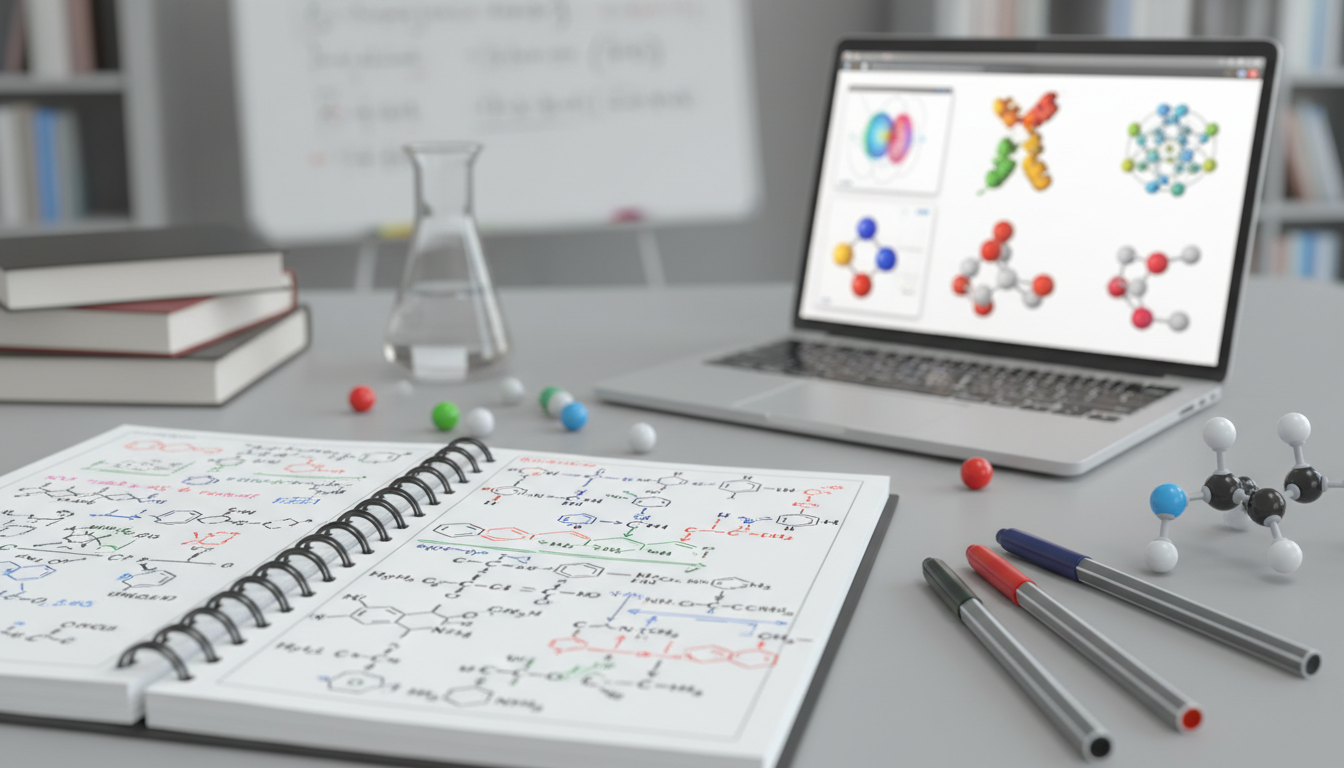
3.1 Mechanisms: The Non‑Negotiable Core
If your course is at all rigorous, mechanisms are the backbone.
Advanced study tactic:
Mechanism Sheets by Reaction Family For each family (e.g., nucleophilic substitution):
- Write the general mechanism (not a specific example)
- Identify:
- Role of each reagent (nucleophile, base, solvent)
- Rate‑determining step
- Stereochemical consequences
- Carbocation or no carbocation?
- Add 2–3 variants underneath with different substrates/conditions
Verbally Narrate Mechanisms Study method: explain out loud each arrow:
- “The lone pair on the hydroxide attacks the electrophilic carbon of the carbonyl, forming a new sigma bond and pushing electrons onto the oxygen…” This forces causal understanding, not just copying.
Blank‑Page Recreation At the end of each week, take a blank sheet:
- List reaction families from memory
- Under each, draw the generic mechanism, not a specific case
- Then test via your notes or solution manual
If you cannot draw the mechanism from scratch, you do not own that reaction.
3.2 Reaction Tables: But Smarter
Traditional reaction tables become 10+ pages of unconnected clutter. That is not helpful.
Instead, create logic‑oriented reaction maps:
- Center column: Functional group class (alkenes, alkynes, alcohols, carbonyls, aromatics)
- Left: “What can this functional group become?” (Products)
- Right: “What reagents or conditions accomplish each transformation?”
- Below or above: Mechanistic category:
- “Electrophilic addition to π bond”
- “Nucleophilic acyl substitution”
- “Radical halogenation”
- “Oxidation” vs “Reduction”
Your brain will recall mechanisms more reliably if you attach them to:
- Mechanistic type
- Functional group
- Electron flow pattern
3.3 Synthesis: How to Train Retrosynthetic Thinking as a Pre‑Med
Pre‑meds often panic when they see multi‑step synthesis. That panic comes from lack of structured practice, not lack of ability.
Training method:
Single‑Functional‑Group Transformations First
- Collect 20–30 very short problems:
- “Convert an alkene to an alkane”
- “Convert an alkene to an alcohol (Markovnikov; anti‑Markovnikov)”
- “Convert primary alcohol to carboxylic acid”
- For each, list all plausible reagent sets (with pros/cons if relevant).
- Collect 20–30 very short problems:
One‑Step Jump Expansion
- When a synthesis seems multi‑step, search for:
- Known target functional group
- Your current starting group
- Ask: “What is the largest single change here?” (e.g., new carbon–carbon bond, oxidation state jump)
- Identify key disconnections:
- C–C bonds in carbonyl chemistry
- Strategic use of organometallics (if covered)
- Build forward and backward on scratch paper:
- Backwards: identify key strategic intermediate
- Forwards: confirm each step is chemically compatible
- When a synthesis seems multi‑step, search for:
Timed Synthesis Drills
- 10–15 minutes, 3–4 synthesis problems
- Goal is structure of thinking, not immediate perfection
- After each problem, analyze:
- Where you got stuck
- Whether your mental “toolbox” was missing a transformation
- Whether you misjudged chemoselectivity or stereochemistry
Your target: by mid‑semester of Orgo II, routine 3–4 step synthesis problems feel slow but manageable, and you can at least map a plan for 5–6 step ones.
4. Biochemistry: Turning Memorization Traps into Logical Systems
Biochemistry feels like a mountain of memorization. It is not, if you structure it.
4.1 Think in Layers, Not Lists
Every major biochem topic has four layers:
Structures
- Amino acids (names, structures, one‑letter codes)
- Monosaccharides (basic families: aldose/ketose; D vs L; furanose vs pyranose)
- Nucleotides and bases
- Lipid types (fatty acids, triacylglycerols, phospholipids, steroids)
Properties
- Charge at physiological pH
- Hydrophobic vs hydrophilic
- H‑bonding capacity
- Stereochemistry constraints
Functions
- Enzyme roles
- Signaling roles
- Structural roles
- Energy storage vs quick energy vs regulation
Pathway Context
- Where it appears in key pathways: glycolysis, TCA, oxidative phosphorylation, urea cycle, β‑oxidation, etc.
When studying, you want to layer these together instead of memorizing each in isolation.
4.2 Metabolic Pathways: How to Master without Drowning
Glycolysis, TCA, oxidative phosphorylation, gluconeogenesis, pentose phosphate pathway, β‑oxidation, urea cycle… many students try to brute‑memorize them as disconnected sequences.
Better method:
Step 1: Anchor the “Story” of Each Pathway
Example: Glycolysis
- Starting point: glucose
- Endpoint: pyruvate (a branch point)
- Energy logic:
- Investment phase (2 ATP used)
- Payoff phase (4 ATP produced, 2 NADH)
- Regulatory logic:
- Rate‑limiting enzymes (hexokinase/glucokinase, PFK‑1, pyruvate kinase)
- Allosteric regulators
For each pathway, write one paragraph answering:
- What is the purpose?
- Where in the cell does it happen?
- What is the main input, main output, energy currency in/out?
Only then move to step‑by‑step detail.
Step 2: Draw Pathways From Memory – Incrementally
Use progressive recall drills:
- Day 1–2:
- Draw only the key steps (committed steps, branch points, rate‑limiting steps)
- Day 3–5:
- Add major intermediates by name (gray boxes for structure)
- Day 5–7:
- Add structures for the most tested intermediates (e.g., fructose‑1,6‑bisphosphate, α‑ketoglutarate, oxaloacetate)
You do not need full structural detail for every single intermediate unless your instructor explicitly says so. You should know:
- Names and structures of metabolic “hubs”
- Where carbons go in and leave (e.g., CO₂ release in TCA)
- Where NADH, FADH₂, GTP/ATP are produced or used
Step 3: Pathway Comparison Tables
Compare related pathways:
- Glycolysis vs gluconeogenesis
- TCA vs anaplerotic reactions
- β‑oxidation vs fatty acid synthesis
For each pair:
- Same: shared intermediates or cofactors
- Different:
- Location (matrix vs cytosol)
- Energy direction (catabolic vs anabolic)
- Regulatory points
- Hormonal control (insulin, glucagon, epinephrine)
Medical schools love to ask these relationships later. Learning them now gives you a head start.
5. Advanced Memory Techniques Tailored to Orgo and Biochem

5.1 Spaced Repetition, But Structured
Anki or similar tools are crucial, but most students use them poorly for these subjects.
High‑yield card types:
Structure → Name
- Front: skeletal formula of an amino acid
- Back: name, one‑letter code, typical charge at pH 7.4, major properties
Name → Properties
- Front: “Lysine”
- Back: structure (simple sketch), side chain type, pKa, frequent roles
Mechanism Checkpoints
- Front: “In SN1, what is the rate‑determining step and what factors stabilize it?”
- Back: explanation, with a tiny sketch
Pathway Checkpoints
- Front: “Rate‑limiting enzyme of glycolysis, allosteric activators/inhibitors”
- Back: PFK‑1, AMP, fructose‑2,6‑bisphosphate, ATP, citrate, etc.
Enzyme‑Defect → Clinical or Biochemical Consequences (Biochem heavy, also pre‑Step foundation)
- Even if your class is not super clinical, you can add 1–2 cards per lecture linking a defect to its biochemical outcome.
Rule: Avoid giant cards. Each card should test one idea or a tightly linked micro‑set of facts.
5.2 Visual and Spatial Memory
Organs and pathways are spatial by nature. Use that.
- Design your own “metabolism map” poster:
- Large sheet of paper or whiteboard
- Put glycolysis center‑left, TCA cycle as a circle to the right, ETC/oxidative phosphorylation on the inner mitochondrial membrane margin, with arrows for shuttles and transports
- Add fatty acid oxidation feeding into acetyl‑CoA pool
- Add gluconeogenesis emerging from the TCA / pyruvate / lactate triad
Repeatedly redrawing this from memory wires the big picture.
For organic, similarly:
- Draw a “functional group transformation subway map”:
- Stations = functional groups
- Lines = common transformations (oxidation, reduction, substitution, addition, elimination)
When you get a synthesis problem on an exam, your brain will subconsciously reference this mental subway map.
6. Tactical Exam Preparation: How to Train Like the Test
6.1 Reverse‑Engineering Your Professor’s Exam Style
Not all orgo/biochem exams are created equal. Some are plug‑and‑chug. Others are designed to be time traps.
You want to classify your professor on three axes:
Recognition vs Transfer
- Are most questions straight from homework, or are problems twisted, integrated, or novel?
Mechanism‑Heavy vs Product‑Heavy
- Do they ask for “complete the reaction” or “draw full mechanism and explain stereochemistry”?
Time Pressure
- Do students consistently finish early, or do many leave questions blank?
Collect at least:
- 2–3 prior exams
- 1–2 problem sets with full solutions
Then build practice blocks that deliberately mirror this style:
- If they love mechanisms, your practice sessions must be at least 50% mechanism‑heavy.
- If they integrate multiple pathways in biochem, you must regularly solve cross‑pathway questions.
6.2 Time‑Boxed Mixed Sets
Twice a week, run a mixed set:
- 50–60 minutes
- 8–12 problems:
- 3–4 organic mechanisms or synthesis
- 3–4 biochem pathway/regulation/structure problems (if concurrent)
- Rest: conceptual short answers
The point is not to cram topics. The point is to train fast context switching, which is exactly what your brain needs under exam conditions.
6.3 Error Analysis: The Step Most Students Skip
After each practice block:
- Spend at least 30–40% of the total time on post‑mortem:
- Classify each missed problem:
- Knowledge gap (did not know reaction/pathway)
- Representation error (knew it but mis‑drew or mis‑labeled)
- Misread the question
- Time management mistake
- For genuine knowledge gaps:
- Create 1–3 Anki cards targeting the precise concept
- For repeated pattern errors:
- Create a “Watch List” on a single sheet:
- E.g., “Keep mixing SN1/SN2 conditions for secondary substrates,” or “Confuse fructose‑1,6‑bisphosphate with fructose‑2,6‑bisphosphate.”
- Create a “Watch List” on a single sheet:
- Classify each missed problem:
When you see the same error type 2–3 times, you design a deliberate practice mini‑session just for that problem type.
This is how top‑tier students steadily crush their weaknesses rather than just redoing everything.
7. Integrating Orgo and Biochem as a Pre‑Med
Here is the subtle advantage: if you handle these courses correctly, you are already building Step 1 and MCAT foundations.
7.1 Biochemical Logic from Day One
While you study:
For organic mechanisms, occasionally ask: “Where do I see similar logic in the body?”
- Nucleophiles/electrophiles in enzyme catalysis
- Acid–base catalysis in active sites
- Stabilization of carbocation‑like intermediates by enzyme side chains
For biochem pathways, always link:
- Enzyme structure–function (active site residues)
- Cofactor chemistry (NAD⁺/NADH, FAD/FADH₂, CoA thioesters)
You want to recognize that the MCAT and medical biochemistry are not new universes but extensions of what you are drilling now.
7.2 Cross‑Referencing Resources Strategically
Advanced move: For difficult biochem topics, read:
- A short Step‑oriented explanation (e.g., from Boards & Beyond notes or a Step 1 book) after you understand the basic lecture material.
Why? Because these resources:
- Emphasize regulation and clinical relevance
- Filter out low‑yield details
- Present the same pathway with a different “angle,” which cements memory
However, do not substitute them for your class notes. Exams are local; boards are global.
8. Daily and Weekly Study Architecture for Peak Performance
Here is what a high‑functioning pre‑med taking Orgo + Biochem in parallel might actually do.
8.1 Daily Structure (On Content‑Heavy Days)
Total focused study time: ~3.5–5 hours, depending on load.
- 20–30 min: Orgo micro‑practice (structures + mechanisms)
- 25–40 min: Biochem spaced repetition (Anki + quick redraw of one pathway section)
- 60–90 min: Deep Orgo session
- 20 min: Review of previous lecture; rewrite mechanisms from memory
- 30–40 min: Assigned / additional problem sets
- 15–20 min: Synthesis or mechanism drills beyond assigned
- 60–90 min: Deep Biochem session
- 20–30 min: Rewriting / redrawing lecture pathways or structures
- 30–40 min: Q‑bank or textbook questions
- 15–20 min: Integrative concept mapping (regulation, cross‑talk between pathways)
Not every day needs both long blocks, but consistency across the week matters more than 1–2 marathon sessions.
8.2 Weekly Structure
1x per week: “Big Picture” redraw
- Orgo: reaction map + functional group transformation summary
- Biochem: metabolism map + regulatory overview
2x per week: Timed mixed practice
- 50–60 minutes, as described above
- 20–30 minutes of error analysis after
1x per week: Office hours or peer‑teaching session
- Come with 3–5 specific questions or problem types
- Teach one mechanism or pathway to someone else (this exposes fragile understanding immediately)
If you follow this for 3–4 weeks, the subject will feel different. Less fog, more structure.
9. Common Failure Patterns and How to Correct Them
Let me call out some very specific traps:
Trap: Over‑highlighting slides and re‑watching lectures.
- Correction: Restrict passive review to ≤25% of your total time. If you are not drawing or solving, you are not doing the work that moves scores.
Trap: Memorizing reaction lists without mechanisms.
- Correction: For every reaction you add to a table, you must at least once draw the full mechanism and explain the role of each reagent.
Trap: Studying pathways as pure sequences.
- Correction: For each pathway, write its “purpose and control” paragraph first, then progressively add detail. Test by explaining it in your own words without looking.
Trap: Ignoring small mistakes because “I basically knew that.”
- Correction: Treat each small error as a signal. If you repeatedly confuse two similar enzymes or reagents, design explicit contrast cards or compare‑and‑contrast tables.
Trap: Saving practice exams for the last few days.
- Correction: Start using prior exams as pattern training from the second week. You do not need to score them like real exams early; you need to learn how your professor thinks.
FAQ (Exactly 6 Questions)
1. How many hours per week should a serious pre‑med devote to organic chemistry and biochemistry combined?
For a rigorous schedule (e.g., Orgo II + Biochem I), many high‑performing students land in the 15–20 hours per week range outside of class and lab. That often breaks down to:
- 7–10 hours for organic (problem‑heavy)
- 6–10 hours for biochem (content + problem‑based) The exact number depends on the intensity of your institution and your prior background, but if you are consistently under 10 hours total, you are likely under‑training for A‑level performance in both.
2. Should I prioritize mechanisms or reaction memorization for organic chemistry exams?
Mechanisms come first. If you understand a mechanism class, you can:
- Reconstruct products for unfamiliar variants
- Rationalize stereochemistry and regiochemistry
- Reduce the total volume of blind memorization Memorization of conditions still matters (e.g., reagents, solvents), but it should be anchored to mechanism categories. If your exam is extremely plug‑and‑chug, you still gain speed and adaptability from mechanism fluency.
3. How many metabolic pathways do I need to memorize in detail for biochemistry?
This depends heavily on your instructor. As a general rule for a typical pre‑med biochem course:
- Full detail (key enzymes, regulation, cofactors, major intermediates): glycolysis, gluconeogenesis, TCA cycle, oxidative phosphorylation, β‑oxidation.
- Intermediate detail: pentose phosphate pathway, glycogen metabolism, urea cycle.
- Conceptual level: amino acid metabolism, fatty acid synthesis, some hormone‑linked regulation. Always check your syllabus and past exams: if your professor rarely tests intermediate names but loves regulation, shift your detail budget accordingly.
4. Is Anki mandatory for success in these courses, or can I use traditional flashcards?
Spaced repetition is the principle that matters; Anki is just a powerful implementation. You can absolutely succeed with:
- Physical flashcards rotated via a box system (Leitner method)
- A different spaced repetition app However, Anki has specific strengths:
- Automated scheduling
- Easy editing and tagging of cards
- Integration with screenshots or LaTeX for structures If you dislike digital tools, commit to a rigorous physical spaced repetition system rather than casual flipping.
5. How early should I start integrating MCAT‑style thinking into orgo and biochem?
From the beginning, but lightly. That means:
- For orgo: recognize which reaction classes are heavily MCAT‑tested (substitutions, eliminations, carbonyl chemistry, spectroscopy) and ensure you understand them mechanistically.
- For biochem: pay extra attention to regulation, physiological context, and clinically relevant deficiencies. You do not need to do full MCAT passages during your first orgo/biochem sequence, but once your course is half‑complete, doing 1–2 relevant MCAT‑style passages per week can be a smart bridge.
6. What should I do in the last 3–4 days before an exam in either subject?
Shift from learning new material to performance optimization:
- Day −3/−4: One full timed practice exam or mixed set; deep error analysis. Redraw key mechanisms or pathways.
- Day −2: Focused drilling of weak topics identified from practice. Light Anki to keep breadth.
- Day −1: Short, high‑yield review: reaction/pattern tables for orgo, regulation maps and pathway overviews for biochem. Sleep on time.
- Day 0 (morning): Glance at one page of “watch list” errors and key regulatory/exception items. No cramming of brand‑new content. The final days are about sharpening recall and reducing avoidable mistakes, not expanding your syllabus.
Key takeaways:
- Treat organic chemistry and biochemistry as skills built through structured, daily practice, not as chapters to memorize.
- Anchor everything in mechanistic and pathway logic, then layer spaced repetition and visual mapping on top.
- Train under exam‑like conditions early and often, using targeted error analysis to systematically eliminate weak points.