
Changing from Engineering to Pre‑Med After Sophomore Year: Next Steps
Did you just finish your second year of engineering, realize you actually want to be a physician, and now feel like you’re two years “behind” every pre‑med you know?
Here is what to do next.
You’re not alone. Every cycle, there are plenty of students who wake up mid‑degree and pivot hard: mechanical engineering at Purdue to MD, computer engineering at Texas A&M to DO, electrical engineering at UIUC to MD/PhD. The change feels huge. But you’re not ruined, you’re not late, and you do not need to start college over.
(See also: Managing Pre‑Med Demands While Working a Part‑Time Job for more on balancing responsibilities.)
You do, however, need a plan.
This guide walks you through that plan step‑by‑step, assuming:
- You’re finishing or have just finished sophomore year in an engineering major
- You now want to pursue medicine seriously (not just “maybe”)
- You’re trying to figure out courses, timeline, major, MCAT, activities, and how to explain the switch
We’ll treat this like a real situation, not theory.
Step 1: Clarify Your Timeline and Non‑Negotiables
Before changing any major, you need constraints on the table.
Sit down and answer, in writing:
When do you ideally want to start medical school?
- After 4 years = straight through
- After 5 years = extended undergrad
- After a gap year (or two) = more common than you think
What’s non‑negotiable?
- “I must graduate with an engineering degree.”
- “I must finish in 4 years because of finances/scholarship/visa.”
- “I can add one extra year if needed but not more.”
What’s your current academic situation?
- Cumulative GPA
- Science GPA (approximate from math/physics/chem)
- Any problem semesters? (e.g., all Cs first semester freshman year)
For example:
“I’m a mechanical engineering sophomore, 60 credits in, GPA 3.45, with A/B in calc and physics but a B‑ in gen chem I. I could stretch to 5 years without losing aid. Ideally want to apply after 4th or 5th year, open to a gap year.”
That’s enough to build from.
If you can, do this this week: email your academic advisor and say:
“I’m strongly considering a pre‑med path. Could we set up a meeting to review my remaining degree requirements and possible timelines, including staying in engineering vs changing majors?”
You need your institution’s rules in front of you before you decide anything else.
Step 2: Decide: Keep Engineering or Change Majors?
The big question:
Stay in engineering and add pre‑med, or switch into something like biology, neuroscience, or chemistry?
Here’s how to think about it practically.
Staying in Engineering: Pros and Cons
Pros:
- Engineering is a rigorous, respected major for med school admissions
- Your quantitative and problem‑solving background will help with MCAT (especially physics, data analysis, reasoning)
- If you decide medicine isn’t for you later, engineering is a strong fallback career
- You may already be deep into degree requirements, so changing majors could actually delay graduation more
Cons:
- Engineering course loads are heavy; adding orgo, bio, and labs can stretch you thin
- Harder to maintain a high GPA if you overload (and GPA still matters a lot)
- Scheduling labs around fixed engineering sequences (like design/controls labs) can be tricky
Staying in engineering makes sense if:
- You’re at or above ~3.4–3.5 and feel you can maintain or climb
- You don’t need to finish in exactly 4 years
- You’re willing to take summers or a 5th year to space things out
Switching to a Different Major: Pros and Cons
Pros:
- Easier to embed pre‑med prereqs into the major (bio/chem, etc.)
- Potentially lighter course load than engineering (depends on school)
- May help you recover GPA if engineering has dragged it down and future courses will be more in your wheelhouse
Cons:
- You may lose credits that don’t count toward the new degree
- Could require an extra year anyway
- You lose the clear “engineering rigor” narrative (not fatal, but something)
Switching might make sense if:
- You’re under ~3.3 and engineering is dragging you down
- You actively dislike your current courses (not just “they’re hard,” but “I dread them and cannot see myself doing this”)
- You can switch without massive credit loss and still graduate in a reasonable time
A Middle Path: Keep Engineering, Adjust Timeline
For many students, the best move is:
- Stay in your engineering major
- Accept a 4.5–5 year undergrad or a gap year before med school
- Use summers for prereqs and clinical experience
- Protect GPA by not cramming everything into 2 remaining years
The key is: do not cram a brutal engineering semester plus organic chemistry plus research plus volunteering “to stay on time.” Being “on time” with a 3.1 and burnout is worse than being “a year late” with a 3.7 and strong experiences.
Step 3: Map Out the Pre‑Med Requirements from Where You Stand
Most med schools expect, at minimum:
- 2 semesters of general biology with labs
- 2 semesters of general (inorganic) chemistry with labs
- 2 semesters of organic chemistry with labs
- 1 semester of biochemistry
- 2 semesters of physics with labs
- 2 semesters of English / writing‑intensive
- 1–2 semesters of math (often stats is very useful)
- Behavioral/Social sciences (psych, sociology recommended for MCAT)
You already likely have:
- Calculus I–II
- Physics I–II with labs
- Possibly Gen Chem I (or an engineering‑oriented chem)
So your “to‑do” probably includes:
- Gen Chem II + lab (if not covered)
- Biology I & II + labs
- Organic Chem I & II + labs
- Biochemistry
- Psychology and Sociology (for MCAT; might be gen‑ed or electives)
- Maybe an English/writing course if you’re short
Now translate “requirements” into actual semester schedules.
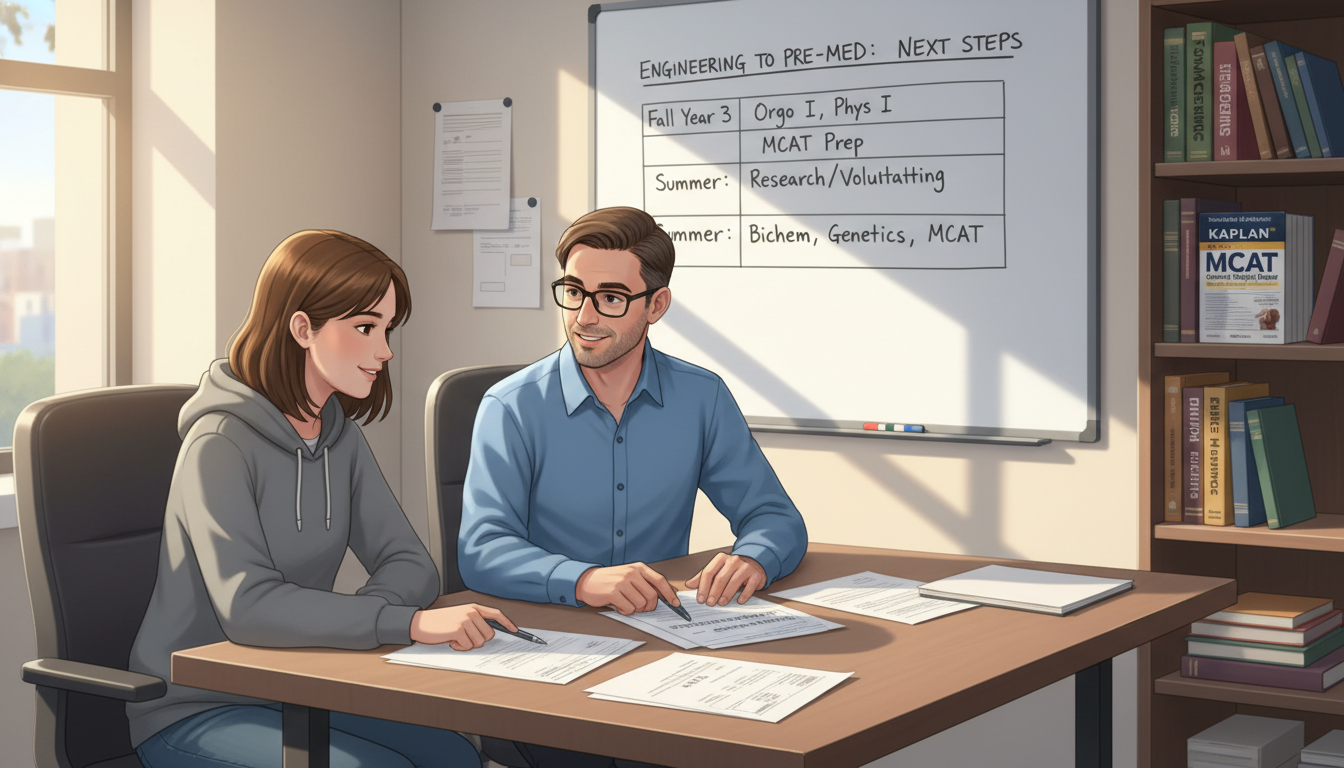
Build a Rough 4–6 Semester Grid
Take a blank spreadsheet and create columns for:
- Fall [Year 3]
- Spring [Year 3]
- Fall [Year 4]
- Spring [Year 4]
- (If needed) Fall [Year 5]
- (If needed) Spring [Year 5]
Then, from your degree audit:
- Drop in your required engineering courses in the semesters they are offered
- Insert the pre‑med classes around them
- Aim for no more than:
- 1 “killer” science course + lab plus 1 heavy engineering design/project course in the same term
- 14–16 credits per standard semester for sanity, more only if you’ve proven you can handle it
Common pattern for a rising junior engineering student pivoting to pre‑med:
- Junior Fall:
- Organic Chem I + lab
- Upper‑level engineering course(s)
- Psych or Soc
- Junior Spring:
- Organic Chem II + lab
- Remaining lower‑level engineering
- Bio I + lab (or push to summer)
- Summer after Junior:
- Bio I or II + lab
- Senior Fall:
- Biochem
- Bio II + lab
- Engineering electives/capstone
- Senior Spring:
- Finish engineering degree
- Light additional elective (ethics, writing, or humanities)
This is just one way. The real grid depends on your school’s course rotations. Your actionable move: after meeting with your advisor, schedule a second meeting with someone in your pre‑health/pre‑med office and walk them through a draft plan.
Step 4: Protect and Improve Your GPA Starting Now
You don’t control the past 4 semesters. You do control the next 4–6.
Admissions look at:
- Cumulative GPA
- Science GPA (BCPM: bio, chem, physics, math)
- Trend over time (upward trend can partially “repair” a rough start)
If your engineering coursework gave you:
- 3.6+ overall: you’re in strong shape
- 3.3–3.5: workable, but you need an upward trend and strong MCAT
- Below 3.3: you’ll likely need a sustained upward trend and maybe more time/post‑bac later
What you do now:
Stop thinking in terms of “average” semesters.
You can’t afford more “meh” 3.0 terms. Every semester from now should be engineered (pun intended) to showcase upward capability.Do not overload with ego‑schedules.
If you’re thinking: “17 credits: thermo, signals, orgo I + lab, bio I + lab, plus volunteering and research,” that’s a red flag. You’re not proving toughness by risking a 2.9 semester.If you had weak earlier grades, consider retaking ONLY if:
- Your school allows grade replacement and
- The course was a core pre‑med prerequisite and
- You received a C– or below
Otherwise, better to move forward and crush the later, harder courses.
Use each science course as a test case.
When you take organic chemistry and biochemistry, treat them as “mini‑MCAT prep” and GPA anchors. A’s here send a massive positive signal.
If your GPA right now is shaky, the next two years are about proving the trajectory. That is more valuable than a rushed, “on‑time” graduation.
Step 5: Build Clinical Exposure and Service into Your New Path
You’re not just behind on courses—you’re probably behind on experiences.
Med schools will expect:
Sustained clinical exposure
- Hospital volunteering
- Scribing
- Medical assistant roles
- Hospice, clinics, EMT, etc.
Shadowing physicians
- Multiple specialties if possible
- At least 20–40 hours; 50–100+ is better over time
Service to others, not just in healthcare
- Tutoring, mentoring, community work, shelters, crisis lines, etc.
As an engineering major now turning pre‑med, do this:
This summer or upcoming term, lock in at least one clinical role.
- Apply for hospital volunteer positions
- Look for scribe jobs (they often like STEM majors)
- Ask local clinics about volunteering or assistant roles
Begin shadowing deliberately.
- Ask family doctor, campus health physicians, or hospital contacts:
“I’m a college student switching from engineering to pre‑med and would love to shadow to better understand the work. Could I observe you for a few half‑days this summer or during breaks?”
- Ask family doctor, campus health physicians, or hospital contacts:
Keep a simple log.
- Date, hours, location, physician, brief reflection (what you saw, what you learned)
This makes future applications and personal statements much easier.
- Date, hours, location, physician, brief reflection (what you saw, what you learned)
Don’t try to “catch up” in one semester. What matters is that from sophomore summer onward, there’s a clear, sustained pattern of involvement.
Step 6: Plan Your MCAT with Your New Academic Reality
You’re changing direction late. The MCAT needs to be planned, not squeezed in.
MCAT content relies on:
- Bio I & II
- Gen chem I & II
- Organic I (II is helpful but less central)
- Biochemistry
- Physics I & II
- Intro Psych & Soc
- CARS (reading and reasoning; any writing‑heavy course helps)
You want to take the MCAT when:
- You’ve completed at least: bio, gen chem, orgo I, physics, biochem, psych, soc
- You can dedicate a solid 3–4 months of focused prep (can overlap with a light semester or summer work, but not with the heaviest engineering term of your life)
Common pivot‑MCAT strategies:
- Take MCAT after junior year summer, then apply at the end of senior year with a gap year (you apply summer after senior, matriculate the next year).
- Take MCAT spring of 4th year, then apply that summer; again, likely with a gap year.
Trying to take the MCAT midway through your heaviest engineering/pre‑med semester usually leads to mediocre scores or burned‑out minds. If you’re switching after sophomore year, a gap year to align everything is not a failure; it’s often the smart move.
Step 7: Shape the Story: How You’ll Explain the Switch
You need a coherent narrative, not a dramatic confession.
Med schools will wonder:
- Why engineering first?
- Why medicine now?
- Is this a panicked reaction or a mature decision?
- Can you handle the academic and emotional demands of a medical career?
Start building your answer now, as you live it, not 3 years from now.
A strong version of your story often looks like:
- You liked math/physics and thought engineering fit
- Experiences (research, project work, health exposure, personal/family health event) pulled you toward the human‑facing side of problem‑solving
- You realized you were more energized by solving problems with and for people than by focusing on systems/components alone
- You tested that interest: clinical exposure, shadowing, volunteering, conversations with physicians
- Then you committed: adjusted your major/plan, took the pre‑med courses, performed well, gained clinical experience, and stayed engaged
What does not land well:
- “I couldn’t hack engineering, so I’m trying medicine instead.”
- “I just realized medicine makes more money.”
- “I watched Grey’s Anatomy and it looked cool.”
You’re allowed to change your mind. Just show it’s a thoughtful pivot, grounded in experience, not fantasy.
Step 8: Use Your Engineering Background as a Strength, Not an Apology
You may feel “behind” traditional pre‑meds. Stop thinking that way.
Engineering gives you:
- Quantitative rigor
- Systems‑level thinking (hugely useful in medicine)
- Comfort with complex problem‑solving
- Experience with teamwork on technical projects
- Often, exposure to design, ethics, or applied research
You can leverage this in:
- Personal statement: framing medicine as another form of problem‑solving where the “system” is the patient and context, not just the device
- Activity descriptions: engineering projects that taught you communication, persistence, error‑checking
- Interviews: specific examples where engineering thinking helped you solve messy, real‑world problems
As you add clinical experience, your narrative becomes:
“I started in engineering because I loved solving complex, technical problems. Over time, through [X experiences], I realized I wanted to apply that same analytical mindset to patient care—where the variables are human, not just mechanical. So I adjusted my coursework, added clinical exposure, and tested this path. The more I did, the more medicine felt like the right fit.”
That’s a strong, believable story.
Step 9: Build a Support System So You Don’t Do This Alone
A late pivot to pre‑med is stressful. You’ll have moments of “I’m too late” and “I ruined everything.” You need people and systems around you.
Concrete moves:
- Identify one academic advisor who understands both your major and your pre‑med intent.
- Connect with your school’s pre‑health office and actually attend their info sessions and advising.
- Find 1–2 older students who are engineering‑to‑med (ask advisors if they know alumni or current applicants).
- Tell your close circle (family, partner, key friends) what you’re doing and why, so you’re not hiding the stress.
You’ll also want to protect your mental health. Combining heavy STEM courses, new clinical commitments, and MCAT prep can get dark if you try to white‑knuckle the whole journey.
Step 10: The Very Next Actions to Take This Month
You don’t need a 5‑year plan fully locked in tonight. You just need the next stack of steps.
Over the next 7–14 days:
Schedule a meeting with your engineering academic advisor.
- Ask: “If I stay in engineering but add pre‑med prerequisites, what’s my graduation timeline?”
- Get a printed or PDF degree audit.
Schedule a meeting with your pre‑health/pre‑med advisor.
- Bring your unofficial transcript.
- Ask: “Given my background and GPA, what’s a realistic application timeline?”
- Start mapping courses and MCAT timing together.
Identify at least one clinical experience to apply for.
- Hospital volunteer, scribe, clinic volunteer, EMT course, etc.
- Submit applications or emails—do not just bookmark them.
Rough‑draft a semester‑by‑semester plan for courses (even if it changes).
- Focus on not doubling up your hardest engineering and hardest pre‑med classes in the same term.
Start a simple reflection document.
- One page where you jot down: why you’re pivoting, what events or experiences pushed you toward medicine, what you’ve learned so far.
This will evolve into your personal statement later.
- One page where you jot down: why you’re pivoting, what events or experiences pushed you toward medicine, what you’ve learned so far.
You’re not too late. You’re just at a fork that requires deliberate planning.
Open your degree audit or unofficial transcript right now and sketch your remaining semesters on paper—then mark where you’ll put Biology, Organic Chemistry, and Biochemistry. That single page will turn an anxious “I’m lost” into the beginning of an actual roadmap.