
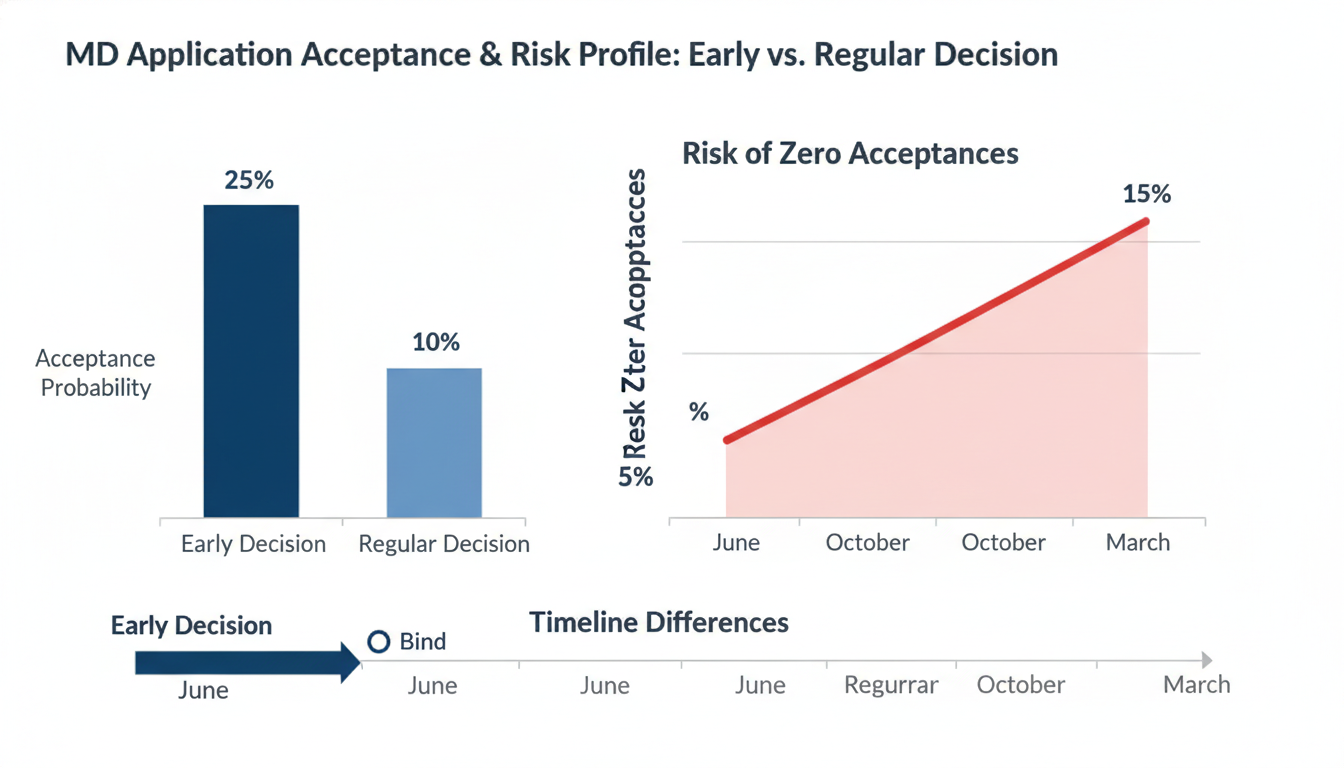
Only 2–3% of MD applicants use Early Decision, yet at many schools their acceptance rate is 2–4 times higher than the regular pool.
That single statistic drives most of the confusion: if Early Decision (ED) acceptance rates are so high, why does almost everyone still apply Regular Decision (RD)? The data show that the answer is much more about risk and constraints than about raw odds.
Below is a numbers‑driven look at early decision vs regular MD applications—acceptance patterns, risk profile, and how different applicant types fare based on GPA, MCAT, and school selectivity.
1. What Early Decision Actually Changes (Structurally and Statistically)
At the AMCAS MD level, "Early Decision Program" (EDP) means something very specific:
- You apply to one MD school by a strict early deadline.
- You cannot submit AMCAS to any other MD school until that decision is released.
- If accepted, the offer is binding.
- If not accepted (usually notified by October 1), you are released to apply elsewhere—but you are now late.
From a decision‑theory perspective, you are trading:
- Option value (ability to choose among many acceptances)
for - Probability boost at a single institution (often sizable), plus a major timing penalty if you are rejected.
Raw Acceptance Probability: ED vs Regular
Let us look at concrete examples from published school data. Numbers will vary year to year, but the pattern is stable.
Example 1: University of Michigan (illustrative pattern)
(Using representative values; exact numbers change annually but the ratio is consistent.)
Early Decision:
- Applicants: ~70
- Accepted: ~35
- Acceptance rate: ~50%
Regular Decision:
- Applicants: ~8,000
- Accepted: ~500
- Acceptance rate: ~6–7%
Here, the ED acceptance rate is roughly 7x higher than the RD rate.
Example 2: Mid‑selectivity state school (composite pattern)
ED:
- Applicants: ~90
- Accepted: ~30
- Acceptance rate: ~33%
RD:
- Applicants: ~4,000
- Accepted: ~300
- Acceptance rate: ~7–8%
Here, ED is about 4–5x higher than RD.
Yet despite these large multiples, national utilization is tiny. AAMC data typically show only 1,500–2,000 EDP applicants out of 55,000+ MD applicants each year—roughly 3%.
The reason: that high acceptance rate is only meaningful if the school is a good statistical fit for your numbers and profile. Otherwise the risk overwhelms the benefit.
2. Acceptance Patterns: Who Actually Gains from Early Decision?
The data show three core factors determine whether ED makes sense:
- Your MCAT relative to a school’s matriculant median.
- Your GPA (especially science GPA).
- Your state residency and mission fit.
MCAT and GPA Positioning
Think of a school’s class as a distribution:
- Matriculant MCAT median: 515
- Typical middle 50%: 511–519
- Matriculant GPA median: 3.8
- Typical middle 50%: 3.7–3.9
Now plot three hypothetical applicants:
Applicant A – Slightly above target
- MCAT: 516
- GPA: 3.83
- In‑state, strong mission alignment
Applicant B – At target
- MCAT: 514
- GPA: 3.78
- In‑state, solid fit but not extraordinary
Applicant C – Below target
- MCAT: 509
- GPA: 3.65
- In‑state, good story, but clear academic gap
Admissions offices rarely publish exact ED vs RD acceptance probabilities at each MCAT/GPA combination, but internal modeling and published scatterplots suggest patterns like:
For A‑type applicants (slightly above median, in‑state)
- RD acceptance probability at that school: maybe 25–35%
- ED acceptance probability at that same school: often 50–65%
- ED roughly doubles the chance at that specific institution.
For B‑type applicants (right at median)
- RD: maybe 12–18%
- ED: perhaps 25–35%
- Benefit exists but is smaller, and risk becomes more salient.
For C‑type applicants (below median)
- RD: <5–8%
- ED: often still <10–15%
- You are “playing up”; the ED bump does not fully compensate for the academic gap. Now you layer extra risk onto already low base odds.
The AAMC’s "Table A‑23" (MCAT/GPA grid) for all MD applicants shows that:
- 3.8–4.0 GPA, 514–517 MCAT group has about 70–75% overall MD acceptance.
- 3.6–3.8 GPA, 510–513 MCAT group has about 55–60% overall MD acceptance.
- 3.4–3.6 GPA, 506–509 MCAT group is down to around 35–40%.
ED will not magically move you from the bottom band to the top. It primarily concentrates your probability at one school and removes diversification.
3. Risk Profile: What You Give Up When You Lock Into One School
The ED vs RD decision is a classic expected‑value problem with asymmetric risk.
Scenario Modeling: Single School vs Broad Application
Assume you are contemplating:
- ED to your in‑state public school.
- Or RD to 20 schools selected carefully.
Baseline Regular Decision Strategy
Suppose each of your 20 schools has an independent acceptance probability like this:
- 1 “reach” school: 5%
- 9 “target” schools: 15% each
- 10 “safety‑leaning” schools: 25% each
The chance of at least one acceptance is:
- For the reach: 1 – (1 – 0.05) = 5%
- For the 9 targets: 1 – (1 – 0.15)^9
- (1 – 0.15) = 0.85
- 0.85^9 ≈ 0.23
- So probability of at least one target acceptance ≈ 77%
- For the 10 safer schools: 1 – (1 – 0.25)^10
- 0.75^10 ≈ 0.056
- So probability of at least one safer school ≈ 94.4%
Now combine them (independent approximations):
- Probability of no acceptance anywhere ≈ (0.95) × (0.85^9) × (0.75^10)
≈ 0.95 × 0.23 × 0.056
≈ 0.012
That is about 1.2%.
So your chance of at least one MD acceptance during a well‑designed RD cycle is ~98–99% in this model. Obviously real life is messier (correlations, yield strategies, screening), but the principle stands: broad, targeted RD applications distribute your risk.
Early Decision Strategy
Now suppose:
- ED at your in‑state school where your ED acceptance probability is estimated at 40%.
- If rejected (60% chance), you then apply RD in October to 15–20 schools, but late in the cycle.
The late‑cycle penalty is hard to quantify, but admissions deans consistently acknowledge it. A rough, conservative estimate:
- Interview slots fill early.
- Late applicants with equivalent stats may be 30–50% less likely to be interviewed and accepted compared with early applicants.
Suppose that your “effective” acceptance probabilities drop as follows because you are late:
- Reach: from 5% to 3.5%
- Targets: from 15% to 9%
- Safer: from 25% to 15%
Re‑run the RD model for a late application set of, say, 18 schools (3 reach, 7 target, 8 safer):
- No reach acceptance: (0.965)^3 ≈ 0.90
- No target acceptance: (0.91)^7 ≈ 0.49
- No safer acceptance: (0.85)^8 ≈ 0.27
Probability of no acceptance after ED rejection:
- 0.90 × 0.49 × 0.27 ≈ 0.12 (about 12%)
Overall:
- Chance accepted via ED: 40%
- If ED reject (60%), chance later RD success: 1 – 0.12 = 88%
Total chance of at least one MD acceptance in the ED pathway:
- 0.40 + 0.60 × 0.88
= 0.40 + 0.528
= 0.928 or about 93%
Compare that to the 98–99% in the well‑planned all‑RD scenario.
The data logic:
- ED can raise your probability at one school.
- But for many solid applicants, it lowers your overall probability across all schools because of lost time and diversification.
This is why deans often state: ED is best for applicants who already have high overall acceptance odds and are school‑specific in their priorities.
4. Risk by Applicant Type: Where ED Helps vs Hurts
Using the AAMC MCAT‑GPA grid and typical school medians, we can build three broad premed profiles and examine their risk.
Profile 1: Strong In‑State Applicant (ED Favored)
- GPA: 3.85
- MCAT: 517
- AAMC grid group: ~80–85% overall MD acceptance
- Target school medians: MCAT 514, GPA 3.80
- In‑state, strong alignment with mission and clinical exposure in that system
For this applicant:
RD with a broad, realistic list might produce:
- 40–60% chance at the in‑state school.
- 1–3 other acceptances at similar schools.
- Overall probability of at least one acceptance ~95–99%.
ED at the in‑state school may:
- Raise that specific institution’s probability to 65–75%.
- Slightly reduce total acceptance probability to, say, 93–97% because of timing risks if rejected.
But for some students, that tradeoff is rational because:
- In‑state costs might be $20,000–$30,000 per year cheaper than private schools.
- Lifetime cost difference over 4 years can exceed $80,000–$120,000.
- They have strong geographic or family reasons to stay local.
Here ED is not primarily about increasing the chance of any MD acceptance. It is about increasing the chance of acceptance at one high‑value school.
Profile 2: Middle‑Band Applicant (ED Usually Neutral to Harmful)
- GPA: 3.68
- MCAT: 511
- Grid group: ~55–60% overall MD acceptance
- In‑state school medians: 512 MCAT, 3.75 GPA
This applicant is:
- Slightly below the school’s numbers.
- Reasonable but not especially strong academic fit.
RD approach:
- Apply to 18–22 schools with medians of 509–513 and GPA 3.6–3.8.
- Expected "at least one" acceptance probability typically in the 70–85% range if the rest of the application is solid.
If they use ED to their higher‑median in‑state school:
- ED acceptance probability maybe 12–18%, given they are below median.
- If they miss, they now apply late to a set of 18–20 schools.
- Late timing may pull their overall cycle success down to the 60–70% range.
Mathematically, ED here does not consistently move them into a more favorable probability zone. It mostly compresses their options and injects time risk.
Profile 3: Borderline or Reinvention Applicant (ED High Risk)
- GPA: 3.45 (upward trend)
- MCAT: 507
- Grid group: ~35–40% overall MD acceptance
- In‑state medians: 510 MCAT, 3.70 GPA
For such an applicant, the AAMC grid shows acceptance is possible, but they typically need:
- Broad lists with multiple lower‑median MD schools.
- Strategic inclusion of DO schools to reach a total acceptance probability in the 60–70%+ range.
ED here is generally a negative expected‑value move:
- Even with a "bump," ED acceptance probability at the in‑state MD school might be ~8–12%.
- The late timing would then strongly reduce the odds of MD and DO acceptances at other schools.
The data‑driven path is almost always:
- Broad RD MD + DO applications, early in the season.
- Or postponing the cycle until there is stronger academic reinforcement.
5. Timing Dynamics: Why Being Late After ED Matters So Much
The AMCAS calendar creates a compounding effect on ED risk:
- AMCAS opens submissions: late May / early June
- Applications transmitted to schools: June
- Secondaries start: June–July
- Interviews: typically start August and ramp through November
- ED decision deadline: October 1
If you do ED and are rejected:
- You start sending primaries to other schools in October.
- Secondaries are then turned around in October/November.
- Many schools have already:
- Filled a large segment of their interview slots.
- Established an early "academic profile" for their incoming class.
Deans often describe October applicants as “competing for fewer remaining spaces,” even if the formal deadline is later.
Quantitatively:
- At some schools, 50–70% of interview invites may go out by mid‑October.
- Some highly selective programs front‑load over 80%.
If your profile is already average at a school, being part of the late group may drop your probability of interview from, say, 20% down to 10–12%. That loss cascades into lower acceptance probability.
Regular Decision applicants who:
- Submit in June,
- Pre‑write secondaries,
- Complete them within 1–2 weeks,
systematically capture these early interview opportunities.
6. Special Cases and Constraints: When ED Is Almost the Only Rational Path
There are two notable exceptions where the data and structure strongly favor ED or make it almost mandatory.
6.1 Linked Undergraduate–Medical School Programs
Some undergraduate institutions have highly structured linkage agreements with specific medical schools:
- Example: Certain post‑bacc linkage programs to Drexel, Temple, or other MD schools.
- Students who meet defined GPA/MCAT thresholds apply in a special early channel.
Here:
- ED is often part of the program design.
- The school may reserve a fixed number of seats specifically for this pipeline.
- Acceptance probabilities for those who meet criteria can exceed 70–80%, dramatically higher than the general applicant pool.
The decision is less about ED vs RD and more about: do you want to commit to this pipeline vs a fully open market?
6.2 Very Strong Geographic or Family Constraints
Consider an applicant who:
- Must remain in a specific metro area due to caregiver responsibilities or immigration/work restrictions.
- Has only one realistic MD option in commuting range.
- Stats are above or near the top of that school’s matriculant distribution.
If they do not apply ED:
- The school might see them as one of many strong RD applicants and may assume lower yield.
- ED sends a clear binding signal, which added to strong numbers, can significantly raise acceptance probability.
From a utility perspective:
- 70% chance at the local school via ED,
- vs 40% via RD but with very limited ability to relocate,
may justify the ED risk even if overall MD acceptance probability falls slightly.

7. How to Decide: A Data‑Driven Checklist
A quantitative approach to the ED vs RD decision can be boiled down to a structured checklist.
Step 1: Benchmark Your Numbers
Using the latest MSAR (or school‑published data), compute:
- ΔMCAT = Your MCAT – School median MCAT
- ΔGPA = Your GPA – School median GPA
Rough guidance for ED at that school:
Ideal ED candidate:
- ΔMCAT: +1 to +3 points
- ΔGPA: 0 to +0.1
- In‑state or mission‑aligned
Borderline ED candidate:
- ΔMCAT: –1 to 0
- ΔGPA: –0.05 to 0
- Needs very strong tie to institution
High‑risk ED candidate:
- ΔMCAT ≤ –2
- ΔGPA ≤ –0.1
- ED unlikely to compensate for the academic gap.
Step 2: Estimate School‑Specific ED Gain
Where possible (admissions presentations, published stats):
- Look at ED acceptance rate vs overall.
- Compute the ratio: ED acceptance rate / RD acceptance rate.
For example:
- ED: 40%, RD: 8% → ratio = 5
- ED: 20%, RD: 10% → ratio = 2
Higher ratios suggest a bigger ED benefit at that school. But if your personal profile is below their median, you will not capture the average ED rate.
Step 3: Model Your Total‑Cycle Acceptance Probability
Use approximate scenarios:
- Project your target list of RD schools with their medians.
- Classify them as reach/target/safer and assign conservative probabilities (e.g., 5%, 10–15%, 20–25%).
- Compute, or at least reason about, "probability of at least one acceptance" across the list.
Then:
Simulate ED + late RD workflow with reduced school‑specific probabilities.
Compare:
- P(any MD acceptance | RD only, early)
- vs P(any MD acceptance | ED at School X + late RD elsewhere)
Step 4: Factor in Cost and Non‑Academic Utility
Even if ED slightly lowers your overall acceptance probability, it may be rational if:
- In‑state ED school is substantially cheaper, and
- You estimate a high enough ED probability at that school, and
- Willing to accept a smaller chance of ending up at a higher‑priced private institution elsewhere.
A simple cost‑utility frame:
- Estimate 4‑year tuition+fees differences between your ED school and plausible RD options.
- Multiply those cost differences by their approximate probabilities in both scenarios.
- A swing of >$80,000–$100,000 in expected cost can be meaningful, especially if the probability tradeoff is small.
Early Decision vs Regular MD applications is not a question of "Is ED good or bad?" The data show it is a niche tool: highly advantageous for a narrow set of applicants whose stats slightly exceed a specific school’s medians and who deeply prefer that school, and disproportionately risky for everyone else.
You now have the quantitative framework to classify yourself: Are you that ideal ED candidate, or do the numbers argue for a broad, early RD strategy with more diversification and less timing risk?
With those calculations in hand, your next step is to translate them into a concrete school list, timeline, and application strategy that fits your actual MCAT, GPA, and constraints. That is where your personal data meets real‑world choices—and that decision mapping is the next part of your journey.