
The biggest myth in premed planning is that you must know your major on day one or you are already behind. That is wrong.
If you move with intention, you can start completely undecided and be medically competitive in just four semesters. The key is a disciplined roadmap, not a declared major.
Below is a concrete, semester‑by‑semester academic plan that takes you from “no idea what to major in” to “med‑ready and on track,” without blowing up your GPA or your options.
(See also: Gap Year Before Med School for tips on maximizing your time.)
The Core Strategy: Protect Options, Front‑Load Flexibility
Before we dive into the four semesters, you need one guiding principle:
Your first four semesters should protect three options at the same time:
- You can still choose almost any major.
- You can still apply to medical school on a normal timeline.
- You can still graduate in 4 years without course overloads every term.
You achieve this by:
- Completing universal premed prereqs early.
- Satisfying common general education (GE) categories.
- Sampling 2–3 likely majors strategically.
- Keeping science rigor high but not reckless.
Think of it like building a “common trunk” that branches into any major + premed.
Semester 1: Build the Foundation Without Burning Out
Goal: Survive and stabilize. Prove you can handle college‑level work, especially in science, while learning how you study best.
Target credit load: 14–16 credits. Avoid taking 18+ credits your first term unless you are absolutely forced to. GPA is your first priority.
Core Moves for Semester 1
- Lock in your first science sequence
You want to start one major science sequence that:
- Satisfies premed requirements.
- Counts toward many majors (bio, chem, neuroscience, psych, engineering).
In most schools, that means one of:
Option A (common and safe): General Chemistry I + Lab
- Example: CHEM 101 + 101L (4–5 credits)
- This keeps biology, chemistry, biochem, neuroscience, and many STEM majors open.
Option B (if you are math‑strong and strongly leaning quantitative): Calculus I
- Example: MATH 121 (3–4 credits)
- This is especially useful for majors like biology (BS tracks), engineering, physics, or certain economics majors.
If you can, do both Gen Chem I + Lab and Calculus I only if:
- You had strong high school preparation (AP/IB honors), and
- You are not stacking another heavy science with lab this term.
- Start your writing/English requirement
Medical schools expect:
- One year of college‑level writing / English composition (often 2 courses).
Start with:
- Freshman Writing / Composition I
- Example: ENGL 101 or WRTG 105 (3 credits)
- This also meets a GE requirement almost everywhere.
- Take one exploratory course toward a likely major
You are undecided, but you are not clueless. You probably have 2–3 candidates in mind, like:
- Biology
- Psychology
- Neuroscience
- Public health
- Chemistry
- Economics
- Philosophy
Pick one 100‑level course that:
- Counts toward that major, and
- Also fulfills a GE (social science, humanities, etc.)
Examples:
- PSYC 101: Introduction to Psychology (social science GE + psych major)
- PHIL 101: Introduction to Philosophy (humanities GE + philosophy major)
- ECON 101: Microeconomics (social science GE + econ major)
- Fill remaining credits with a lighter but useful GE
Choose something:
- Reading/writing heavy but not technically complex, or
- Conceptual STEM without lab, depending on your strengths.
Examples:
- Sociology 101 (valuable for MCAT + social science GE)
- Anthropology 101
- Public Health 101
- History or political science survey
- Avoid this mistake
Do not take:
- General Chemistry I + Lab
- Biology I + Lab
- Calculus I
- And a heavy writing course
All in your very first semester. That is a classic GPA trap.
Sample Semester 1 Schedules
Conservative but solid (15 credits):
- CHEM 101 + 101L – General Chemistry I with Lab (4)
- ENGL 101 – College Writing I (3)
- PSYC 101 – Intro to Psychology (3)
- SOCI 101 – Intro to Sociology (3)
- First‑year seminar / orientation class (2)
More aggressive (16 credits), if very strong in math/science:
- CHEM 101 + 101L – General Chemistry I with Lab (4)
- MATH 121 – Calculus I (4)
- ENGL 101 – College Writing I (3)
- PHIL 101 – Intro to Philosophy (3)
- 1‑credit seminar or study skills course (1–2)
Semester 2: Commit to Premed, Still Flex on Major
Goal: Finish year one with clear evidence you can handle science and with 2–3 realistic major options still alive.
Target credit load: 15–16 credits.
Core Moves for Semester 2
- Continue your science sequence
Almost always:
- General Chemistry II + Lab
- Example: CHEM 102 + 102L (4–5 credits)
This positions you to start Organic Chemistry by Year 2, which keeps you on a traditional premed timeline.
If you started calculus instead of chem in Semester 1:
- Add General Chemistry I + Lab now and delay Gen Chem II to fall of Year 2.
- This will slightly shift your MCAT timing, but is still workable.
- Add your first biology or psychology with lab (if prepared)
Choose based on interest and strength:
- BIO 101 + 101L – Intro Biology I with Lab
Good if you lean biologic sciences / neuroscience.
or
- PSYC 2XX – Research Methods / Statistics in Psychology (if allowed this early)
Good if leaning psych/neuro/behavioral health.
If your Semester 1 was rough (GPA < 3.2):
- Consider a non‑lab science instead and start labs in Year 2 to rebuild GPA confidence.
- Complete or continue your writing sequence
Take:
- ENGL 102 / Writing II / Research Writing (3 credits)
- Add a second potential major sampler
You tested one domain in Semester 1. Now test another, with rules:
- It must be 100‑/200‑level.
- It must count toward a major.
- It preferably meets a GE.
Examples:
- For public health interest: PUBH 101 – Intro to Public Health
- For neuroscience interest: NEUR 101 – Intro to Neuroscience
- For humanities interest: HIST 101 – World or US History survey
- Start basic statistics if possible
Statistical literacy matters for:
- Med school
- MCAT (psych/soc)
- Many majors
If you can fit it:
- MATH/STAT 201 – Introductory Statistics (3 credits)
If not, plan it for Semester 3.
Sample Semester 2 Schedules
Classic bio‑leaning premed (16 credits):
- CHEM 102 + 102L – General Chemistry II with Lab (4)
- BIO 101 + 101L – Intro Biology I with Lab (4)
- ENGL 102 – College Writing II (3)
- SOCI 101 – Intro to Sociology (3) or PSYC 101 if not yet taken (3)
- 2‑credit seminar / language / wellness course (2)
Balanced with stats and exploration (15–16 credits):
- CHEM 102 + 102L – General Chemistry II with Lab (4)
- STAT 201 – Intro Statistics (3)
- PSYC 101 – Intro to Psychology (3)
- HIST 101 – Survey History (3)
- 1–3 credits: language or elective
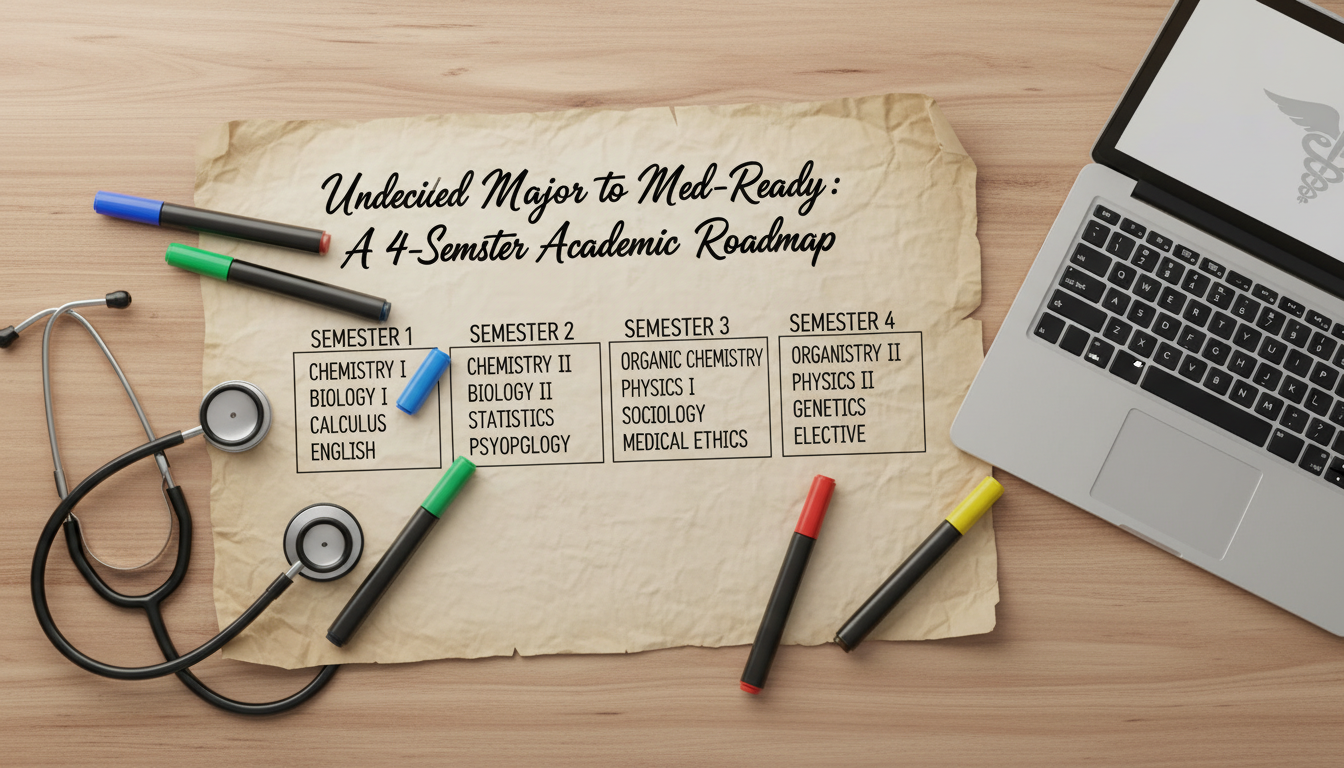
Semester 3: Declare a Direction, Not Lifetime Destiny
Goal: Declare or strongly lean toward a major, while staying fully aligned with premed timelines.
This is the semester where many undecided students either:
- Lock into a realistic, compelling major, or
- Realize their first love (e.g., engineering) will crush their GPA and pivot intelligently.
Target load: 15–17 credits. By now you know your academic capacity.
Big Decision: Which Major Lane Makes Sense?
By the start of Semester 3, you should be ready to answer:
“If I had to pick a major today that I could complete in 4 years and maintain a 3.6+ GPA, what would it be?”
Not your dream. Your probable.
Common premed‑friendly majors that still allow flexibility:
- Biology (BA or BS)
- Psychology
- Neuroscience
- Biochemistry
- Public Health
- Human Physiology / Health Science
- Sociology (especially if you like MCAT psych/soc content)
You do not need a science major for med school. But:
- Science majors can align more naturally with prerequisites.
- Non‑science majors require extra planning to fit all sciences without overload.
Core Moves for Semester 3
- Start Organic Chemistry I + Lab (if you completed Gen Chem I & II)
- CHEM 201 + 201L – Organic Chemistry I with Lab (4–5 credits)
This is a high‑risk, high‑importance course. Plan your schedule around it.
- Start Biology I or II depending on your track
If you have not taken biology:
- BIO 101 + 101L – Intro Biology I with Lab (4 credits)
If you completed Bio I in Semester 2:
- BIO 102 + 102L – Intro Biology II with Lab (4 credits)
- Begin major‑specific core courses
Now that you are leaning toward or declaring a major:
- Take 1–2 courses that are:
- Required for that major,
- At the 200‑level if prepared, and
- Not labs in the same semester as Organic Chemistry, if avoidable.
Examples:
- For psych: PSYC 201 – Research Methods; PSYC 2XX – Biological Bases of Behavior
- For public health: PUBH 201 – Epidemiology; PUBH 2XX – Global Health
- For sociology: SOCI 201 – Social Theory
- Finish statistics if not yet done
Stat courses that work well:
- PSYC/STAT 201 – Statistics for Behavioral Sciences
- MATH/STAT 201 – Intro to Statistics
- Begin language progression or remaining GE categories
You do not want to be scrambling for humanities / language requirements in Year 4 while interviewing. Use this semester to:
- Continue or start a language sequence, or
- Knock out remaining core humanities/arts courses.
Sample Semester 3 Schedules
Science major (biology) example (16 credits):
- CHEM 201 + 201L – Organic Chemistry I with Lab (4)
- BIO 102 + 102L – Intro Biology II with Lab (4)
- STAT 201 – Intro Statistics (3)
- PSYC 101 – Intro to Psychology (3)
- Language 101 or humanities elective (2)
Non‑science major (psychology) example (16–17 credits):
- CHEM 201 + 201L – Organic Chemistry I with Lab (4)
- BIO 101 + 101L – Intro Biology I with Lab (4)
- PSYC 201 – Research Methods in Psychology (3)
- STAT 201 – Statistics for Behavioral Sciences (3)
- 2–3 credits: language or humanities GE
Notice in both: Organic Chemistry I is paired with only one other serious lab. That is deliberate.
Semester 4: Lock Your Major, Solidify the Premed Spine
Goal: By the end of your fourth semester, you should:
- Have a declared major or a written plan to declare by start of Year 3.
- Be on track to finish all core premed prerequisites by end of Year 3.
- Have GPA data that tells you whether a traditional MCAT / app timeline (between Year 3 and Year 4) is realistic.
Target load: 15–17 credits.
Core Moves for Semester 4
- Complete Organic Chemistry II + Lab (or finish Organic I if delayed)
- CHEM 202 + 202L – Organic Chemistry II with Lab (4–5 credits)
If your school compresses organic into one semester or a 3‑semester sequence, adjust accordingly. The goal: have at least one semester of orgo done by the end of Year 2, ideally both.
- Advance in biology or a second key science
Depending on what you have:
If you completed Bio I and II:
- Start Cell Biology, Genetics, or Physiology (3–4 credits, with or without lab).
If behind on biology:
- Take BIO 102 + 102L – Intro Biology II with Lab (4).
If eligible and well‑prepared:
- Start Physics I (algebra‑based or calculus‑based) only if your schedule is not overloaded with orgo + another heavy lab.
- Deepen into your major
Take 1–2 courses such as:
- 200‑ or 300‑level major requirements.
- Writing‑intensive or seminar‑type courses in your chosen field.
Examples:
- PSYC 2XX – Abnormal Psychology
- BIO 2XX – Genetics
- PUBH 2XX – Health Policy
- PHIL 2XX – Bioethics (also great for med‑school interviews)
- Finish or advance any remaining GE / language requirements
You want Year 3 for:
- MCAT prep.
- Clinical, research, and leadership experiences.
- Upper‑level science.
So you close as many GE loops as possible now.
- Create your full 4‑year academic map this semester
By mid‑Semester 4, sit down with:
- Your degree audit.
- Premed prerequisites list.
- Your institution’s course rotation (which semesters courses are offered).
And build the rest of your timeline, including:
- When you will take Physics I & II.
- When you will take Biochemistry.
- When you will take upper‑level biology (e.g., physiology, microbiology).
- When you intend to take the MCAT (end of Year 3 is common).
- Whether you are planning a gap year.
Sample Semester 4 Schedules
Aggressive but realistic premed load (16–17 credits):
- CHEM 202 + 202L – Organic Chemistry II with Lab (4)
- BIO 2XX – Genetics or Cell Biology (with or without lab) (3–4)
- PHYS 101 – Physics I (no lab, if allowed) (3–4) or a non‑lab major course
- Major course – 200‑level (3)
- Humanities / language GE (2–3)
Balanced for GPA protection (15–16 credits):
- CHEM 202 + 202L – Organic Chemistry II with Lab (4)
- PHIL 2XX – Bioethics (3)
- Major course – 200‑level seminar (3)
- Humanities / arts GE (3)
- Language 102 or elective (2–3)
Parallel Tracks: What You Should Do Outside the Classroom
Your academic roadmap is necessary but not sufficient. Medical schools evaluate full context.
Here is how your four semesters should look in terms of experiences.
Year 1 (Semesters 1–2): Exposure and Habits
Priorities:
Learn to study effectively. Explore:
- Active recall
- Spaced repetition
- Group study boundaries
Gain light exposure to medicine:
- 2–3 shadowing sessions with different specialties.
- Join premed or health‑related clubs (1–2, not 6).
Start community or campus service:
- Volunteering at a clinic, hospital, crisis line, tutoring, or community center.
Rule: Class performance > extracurricular density. Build sustainable study systems first.
Year 2 (Semesters 3–4): Depth and Direction
Priorities:
Stabilize your major decision.
Take on more sustained involvement:
- Regular weekly clinical volunteering.
- A research assistant role if available (even unpaid).
- Leadership track in one organization you actually care about.
Start MCAT awareness:
- Familiarize yourself with MCAT sections.
- Begin slow, light content review end of Semester 4 if planning MCAT after Year 3.
Build relationships with 2–3 professors for future letters of recommendation.
Common Pitfalls That Derail the Undecided‑to‑Premed Plan
You have only four semesters to keep your options open without chaos. These are the traps that ruin that flexibility.
1. Overloading on Labs Too Early
Typical mistake:
- Semester 2: Gen Chem II + Lab, Bio I + Lab, Calculus, Writing II
Even for strong students, that is volatile. Your early GPA is your buffer for later semesters.
Fix:
Limit to two lab sciences max per semester, preferably just one in Year 1.
2. Chasing Prestige Majors while Ignoring GPA Reality
A 3.2 in Chemical Engineering is still a 3.2.
Medical schools rarely give heavy “bonus points” for difficult majors. What they actually see is:
- Your cumulative GPA
- Your science GPA
- Your trend (upward/downward)
Fix protocol:
- After Semester 2, review:
- Overall GPA
- Science GPA
- If < 3.4 and you are in a traditionally brutal major, seriously reassess whether that major is worth the risk.
3. Waiting Too Long to Confirm Your Major
Undecided through end of Year 2 can cause:
- Extra semesters to graduate.
- Overloaded junior/senior years.
- Less time for MCAT prep and experiences.
Fix:
Use Semesters 1–3 to sample, then lock a plan in Semester 4 at the latest.
4. Ignoring Course Sequencing and Prerequisite Chains
Example:
- Your school only offers Biochemistry in spring, but you realize in Year 3 you lack Organic II, making Biochem impossible before the MCAT.
Fix:
- During Semester 4, build a prerequisite map:
- What requires what?
- Which semesters are they offered?
- How do they fit around MCAT timing?
How This 4‑Semester Plan Sets You Up for the MCAT and Beyond
By following this roadmap, at the end of Semester 4 you will typically have:
Completed:
- General Chemistry I & II + labs
- Organic Chemistry I & II + labs (or at least Organic I)
- 1–2 semesters of Biology + lab
- 2 semesters of English / writing
- Statistics
- Intro Psychology and/or Sociology (huge for MCAT psych/soc)
In progress / planned:
- Physics I & II (usually in Year 3)
- Biochemistry (Year 3)
- Upper‑level biology (physiology, genetics, etc.)
This means:
- You can take the MCAT late spring / early summer after Year 3 with nearly all tested coursework completed.
- You can realistically apply in the summer after Year 3 (no gap year) or choose a gap year for a stronger application without academic chaos.
Practical Checklists by Semester
Use these quick checks at the end of each term.
End of Semester 1 Checklist
- GPA ≥ 3.5 or clear plan to improve.
- Completed at least one major science (Chem I or Bio I or Calc I).
- Completed or started writing/English requirement.
- Sampled at least one potential major via intro course.
- Joined 1–2 meaningful clubs or started basic volunteering.
End of Semester 2 Checklist
- General Chemistry sequence complete or planned (I & II).
- Taken at least one biology or psychology course.
- English / writing sequence complete.
- Two potential majors still viable and interesting.
- Early exposure to clinical environment and premed advising.
End of Semester 3 Checklist
- Organic Chemistry I complete or in progress.
- 2–3 core courses complete that count toward a likely major.
- Statistics completed or on schedule.
- Short list of 1–2 majors you can finish in 4 years with strong GPA.
- At least one faculty member starting to know you well.
End of Semester 4 Checklist
- Organic Chemistry sequence completed (or clear timeline if compressed).
- Intro bio sequence completed or upper‑level bio started.
- Major declared or declaration scheduled with concrete plan.
- GE/core requirements mapped so you do not get stuck later.
- Preliminary MCAT + application timeline decided (with or without gap year).
FAQ (Exactly 4 Questions)
1. What if my first semester GPA is low? Am I already out for medical school?
No. A single rough semester is survivable. Action steps:
- Meet with academic support and your premed advisor.
- Reduce science/lab load for Semester 2 if necessary.
- Switch to a slightly lighter GE or non‑lab science.
- Aim for strong upward trends. A pattern of 3.7–3.8 after a 2.8–3.0 first term can still be competitive, especially with a solid MCAT.
You are out only if you ignore the warning sign and repeat the same pattern.
2. Do I absolutely need to take Organic Chemistry in Year 2?
Not absolutely, but it is preferred if you want to apply without a gap year. If you delay Organic to Year 3:
- You must either:
- Take the MCAT later (after Orgo), or
- Self‑study significant organic chemistry content for the MCAT.
If your foundation is shaky, it can be safer to push Organic to Year 3 and adjust your MCAT/app timeline than to fail it in Year 2.
3. Can I be a non‑science major and still follow this roadmap?
Yes. The backbone is the same:
- Year 1–2: General chem, biology, stats, psych/soc, writing.
- Year 2–3: Organic chem, physics, biochemistry, upper‑level science.
Your major courses will simply be in another field (e.g., history, music, philosophy). You just must be more intentional about fitting in the sciences without overwhelming any single semester.
4. When should I officially stop calling myself “undecided”?
From an administrative standpoint: by the end of Year 2 at the latest. From a planning standpoint: by mid‑Semester 4, you should have a detailed 4‑year plan built around a chosen major. You can still pivot later, but every pivot after that point must be strategic and based on concrete conversations with advisors, not vague discomfort.
Open your current or planned course schedule right now and compare it, semester by semester, to this four‑semester roadmap. Where are you overloaded, underprepared, or missing key pieces? Adjust one upcoming semester today so that your path moves from “undecided” to truly med‑ready.