
The question “Post‑bacc or SMP?” is the wrong first question.
The real question is: “Do I need to prove I can handle med school, or just clean up and complete my pre‑med record?”
Once you answer that, the choice usually becomes obvious.
Let’s break this down like a decision tool, not a vague discussion.
(See also: What Counts as ‘Clinical Experience’ for Medical School Admissions? for more details.)
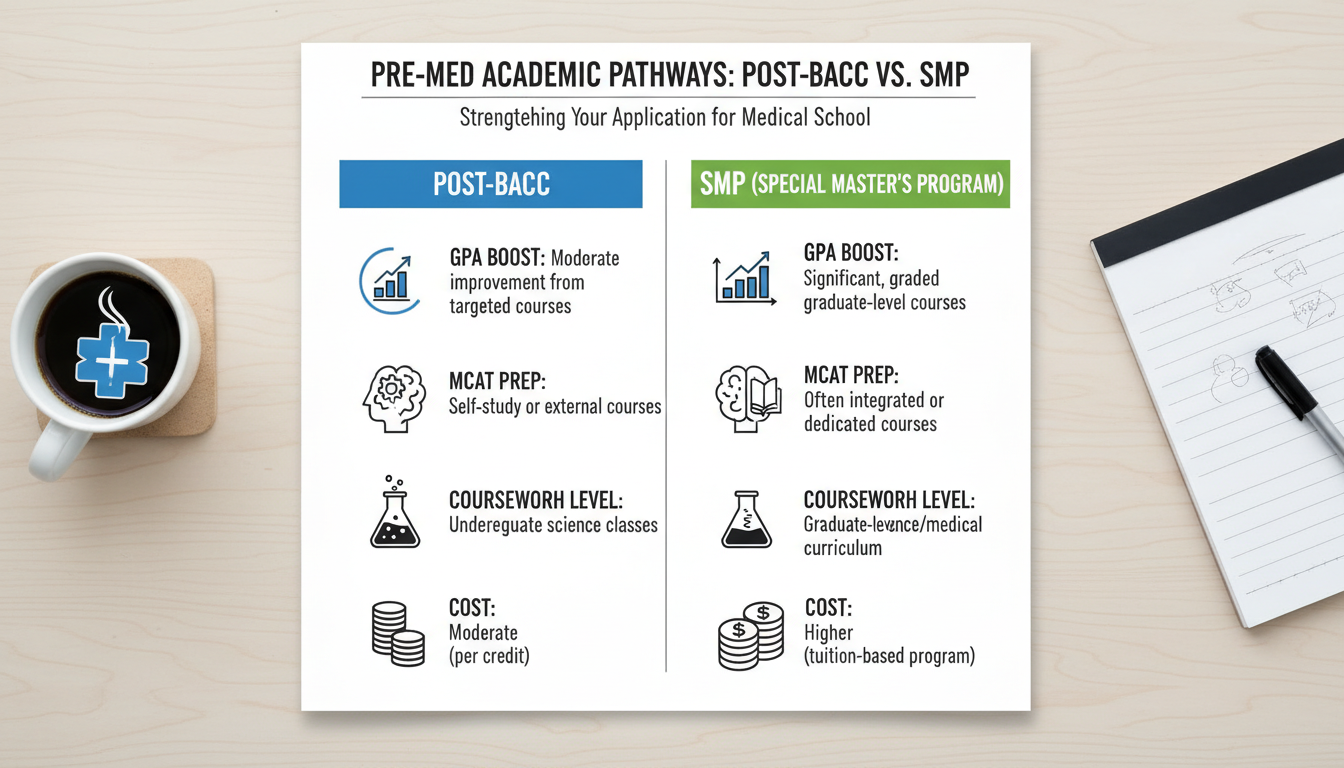
The Core Difference: What Post‑Baccs and SMPs Actually Signal
Here’s the cleanest way to think about it:
Undergrad/post‑bacc coursework says:
“I can succeed in demanding college‑level science classes.”SMP (Special Master’s Program) coursework says:
“I can survive and excel in medical‑school‑level coursework, often side‑by‑side with M1s.”
So:
- If your weakness is unfinished prerequisites, non‑science background, or a choppy academic start, a post‑bacc is usually the right move.
- If your weakness is a low undergraduate GPA (especially science), patterns of poor performance, or you’ve already done a lot of repair work without big improvement, an SMP may be more appropriate.
Both can help. But they help in different ways and are designed for different problems.
Step 1: Diagnose Your Situation (Brutally Honestly)
Before you pick anything, you need a clear snapshot of where you are.
Ask yourself:
What’s my undergraduate GPA?
- cGPA and sGPA (BCPM: biology, chemistry, physics, math)
- Rough ranges:
- 3.6+ – Generally competitive (depending on school/MCAT)
- 3.3–3.5 – Borderline; needs strategic support
- 3.0–3.3 – Significant concern; needs strong repair
- <3.0 – Major academic rehabilitation needed
How many core pre‑med prerequisites have I completed?
- Gen chem, orgo, bio, physics, biochem, stats, sometimes psych/soc
What’s my MCAT (or practice test) situation?
- No MCAT yet
- Practice scores stuck below ~505
- Official score <500, 500–507, or 508+
What’s the story behind my grades?
- Upward trend?
- Alternating good and bad semesters?
- One catastrophic term? Health/family crises?
What’s my timeline and risk tolerance?
- Need to start med school ASAP?
- Able to accept high cost and risk?
- Willing to consider DO and not just MD?
Keep this in mind as we walk through each option.
What a Post‑Bacc Is Best For (and When It’s Enough)
Post‑bacc programs come in a few flavors, but the ones most relevant to you as a pre‑med are:
Career‑changer post‑baccs
- For students who never took the pre‑med prereqs (or took very few)
- Structured programs, usually 1–2 years
- Cohort, advising, MCAT support, committee letter
- Example: Bryn Mawr, Goucher, Scripps, Columbia, etc.
Record‑enhancer post‑baccs
- For students who did take the prereqs but underperformed
- Focused on upper‑level undergrad science (physiology, micro, genetics, etc.)
- Goal is a strong upward trend and higher sGPA
- Can be formal (structured) or informal (you design it at a local university)
A post‑bacc is usually better if:
- Your cGPA and sGPA are in the ~3.1–3.4 range, especially with:
- A solid upward trend in your last 30–60 credits
- Weak early semesters but stronger later performance
- You haven’t completed all the core pre‑med courses
- You’re a career changer (business, engineering, humanities major, etc.)
- Your big need is: "I must raise my GPA and finish my prereqs"
- You’re not yet ready for medical‑school‑level intensity
- You want more flexibility (DIY post‑bacc at a local state school, for example)
- Your MCAT is untested or currently weak, and you need more foundational science before retaking
What med schools “hear” when they see a strong post‑bacc:
- “This applicant grew academically and matured.”
- “Their early undergrad doesn’t define them anymore.”
- “They can handle a demanding science load now.”
If you can get ~3.7+ GPA in 24–36 credits of upper‑level sciences in a post‑bacc, that’s powerful—especially if your MCAT backs it up.
When post‑bacc alone may not be enough:
- UG GPA < 3.0 that only gets up to ~3.1–3.2 after a post‑bacc
- Multiple F’s/D’s without retakes
- Very inconsistent record without a long, clear upward trend
- You’ve already done a lot of undergrad repair and it’s still not moving the needle
In those cases, an SMP (or a very carefully engineered long‑term plan) might be warranted.
What an SMP Is Best For (and When It’s Worth the Risk)
An SMP (Special Master’s Program) is not just “more school.”
It’s usually:
- Graduate‑level or med‑school‑level coursework
- Often taken alongside M1 students, or using a med school’s actual curriculum
- 1 year (sometimes with an optional 2nd year for research or thesis)
- Expensive and high stakes
The key distinction: SMPs are for high‑risk, high‑reward academic rehabilitation. They are not for “nice‑to‑have” polishing.
An SMP may be the better choice if:
- Your undergrad GPA is significantly low, especially:
- cGPA <3.0 or sGPA <3.0
- Or 3.0–3.2 with flat/weak trend and prior repair attempts
- You’ve already done:
- Some post‑bacc work or extra science credits
- But med schools still see your academic record as a concern
- You need to send a loud, unambiguous signal:
- “I can handle med‑school‑level coursework. Period.”
- You want a direct linkage to a specific med school (for some SMPs):
- Example: certain SMPs offer interviews or conditional acceptances if you hit GPA/MCAT thresholds
What med schools “hear” when they see a strong SMP:
If you crush it (think 3.6+ in a rigorous SMP with legit med‑school‑style courses):
- “This applicant can absolutely handle M1 content.”
- “Their old GPA is no longer the full story.”
- “They’ve proven success under conditions very similar to ours.”
But here’s the hard truth:
- A mediocre SMP performance (e.g., 3.0–3.3) can hurt you more than no SMP at all.
- It tells schools: “You struggled even at the repair stage.”
When SMPs are especially strategic:
- You have:
- cGPA around 3.0–3.2
- MCAT of maybe 505–510 (or strong practice scores)
- Strong recent performance in undergrad/post‑bacc but an ugly early GPA anchor
- You’re aiming for:
- MD and DO both, but want to maximize MD chances
- Or you’re reapplying after previous rejection due to academics
- You’re comfortable with:
- Taking on major loans
- Living in a high‑pressure environment where anything less than excellent can backfire
Cost, Risk, and Reality: Post‑Bacc vs SMP
Let’s compare them on the big levers that actually matter.
1. Academic Risk
Post‑bacc: Medium risk.
- If you get a 3.5 instead of a 3.8, it’s not ideal, but it’s not fatal.
- You can sometimes retake key courses or spread them over more semesters.
SMP: High risk.
- You’re under intense pressure.
- Many SMPs expect you to match or outperform current med students.
- A low GPA can confirm adcom fears instead of resolving them.
2. Financial Cost
Post‑bacc:
- DIY at a state school: Often the most cost‑effective path.
- Formal programs: Can still be expensive but often less than SMPs.
- You can sometimes work part‑time.
SMP:
- Often very expensive (think private school graduate tuition + fees).
- Usually requires full‑time commitment.
- You’re stacking this on top of future med school debt.
3. Impact on Application
Post‑bacc:
- Great for:
- Smoothing trends
- Finishing or retaking prereqs
- Pushing GPAs over key cutoffs (3.0, 3.3, 3.5)
- Med schools look at:
- Trend and consistency
- Difficulty of courses
- Total number of credits
- Great for:
SMP:
- High‑impact if:
- Strong reputation of program
- You outperform med students or class average
- Some SMPs have:
- Formal or informal linkage
- Guaranteed interview if you hit specific bars
(but not guaranteed admission—don’t confuse the two)
- High‑impact if:
How to Decide: A Simple Framework
Here’s a rough decision framework you can adapt:
If your main issues are:
- You haven’t finished prereqs
- You changed careers into medicine
- You have limited science background
- Your GPA is 3.3+ with an upward trend, but you need more proof
→ Lean strongly toward a post‑bacc
If your main issues are:
- cGPA or sGPA below ~3.2, especially if:
- Large chunk of weak grades early in undergrad
- Already completed most core prereqs
- You’ve done some GPA repair but your numbers are still:
- Below common automatic screens (e.g., 3.0)
- You need a bold, decisive academic turnaround signal
→ Consider an SMP, but only if:
- You’re confident you can excel under high intensity
- You have a realistic MCAT plan (ideally 505+ or trending there)
- You accept the financial and academic risk
If you’re somewhere in the gray zone:
- cGPA around 3.2–3.4
- Solid upward trend in last 60 credits
- Haven’t yet done much targeted repair
- Unsure of your MCAT potential
A smart starting move is usually:
- Add 1–2 semesters of upper‑level science (post‑bacc style):
- At least 12–20 credits
- Aim for 3.7–4.0 in these classes
- Take the MCAT once your foundation and practice scores are solid
- Re‑evaluate:
- If you end up with cGPA ~3.4, sGPA ~3.5, and MCAT 510+ → You may not need SMP.
- If your GPA is still dragging or MCAT is marginal → Then reevaluate whether SMP or DO schools or a longer post‑bacc is more realistic.
How to Choose Specific Programs (Once You Know Your Path)
Once you know post‑bacc vs SMP, don’t just pick randomly.
For post‑baccs, prioritize:
- Structure vs flexibility:
- Need hand‑holding, advising, cohort? Formal.
- Need cheaper and more control? DIY at a local college.
- Reputation and outcomes:
- Look up where their students actually matriculate.
- Linkage options:
- Some formal post‑baccs have formal linkages to med schools.
- Location and finances:
- Commuting from home can save you tens of thousands.
For SMPs, prioritize:
- Affiliation with a med school:
- Strongly prefer programs that are embedded in or tightly linked to a med school.
- Curriculum:
- Are you taking real M1 courses? Graded alongside medical students?
- Track record:
- Ask directly: “What percentage of your grads matriculate into MD/DO within 2 years?”
- Support and expectations:
- What GPA do they consider successful?
- What happens if you underperform?
Actionable Next Step (Today)
Pull up your transcripts right now and calculate:
- Cumulative GPA
- Science GPA
- Last 30–60 credits GPA
Then ask yourself:
- Do I mainly need more and better undergrad science → probably post‑bacc.
- Or do I need to prove I can crush med‑school‑level work despite a low GPA anchor → consider SMP.
Write that conclusion down. That’s your starting point.
FAQ: Post‑Bacc vs SMP for Pre‑Meds
1. If I do an SMP, do med schools ignore my undergrad GPA?
No. They’ll always see your full undergraduate record. A strong SMP doesn’t erase a low GPA, but it can override concerns by showing you can now handle high‑level work. Both GPAs will be on the table, and schools will look at the full trajectory.
2. Is it better to do a DIY post‑bacc or a formal post‑bacc program?
It depends on your needs. A DIY post‑bacc at a local university is cheaper and more flexible but requires you to self‑manage course selection, advising, and MCAT planning. Formal post‑baccs often offer better advising, structured curriculum, linkage agreements, and committee letters—but cost more. If you’re organized and cost‑conscious, DIY can absolutely work.
3. Can I do both a post‑bacc and an SMP?
Yes, but it should be intentional. A common path: do a post‑bacc first to build recent success and raise GPA; if your GPA is still too low for your target schools, then consider an SMP. Going straight from a poor undergrad record into an SMP without proving you can ace post‑bacc‑level work can be very risky.
4. How many credits of post‑bacc work do med schools want to see?
There’s no official number, but a good rule of thumb is at least 20–30 credits of recent, strong science (3.7+ if possible). Enough credits that a clear trend is visible and not just a “one good semester” blip. If your earlier record was very weak, you may need more.
5. If I’m aiming mainly for DO schools, do I still need an SMP?
Often not. DO schools tend to be more forgiving of lower GPAs—especially with strong upward trends, good post‑bacc work, and a solid MCAT. Many applicants get into DO programs with a carefully done post‑bacc and don’t need the cost and risk of an SMP. An SMP might still help, but it’s not mandatory for most DO‑focused applicants.
6. What MCAT timing works best with post‑bacc or SMP plans?
For post‑baccs, many students finish most of their key science courses and then take the MCAT, so the material is fresh. For SMPs, you usually want a competitive MCAT before starting or early in the program, because you don’t want to study for the MCAT while juggling med‑school‑level classes. In both cases, don’t rush the MCAT; it should match and reinforce your academic repair, not undermine it.
Open your unofficial transcript on your screen right now and highlight your last 30–60 science credits. That pattern—not just your overall GPA—is going to drive whether a post‑bacc or an SMP is the smarter play for you.