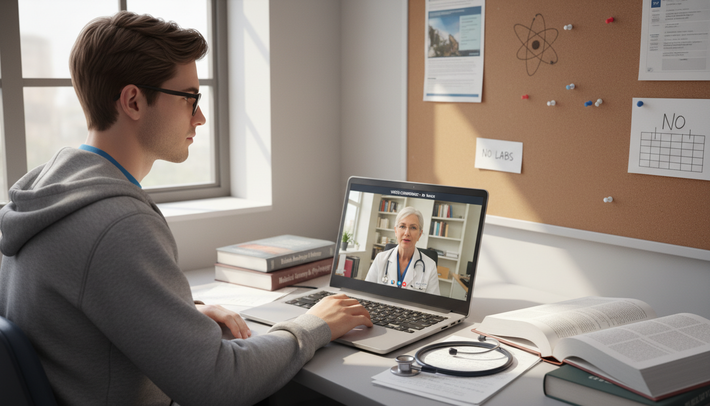
Most premeds misunderstand what actually counts as clinical experience — and admissions committees can tell.
If you only remember one line from this: clinical experience means direct, meaningful exposure to patient care in a real healthcare setting where patients are being diagnosed, treated, or managed.
Shadowing alone won’t cut it. Working in a lab won’t cut it. Volunteering “in a hospital” but never seeing or talking to patients often doesn’t cut it either.
Let’s break down exactly what does and doesn’t count — and how to build a clinical profile that actually impresses medical schools.
What Medical Schools Really Mean by “Clinical Experience”
When admissions committees say they want “clinical exposure” or “clinical experience,” they’re looking for 3 core things:
- Proximity to patients – You’re physically present where patient care happens (hospital, clinic, hospice, nursing home, pre-op, ER, etc.).
- Contact with patients – You interact with patients or their families in a way that affects their experience or care (even in a small way).
- Insight into healthcare delivery – You see how physicians and teams diagnose, treat, communicate, and make tough decisions.
Here’s the key:
You don’t have to be performing medical procedures for it to count as clinical. But you do have to be close enough to patient care that you’re:
(See also: Is a Post‑Bacc or SMP Better for Strengthening My Pre‑Med Record? for more details.)
- Hearing their stories
- Observing their struggles
- Watching how the team works around them
- Contributing in some way to their comfort, information, or logistics
If your role could be done in a regular office without any patients around, it’s probably not clinical.
Activities That Clearly Count as Clinical Experience
These are the types of roles admissions committees instantly recognize as clinical, assuming you’re actually doing what the job title implies.
1. Clinical Volunteering with Direct Patient Contact
This is the classic premed lane — and it still works.
Examples that count:
Hospital volunteer on a patient floor
- Bringing patients water or blankets
- Helping transport patients
- Assisting staff with non-medical tasks in patient rooms
- Talking with lonely or anxious patients
Emergency department volunteer
- Escorting patients and families
- Sitting with patients who are waiting
- Helping with check-in, comfort measures, restocking in patient areas
Hospice volunteer
- Sitting with patients at end-of-life
- Providing companionship, reading, talking with families
- Helping with non-clinical comfort tasks
Nursing home / assisted living volunteer
- Running activities with residents
- Feeding assistance if trained
- Spending time in residents’ rooms or common spaces
These roles are powerful because they put you right in the middle of human vulnerability, illness, and communication — exactly what med schools want you to experience.
2. Paid Clinical Roles with Patient Interaction
If you can get trained and hired into a direct-care role, that’s gold.
Common examples that count:
- Medical assistant (MA) – Taking vitals, rooming patients, recording histories, assisting in procedures.
- Certified nursing assistant (CNA) – Direct daily care: helping with bathing, feeding, transfers, monitoring comfort. Some CNAs later pursue graduate nursing paths such as an MSN FNP program.
- Emergency medical technician (EMT) – Responding to 911 calls, assessing patients, transporting them to hospitals.
- Patient care tech / patient care assistant – Similar to CNAs in hospitals; often on inpatient units.
- Scribe – Documenting patient encounters in real time while shadowing physicians and seeing full clinical reasoning.
All of these put you in the flow of real medicine. You see what physicians do, how the team functions, and what patients experience.
3. Substantial Physician Shadowing
Shadowing is often overhyped, but it does count as clinical exposure — just not usually as your only clinical activity.
Examples that count:
Following a physician through clinic days
- Sitting in on patient visits
- Observing history-taking and physical exams
- Listening to counseling and shared decision-making
Shadowing in the OR
- Watching surgeries
- Seeing pre-op and post-op conversations
- Understanding how surgical teams coordinate
Shadowing across different settings
- Primary care clinic
- Inpatient wards
- Emergency department
- Subspecialty clinics
Shadowing is typically more passive clinical experience, but it still counts if you’re inside the exam room, hearing real patient-doctor interactions.
4. Hotline, Counseling, and Support Roles Linked to Healthcare
Some “nontraditional” roles absolutely qualify as clinical, even if you’re not in a hospital.
These can count as clinical if:
- You’re interacting with people about health-related problems, and
- You’re integrated into a healthcare or social service system.
Examples:
- Crisis hotline worker for mental health or suicide prevention
(especially if connected to a hospital or mental health service) - Planned Parenthood or community health clinic volunteer doing intake, patient navigation, or counseling
- Patient navigator or case manager assistant helping people access care, understand treatment plans, or overcome barriers
These experiences show you the psychosocial side of medicine and patient struggles outside the exam room.

Activities That Might Count as Clinical (Depends on What You Actually Do)
Some roles sit in a gray zone. Whether they count as clinical depends on how much real patient interaction you have.
1. Hospital Volunteer Roles Without Patient Contact
For example:
- Sorting supplies in a basement
- Delivering mail to staff offices only
- Working only at the front desk without interacting with patients about medical issues
If you never go into patient areas and never speak with patients or families in a health-related context, it’s not really clinical. It’s community service in a healthcare building.
You can sometimes fix this by:
- Asking your volunteer coordinator for a more patient-facing placement
- Shifting to a unit where you’re on the floor (oncology, med/surg, ER, etc.)
- Taking on extra responsibilities that involve patients more directly
2. Public Health and Community Outreach
These can sometimes count as both clinical and nonclinical, depending on the details.
Gray-zone examples:
- Health fairs – If you’re counseling people on screenings, blood pressure, vaccines, or health behaviors, and working under clinical supervision, that’s usually clinical.
- Vaccination clinics – Helping with check-in, patient flow, and post-vaccine observation can be clinical.
- Community health worker roles – If you’re routinely helping patients manage conditions, attend appointments, understand medications, etc., that’s clinical.
But if your role is mostly:
- Data entry
- Behind-the-scenes logistics
- Purely administrative work with no direct patient contact
Then med schools will probably see it as public health or service, not clinical exposure.
3. Research with Patient Interaction
Clinical research is another gray area.
It leans clinical if you:
- Consent patients for studies
- Administer questionnaires to patients
- Escort patients to study visits
- Observe clinical assessments as part of research
- Spend time talking with patients about their health in a structured way
It leans nonclinical if you only:
- Analyze datasets
- Work in a lab
- Do chart reviews
- Run statistics with no patient contact
Most applications will have you list research primarily as “Research,” but you can still describe the patient-contact parts in a way that highlights clinical exposure.
What Clearly Does Not Count as Clinical Experience
A shocking number of premeds list these as their main “clinical” activities and then wonder why their apps fall flat.
1. Basic Science or Wet Lab Research
Even if the disease you’re studying is cancer or Alzheimer’s, if:
- You never see patients
- Your work is all cells, mice, or computer screens
- You’re isolated from actual care settings
…it’s research, not clinical experience.
Still valuable. Just doesn’t replace being around real patients.
2. Generic Volunteering That Just Happens to Be Near a Hospital
Examples:
- Fundraising walks for hospitals
- Running charity drives for a medical nonprofit
- Office assistant roles at a hospital foundation
- Working in the hospital cafeteria with no patient interaction
This is community service, not clinical exposure.
3. Purely Administrative Healthcare Jobs
Examples:
- Billing and coding with no patient contact
- Back-office insurance processing
- Scheduling from a call center with minimal health discussion
- IT support in a hospital
You might learn about the healthcare system, but you don’t see the patient-physician relationship or direct care.
4. Scribing Done Remotely with No Real-Time Clinical Integration
Some virtual scribe or documentation roles have you:
- Logging into an EHR
- Transcribing dictated notes
- Never seeing or hearing the actual patient encounter
That’s borderline. True scribing means listening to live or near-live patient interactions. If you’re only working with text after the fact, it’s not really clinical.
How Much Clinical Experience Do You Actually Need?
There’s no magic number, but here’s a practical framework:
Minimum bar (for most MD/DO schools):
~100–150 hours of real clinical exposure with actual patient contact.More competitive range:
200–400+ hours spread over at least 6–12 months.Excellent positioning:
400–800+ hours across different settings (e.g., scribe + hospital volunteer + hospice).
Forgiveness exists for nontraditional students, career changers, and people with heavy work/family responsibilities, but you still need enough patient exposure to show:
- You know what you’re getting into
- You’ve seen sick, scared, and dying patients up close
- You’ve watched physicians and teams work over time
Depth matters as much as hours. A year as a CNA at 8–10 hours/week beats 20 different scattered “volunteer events” with vague hospital connections.
How to Describe Clinical Experience on Your Application So Committees Respect It
Even if your role is borderline, you can make it clear it’s clinical by:
Emphasizing patient interaction
- “I spent most of my shift in patient rooms, talking with patients and families.”
- “I assisted nurses with basic patient care tasks like feeding and transport.”
Highlighting what you observed about physicians and the team
- “Working alongside hospitalists, I watched how they communicated complex diagnoses to families.”
Showing emotional and ethical insight
- “Many patients were at the end of life, and I learned how different families process grief and uncertainty.”
Avoid vague descriptions like “helped staff,” “supported patients,” or “performed tasks.” Be concrete. Use verbs like:
- Transported
- Listened
- Observed
- Comforted
- Monitored
- Assisted (with what, specifically?)
If you’re unsure whether something counts as clinical, imagine an interviewer asking:
“Tell me about a patient you remember from that experience.”
If you can’t answer with a real story where you interacted directly, it’s probably not strong clinical exposure.
Putting It All Together: A Solid Clinical Experience Strategy
Here’s a simple, realistic plan for a typical premed:
Year 1–2 (or early in the process):
- Start volunteering in a hospital or clinic 2–3 hours/week in a patient-facing role.
- Aim for >100 hours over the first year.
- Get comfortable talking to patients and staff.
Year 2–3:
- Add a paid or higher-responsibility clinical role if possible:
- CNA, MA, EMT, scribe, or patient care tech.
- Continue or deepen your original role (consistency matters).
Year before applying:
- Maintain 4–8 hours/week of clinical exposure.
- Ensure your experiences span at least 12–18 months total.
- Gather a few strong patient stories and reflections you can speak about in your personal statement and interviews.
If you’re late in the game and don’t have much clinical experience, don’t panic — but don’t ignore it. Prioritize getting something real in place, even if it means pushing your application back by one cycle. A strong extra year of clinical work is often the difference between “borderline” and “admit.”
FAQ: Clinical Experience for Medical School
1. Does virtual clinical experience count for medical school?
It depends. Virtual shadowing or telehealth observation can supplement in-person experiences but should not replace them. If you’re observing real-time patient encounters over telehealth, that’s some degree of clinical exposure. But if it’s just lectures, case discussions, or recorded sessions without patient interaction, med schools will treat it more like education, not true clinical experience.
2. Is scribing considered clinical experience?
Yes, in-person or live virtual scribing is considered clinical experience. You’re present (physically or virtually) for real patient visits and you see full histories, exams, and decision-making. Scribing is especially strong because you’re exposed to clinical reasoning and documentation. Just make sure your role is truly integrated with active patient encounters, not just post-hoc note editing.
3. Does working as a pharmacy tech count as clinical experience?
Pharmacy tech roles are generally considered adjacent clinical exposure, but not as strong as direct patient-care roles. If you regularly counsel patients at the counter, answer health-related questions, and interact with people about their medications and conditions, you can argue it has clinical elements. Still, it’s wise to pair this with more traditional clinical experiences where you’re clearly seeing physicians and patient care directly.
4. Is mental health crisis line or peer counseling work clinical?
Often yes, or at least very close. If you’re working with people in crisis about self-harm, depression, anxiety, or other mental health issues, and your role is structured, supervised, and integrated with healthcare or social services, many med schools will view that as legitimate clinical or clinical-adjacent experience. It’s especially valuable if you’re considering psychiatry or primary care. Just be very clear in your descriptions about what you actually did.
5. How much shadowing do I really need if I have other clinical experience?
If you have strong, hands-on clinical roles (MA, CNA, EMT, scribe, etc.), you don’t need huge amounts of shadowing. Around 30–50 hours of shadowing multiple physicians across a few specialties is usually enough to show you’ve seen physicians’ day-to-day life. The goal of shadowing is breadth and perspective, not racking up hundreds of hours.
6. I volunteered “in a hospital” but mostly stocked supplies. Can I still list it as clinical?
You can still list it as an experience, but it’s not strong clinical exposure if you rarely interacted with patients. On your application, be honest about what you did. If you had even occasional patient contact, you can mention those moments, but don’t try to oversell it as your primary clinical experience. If this is your main exposure, your best move is to find a more patient-facing role before you apply.