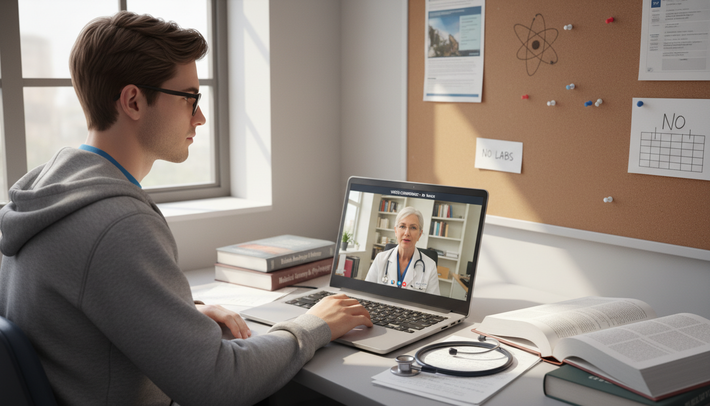
What actually matters more for getting into medical school: research or clinical experience?
That’s the decision most serious pre-meds wrestle with once they realize there are only so many hours in a week. You have classes, maybe a job, and then you hear some people say, “You must do research,” while others insist, “Admissions cares mostly about clinical exposure.”
Here’s the answer:
For most applicants, clinical experience is non‑negotiable; research is strategic.
(See also: Is It Okay to Take a Gap Year Before Medical School, and How Many? for more on timing your experiences.)
Let’s break down exactly how to decide where you should put your time.
The Core Rule: Clinical Is Required, Research Is Conditional
If you remember nothing else, remember this:
- You cannot get into medical school without meaningful clinical exposure.
- You can get into medical school without research, unless you’re targeting research‑heavy schools or MD‑PhD.
Think of clinical experience as proof that:
- You understand what doctors actually do.
- You’ve seen patients up close.
- You’re making an informed decision about medicine.
Think of research as:
- A way to show academic curiosity and higher‑level thinking.
- A major plus for certain schools and certain career goals.
- Optional but powerful, if it matches your interests and target programs.
So the first decision isn’t “research vs clinical.”
It’s: “Do I already have strong clinical experience?”
If the answer is no, research is secondary. Full stop.
What Admissions Committees Expect From Clinical Experience
You do not need 1,000 hours in the hospital. But you do need:
- Exposure to patients and the clinical environment
- Longitudinal involvement (over time, not just a 2‑week burst)
- Reflection on what you learned about medicine and yourself
Typical “core” clinical experiences:
- Hospital volunteering (transport, unit volunteer, ED, etc.)
- Scribing in an ER or outpatient clinic
- Medical assistant work
- Hospice or clinic volunteer
- EMT work with real patient contact
- Free clinic volunteering
Shadowing falls in a gray zone: it is important, but it’s not enough by itself because it’s usually passive. Aim for:
- ~40–60 hours of shadowing (minimum across 2–3 specialties)
- Several hundred hours of active clinical involvement over at least a year
Baseline targets for a competitive typical MD applicant:
These are not rules, but useful ballparks:
- Shadowing: 40–100 hours
- Direct clinical experience (volunteering, MA, scribe, EMT, etc.):
150–300+ hours over at least 6–12 months
If you’re non‑traditional or already work clinically (e.g., RN, paramedic, RT), you may hit this naturally.
What you should be able to say in your application:
- “I’ve seen chronic illness, acute emergencies, and routine visits.”
- “I’ve seen physicians at good and bad moments.”
- “I’ve interacted with patients myself, not just watched from the wall.”
If you cannot say those things honestly yet, prioritize clinical work over research until you can.
When Research Truly Matters (and When It Doesn’t)
Research is not a universal requirement, but it is a significant advantage in specific scenarios:
Research is high‑yield for:
Top‑tier, research‑heavy MD schools
Places like Harvard, UCSF, Penn, Hopkins, Stanford, Columbia, and many state flagships with strong academic reputations often expect or strongly favor research.MD‑PhD / physician‑scientist pathways
Non‑negotiable. MD‑PhD programs want:- Significant research time (often 1–2+ years total)
- Evidence of ownership/independence in a project
- Strong letters from research mentors
Students drawn to academic medicine
If you’re already thinking, “I want to do oncology research” or “I want to be a neurosurgeon at an academic center,” then lab or clinical research makes sense early.
Research is nice but not essential for:
- Many mid‑tier and state MD schools focused on training clinicians
- DO schools
- Applicants whose stats or life circumstances limit time
In these cases, solid clinical work, non‑clinical service, and strong academics often beat mediocre, box‑checking research.
What “Counts” as Real Research?
Not all research experiences are equal. Admissions committees look for:
- Substantive involvement: You did more than wash dishes or enter data.
- Understanding of the question: You can explain what the project asked and why it mattered.
- Time commitment: Ideally at least 1 year, or an intense summer.
- Mentor evaluation: A strong letter saying you were thoughtful, reliable, and responsible.
Publications and posters help, but they’re not required for most MD programs. Focus more on:
- Consistency
- Responsibility
- Your ability to discuss your project clearly
Decision Framework: How To Choose Between Research and Clinical
Here’s a simple way to decide what to prioritize based on where you are right now.
Step 1: Ask 4 Key Questions
Do I already have at least 150–200 hours of meaningful clinical experience?
- No → Clinical comes first.
- Yes → Move to next question.
Do my target schools emphasize research?
- If you’re aiming for top‑tier, research‑heavy MD or MD‑PhD → Research becomes high yield.
- If most target schools are community‑focused MD or DO → Research is optional.
Do I personally enjoy or want to explore research?
- Curious about science, data, or academic medicine? → Try research.
- Hate the idea, and limited time? → Focus on clinical and community service.
What does my application already look like?
Where are your weaker areas:- Weak clinical → Clinical first.
- Weak service/leadership → Strengthen those.
- Strong in everything else → Research can be the differentiator.
Concrete Scenarios
Scenario 1: High‑stat sophomore, wants top‑tier MD
- GPA 3.9, projected MCAT strong, already 200 hours clinical and 60 hours shadowing.
- You should add research if at all possible.
- Ideal: 1–2 years in a lab producing at least a poster and a strong letter.
Scenario 2: Junior, no clinical, 1 year of lab work already
- You’ve got research but nothing clinical.
- You need to urgently shift time to clinical.
- Keep minimal lab involvement if needed, but admissions will care more about you validating your commitment to patient care.
Scenario 3: Non‑trad working full‑time with direct patient care (e.g., ICU nurse)
- You already have excellent clinical exposure.
- If you’re aiming at research‑heavy MDs and you can carve out time, research would be a plus.
- If you’re targeting regional schools and have strong stories from your work, research is optional.
Balancing Both: If You Want Research and Strong Clinical
You don’t have to choose only one. You do have to manage time.
Rough sample balance for a traditional pre‑med with 2–3 free weekdays + weekend:
- Clinical: 4–8 hours/week (hospital volunteer, scribe, MA, etc.)
- Research: 6–10 hours/week (more in summer if possible)
- Non‑clinical service: 2–4 hours/week
- Shadowing: Periodic, in blocks (e.g., 1 day/month, or 1–2 week bursts during breaks)
Key principles:
- Don’t stack everything in one semester and burn out. Show sustained involvement.
- It’s better to do 2–3 things well and consistently than 7 things for 5 hours each.
- Always protect your GPA and MCAT prep first; nothing compensates for weak academics.

How Admissions Actually Weigh These Experiences
Admissions committees look at patterns, not checkboxes.
They ask:
- Has this student seen medicine up close and still wants it?
- Has this student shown intellectual curiosity (research is one way)?
- Does this student serve others, not just chase titles?
- Has this student stuck with things long enough to learn and grow?
Between a student with:
- 700 hours research, 20 hours clinical
vs. - 300 hours clinical, 50 hours shadowing, no research
For most standard MD schools, the second student is more reassuring, because the first student might not understand the clinical world at all.
For a research‑heavy school like UCSF or an MD‑PhD program, that calculus shifts—but even there, a complete absence of clinical insight is a problem.
Practical Next Steps: What You Should Actually Do This Semester
Use this as a checklist:
Evaluate your current hours and depth
- Clinical: how many hours, and over how many months?
- Research: any at all? How sustained?
- Shadowing: how much, how recent?
Define your target school type (not exact list yet)
- Mostly state and regional MD / DO → clinical priority, research optional.
- Mix including some top‑tier MD → try to add at least 1 year of research.
- MD‑PhD or heavy academic focus → research becomes central, but do not neglect clinical.
Pick 1–2 primary activities to deepen
- Example combo: hospital volunteer + clinical research
- Or: scribing + bench lab
- Or: EMT + public health/community‑based research
Track your reflections
- Keep a simple journal with:
- Meaningful patient encounters
- What surprised you about physicians’ lives
- What you learned from mistakes or challenges
- These will feed your personal statement and secondaries.
- Keep a simple journal with:
Reassess every 6 months
- Are you getting more responsibility in your clinical role?
- Are you taking on more intellectual ownership in research?
- Does your story as a future physician feel more coherent?
If your honest answer to “Why medicine?” is now tied to real patients and real experiences, you’re on the right track.
FAQ: Research vs Clinical for Pre‑Meds (7 Questions)
1. Can I get into med school with no research at all?
Yes. Many students do, especially at state schools and DO programs. You’ll need:
- Strong clinical experience
- Solid non‑clinical service
- Strong GPA and MCAT Research becomes more important the more you aim for top‑tier, research‑heavy MD programs.
2. How many clinical hours do I need before I “earn” time for research?
There’s no official number, but as a rule of thumb:
- Aim for at least ~150–200 hours of meaningful, direct clinical interaction over time. Once you’re on track for that (or already there), it’s reasonable to spend more time on research if that fits your goals.
3. Does bench (wet lab) research look better than clinical research?
Neither is automatically better. What matters more is:
- Your understanding of the project
- Your level of responsibility
- Your ability to talk about what you did and learned
Bench research can lean more “basic science.” Clinical research connects more clearly to patient care. Choose based on your interests and opportunities.
4. Is scribing considered clinical experience?
Yes. Scribing is typically viewed very favorably:
- You’re in the room with patients and physicians.
- You learn medical decision‑making and documentation.
It’s not hands‑on like an MA or EMT, but it’s legitimate clinical exposure with strong educational value.
5. Do I need a publication to “count” research?
No. Most successful applicants with research experience don’t have publications by application time. Posters, abstracts, or just substantial project involvement are all fine. Publications help, especially for MD‑PhD or very research‑heavy schools, but they’re not mandatory for typical MD admissions.
6. If I start research late (junior year), is it still worth it?
Yes, if:
- You can commit at least 6–12 months.
- You’re actually curious and engaged.
- You have enough clinical exposure already or can maintain it in parallel.
You’re less likely to see a publication, but you can still learn a lot and get a strong letter.
7. What if I genuinely dislike research? Will that hurt me?
Not necessarily. Many excellent clinicians don’t do research. If you dislike it:
- Make sure you have very solid clinical and service experiences.
- Target schools that focus on clinical training and community service.
Don’t force yourself into a miserable lab experience just to “check a box”—admissions can usually tell when something was joyless padding.
Key takeaways:
- Clinical experience is mandatory; research is optional but strategic.
- Prioritize clinical exposure until you can clearly say you understand physicians’ work and still want it.
- Add research if your target schools, your interests, or your career goals make it genuinely valuable—and if you can do it well without sacrificing your grades or meaningful clinical time.