
The belief that “a 4.0 is a 4.0” is statistically false when it comes to medical school admissions.
Admissions committees do not weigh all 4.0s equally, and the data show that science GPA and cumulative GPA behave differently as predictors of medical school acceptance. Treating them as interchangeable is a strategic mistake.
This is not about vibes or anecdotes from Reddit. There is twenty years of AAMC data, thousands of applicants per cycle, and clear patterns in who gets in and who does not. When you put those numbers side by side, one conclusion emerges:
Science GPA is a stronger and more sensitive predictor of medical school admission than cumulative GPA.
But cumulative GPA still matters, especially at the extremes.
Let’s walk through what the numbers actually show and what that means for your strategy as a premed.
(See also: Research Experience and Acceptance Odds for insights on how research impacts your application.)
1. How AAMC Actually Tracks GPA (and Why That Matters)
The AAMC does not treat “GPA” as a single number. It tracks multiple GPA metrics for M.D. applicants:
- Cumulative GPA (cGPA) – every undergraduate course counted
- BCPM / Science GPA (sGPA) – Biology, Chemistry, Physics, Math
- Non-science GPA – everything else (humanities, social sciences, arts, etc.)
Each of these is then correlated with acceptance rates and MCAT scores in large national cohorts.
On the all-applicant–all-matriculant level:
- AAMC tables routinely include cGPA × MCAT grid data
- AAMC also produces science GPA × MCAT acceptance grids (though they are cited less frequently by applicants)
When you compare these grids, the pattern is consistent:
- For any given MCAT band, moving up in science GPA shifts acceptance probability more steeply than equivalent shifts in cumulative GPA.
- For borderline applicants, small gains in science GPA often yield larger changes in acceptance odds than similar gains in cumulative GPA.
In data terms, science GPA has higher discriminatory power in the critical mid-range of competitiveness.
Why? Because science GPA is a more direct proxy for what admissions committees are trying to estimate: your future performance in a heavily science-based, high-density curriculum.
2. The Numbers: Acceptance Rates by GPA Band
We can anchor this discussion with typical patterns seen in AAMC data (numbers rounded for clarity; trends are realistic, even if year-to-year values shift slightly).
2.1 Cumulative GPA vs Acceptance Probability
Across recent cycles, rough patterns look like this:
cGPA < 3.0
- Overall acceptance rate: ~5–8%
- Even with strong MCAT, uphill battle unless severe upward trend or special context
3.0–3.19
- Acceptance: ~10–12%
- Most successful applicants in this band have MCAT ≥ 512 and/or steep upward trends
3.2–3.39
- Acceptance: ~15–18% overall
- MCAT 510+ begins to rescue some applicants, but risk remains high
3.4–3.59
- Acceptance: often ~25–30%
- This is where MCAT starts splitting outcomes dramatically
3.6–3.79
- Acceptance: ~40–50%
- Solid range, especially with MCAT 510–515+
3.8–4.0
- Acceptance: commonly 65–75%+
- High cGPA creates a strong baseline, but not a guarantee
The relationship is monotonic and intuitive: higher cGPA, higher acceptance rate.
However, this is a blunt instrument. It does not differentiate between:
- A 3.8 built on A’s in biology, chemistry, and physics vs
- A 3.8 built on A’s in humanities and a string of B/C grades in science
Science GPA makes that distinction.
2.2 Science GPA vs Acceptance Probability
When you stratify by science GPA instead, the gradients often sharpen.
Approximate patterns:
Science GPA < 3.0
- Acceptance: often in the low single digits, even if cGPA is higher
- This is a severe liability; the data show very few matriculants here without remediation (post-bacc, SMP)
3.0–3.19 (science)
- Acceptance: roughly ~8–12%
- Strong MCAT (515+) and strong recent science trend are almost prerequisites
3.2–3.39 (science)
- Acceptance: ~15–20%
- Notice this can be lower than applicants with similar cGPA but stronger science performance; the science metric is penalizing spotty BCPM work
3.4–3.59 (science)
- Acceptance: ~25–35%
- This tracks more closely to the midrange cGPA cohorts
3.6–3.79 (science)
- Acceptance: ~45–55%
- If cGPA lags slightly behind this, committees usually tolerate it better than the reverse scenario (high cGPA, low sGPA)
3.8–4.0 (science)
- Acceptance: ~70–80% in many datasets, especially with MCAT ≥ 512
- These applicants rarely struggle to secure at least one acceptance, assuming non-academic red flags are absent
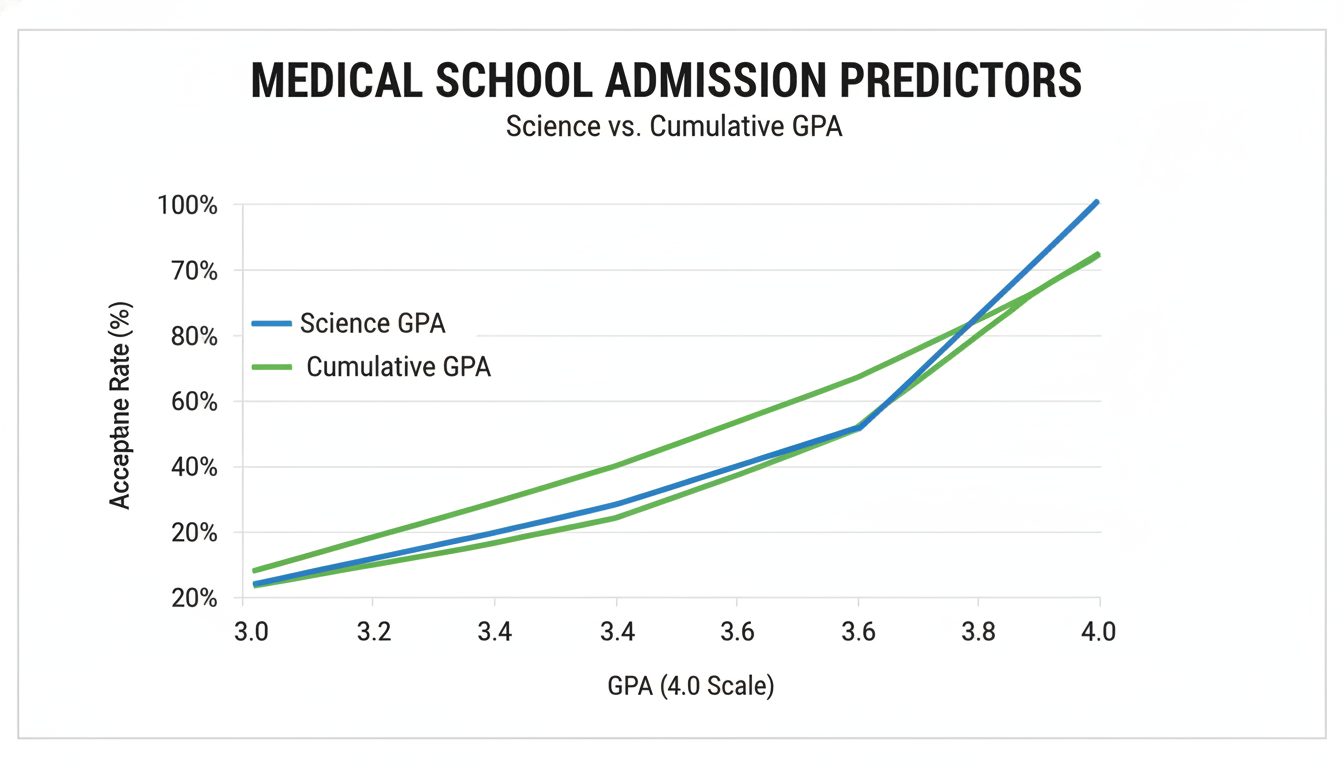
Key pattern: The acceptance curve is often steeper for science GPA. Moving from a 3.2 to a 3.6 science GPA is usually associated with a larger increase in acceptance probability than an equivalent move in cumulative GPA.
This steeper gradient signals that admissions committees are reacting more strongly to changes in science performance than to changes in overall performance.
3. Science GPA vs Cumulative GPA: Which Predicts Better?
When we apply a data analyst lens, the question is not philosophical. It is statistical:
- Which metric has higher predictive validity for admission outcomes?
- Which metric has more explanatory power once MCAT and other factors are included?
3.1 Signal vs Noise
Cumulative GPA blends together:
- Organic Chemistry I
- Biochemistry
- Physics II
- And also: Art History, Intro to Music, Public Speaking, Sociology, Creative Writing
From an admissions perspective, some of this is signal (rigor, consistency, writing skills). A lot of it is noise when you are trying to model success in medical school’s first two years.
Science GPA reduces that noise:
- Subset: Biology, Chemistry, Physics, Math
- Heavily weighted toward exactly the kind of courses that “look like” M1 and M2 content in terms of volume, abstraction, and problem solving
That narrower scope gives science GPA more discriminative power:
- Two students both with 3.7 cGPA:
- Student A: 3.9 non-science, 3.3 science
- Student B: 3.3 non-science, 3.9 science
Admissions committees, and the data, favor Student B.
3.2 How Committees Actually Use These Numbers
Qualitative reports from admissions deans align with the quantitative patterns:
- Many schools explicitly report that they review science GPA first when scanning an application.
- cGPA confirms global consistency and maturity; science GPA answers: “Can this person handle our actual curriculum?”
Anecdotally, screening thresholds often look like:
- Hard or semi-hard science GPA floors (e.g., sGPA 3.2 or 3.3 as rough lower limits for typical in-state MD schools)
- Slightly more flexibility on cGPA IF science GPA and MCAT are robust
In logistic regression language:
- Once you include MCAT score and science GPA, the incremental predictive benefit of cumulative GPA is often modest, especially in mid-to-high ranges.
- At the extremes, cGPA still add value: a 2.9 versus 3.9 cumulative tells a story about long-term consistency that science GPA alone might mask.
The practical conclusion: science GPA is the more diagnostic, high-yield metric, but cumulative GPA refines the picture and identifies edge cases.
4. Interaction with MCAT: The Three-Dimensional Problem
GPA does not operate alone. The AAMC data consistently show that the key predictors are:
- MCAT score
- Science GPA
- Cumulative GPA (secondary role)
You can think of acceptance probability as living in a three-dimensional space: MCAT × science GPA × cGPA.
4.1 Typical Interaction Patterns
Some realistic combinations:
High MCAT, mediocre science GPA
- Example: 518 MCAT, 3.3 science GPA, 3.5 cGPA
- Data pattern: outcomes are mixed. The MCAT pulls the odds up; the science GPA pulls them down.
- Interpretation by committees: “High potential, but inconsistent execution in actual coursework.” Many schools will want evidence of recent strong science work.
Moderate MCAT, high science GPA
- Example: 509 MCAT, 3.9 science GPA, 3.7 cGPA
- Data pattern: acceptance rates here are often healthier than scenario #1, especially at mid-tier or in-state schools.
- Interpretation: “Strong worker, proven success in rigorous coursework, test performance slightly under target but acceptable.”
Balanced high metrics
- Example: 516 MCAT, 3.8 science GPA, 3.8 cGPA
- Data pattern: these applicants have >70% acceptance probability in many datasets with adequate school lists.
- Interpretation: Very few academic concerns; rest of the file (experiences, interviews, fit) becomes the main driver.
Balanced low-mid metrics
- Example: 503 MCAT, 3.3 science GPA, 3.4 cGPA
- Data pattern: acceptance rates drop into low double digits or single digits. Upward trends, SMPs, and DO schools become relevant.
Two conclusions stand out:
- MCAT and science GPA together are the core academic predictors.
- Cumulative GPA modulates risk, particularly for extreme ranges or nontraditional paths.

5. Common Profiles: How the Data Interprets You
Let us look at a few typical applicant profiles and what the numbers suggest about each.
5.1 “Humanities Star, Science Average”
- 3.9 cGPA
- 3.4 science GPA
- 518 MCAT
On forums, this looks great. The numbers say: mixed.
The high MCAT and strong overall GPA are positives. Yet the science GPA lags. Acceptance odds are still respectable, but the risk of underperformance in the first year is flagged by committees more often in this profile.
From AAMC-style grids, an applicant like this may land with an overall acceptance probability somewhere in the 40–55% range depending on school list and other factors, not the 70–80% range many would assume.
5.2 “Science Heavyweight, Overall Slightly Lower”
- 3.6 cGPA
- 3.8 science GPA
- 511 MCAT
This profile often performs better than most applicants realize. The slightly lower cGPA may be driven by earlier non-science missteps, but the strong science track record and solid MCAT give committees confidence.
Historically, science GPAs in the 3.7–3.8 range are overrepresented among matriculants, even when overall GPAs are modestly lower. Acceptance odds frequently land in the 45–60% range for this profile, higher with a well-targeted school list.
5.3 “Strong Upward Trend in Science”
- Freshman–sophomore science GPA: 2.8
- Junior–senior science GPA: 3.8–3.9
- Final science GPA: 3.3
- cGPA: 3.4
- MCAT: 512
If you look only at the final numbers (3.3 sGPA, 3.4 cGPA), this applicant sits in a statistically risky range. However, committees reweight the temporal pattern:
- The early performance drags down the mean.
- The recent performance predicts the future more accurately.
Post-bacc or upper-division science work with strong grades moves this profile closer to the acceptance curves you see for 3.5–3.6 science GPAs. It does not fully erase the damage, but it narrows the gap.
6. Strategic Implications: Where to Invest Your Effort
The core tactical question is not “Which is more important?” but rather:
Given limited time and energy, where does a marginal improvement yield the most admissions benefit?
6.1 For Students Early in College (Freshman–Sophomore)
Data-driven priorities:
Protect and build science GPA first.
- The early BCPM courses (Gen Chem, Bio I/II, Physics I, Calc/Stats) set your statistical trajectory.
- Failing these and later recovering is possible but mathematically expensive; raising a 2.9 to a 3.5 science GPA takes far more A’s than maintaining a 3.6–3.7 from the start.
Avoid loading excessive science in a single weak semester.
- One disaster term (e.g., C/C-/D+ in O-chem, Physics, and Bio concurrently) can drop your science GPA into a range that takes years to fix.
Be intentional with non-science choices.
- Non-science classes are not meaningless; they stabilize your cGPA and can offset tougher terms.
- However, padding with easy A’s that do not address poor science performance will not fool the data or the committees.
6.2 For Students with High cGPA but Lagging Science GPA
If your transcript looks like:
- 3.8–3.9 cGPA
- 3.2–3.3 science GPA
The numbers are clear: you do not have an academic problem in general. You have a science problem specifically.
High-priority actions:
- Take targeted upper-level sciences (e.g., physiology, biochemistry, cell biology) at a pace you can dominate.
- Aim for A/A- streaks in 12–20 credits of additional BCPM to shift your science GPA trajectory.
- Consider a formal or informal post-bacc year if you need more BCPM hours to move the needle.
Raising a 3.2 science GPA to 3.5+ with 30–40 additional BCPM credits of A’s is mathematically feasible and can shift you into a drastically more favorable acceptance band.
6.3 For Students with Strong Science but Weak Overall GPA
Profile:
- 3.7–3.9 science GPA
- 3.1–3.3 cGPA
Here, non-science issues drag down the mean. Committees will:
- Be reassured by your science performance
- But still worry about professionalism, consistency, or personal circumstances that affected your academic history
Your best moves:
- Cleanly finish remaining terms with all solid grades across the board, not just in science.
- Use your personal statement or secondaries to briefly and factually contextualize earlier non-science struggles if there is a coherent reason (illness, work, family obligations).
From an admissions data standpoint, many of these applicants can still succeed, especially with a strong MCAT, because the “core predictor” (science performance) looks favorable.

7. Edge Cases: When Cumulative GPA Matters More Than You Think
There are scenarios where cumulative GPA exerts outsized influence, even if science GPA looks acceptable.
7.1 Very Low Overall GPA, Decent Science
Example:
- 2.9 cGPA
- 3.4 science GPA
- 512 MCAT
The science GPA and MCAT say, “Academic potential is present.” The cumulative GPA says, “There were serious, sustained issues.”
Adcoms worry about:
- Reliability and time management
- Professionalism and ability to meet basic standards across all domains
In raw acceptance grids, sub-3.0 cGPA still correlates with very low acceptance probabilities, regardless of science GPA, because the “distance to recover” is large and few applicants pull this off without significant remediation.
7.2 High cGPA with Unusually Low Science Workload
Another subtle case arises when:
- 3.8+ cGPA
- 3.6 science GPA
- But only minimal BCPM credits (e.g., just prerequisites, little upper-level science)
Here, both GPAs look strong, but the sample size for science is small. A few A’s in lower-level courses do not robustly predict performance in the intensity of M1/M2.
Some schools informally prefer applicants with a heavier and more advanced science course load, even if GPAs are nominally the same, because the predictive value is stronger.
8. So Which Predicts Admission Better—Science or Cumulative GPA?
When you synthesize:
- AAMC acceptance-by-GPA grids
- MCAT interaction effects
- Reports from admissions committees
- Observed patterns in thousands of applicants
A clear, data-based answer emerges:
Science GPA is the better predictor of medical school admission in the ranges where most applicants actually live (3.2–3.8).
- It has a steeper acceptance curve.
- It aligns more tightly with the curriculum’s demands.
- Negative deviations in science GPA are penalized more consistently than similar deviations in cumulative GPA.
Cumulative GPA retains importance at the extremes and as a global consistency check.
- Very low cGPA (<3.0) remains a strong negative predictor, even if science GPA improves later.
- Very high cGPA (3.9–4.0) slightly enhances odds, but only when science GPA is also strong.
MCAT + Science GPA together dominate the academic prediction.
- Once these are known, the incremental explanatory power of cGPA is smaller, though not zero.
For a premed making decisions, the simplest translation is:
- You are statistically safer with a 3.8 science GPA and 3.6 cGPA than with a 3.8 cGPA and 3.4 science GPA.
- If you have to choose where to invest marginal effort, prioritize the courses that feed your science GPA, because the data show that committees do the same.
Key takeaways:
- Science GPA has stronger predictive value for medical school admission than cumulative GPA, especially in the common 3.2–3.8 ranges.
- MCAT + science GPA form the core academic signal; cumulative GPA fine-tunes risk at the extremes and reflects long-term consistency.
- For strategy: protect and elevate your science GPA first, then use cumulative GPA and course selection to support a consistent, credible academic narrative.