
You are not “bad at science”; you are using the wrong tactics for the most tactical course in the premed pipeline.
Organic chemistry is not a measure of intelligence. It is a stress test of your systems: how you learn, how you practice, how you handle failure, and how quickly you can correct course. If you are underperforming, the goal is not motivation or “trying harder.” The goal is a structured, ruthless strategy shift.
(See also: No Clinical Experience Yet? A 6‑Month Plan to Build Real Exposure for more details.)
This guide gives you that shift.
1. Diagnose the Problem Like a Clinician, Not a Panicked Student
You cannot fix “I suck at orgo.” That is too vague. You can fix “I lose 20+ points on multi-step synthesis because I never practiced backwards planning.”
Start with a precise diagnosis.
Step 1: Run a 30-Minute Post-Mortem on Your Last Exam
Grab:
- Your exam
- The answer key or graded rubric
- Your notes / problem sets
- A blank sheet for analysis
Create four columns:
- Topic / Question Type
- Points Lost
- Reason for Error
- Fix Strategy
Then, go through each missed or partially missed question.
Common “reason for error” categories:
- Content gap (did not know concept)
- Pattern recognition failure (had seen it but did not recognize)
- Misread question (rushed, ignored a condition)
- Mechanism breakdown (forgot an intermediate or arrow)
- Time management (left blank or guessed at end)
- Careless work (wrong stereochemistry, missed reagent)
Example:
| Topic / Question | Points Lost | Reason for Error | Fix Strategy |
|---|---|---|---|
| SN1 vs SN2 vs E1 vs E2 classification | 6 | Pattern recognition failure | Build decision tree + 20 targeted practice Qs |
| Diels–Alder | 4 | Content gap | Re-learn concept + draw 15 variants from memory |
| Multi-step synthesis | 10 | Mechanism breakdown | Practice backtracking approach, 10 synthesis sets |
Now total the points in each “reason” category. You might find:
- 60% of lost points from mechanism issues
- 25% from time management
- 15% from content gaps
That distribution tells you where to attack.
Step 2: Identify Your “Failure Mode Type”
Most struggling orgo students fall into 1–3 clusters:
The Memorizer
- Relies on memorizing reactions as isolated facts
- Freezes when question is slightly different from the example
- Exams feel like “they never taught this” even when they did
The Conceptual-But-Slow Student
- Understands mechanisms conceptually
- Can explain things verbally but cannot do them fast under time pressure
- Runs out of time, leaves questions blank
The Rushed Pattern Guesser
- Tries to shortcut with pattern matching
- Does many problems, but shallowly
- Forgets to check stereochemistry, regiochemistry, or conditions
Know your type. Your fix strategy depends on it.
2. Rebuild Your Organic Chemistry System (Not Just “Study More”)
You do not need more hours. You need the right structure for the hours you already spend.
Here is a tactical weekly system designed for a struggling student aiming for recovery mid-semester.
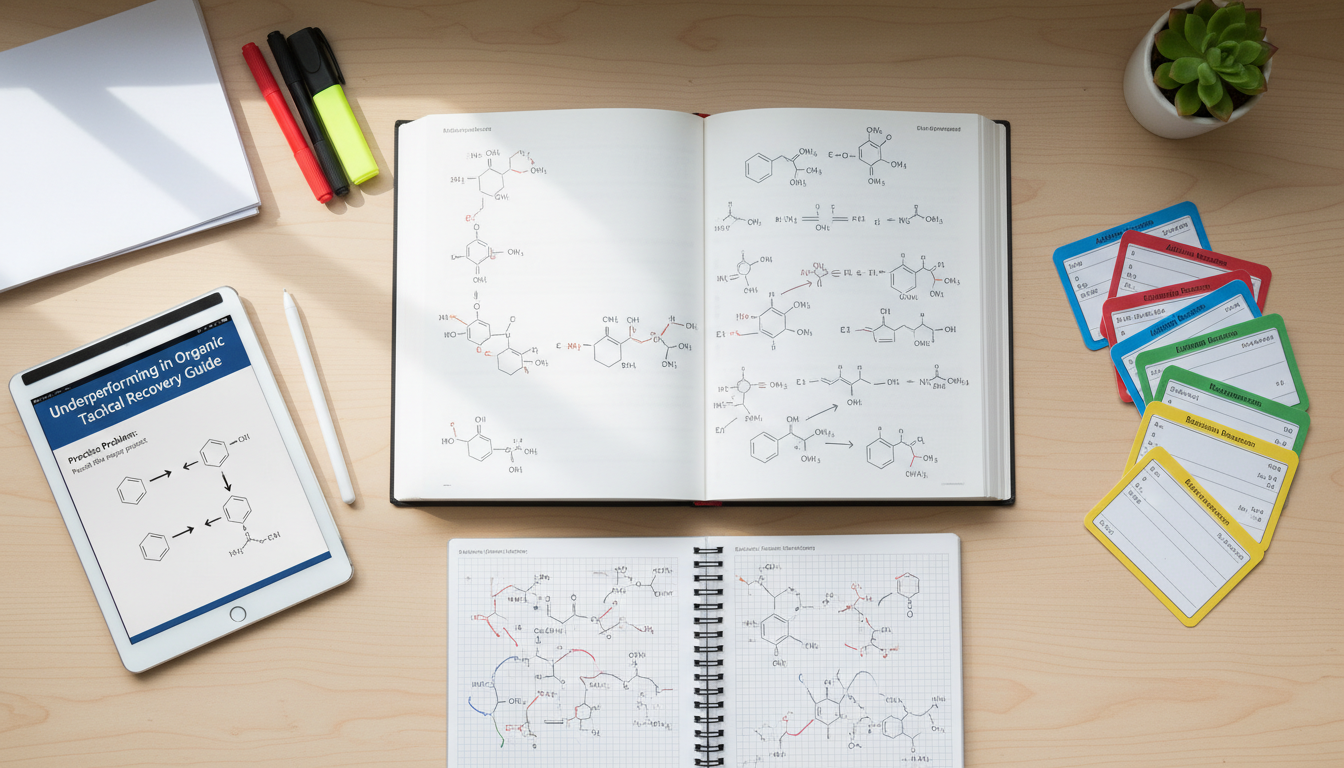
Core Principle: Organic Chemistry = Skill, Not Trivia
Treat orgo like:
- Chess, not flashcards
- Piano practice, not history reading
You are training pattern recognition and procedural fluency under time pressure.
The 4-Part Weekly Structure
Assuming a typical load of 8–10 focused hours per week outside class:
Concept Build (2–3 hours / week)
- Objective: Understand “why” for each new reaction or topic.
- Actions:
- Before lecture:
- Skim textbook section or a structured resource (e.g., Organic Chemistry as a Second Language by Klein)
- Write down:
- What goes in
- What comes out
- What appears to be changing (bonds broken/formed)
- After lecture:
- For each reaction:
- Draw it once from scratch
- Annotate: nucleophile, electrophile, leaving group, type of mechanism
- Add 1–2 “what if” notes: what if solvent changes, what if substrate is tertiary, etc.
- For each reaction:
- Before lecture:
Mechanism Training (2–3 hours / week)
- Objective: Arrow-pushing fluency.
- Actions:
- Pick 5–10 core mechanisms for the week (e.g., SN1, SN2, E1, E2, epoxide opening, oxymercuration-demercuration).
- For each mechanism:
- Draw full mechanism 3 times from memory:
- With detailed arrows
- With minimal intermediate labels
- As a bullet list of steps (protonation, nucleophilic attack, etc.)
- Draw full mechanism 3 times from memory:
- Use a whiteboard or blank printer paper, not lined notes. Space matters for clarity.
Problem Drills (3–4 hours / week)
- Objective: Apply concepts rapidly to many variations.
- Use a mix of:
- Textbook end-of-chapter problems
- Instructor-provided worksheets
- Old exams (if available)
- Structure:
- 25–30 minute focused blocks (Pomodoro style)
- 80% of problems should be at or slightly above exam difficulty
- For each problem type (e.g., substitution vs elimination; synthesis; spectroscopy), do sets:
- 5 easier warm-up questions
- 5–10 exam-level or harder questions
- 25–30 minute focused blocks (Pomodoro style)
Exam Simulation + Review (1–2 hours / week)
- Objective: Time management and stress inoculation.
- Once each week:
- Build a “mini-exam” of 8–12 problems covering:
- Reactions
- Mechanisms
- Synthesis
- Spectroscopy/structure
- Set a timer 10–15% shorter than real exam pacing (train under pressure).
- No notes, no solutions.
- Build a “mini-exam” of 8–12 problems covering:
- After:
- Grade it yourself strictly.
- Perform a micro post-mortem like you did for the real exam.
3. Attack the Highest-Yield Orgo Skills First
Not all orgo content is equal. Some skills drive a disproportionate amount of exam performance.
Skill #1: Acid–Base and Stability Judgments
If your foundation here is weak, almost everything else becomes slower and more confusing.
Tactical drill:
- Make a one-page sheet listing:
- Strong acids (HCl, HBr, HI, H2SO4, etc.)
- Typical organic acids (carboxylic acids, phenols, protonated amines)
- Strong bases (NaH, LDA, alkoxides, amide bases)
- Practice:
- Given two acids, circle the stronger and justify in one phrase:
- “Resonance stabilized conjugate base”
- “More electronegative atom bearing negative charge”
- “Inductive withdrawal stabilizing charge”
- Given two possible resonance structures, identify which one contributes more to stability and why.
- Given two acids, circle the stronger and justify in one phrase:
You want to be nearly instantaneous on:
- Which proton is most acidic
- Which site of a molecule is most nucleophilic or basic
Skill #2: Substitution vs Elimination Decision Trees
SN1, SN2, E1, E2 confusion kills exams.
Build a decision tree you can rewrite from memory:
- Look at substrate:
- Methyl, primary, secondary, tertiary
- Look at nucleophile/base:
- Strong base (e.g., t-BuO–, NaH)
- Strong nucleophile, weak base (e.g., I–, Br–, CN–)
- Weak nucleophile / weak base (e.g., H2O, ROH)
- Look at solvent:
- Polar protic vs polar aprotic
- Look at temperature (if provided)
Then create a 1-page chart summarizing tendencies:
- Methyl + strong nucleophile → SN2
- Tertiary + strong base → E2
- Tertiary + weak nucleophile in protic solvent → SN1/E1 mixture
…and so on.
Practice:
- 20–30 quick classification problems:
- Given substrate + reagent(s) + conditions, choose mechanism and major product.
- No full mechanism drawing during these speed drills; focus on fast pattern recognition.
Skill #3: Arrow-Pushing Mechanics
Many students lose big points not because they do not know the reaction, but because their arrow-pushing is sloppy or wrong.
Fix protocol:
- Pick 5 core mechanisms currently being tested.
- For each:
- Watch 1 high-quality explanation (e.g., from your professor’s videos or a vetted resource like Leah4Sci, Professor Dave, or Khan Academy advanced orgo).
- Immediately redraw the mechanism WITHOUT looking.
- Compare. Mark every missing arrow or mis-located charge.
- Next day:
- Redraw again from scratch.
- End of week:
- Do a “mechanism sprint”: 5 mechanisms in 20 minutes from memory.
You do this every week for new content. It compounds quickly.
Skill #4: Synthesis Strategy (Forward and Backward)
Multi-step synthesis separates average from strong performers.
Basic framework:
- Backward planning (retrosynthesis):
- Start from product. Ask:
- “What simpler molecule could give this product in one step?”
- “Where did each piece likely come from?”
- Identify:
- Disconnections: where you “cut” the molecule
- Recognizable patterns: alcohols from carbonyls, alkenes from elimination, etc.
- Start from product. Ask:
- Forward checking:
- Starting from starting material, plan sequence:
- Functional group interconversions
- Reagent selection
- Protection / deprotection if needed
- Starting from starting material, plan sequence:
Targeted drill:
- Each week, select 10 synthesis problems:
- 5 short, 1–2 steps
- 5 longer, 3–5 steps
- For each:
- Spend 1–2 minutes only on retrosynthetic thinking (do not touch reagents yet).
- Then another 3–5 minutes filling in actual steps.
4. Turn Around Your Exam Performance in 3–4 Weeks
You want concrete, short-term change, not vague reassurance. Here is a 3-week tactical recovery plan.

Week 1: Stabilize and Clarify
Goals:
- Stop grade bleeding.
- Build clear control over basics and current content.
Actions:
- Full exam post-mortem as detailed earlier.
- Office hours meeting with professor or TA:
- Bring:
- Your exam analysis
- 3–4 specific questions:
- “I consistently misjudge SN1 vs SN2 in borderline cases. What cues do you emphasize?”
- “On Q4, my mechanism was partially correct. Can you walk me through the ideal answer?”
- Ask explicitly:
- “If I want to move from a C to a B+/A– by the next exam, where should I focus?”
- Bring:
- Rebuild notes on:
- Acid–base and stability
- SN1/SN2/E1/E2 logic
- Any topic that cost you >10 points on the last exam
- Start the weekly system from Section 2.
Week 2: Aggressive Practice and Pattern Recognition
Goals:
- Convert understanding into speed.
- Close the gap on your biggest weakness area from exam 1.
Actions:
- Choose your primary weak domain (e.g., mechanisms, spectroscopy, synthesis).
- Add:
- Daily 30-minute focused drill on that domain:
- Monday: 15 mechanism problems
- Tuesday: 10 synthesis problems
- Wednesday: 12 SN1/SN2/E1/E2 classification questions
- Etc.
- Daily 30-minute focused drill on that domain:
- Run two mini-exams under timed conditions this week.
- End of Week 2:
- Compare mini-exam scores and time usage.
- Identify remaining bottleneck (e.g., still slow on synthesis; still missing resonance cases).
Week 3: Exam-Mode Training
Goals:
- Replicate exam conditions.
- Test your new system with pressure.
Actions:
- Three mini-exams this week:
- One early, one mid, one 1–2 days before the real exam.
- For each:
- Strict timing.
- No notes, no pausing, phone off.
- After each:
- Grade.
- For every missed problem, write:
- The underlying concept
- The reason for your error
- One change you will make in your process
You are building not just knowledge but process awareness. Strong students know why they get questions wrong and how they will avoid that error type in the future.
5. Fix Common Tactical Errors That Destroy Orgo Grades
Certain mistakes recur in almost every struggling student’s workflow.
Error 1: Reading Solutions Like a Story
Passively reading the solution key tricks you into thinking you “get it.”
Replacement habit:
- Cover the solution with a sheet of paper.
- Reveal one line at a time.
- At each step, ask:
- “Could I have produced that line on my own?”
- If no, stop and write that step from scratch 3 times.
If you read a full solution in under 30–45 seconds, you probably learned almost nothing.
Error 2: Ignoring Spectroscopy Until the Week Before Exam
Spectroscopy (NMR, IR, MS) looks intimidating but is extremely pattern based. Leaving it to the end is a tactical mistake.
Compact protocol:
- Build a 1-page NMR cheat sheet:
- Chemical shift ranges (aromatic, aldehyde, alkene, alkane, etc.)
- Typical splitting patterns (CH3, CH2, CH, isopropyl)
- Daily 10–15 minute practice:
- 2–3 NMR problems
- 1–2 IR problems
- Always:
- Translate data into structural constraints:
- “One singlet at ~9–10 ppm → aldehyde proton”
- “Broad peak at 3200–3600 cm–1 → OH or NH”
- Translate data into structural constraints:
Error 3: Over-Highlighting and Under-Writing
If your notebook is mostly highlighted textbook phrases and few original diagrams, you are not engaging at the right level.
Corrective tactic:
- For every 50 minutes of “reading / watching,” force at least 25 minutes of active output:
- Drawing mechanisms from memory
- Creating your own summary diagrams
- Writing mini-explanations of reactions in your own words
Think of the pen or stylus as your primary learning tool.
Error 4: Treating Orgo as a Solo Sport
Students who recover fastest almost always:
- Attend office hours consistently
- Work in a small, focused study group (2–3 people)
- Share and critique each other’s mechanisms
Study group protocol:
- Meet 1–2 times per week for 60–90 minutes.
- Structure:
- 10 minutes: share what each person struggled with this week.
- 40–60 minutes: work 6–10 problems silently first, then discuss.
- Last 10–15 minutes: each person teaches 1 mechanism or reaction to the group.
You remember what you teach.
6. Integrate Orgo Recovery Into Your Premed Trajectory
Organic chemistry feels high stakes because of what it signals to medical schools. That anxiety can become paralyzing. You must keep two tracks in mind:
- Short-term: Improve your grade in the current course.
- Medium-term: Protect your premed trajectory and narrative.
If You Are Mid-Semester with One Bad Exam
Concrete steps:
- Calculate hypothetical grade outcomes using your syllabus weights.
- Talk to your professor:
- Ask how many exams/assignments remain.
- Ask if the final exam replaces the lowest exam or is cumulative with heavier weight.
- Set a target:
- For example, “I need to average 85+ on the remaining assessments to end with a B+.”
Then align your weekly orgo system with that target. This becomes your central academic priority.
If You Are Deeply Underperforming (Low C or Below)
You have options:
- Stay in the course and attempt maximal recovery
Appropriate if:- It is still early- to mid-semester.
- You can realistically change your habits as above.
- You have support (office hours, tutoring, time).
- Withdraw strategically
More reasonable if:- You are far into the term with multiple failing assessments.
- Even near-perfect performance would not pull you to a grade you can accept.
- The rest of your course load or mental health is at risk.
If you withdraw:
- Make a plan for how you will prepare before retaking:
- Self-study using a structured text (Klein, Bruice, or McMurry).
- Possibly take gen chem review if foundations are weak.
- Document your learning from the failure. This matters for future med school applications where you might write about academic setbacks.
Thinking Ahead to the MCAT
Strong orgo habits now will reduce future suffering:
- Mechanistic thinking will help in MCAT chem/phys and biochem.
- Comfort with acid–base, resonance, and electron flow helps in enzyme mechanisms and pharmacology later.
Your goal is not merely to “survive” orgo. It is to build a skill set that will make second-year med school biochemistry and pharmacology less brutal.
FAQ (Exactly 2 Questions)
1. If I am already halfway through the semester with a low C, is it realistic to aim for a B or higher?
Yes, in many cases it is realistic, but only with a radical change in tactics, not incremental tweaks. Start by calculating your grade math precisely: how much do remaining exams, quizzes, the final, and homework weigh? If, for example, 60–70 percent of the grade is still ahead of you, a strong rebound is mathematically possible.
Implement the 3-week recovery plan immediately: exam post-mortem, structured weekly system, and consistent mini-exams. Meet with your professor in person to confirm what performance levels on remaining assessments would translate into your target letter grade. Then rebuild your weekly schedule around orgo as a top priority. If you cannot dedicate the necessary time and structural change, adjust expectations realistically and focus on learning the material deeply to protect your MCAT and future coursework, even if the letter grade is not ideal.
2. Do medical schools view one lower grade in organic chemistry as a deal-breaker?
A single B– or even a C in organic chemistry is not an automatic rejection, especially if it is isolated and the rest of your science GPA is strong. Admissions committees look for patterns. A transcript with a consistent downward trend in hard sciences is a concern. A transcript with one challenging term followed by strong recovery in later upper-division courses tells a very different story.
If you end up with a less-than-ideal orgo grade, your job is to demonstrate three things afterward: (1) clear academic recovery in later rigorous sciences (biochem, physiology, advanced biology); (2) a strong MCAT that reassures committees about your readiness; and (3) a coherent narrative in your application that frames orgo as a turning point that led to improved study systems, resilience, and time management. Your tactical recovery now is not just about one class; it is about building that narrative.