
Only 41% of residency applicants use an intentional strategy when choosing letter writers; the rest just ask “who seems available.”
That would be fine if programs all valued letters the same way. They do not. And they especially do not when you start talking about clinical-heavy careers vs academic tracks.
Let me break this down specifically.
If you are aiming at a clinical workhorse role—community hospitalist, bread-and-butter outpatient, high-volume surgeon—programs read your letters through one lens: Will this person function on the wards tomorrow without imploding?
If you are aiming for an academic track—physician–scientist, subspecialty fellow, future program faculty—they read your letters through a very different lens: Is this someone I can trust to produce scholarship, teach, and represent the program?
Your letter of recommendation (LOR) strategy has to match that lens. Most applicants do not align those pieces. They send the same portfolio of letters to community internal medicine programs and to academic fast-track research IM programs and then wonder why the results are erratic.
Step 1: Get Clear on Your Actual Track – Clinical vs Academic
Before you can play chess with letters, you need to stop pretending all residencies are the same.
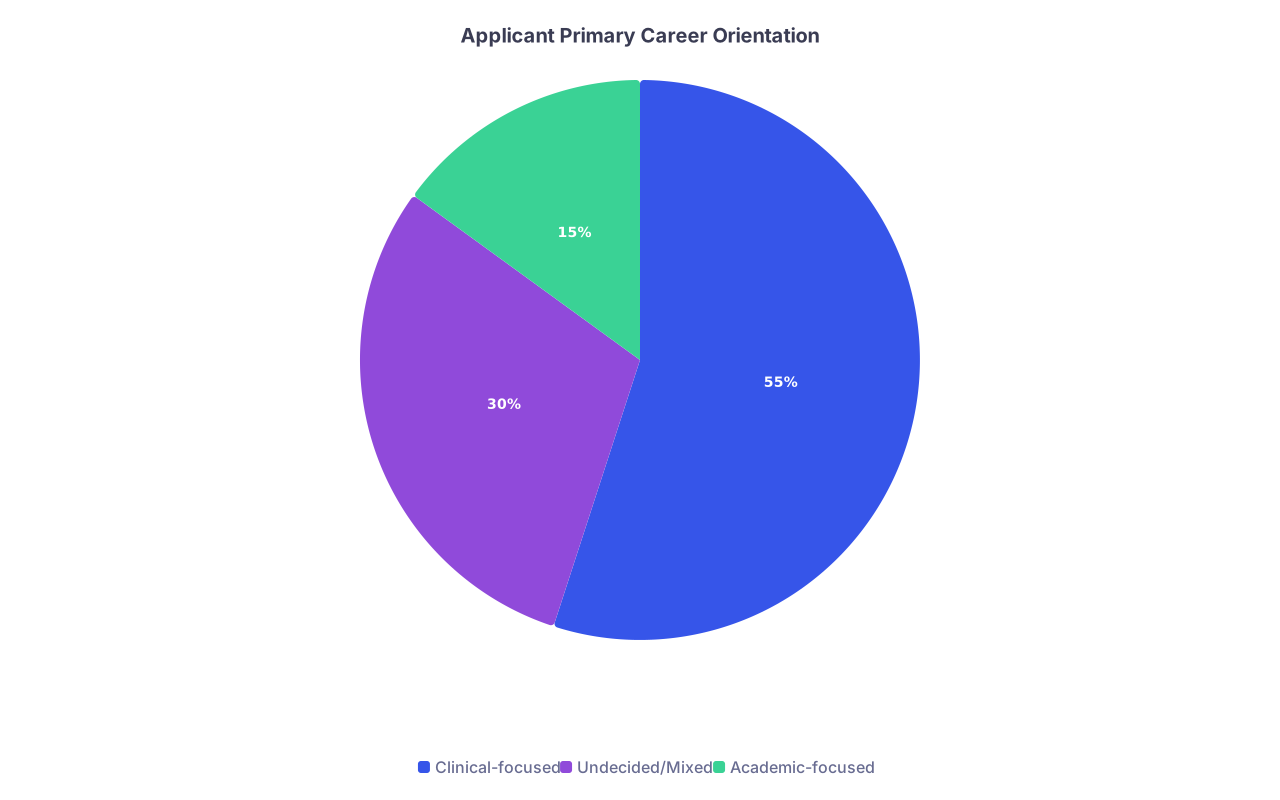
| Category | Value |
|---|---|
| Clinical-focused | 55 |
| Undecided/Mixed | 30 |
| Academic-focused | 15 |
Most people are somewhere in the middle, but for LOR strategy, I want you to push yourself into one of three working buckets:
Predominantly clinical track
You see yourself in:- Community IM/FM/OB/peds without a big research component
- Procedural specialties in community or mixed settings (anesthesia, EM, general surgery, ortho)
- Hospital-based roles where your main metric is clinical throughput and reliability
Programs care most about:
- Can you manage a sick service at 2 a.m.?
- Are you safe, efficient, team-oriented?
- Will nurses hate or love working with you?
Predominantly academic track
You are realistically aiming at:- Research-oriented residency tracks (e.g., Yale PSTP, UCSF research tracks, big-name academic IM, neuro, pediatrics, radiation oncology, etc.)
- Early subspecialty fellowship plans where publications matter (cards, GI, heme/onc, pulm/crit, rheum, etc.)
- Long-term faculty roles with teaching and research expectations
Programs care most about:
- Evidence of sustained scholarly productivity
- Intellectual curiosity and rigor
- Ability to work with mentors and complete long-term projects
Hybrid or undecided
This is most common. You want doors open both ways. That just means you need a balanced LOR portfolio that can be selectively emphasized depending on the program.
The mistake: Undecided applicants sending all-clinical letters to hardcore academic programs, or all-research letters to high-volume community places that could not care less about your R package.
You need to design your letter pool on purpose.
Step 2: Understand What Different Types of Letters Actually Signal
Programs read between the lines of your letter writer list before they even read the content. Who wrote for you is as revealing as what they wrote.
Here is the functional difference between common writer categories:
| Writer Type | Primary Signal to Programs |
|---|---|
| Core clerkship attending | Clinical performance, reliability, work ethic |
| Sub-internship (acting intern) attending | Residency readiness, autonomy, team role |
| Subspecialty academic attending | Fit for academic track, depth of interest |
| Research PI (MD/PhD) | Scholarly potential, follow-through, intellect |
| Department chair/program director | Endorsement “stamp,” institutional backing |
| Community preceptor | Real-world clinical skills, professionalism |
For clinical tracks, the hierarchy is simple: sub-I letters and core clerkship letters rule. Research PI letters are neutral at best and occasionally counterproductive if they say very little about clinical work.
For academic tracks, one strong research/scholarship letter is almost mandatory in certain specialties (hemonc, cards, rad onc, neurosurgery). A letter packet that is all “good team player on wards” with zero mention of scholarship is a quiet red flag for a research-heavy program.
And then there are “decorative” letters—department chairs and big names who barely know you. These can help in very specific scenarios, but they are overused, especially by academically oriented students who think prestige beats detail. It does not.
Step 3: Baseline Requirements by Specialty (Clinical vs Academic Weight)
If you want to be deliberate, you need to respect specialty norms. Some fields are inherently academic-leaning; others are unapologetically clinical.
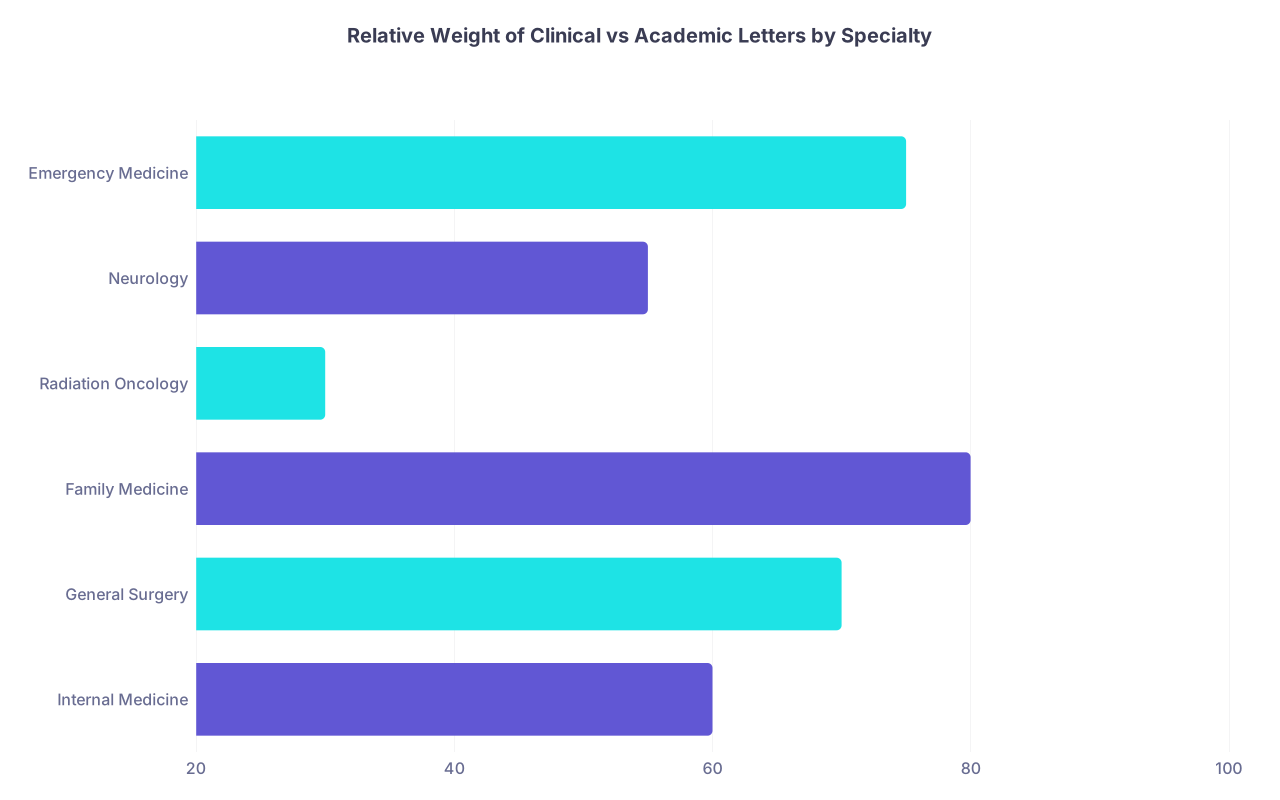
| Category | Value |
|---|---|
| Internal Medicine | 60 |
| General Surgery | 70 |
| Family Medicine | 80 |
| Radiation Oncology | 30 |
| Neurology | 55 |
| Emergency Medicine | 75 |
Interpretation: Higher value = stronger preference for clinically oriented letters.
Breakdown:
Strongly clinical preference (high value above):
- Emergency Medicine: SLOEs are clinical weapons, research letters are almost decorative unless EM-focused.
- Family Medicine: Longitudinal clinical performance, patient relationships, and humanism > bench research.
- General Surgery (community-heavy): Work ethic, endurance, OR behavior, team function.
Mixed:
- Internal Medicine (non-PSTP tracks), Neurology, OB/GYN, Pediatrics, Anesthesia:
Clinical letters still core; research is “bonus” unless you are specifically applying to research tracks.
- Internal Medicine (non-PSTP tracks), Neurology, OB/GYN, Pediatrics, Anesthesia:
Strong academic expectation:
- Radiation Oncology, Neurosurgery, Dermatology, some Pathology, highly academic IM tracks, many competitive subspecialty-heavy programs.
A strong research/scholarship letter is essentially part of your basic application “grammar.”
- Radiation Oncology, Neurosurgery, Dermatology, some Pathology, highly academic IM tracks, many competitive subspecialty-heavy programs.
If you are choosing between two excellent potential writers and you know your target specialty leans heavily one way, that should break the tie.
Step 4: Building a Portfolio: Clinical Track vs Academic Track
Think of your letters as a 4-slot portfolio. ERAS generally allows up to 4 letters per program. You will not send the same 4 to every place if you are doing this correctly.
A. Strongly Clinical Track Portfolio
Standard target: 3–4 letters emphasizing clinical excellence. One research letter at most, and only if genuinely strong and clinically informative.
Ideal composition for, say, community Internal Medicine, EM, or FM:
1–2 core clerkship attendings in the specialty
- Example: IM clerkship site director at your home program
- Content: Reliability, ownership of patients, how you handle cross-coverage, your notes, communication
1 sub-internship (acting intern) attending
- This letter is gold. Attending on your medicine or surgery sub-I who saw you function at near-resident level.
- Content: “Already functions at level of an intern,” “managed X patients independently,” etc.
0–1 additional clinical letter (subspecialty or community preceptor)
- Example: Community hospitalist who saw you on a 4-week elective, or outpatient IM/FM preceptor
- Content: Real-world clinical judgment, bedside manner, patient interaction, efficiency
What you do not need:
A research PI who supervised you entering survey data and saw you clinically for 2 half-days.
B. Strongly Academic Track Portfolio
Here your mix changes. You still need to prove you can function on the wards, but you must also prove you can generate academic work that survives peer review and funding committees.
Think about a candidate applying to an academic IM research track or radiation oncology:
2 clinical letters:
- One from a core clerkship in your specialty (or related specialty)
- One from your sub-I in the specialty (or closely allied field)
1 strong research PI letter:
- Ideally MD/PhD or at least someone with publications in the field
- Should explicitly mention:
- Duration and intensity of work
- Specific contributions (data analysis, first-authorship, drafting manuscripts, presenting at conferences)
- Traits predictive of academic success: curiosity, independence, resilience when projects stall
1 flex slot:
- Could be:
- Another research letter if you had two truly major mentors
- A departmental “big name” (chair, PD) who actually knows you through a project or repeated contact
- Or another strong clinical letter if your clinical side needs reinforcement
- Could be:
For some ultra-academic specialties (rad onc, neurosurgery, derm), two research/scholarship letters plus two clinical letters is completely standard.
C. Hybrid Strategy for the Undecided
If you are applying to a mix of community + academic programs, or you are broadly unsure, you build a 4-letter pool then vary what each program sees.
For example, an IM applicant with:
- Letter A: Medicine sub-I attending (strong clinical)
- Letter B: IM clerkship director (clinical)
- Letter C: Cardiologist research PI (heavy research, some clinical observation)
- Letter D: Department chair who knows you through a QI project and teaching
You can then:
- Send A, B, C, D to academic IM research tracks
- Send A, B, D (and possibly drop C) to community IM or less research-heavy programs
ERAS allows you to select per program. Most people do not exploit that.
Step 5: Choosing Individual Writers – Precision Rules
Now we get surgical.
When you are comparing potential letter writers, stop asking “Who is more famous?” and start asking these questions:
- Who can write the most detailed, story-filled letter about me?
- Who has seen me in a context aligned with my target track?
- Who actually likes me and has signaled they are enthusiastic?
You should almost always prioritize:
- Detailed, mid-tier name > Vague, famous name
- Recent clinical performance > Distant but prestigious contact
- Direct supervision > Secondhand “heard they were good on the team”
For clinical-track applicants:
If you must choose between:
- The department chair you scrubbed with twice, whose fellow mostly supervised you
- The associate program director who rounded with you for 4 weeks on your sub-I and knows your patients’ names
You choose the associate PD every time.
For academic-track applicants:
If you must choose between:
- A big-name PI who will say “helped with data collection” and nothing else
- A mid-career investigator who will detail your first-author abstract, your independent work on an IRB, and how you rewrote a manuscript twice without complaint
You choose the detailed mid-career mentor. Programs smell “name-only” letters instantly.
Red flag letter writers (I would avoid unless trapped)
- Attendings who say, “Sure, but I do not know you very well. Maybe you should ask someone else?”
- People who never gave you positive feedback during the rotation and now agree to write “if needed”
- Research mentors who have not replied to your emails for 6 months and have no clear idea what you actually did
- The “soft” or lukewarm letter writers who emphasize “pleasant” and “nice” but nothing substantive
Step 6: Clinical vs Academic Emphasis Within the Same Writer
A good letter writer can shift tone depending on the residency type. Your job is to cue them.
You do that with a short, targeted email when you ask:
For clinical-heavy programs:
- “I am primarily applying to community-based IM programs with a strong clinical emphasis. If you feel comfortable, I would be grateful if you could comment specifically on my clinical reasoning, efficiency on the wards, and readiness to function as an intern.”
For academic-heavy programs:
- “I am applying mainly to academic IM research tracks with interest in cardiology. I would be grateful if you could highlight both my clinical performance and any features you feel reflect my potential for an academic career—such as critical thinking, engagement with literature, or work on our project.”
You are not writing the letter for them. You are calibrating.

| Step | Description |
|---|---|
| Step 1 | Identify Target Track |
| Step 2 | Highlight wards performance |
| Step 3 | Highlight scholarship + critical thinking |
| Step 4 | Draft targeted email to writer |
| Step 5 | Attach CV, draft PS, project summary |
| Step 6 | Clinical or Academic Emphasis |
Good attendings appreciate clarity. They do not have time to reverse-engineer what you want.
Step 7: Timing and Sequence – When to Lock Writers In
Here is reality: Letters written 2 weeks after your rotation are sharp. Letters written 9 months later are mush.
For a strategic applicant, the timeline often looks like this:
MS3 mid-year:
- Identify your likely track direction (clinical vs academic-leaning)
- Start building deeper relationships with 1–2 potential clinical mentors in your specialty and 1 research mentor if academic-leaning
Around each key rotation:
- If the evaluation and feedback are strong, approach the attending near the end:
- “I have really enjoyed working with you this month. I am planning to apply in neurology and would be honored if you would consider writing a strong letter of recommendation on my behalf.”
That “strong letter” phrase matters. It gives them an out if they are lukewarm.
- “I have really enjoyed working with you this month. I am planning to apply in neurology and would be honored if you would consider writing a strong letter of recommendation on my behalf.”
- If the evaluation and feedback are strong, approach the attending near the end:
MS4 early:
- Sub-I attendings become primary clinical letter writers.
- Research mentors finalize letters after you have something concrete: manuscript, abstract, poster, or at least a clear long-term project.
Do not wait until August of application year to realize you have zero letters from your actual target specialty.
Step 8: Tailoring Letters to Specific Program Types
This is where advanced strategy matters. You can hold the same 4 letters but change which ones each program sees.
Scenario 1: Internal Medicine Applicant, Mixed Programs
You have:
- A: IM sub-I attending (heavy clinical, excellent)
- B: IM clerkship director (clinical)
- C: Cardiology research PI (academic)
- D: Community hospitalist preceptor (strong real-world clinical)
For:
Massachusetts General, UCSF, Penn research tracks:
- Use A + B + C + D (all four)
- Or A + C + D if they strongly cap/expect specifics, but using 4 is typical
Mid-tier university IM with lighter research expectations:
- A + B + C OR A + B + D, depending on your read of the program’s tone
Community IM programs:
- A + B + D; you can drop the research PI if the letter is mostly academic and short on clinical detail.
Scenario 2: Academic Neuro Applicant with Strong Bench Work
You have:
- A: Neuro sub-I attending
- B: Neurology clerkship attending
- C: PhD neuroimmunology PI (strong letter about your lab work, first-author abstract)
- D: Department chair who supervised you on a funded project and knows you fairly well
For heavy academic neurologic programs (UCSF, Hopkins, Columbia):
- A + C + D, possibly plus B
- Emphasize scholarship and advanced neuroscience work, but ensure at least one letter screams, “This person will not drown on inpatient neuro.”
For more clinical or mixed neuro programs:
- A + B + C most likely.
- If you have concerns programs will see you as “too lab-heavy,” emphasize your sub-I and clerkship letters.
Step 9: Special Cases People Consistently Mishandle
A few niches where applicants mess up LOR strategy badly:
EM Applicants
SLOEs (Standardized Letters of Evaluation) are king. Random research letters are mostly noise.
Your priority:
- 1–2 EM SLOEs from rotations at programs that understand the format
- Maybe 1 additional non-EM clinical letter (IM, surgery)
- Research or academic letters only if EM-related and based on real supervision
If you are academic-leaning, your “academic” signal usually comes from your SLOEs mentioning scholarly activity, not from a detached PI letter.
Surgery Applicants
For straight clinical surgery (especially community or non-research-heavy):
- Sub-I general surgery letters > research letters
- OR performance, stamina, and team behavior dominate
For academic surgery (future fellowship, research-rich programs):
- 1–2 strong clinical surgery letters
- 1 research letter from a surgeon–scientist who can vouch for actual work (papers, projects, QI)
The worst combo: Two research letters, both vague, and only one lukewarm core clinical letter from someone who barely watched you in the OR.
“Chair Letter” Myth
Some schools or older mentors will still tell you, “You need a chair letter no matter what.”
Reality now:
Some specialties and programs still expect a departmental letter (e.g., some IM programs want one “from the department”). Often it is templated and based on internal summary evaluations and not a true individualized LOR.
A chair letter is helpful if:
- The chair actually knows you through a project, repeated teaching contact, or direct mentoring.
- The letter can combine: institutional endorsement + concrete stories.
It is nearly useless if:
- It is built from a file review.
- It just repeats your CV.
If you have to choose between a “committee-style” chair letter and a clinically detailed letter from a mid-seniority faculty member who worked with you daily, the latter often has more impact, especially for community or clinically focused programs.
Step 10: What Programs Actually Underline While Reading
Let me be blunt. When PDs and selection committees read letters, they skim paragraphs and hunt for:
- Strength language: “Outstanding,” “top 5%,” “one of the best students I have worked with in X years.”
- Comparators: “Compared with other students and residents…”
- Specifics:
- “On our busy VA service, they managed 8–10 complex patients and always knew the plans cold.”
- “They independently analyzed our dataset and drafted the first version of the manuscript, which is now under review.”
- Red flags:
- “Will do well in a supportive environment.”
- “Completed all assigned tasks.” (Translation: bare minimum.)
- “Pleasant” as the main compliment with little else.
A good clinical letter for a clinical track will read like:
- “I would rank them among the top 5% of students I have worked with in 15 years of teaching. They eagerly took ownership of patients, often arriving early to pre-round, and their notes required minimal editing. Nurses and residents repeatedly commented on their reliability, especially on night float.”
A good academic letter for an academic track will read like:
- “In my lab of over 30 trainees across a decade, they stand in the top tier. They independently mastered advanced imaging analysis, led a project from hypothesis generation through data analysis, and presented our findings at the AHA meeting. We are currently preparing a manuscript on which they will be first author.”
You choose writers who can write that, not just plug your name into a template.
Step 11: Putting It All Together – A Practical Mapping Exercise
Here is how I would tell a real student to proceed.
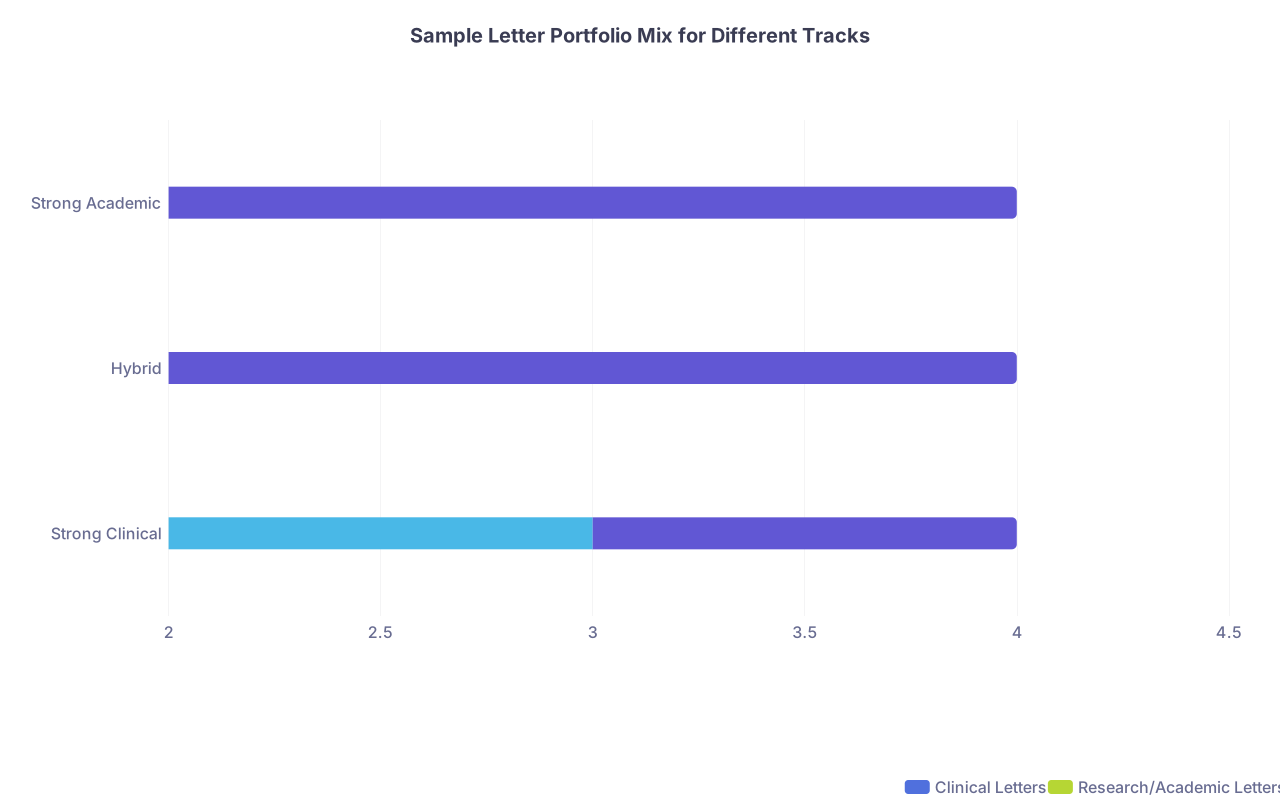
| Category | Clinical Letters | Research/Academic Letters |
|---|---|---|
| Strong Clinical | 3 | 1 |
| Hybrid | 2 | 2 |
| Strong Academic | 2 | 2 |
You:
- List every potential writer on a page.
- For each, mark:
- C = Strong clinical content
- R = Strong research/scholarship content
- N = Name recognition (local or national)
- ? = Uncertain depth
Then you:
- Pick 2–3 C’s in your specialty or closely related fields.
- Pick 1–2 R’s aligned with your intended academic interests (if any).
- From those, choose the 4 who know you well enough to write at least one or two specific stories.
- Map combinations:
- Set A (more clinical-heavy) for community or clinically weighted programs.
- Set B (more research-heavy) for academic and fellowship-heavy programs.
If, when you do this, your only R’s barely know you, you are not an “academic track” candidate yet. That is fine. Own the clinical emphasis and use your personal statement and future work to pivot later.
If your only C letters are from non-core, non-specialty rotations and they say very little about your actual wards performance, you have work to do in MS4 to secure a strong sub-I letter before you apply.
With this level of intention, your letters stop being an afterthought and start functioning like targeted weapons—different configurations for different kinds of programs, each telling a coherent story about who you are and where you are going.
You have aligned your writers, your track, and your targets. Next step in the sequence is making sure your personal statement and experiences reinforce that same narrative instead of fighting it. That, and how to handle interview questions that probe your “clinical vs academic” identity, is the next phase in the journey.