
The most dangerous thing you can take into a residency interview is a perfectly memorized answer.
Why “Polished” Answers Get You Rejected
Program directors are not impressed by your rehearsed “greatest strength is my passion for patient care” monologue. They have heard that line—almost verbatim—from twenty applicants before you. In the same day.
They are listening for something else: insight.
Do you actually understand yourself, the specialty, and residency training? Or did you just binge interview guides on Reddit and Anki your answers?
Here is the core distinction:
- Memorized answers show that you can recite what you think they want to hear.
- Insightful answers show how you think, how you learn, and how you respond to reality when it is not curated.
Programs hire the second category.
Let me break down the exact residency interview questions that expose who has genuine insight versus who is running on scripts—and how to be in the first group without sounding like a robot.
The Core Difference: Content vs Cognition
Memorized answers focus on content:
- Pre-packed stories
- Buzzwords: “team player,” “lifelong learner,” “resilient”
- Overly polished narratives where everything “worked out” and there is a neat “lesson”
Insightful answers reveal cognition:
- How you process events
- How your thinking changed
- What you do differently now—specifically
- Where you still see your own limits
PDs, APDs, faculty, and even senior residents are unconsciously testing three cognitive traits:
- Self-awareness – Do you see your own patterns and blind spots?
- Reflective capacity – Do you extract meaningful, actionable insight from experiences?
- Alignment – Do your actual behaviors align with the realities of this specialty and this program?
Most of the “hard” questions are not about content at all. They are about these three.
Category 1: “Tell Me About Yourself” – The First Insight Trap
This is where most people start reciting their personal statement. Big mistake.
The interviewer is not asking for your whole life story. They are testing whether you can:
- Set priorities (what do you choose to highlight?)
- Understand what matters for residency
- Show a coherent arc from who you were → to what shaped you → to why you are here
Here is the difference in answers.
Memorized answer:
“I grew up in [city], did my undergraduate at [school] in biology, then went to [med school]. I have always been passionate about [generic interest]. During medical school, I was involved in research, leadership, and volunteering, and now I am excited to apply to [specialty].”
That tells them almost nothing.
Insightful answer:
“I tend to organize my story around three things: I am someone who likes structure, I am drawn to high-acuity medicine, and I need a team around me. I started out pre-med thinking I wanted something more outpatient and longitudinal, but during third-year, the moments I felt most alive were on nights in the ICU. I liked that the work was clear, time-sensitive, and collaborative. That combination is what pushed me toward internal medicine with an eye toward critical care, and shapes how I think about where I will fit in residency.”
Notice what changed:
- There is a frame: three defining traits.
- There is acknowledged evolution: changed from initial plan.
- There is a clear specialty-relevant insight: structure + acuity + team.
How to build an “insight” version of this answer
Use a simple scaffold in your prep, but do not memorize the wording:
- Identity anchor: “I’m someone who tends to ______ and is drawn to ______.”
- Inflection points: “I thought I would do X, but Y experience shifted my thinking by showing me ______.”
- Link to specialty: “That is why [specialty] makes sense for me—because it demands ______, and that fits how I work.”
You can vary the words every time. The structure holds; the answer still sounds alive.
Category 2: “Why This Specialty?” – Where Scripts Go To Die
This is the question that separates people who actually understand the day-to-day work from those who just liked their clerkship or a mentor.
Weak, memorized version:
“I love the mix of medicine and procedures, the continuity of care, and the opportunity to build long-term relationships with patients. I also appreciate the teamwork and the intellectual challenge of the field.”
You can plug that into IM, FM, OB, even heme/onc. Which means it tells the program nothing.
Insightful version focuses on tradeoffs, not just positives:
“For me, the core attraction of emergency medicine is the combination of high-uncertainty decision-making and the responsibility to act with incomplete information. On my EM rotation, what stood out was not just the big traumas but the constant recalibration—patients who come in looking fine and then decompensate forty minutes later. I like that the job is front-loaded with decision-making and then you hand off, rather than following the long arc. I have tried to stress-test that preference by doing more longitudinal experiences, like a primary care continuity clinic, and I found that while I value those relationships, I am more energized by high-volume, high-acuity shifts where decisions matter in minutes, not months.”
That answer shows:
- You understand what you are choosing and what you are giving up.
- You did not just “fall in love” in week 2 of a rotation.
- You actively tested your hypothesis through other experiences.
Residency selection committees like people who test their assumptions.
Category 3: Behavioral Questions That Reveal Real Insight
This is where interviewers pull out the “tell me about a time…” questions. These are gold mines for insight testing. They are also where memorized STAR templates go to die if you use them badly.
Classic prompts:
- “Tell me about a time you made a mistake.”
- “Tell me about a conflict with a colleague.”
- “Tell me about a time you received critical feedback.”
- “Tell me about a time you were overwhelmed or failed.”
Let me show you what most applicants do wrong.
The fake mistake / fake conflict problem
Common pattern:
- The “mistake” is actually humble-bragging.
- The “conflict” is trivial (someone was late to rounds, but you heroically solved it).
- The “feedback” is generic (“be less hard on yourself”).
Interviewers see these for what they are: avoidance. Lack of insight. Lack of emotional honesty.
An insightful answer does not need drama. It needs:
- A real tension (you vs time, you vs your habits, you vs another person).
- Concrete detail (what actually happened).
- Specific learning tied to changed behavior.
Memorized-style mistake answer:
“During my third-year rotation, I miscommunicated a lab result to my attending, but I quickly corrected it and learned the importance of double-checking labs and communicating clearly.”
That is content-only, vague, and safe.
Insightful mistake answer:
“On my sub-I, I was covering a cross-cover list and got paged about a patient with increasing shortness of breath. I was in the middle of updating notes for sign-out and I let myself finish what I was doing before going to see the patient. By the time I got there, he was in significant respiratory distress and the nurse was visibly frustrated. He did fine after we escalated care, but my attending asked me—very directly—why it took me so long to see him.
I realized I was prioritizing task completion over acuity. I went home that night and wrote out how I was triaging pages and realized I had no explicit system. After that, I started mentally sorting pages by stability keywords and physically pausing what I was doing to see anyone with breathing issues or chest pain. I have also started asking nurses whether they are “worried” when they call. It is a simple question, but it has already changed how fast I respond.”
That answer has:
- Concrete sequence.
- Admission of a real error in judgment.
- A specific, observable change in future behavior.
That is reflective capacity. Exactly what interviewers are testing.
Category 4: Program-Fit Questions That Expose Shallow Prep
This is where most applicants sound identical and scripted.
Questions like:
- “Why this program?”
- “What are you looking for in a residency?”
- “How do you see yourself fitting into our program?”
If your answer could be used interchangeably at 15 programs, you are not answering the question.
Memorized / lazy answer:
“I am impressed by your strong clinical training, diverse patient population, and supportive environment. I also really value the research opportunities and the collegial culture I have heard about from residents.”
Everyone says that. About every program.
Insight-focused answer proves you actually looked under the hood:
“When I look at programs, I’m specifically looking for three things: (1) high-volume, high-complexity medicine early on, (2) a track record of placing graduates into critical care fellowships, and (3) a culture where residents are allowed to have opinions and shape the program.
Here, the things that stand out are your early ICU exposure for interns, the fact that several of your graduates have gone into CCM at [X, Y, Z programs] in the last few years, and the resident-led QI projects you highlighted during the noon conference I attended. When I spoke with [Resident Name], she mentioned that interns actually present at M&M rather than just watching, which is exactly the kind of ownership I am looking for.”
That answer:
- Names specific structural elements.
- Connects them to your concrete goals.
- References real people and interactions.
You cannot manufacture that thirty minutes before the interview. It requires actual thinking and preparation.
Category 5: “Red Flag” and Stress Questions – Where Insight = Damage Control
Programs know applicants are coached to “stay positive” and “spin” anything. So they push.
Questions like:
- “Walk me through this failed Step attempt / leave of absence / gap year.”
- “If we asked your attendings about your biggest weakness, what would they say?”
- “Have you ever had a significant professionalism concern raised about you?”
- “What is something you are still struggling with as you enter residency?”
Memorized defensive answer:
“I failed Step 1 because of personal reasons and stress, but I worked hard, improved my study habits, and passed the next time. I learned the importance of balance and resilience.”
That is vague. That dodges responsibility. It tells them nothing about whether this will happen again under their watch.
Insightful, controlled, but honest answer:
“I failed Step 1 the first time. The short explanation is that I underestimated how difficult it would be for me to transition from structured coursework to entirely self-directed study. I created an ambitious schedule but did not build in any contingency for when I fell behind. When I started scoring lower than expected on NBMEs, I responded by adding more resources and more hours instead of simplifying. By the time I sat for the exam, I was burned out and fragmented.
After I failed, I met with our dean and a learning specialist and did two things differently: I cut down to two primary resources and I committed to weekly check-ins with a faculty mentor to review my progress and my actual scores. I passed comfortably on the second attempt.
The bigger lesson for me was that my default is to “do more” when I am under stress instead of “do differently.” I expect residency will test that again, so I have already identified two senior residents I would plan to check in with regularly about workload and performance, rather than waiting until I am underwater.”
That shows:
- Ownership, not excuses.
- Specific pattern identified (“do more” vs “do differently”).
- A plan that maps directly onto residency structure.
Programs do not need perfection. They need predictability and insight into your risk profile.
Category 6: Questions That Directly Test Metacognition
Some interviewers are blunt. They skip the behavior stories and go straight at your thinking.
You might hear:
- “What is something your application does not reflect well about you?”
- “What is a belief you had about this specialty that turned out to be wrong?”
- “How have your career goals changed in the last two years, and why?”
- “What kind of resident do you NOT want to become?”
Memorized / shallow answers here sound like motivational posters.
Better to pick a real example that shows evolution.
Example: “What is a belief you had about this specialty that turned out to be wrong?”
Weak answer:
“I used to think surgery was all about the OR, but I learned there is a lot of patient care outside the OR as well.”
Sure. And water is wet.
Insightful version:
“I started med school thinking surgery was primarily a technical field, and that if you had good hands and stamina, you would thrive. During my third year, what surprised me most was how much of surgery is about managing uncertainty on the wards—borderline abdomens, marginal airways, patients who are “too sick not to operate and too sick to operate.”
I initially thought I would be happiest if I could just operate all day, but watching attendings navigate those judgment calls changed my thinking. I realized the part of the job that I find most intellectually satisfying is deciding whether and when to operate, not just how. That shifted my attention from pure technical skill to wanting a program with strong pre- and peri-operative teaching and exposure to complex decision-making, not just case volume.”
There is a visible before/after in your thinking. That is insight.
How Interviewers Actually Use These Questions
Here is the thing most applicants underestimate: no one question will save or kill your application. Interviewers are sampling.
They are implicitly rating:
- Insight / Self-awareness
- Maturity / Reliability
- Team fit
- Specialty fit
- Risk (burnout, professionalism, remediation, attrition)
To make it concrete:
| Dimension | What They Look For In Your Answers |
|---|---|
| Self-awareness | Can you see your own patterns and limits? |
| Reflective capacity | Do you learn meaningful lessons from experiences? |
| Resilience | Do you adapt behavior, not just suffer and move on? |
| Team dynamics | Are you safe to work with at 3 a.m.? |
| Specialty fit | Do you understand the real work, not the fantasy? |
They do not care whether your “weakness” is time management vs perfectionism. They care whether your story shows actual growth and recognition of pattern.
If they sense you are performing a persona, you lose points across several domains at once.
A Simple Framework To Turn Memorized Content Into Insight
I am not going to tell you not to prepare. Of course you should prepare. But you need to prepare at the right level.
Here is a 4-step conversion framework I use with applicants:
List your 10–12 “anchor stories”
Clinical mistake, conflict, hard feedback, great save, leadership role, research setback, etc.For each story, write the real lesson in 1–2 sentences
Not the “growth mindset” fluff. The actual behavioral change.
Example: “I learned that my first instinct is to avoid confrontation with seniors, so I need explicit scripts and support to speak up in the moment.”Identify the pattern it reveals about you
Is this about your conflict style? Response to stress? Need for validation? Tendency to overfunction alone instead of asking for help?Practice answering the question behind the question
When they say “Tell me about a time you failed,” they really mean:
“Show me how you handle being wrong, and whether you can talk about it like an adult.”
If you do this, you do not need word-for-word memorization. You just need clarity about:
- What happened.
- What it shows about you.
- What changed.
You will sound natural, because you are thinking in real time instead of reciting.
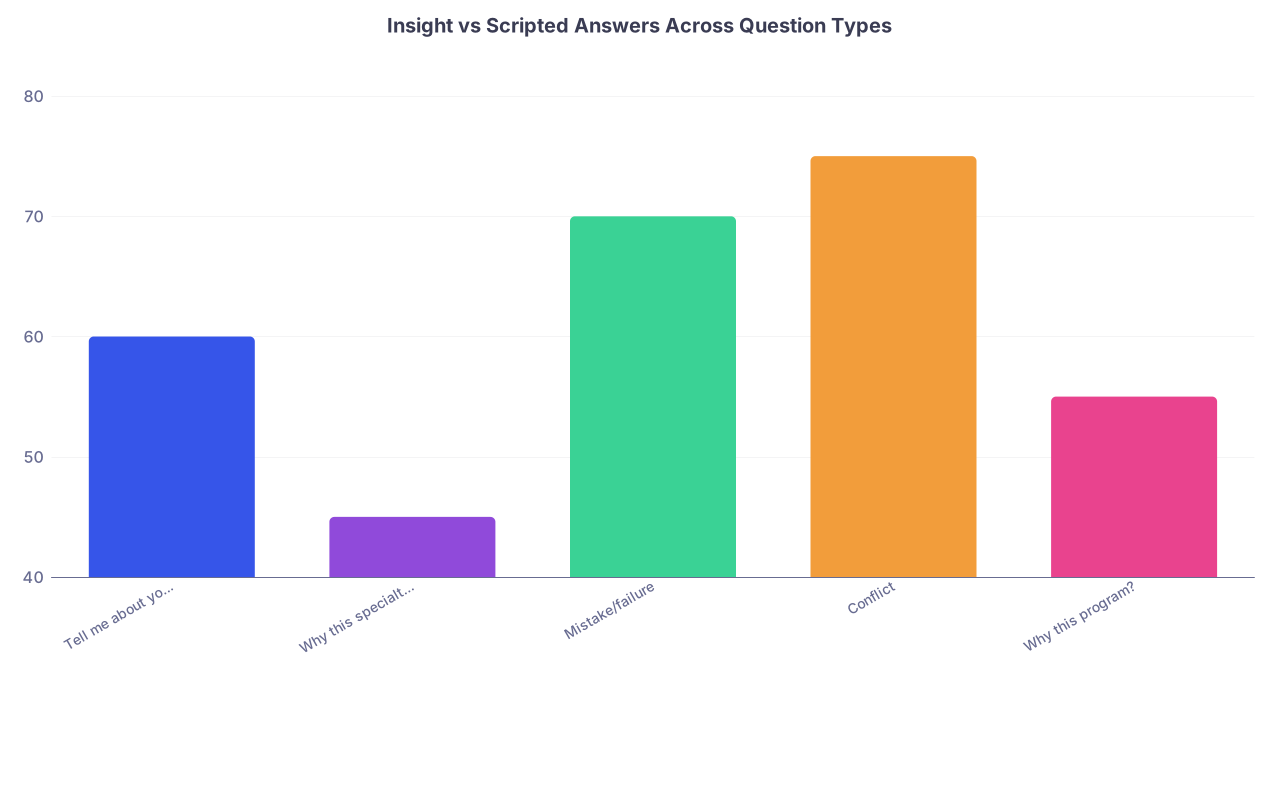
Visual: Insight vs Scripted Answers Across Common Questions
| Category | Value |
|---|---|
| Tell me about yourself | 60 |
| Why this specialty? | 45 |
| Mistake/failure | 70 |
| Conflict | 75 |
| Why this program? | 55 |
Think of that “insight score” as: how much does your answer reveal how you think, not just what happened?
How To Practice Without Becoming a Robot
Mock interviews can ruin you if you do them badly. I have watched good applicants become stiff and over-rehearsed after doing five generic Zoom mocks with random residents.
Better approach:
- Do 1–2 full-length mock interviews for timing, stamina, and basic exposure.
- Then switch to focused drills:
- 15 minutes only on “mistake / failure” variants.
- 15 minutes only on “why this specialty / why this program.”
- 15 minutes only on “red flag / weakness / struggle.”
Record yourself. Watch for:
- Overused phrases (“I learned the importance of…” “At the end of the day…”).
- Over-polished transitions that sound memorized.
- Lack of specifics (if you could not draw the scene, it is too vague).
And rotate who you practice with:
- One attending or senior resident in your specialty.
- One friend who is blunt and does not care about your feelings.
- One non-medical person; if they cannot follow your story, you are rambling.
A Quick Flow For Handling Any “Insight” Question On The Fly
If you freeze, use this mini-structure in your head: Event → Emotion → Evaluation → Evolution.
- Event – 1–2 sentences: What actually happened.
- Emotion – 1 sentence: What it felt like then (confused, defensive, embarrassed).
- Evaluation – 1–2 sentences: What you realized after reflection.
- Evolution – 1–2 sentences: What you do differently now.
Example: “Tell me about a time you got tough feedback.”
Event:
“On my surgery rotation, my attending told me after a case that I was ‘mentally checked out’ during closure because I stopped anticipating the next step.”
Emotion:
“In the moment, I felt embarrassed and defensive because I thought I had been focused the whole time.”
Evaluation:
“On the drive home, I replayed the case and realized that once the main part of the operation was done, my attention drifted. I was less proactive, and the attending was right to call it out.”
Evolution:
“Since then, I have made a deliberate effort to mentally ‘finish strong’—I pick a specific part of the last 20% of the case to focus on learning or anticipating. It sounds small, but it has changed how I show up for the entire case, not just the exciting parts.”
This is simple, fast, and naturally insightful if you are honest.
Process Map: From Question to Insightful Answer

| Step | Description |
|---|---|
| Step 1 | Hear Interview Question |
| Step 2 | Select 1 clear event |
| Step 3 | Pause 2-3 sec and pick closest experience |
| Step 4 | State event briefly |
| Step 5 | Name your reaction/emotion |
| Step 6 | State what you realized or learned |
| Step 7 | Describe what you now do differently |
| Step 8 | Link to being a better resident/team member |
| Step 9 | Know a relevant story? |
That is the mental flow you want to internalize. Not a 10-sentence script.
Common Pitfalls That Kill Insight
I have to call these out because they are everywhere.
Over-sanitizing your stories
If every story ends with you as the quiet hero who learned a lesson and now never makes that mistake, no one believes you.Hiding all negative emotion
You are allowed to have felt anxious, frustrated, or defensive. The question is what you did with that.Name-dropping without substance
“Working with Dr. Famous on X study was inspiring” tells them nothing. What did you actually learn, and how did it change what you want from training?Over-intellectualization
Some applicants use abstract language to avoid vulnerability. Lots of “I realized the importance of communication and collaboration” with zero detail. Interviewers pick up on that.Using the same story for everything
If the same call night story is carrying your “conflict,” “mistake,” and “stress” answers, your interview will feel thin.
FAQs
1. How many “prepared stories” should I have before residency interviews?
Around 10–12 is usually sufficient:
- 2–3 clinical mistakes or near-misses with clear learning.
- 2 conflict situations (one peer-level, one hierarchy-related).
- 2 feedback stories (one you handled badly at first, one you handled well).
- 2 high-stress / overload moments.
- 2 leadership / initiative examples. You will reuse them in different ways, but each should show a distinct aspect of how you think and grow.
2. Is it ever okay to say “I don’t know” in an interview?
Yes—and it can actually showcase insight if done correctly. For opinion or reflection questions, saying:
“I do not have a fully formed answer to that yet, but I am currently thinking about it this way…”
is far better than faking certainty. For factual questions (rare in residency interviews), you can say:
“I am not sure off the top of my head, but here is how I would go about figuring it out…”
That shows humility and process, not ignorance.
3. How honest should I be about burnout or mental health struggles?
Measured honesty works; uncontrolled disclosure does not. If you had burnout or a depressive episode that affected performance:
- Own it briefly.
- Show the concrete steps you took (treatment, schedule change, therapy, time management).
- Emphasize what you learned about your limits and how you will monitor them in residency. Avoid graphic detail or present-tense chaos. Programs want to know you are stable now and have insight and systems to avoid recurrence.
4. What if I genuinely have not had major “conflicts” or “big mistakes”?
Then pick smaller but real tensions and be precise. Conflict does not require shouting; it might be:
- Disagreeing about a plan with another team member.
- Speaking up when a supervising resident ignored a nurse’s concern.
- Managing different work styles in a group project. The key is that there was a difference in expectations or perspective, and you had to navigate it thoughtfully. Same with mistakes—misjudging priorities, misreading a social cue, poor time allocation all count.
5. How do I avoid sounding repetitive across multiple interviews in one day?
Do not memorize exact wording. Memorize the logic of your stories. Vary:
- Which detail you emphasize.
- Which lesson you foreground.
- Which part of the story you compress or expand. For example, the same ICU mistake story can be framed as:
- A time you made a mistake.
- A time you got tough feedback.
- A time you were overwhelmed and had to change your triage system. Same event, different lens, different emphasis. That keeps you fresh while still grounded in real experiences.
Key points:
- Residency interview questions are designed to test your insight, not your ability to recite polished answers.
- The strongest answers show concrete events, real emotion, clear evaluation, and specific evolution in your behavior.
- You do not need more scripts; you need a clear understanding of your own patterns, tradeoffs, and growth—and the courage to talk about them like an adult.