The way a residency program designs its website tells you more about their interview style and culture than anything they will say on interview day.
Not “can you find the application deadlines” obvious. I mean the deep stuff: how they treat residents, whether interviews will feel like a conversational fit-check vs a grill session, whether they value wellness or just market it, and how much risk you take ranking them highly.
Let me break this down specifically.
The Core Premise: Websites Are Unfiltered Culture
Residency websites are the one place programs talk at length without time pressure, NRMP oversight, or a recording running. No Zoom performance. No carefully scripted interview day.
They reveal:
- How the program sees itself
- What it thinks applicants care about
- What it is trying to hide or overcompensate for
You are not just scanning for “call schedule” and “fellowship placement.” You are decoding:
- Likely interview format and tone
- How much the program actually cares about fit vs metrics
- Whether the culture is resident-centered, faculty-centered, or hospital-centered
- How much micromanagement and hierarchy you should expect
Once you know what to look for, you can predict interview style with unnerving accuracy.
Step 1: Home Page and Taglines – What Are They Over‑Selling?
The landing page is the diagnostic equivalent of a chief complaint. It is where programs lead with what they want you to believe.
Ignore the pretty skyline photo. Read the first 3 sentences and any large-font taglines.
Common patterns:
“Excellence, Innovation, Leadership” spam
- Lots of generic words: excellence, innovation, outstanding, cutting-edge.
- No concrete examples in the same paragraph.
- Usually means: image-conscious, brand-forward, potentially status-focused interviews.
- Expect: questions about “leadership,” polished faculty, less vulnerability, more posture.
“We are a family” hammered repeatedly
- “We’re a tight-knit family,” “like a family,” “supportive family environment” in multiple sections.
- Zero specifics about how that support shows up (coverage when sick, backup call, etc).
- This can mean one of two things:
- Genuinely warm, smaller program; conversational interviews.
- Or overcompensation for high workload and emotional burnout.
- Expect on interview day: heavy emphasis on “how do you work in a team,” “tell us about conflicts,” and lots of resident testimonials.
Mission-first, patient-population heavy
- Early, detailed emphasis on:
- Underserved care
- Safety-net hospital
- Immigrant or non-English speaking population
- If concrete (stats, clinic names, community partners), this is good. They know who they are.
- Expect: structured interviews with specific “mission fit” questions:
- “Tell us about a time you advocated for a vulnerable patient.”
- “Why are you specifically interested in our patient population?”
- Early, detailed emphasis on:
Research / NIH / publication counts front and center
- Home page leads with: “Top 10 NIH funding,” list of labs, grants, or h-index name-dropping.
- If faculty PI names are there before any mention of residents, that is very telling.
- Expect:
- Interview with research faculty who will ask detailed questions about your project design, not just your “role.”
- Strong expectation that you can discuss stats, methodology, or at least the logic of your study.
If the home page cannot articulate what is actually unique in 3–4 sentences and just sounds like generic residency word salad, you are often looking at a program that has not done real introspection. Their interview day will mirror that: standard slide decks, generic questions, and heavily rehearsed lines.
Step 2: Program Leadership Page – How They’ll Interview You
Now go to the Program Director (PD) and Associate PD bios. This is one of the highest-yield pages for predicting interview style.
What to read:
-
- Heavy education/MedEd track, teaching awards, simulation interests:
- These PDs tend to run more structured, competency-based interviews.
- Expect behavioral questions: “Tell me about a time…”
- PD with big research footprint, numerous publications in subspecialty journals:
- Interviews more likely to probe your scholarly work and academic goals.
- PD who mentions ethics, professionalism, wellness in their bio:
- Often more resident-centered, values-based interviews.
- Heavy education/MedEd track, teaching awards, simulation interests:
Tone of their bio
- Bio written like a CV, dense with titles and roles, third-person, zero personality:
- On interview day, the PD talk is usually hierarchical, formal, and time-pressed.
- Interviews may feel more evaluative and stiff.
- Bio that mentions hobbies, family, or non-medical interests:
- Usually a PD comfortable humanizing themselves on interview day.
- You can expect at least some small talk and personal connection.
- Bio written like a CV, dense with titles and roles, third-person, zero personality:
How many APDs and what they cover
| APD Portfolios Highlighted | Likely Interview Focus |
|---|---|
| Wellness / DEI / Curriculum | Fit, values, experiences with teams and diversity |
| Research / QI / Scholarship | Your projects, academic trajectory, future goals |
| Simulation / Assessment | Behavioral scenarios, how you respond under stress |
| Clinical Operations / QI | Systems thinking, efficiency, ownership of tasks |
If they have an APD specifically for “Wellness and Professional Development” and that person is scheduled to interview you, expect direct questions about burnout, boundaries, and how you seek support.
If the leadership page lists a large GME leadership infrastructure but almost nothing about residents, the interview day will often feel top-down: many people telling you how great they are, fewer people genuinely asking who you are.
Step 3: Resident Bios and Photos – Your Best Window Into Culture
This is where things get real. The resident page tells you how the program thinks about its trainees.
1. What kind of information do resident bios include?
There are three rough archetypes:
“CV-lite” bios
- Med school, undergrad, maybe a research interest.
- No hobbies, no personality.
- This correlates with:
- More formal, achievement-based interviews.
- Programs that value pedigree and scores (even if they say Step 1 is pass/fail and “we review holistically”).
Balanced professional + personal
- School + interests (global health, medical education) + hobbies (running, baking, lifting).
- Shows intention to present residents as whole people.
- Interviews tend to be conversational with structured anchors:
- “I saw you like X, tell me more about that.”
- Then a few behavioral or standard questions.
Very personal, story-heavy bios
- Residents share why they chose the program, their path to medicine, passions outside work.
- Frequently includes non-traditional backgrounds or career changes.
- Usually indicates:
- Strong value on narrative and fit.
- Interviewers will ask you about your story, not just your achievements.
If they do not list residents at all (or list only names with no photos), be suspicious. Either the website is catastrophically outdated or the program is not proud enough of its residents to show them off. I have yet to see that correlate with a stellar culture.
2. Photos: Formal vs casual vs… no one smiling
Look at the resident headshots and group photos:
Highly formal headshots, suits, identical backgrounds
- Often associate with more traditional hierarchy.
- Interview day: businesslike, efficient, sometimes stiff. Faculty may expect you in full suit, fully traditional demeanor.
Mix of professional and casual photos, residents in clinics, social settings
- Suggests a culture that recognizes residents as humans first.
- Interviews often have lighter energy, more small talk, and more attempts to assess “would you be fun to work with.”
Group photos that look forced vs genuinely relaxed
- Forced: everyone posed in a line, stiff. Could just be poor photography, but too often it matches a stiff culture.
- Relaxed, candid, multiple events over years: somebody cares about capturing real moments, not just checking a box.
Also scan for actual diversity vs brochure diversity. If every section of the website talks about DEI but resident photos show almost no apparent diversity, expect interview-day messaging to feel aspirational rather than lived.
Step 4: Curriculum, Call, and Rotation Layout – This Predicts Question Types
Programs that obsess over structure will interview you differently than those that barely explain their curriculum.
Key signals:
Detailed rotation schedules by PGY year
- If they show month-by-month tables and specific elective blocks, they are organized and proud of their training plan.
- On interview day:
- Expect clear explanations of schedule.
- Expect you to ask informed questions.
- They may test your understanding of training priorities: “What parts of our curriculum are you most excited about?”
Vague “we offer a diverse set of rotations” with no specifics
- Often means either:
- Rapidly changing structure they have not stabilized.
- Or lack of investment in transparency.
- Interviews may have inconsistent answers about schedule. Residents give different stories. Red flag.
- Often means either:
Emphasis on tracks or pathways
- “Primary Care Track,” “Hospitalist Track,” “Physician-Scientist Pathway.”
- If these are deeply described (requirements, mentorship, deliverables):
- Expect targeted questions about your career plans.
- “Which pathway would you see yourself joining and why?”
- If here only as buzzwords with zero meat:
- Likely marketing, not reality. On interview day, they will still tell you about them, but details will be fuzzy.
Call schedule transparency
Programs telegraph their attitude toward workload by how they show call.
Transparent: “PGY-1: q4 overnight on wards, max 1–2 weekend days per month off,” block diagrams, explicit “night float weeks.”
- These programs assume you are an adult who can handle the truth.
- Interviews tend to be similarly direct. Residents will give straight answers if you ask, “How tired are you really?”
Vague: “We adhere to ACGME duty hours” with no specifics.
- Translation: there is probably something they do not want to write down.
- On interview day, residents may look at each other before answering schedule questions. PDs will default to policy language.
Step 5: Wellness and DEI Sections – Sincere vs Cosmetic
Every program now has a wellness and DEI page. Most are hollow. Your job is to sort signal from noise.
Wellness page decoding
Look for concrete structures vs vibes.
Concrete examples (good sign):
- Protected half-days that are actually described.
- Backup call systems when residents are sick.
- Specific counseling resources, childcare stipends, meal cards, taxi vouchers for post-call.
- Photos of events that clearly are not staged (residents in jeans at a park, board game nights, etc).
Vague/marketing (“we care about wellness,” yoga stock photo, no specifics):
- Often paired with high service burden and resentment.
- On interview day, they will talk more about pizza than policy.
Expect interview style:
- Robust, concrete wellness structures → PDs and chiefs will ask you how you take care of yourself and what you need from a program.
- Cosmetic wellness pages → They will mention resident well-being in every group session, but individual interviews will not ask anything substantive about burnout or sustainability.
DEI page decoding
Again, specifics vs slogans.
Specifics that predict serious DEI culture:
- Named affinity groups (LGBTQ, WIM, URiM), with listed leaders.
- Funded positions: “Vice Chair for DEI,” “Resident DEI council with protected time.”
- Actual projects: bias training in evals, recruitment initiatives, language services support.
Slogans that predict checkbox DEI:
- Long statements of solidarity with almost no mention of what has changed internally.
- Entire page of text, zero photos of actual residents or events.
- No URiM highlight or success metrics.
Interview impact:
- Serious DEI programs will often ask:
- “How have you engaged with diversity, equity, inclusion in your training or life?”
- “What does working with diverse populations mean to you beyond just exposure?”
- Checkbox programs will mention DEI generically in the PD welcome but not probe it deeply in individual interviews.
Step 6: Application / Selection Criteria – How Hard They Screen
Some programs quietly reveal how they truly evaluate applicants. That tells you how they will interview you.
Look at their “How to Apply” or “Selection Process” pages.
You may see:
Explicit Step 2 cutoffs or preferences
- “Applicants with Step 2 CK scores above X are preferred.”
- Expect structured, high-yield interviews that often include:
- Rapid-fire clinical questions (less common now, but still exists).
- Several core PD questions aimed at verifying professionalism and reliability.
Emphasis on holistic review, no mention of scores, long paragraph about non-traditional paths
- If credible (matched by resident diversity and broad med school representation):
- Interviews will probe your story, growth, obstacles.
- You will hear more “Tell me about a time you failed” and “What are you working on improving?”
- If credible (matched by resident diversity and broad med school representation):
List of “what we value” with no connection to concrete processes
- “We value professionalism, teamwork, and communication.”
- If they do not show you how they evaluate those, expect disorganized interviews that do not feel consistently aligned with their stated values.
Step 7: Virtual Interview Logistics Page – Format, Structure, and Pressure
Many programs now have a dedicated “Interview Day” or “Virtual Interview” page. Pure gold.
Red flags and green flags:
Clear schedule with time blocks and participants
- “Two 20-minute faculty interviews, one 15-minute chief interview, 30-minute resident Q&A.”
- Signals organized, predictable interviews. Less likely that you will be ambushed with left-field questions.
Emphasis on MMI (Multiple Mini Interviews) or station-based formats
- “You will rotate through several brief rooms with different faculty.”
- Expect:
- Highly structured, scenario-based questions.
- Less casual small talk; they are scoring domains.
“Informal” or “conversational” language without structure
- “You will meet with several of our faculty and residents in a relaxed environment.”
- Sometimes good, sometimes code for:
- No interviewer training.
- Wide variability in questions.
- You might get:
- Deep introspective questions in one room, awkward filler in another, and borderline-inappropriate personal queries in a third.
Pay attention to whether they:
- Encourage you to ask questions and give you a list of suggested questions.
- Or simply describe what they will present.
Programs that explicitly say things like “We see interviews as a two-way process” and back it up with extra resident-only spaces tend to care more about mutual fit. Programs that emphasize “We evaluate applicants based on X, Y, Z” with almost no mention of you evaluating them are more one-sided.
Step 8: Alumni / Fellowship Outcomes – How Much They Care About Trajectory
The alumni or “where our graduates go” section tells you what conversations they are likely to push in your interviews.
Look for:
- Tables or maps of fellowship matches
- Lists of hospitalist / primary care positions
- Highlight reels of grads in academics vs community
| Alumni Page Emphasis | Likely Interview Theme |
|---|---|
| Fellowship placement by specialty | “What are your long-term career goals?” |
| Hospitalist / community jobs | “Where do you see yourself practicing?” |
| Mix of academics and community | “How open are you to different paths?” |
Programs proud of subspecialty placement will:
- Ask you early about research, mentorship needs, and your subspecialty leanings.
- Introduce you to faculty in those fields on interview day.
Programs focused on primary care or hospital medicine:
- Will test real-world seriousness: “How do you see yourself fitting into a community like ours?” not just “I want to work with underserved populations” fluff.
If the alumni page is empty or “coming soon,” you are dealing with either a very new program or one that is not tracking outcomes well. Expect more generic interviews and limited alumni networking discussion.
Step 9: Cross-Checking Website Signals with Reality
You are not just decoding for curiosity. You are trying to build a predictive model:
Website → Interview style → Program culture.
Here is a simple way to sanity-check while you go through websites.
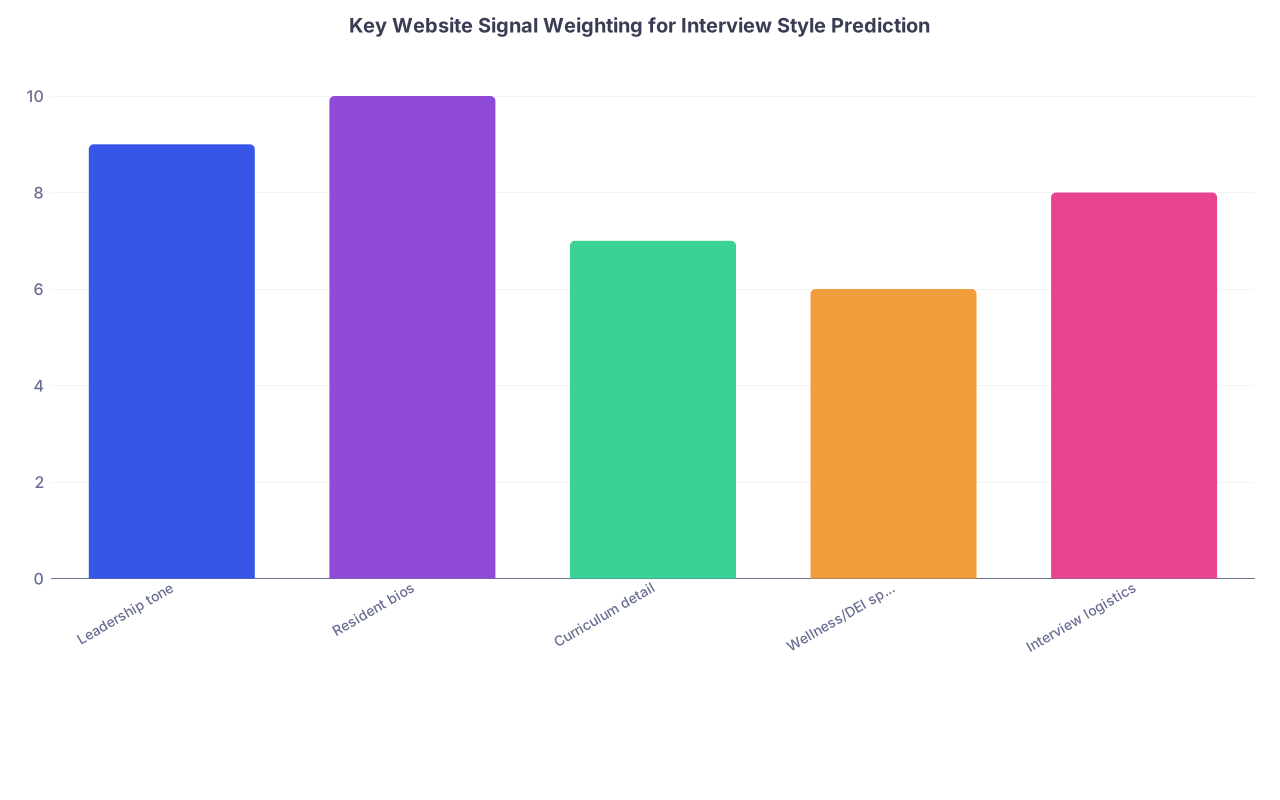
| Category | Value |
|---|---|
| Leadership tone | 9 |
| Resident bios | 10 |
| Curriculum detail | 7 |
| Wellness/DEI specifics | 6 |
| Interview logistics | 8 |
In practice, I give the heaviest weight to:
- Resident bios + photos – how they present the people actually doing the work.
- PD / leadership pages – tone, values, background.
- Interview logistics – level of structure and clarity.
Curriculum and wellness/DEI pages modify the picture but rarely overrule resident and leadership signals.
During interview season, you can verify your decoding in real time:
- Before interview:
- Write down 3 predictions based on the website:
- Example: “Interviews will be structured 20-minute blocks, academic-focused, heavy on research and career goals; culture is formal but supportive.”
- Write down 3 predictions based on the website:
- After interview:
- Check how close you were:
- Were the interviews conversational or scripted?
- Did they probe your story vs your metrics?
- Did resident Q&A match the wellness / schedule narratives online?
- Check how close you were:
If you repeatedly see big mismatches between website and reality, downgrade your trust in that program’s transparency. It often spills into other areas, including schedule, support, and feedback.
Step 10: Using Website Intel to Prepare Targeted Answers
Once you decode a program’s site, you should not walk into their interview with a generic script. You tailor.
Let me give you a pattern.
Example 1: Research-heavy, formal website
Signals:
- PD with large PubMed footprint.
- Home page emphasizes NIH funding and fellowships.
- Resident bios list research interests.
- Interview schedule: “Two 25-minute faculty interviews, one 15-minute PD interview.”
Prepare:
- A tight, 60–90 second summary of your main research project:
- Your question, your role, methods in plain language, what changed as a result.
- Clear, specific career goals that align with their strengths:
- “I am interested in becoming a transplant hepatologist in an academic center, with protected time for outcomes research.”
- 1–2 smart questions about mentorship, scholarly time, or project support.
Expect:
- Technical curiosity about your project, not just a superficial “tell me about your research.”
Example 2: Mission-driven, underserved focus website
Signals:
- Home page leads with safety-net language and patient population descriptions.
- DEI page is concrete and detailed.
- Resident bios mention advocacy, free clinics, global health.
Prepare:
- 2–3 real experiences where you worked with vulnerable populations:
- What you did, what you learned, how your own biases were challenged.
- Clarity on why that kind of work sustains you, not just “it is important.”
- Questions about partnerships, language support, or community-based projects.
Expect:
- At least one interviewer to push beyond your polished story: “Tell me about a time you got it wrong with a patient.”
Example 3: “We are a family,” small community program
Signals:
- Many group photos, social events.
- Resident pages show hobbies, families, pets.
- Wellness page has photos, minimal metrics.
Prepare:
- Stories about teamwork, supporting colleagues, resolving conflict gracefully.
- Be ready to talk about how you are as a colleague at 2 AM.
- Have 1–2 questions about mentoring, informal support, how they back each other up on tough rotations.
Expect:
- Interviews that feel like “Do we like you?” assessments more than “Are you smart enough?”
- Your interpersonal energy matters a lot here.
A Quick Visual: How Website Elements Map to Interview Reality

| Step | Description |
|---|---|
| Step 1 | Program Website |
| Step 2 | Leadership Pages |
| Step 3 | Resident Bios |
| Step 4 | Curriculum & Call |
| Step 5 | Wellness & DEI |
| Step 6 | Interview Logistics |
| Step 7 | Formality & Hierarchy |
| Step 8 | Personality vs Metrics Focus |
| Step 9 | Structure & Transparency |
| Step 10 | Values-Based Questioning |
| Step 11 | Interview Format & Pressure |
| Step 12 | Interview Tone |
| Step 13 | Question Consistency |
The idea is simple: each section of the website feeds into a handful of interview-day realities. If you read it like a clinician instead of a customer, you see the pattern.
How to Practice This Skill Quickly for 30–50 Programs
You do not have time to write a doctoral thesis on every program website. You need a fast, repeatable system.
Here is a 15–20 minute per program approach:
- 3 minutes – Home page + PD welcome letter
- Tagline content, major themes.
- 5 minutes – Leadership and resident pages
- PD background, tone, APD portfolios, resident bios and photos.
- 5 minutes – Curriculum, call, wellness, DEI
- Look for specificity vs vagueness.
- 2 minutes – Interview logistics / application info
- Format, structure, selection criteria.
- 3–5 minutes – Write:
- 2–3 bullet predictions about interview style.
- 2–3 tailored questions you will ask.
Do this for your top 15–20 programs at minimum. It will change how prepared and grounded you feel when you log onto Zoom.
You will never see a program website the same way again, and that is the point. This phase of the residency match is not just about submitting ERAS and praying for emails. It is about building an accurate internal model of where you fit and how you will be evaluated.
Once you can read websites as x-rays of program culture, you are ready for the next step: using interview day itself as your final diagnostic test before you rank them. That is where you stop decoding words and start reading facial expressions, resident dynamics, and what gets whispered after the official schedule ends. But that is a story for another day.