
Most applicants rank programs without truly understanding what their training will look like day to day. That is a mistake.
If you do not analyze case mix and call schedule properly, you are not “rolling the dice.” You are actively choosing blindfolded. I have watched residents in PGY-2 realize their program essentially does not do X specialty area they care about, or that their “q4 call” is actually q2.5 in real life. By then, you are stuck.
Let me break this down specifically: how to dissect a program’s case mix and call schedule before you certify your rank list. Not vibes. Not “seems busy.” Real analysis.
1. The Two Questions That Actually Matter
Strip the noise away. You are trying to answer two very concrete questions for each program:
- Will I see enough of the right cases to become independently competent in my target scope of practice (and competitive for my target fellowships)?
- Will the call structure and workload be sustainable for me for 3–7 years without destroying my health or my relationships?
Everything else—location, perks, reputation—sits on top of those two pillars. If either pillar is weak, the whole house leans.
To answer them, you need to look at:
- Case volume and case mix (what you see, how often, and at what level of complexity)
- Call structure on paper vs call reality on the ground
We will go specialty-agnostic, but I will drop examples (IM, surgery, EM, OB, anesthesia) so you can map this to your own world.
2. Case Mix: What You Must Extract From Every Program
Most applicants stop at: “Level 1 trauma, high volume, tertiary referral center, lots of pathology.” That tells you almost nothing.
You need numbers and distribution.
2.1 Start with the hard data you can actually get
You will not get a perfectly clean dataset from any program, but you can usually assemble enough.
Where to look:
- Program website – “by the numbers” or “clinical experience” pages
- ACGME case logs or minimums by specialty (to compare against)
- FREIDA and program brochures
- Interview day slide decks (screenshot them; people forget)
- PD or APD during Q&A
- Senior residents on your interview day or pre-interview dinner
- Alumni (LinkedIn, med school alumni network) – ask what they actually saw
You want at least:
- Annual total volume in your department (e.g., ED visits per year, OR cases per year, births per year, cath lab volume)
- Number of residents per year
- Structure of rotations (how many months on each key service)
- Fellow presence (helps or cannibalizes cases, depending on program culture)
Now convert that into something interpretable.
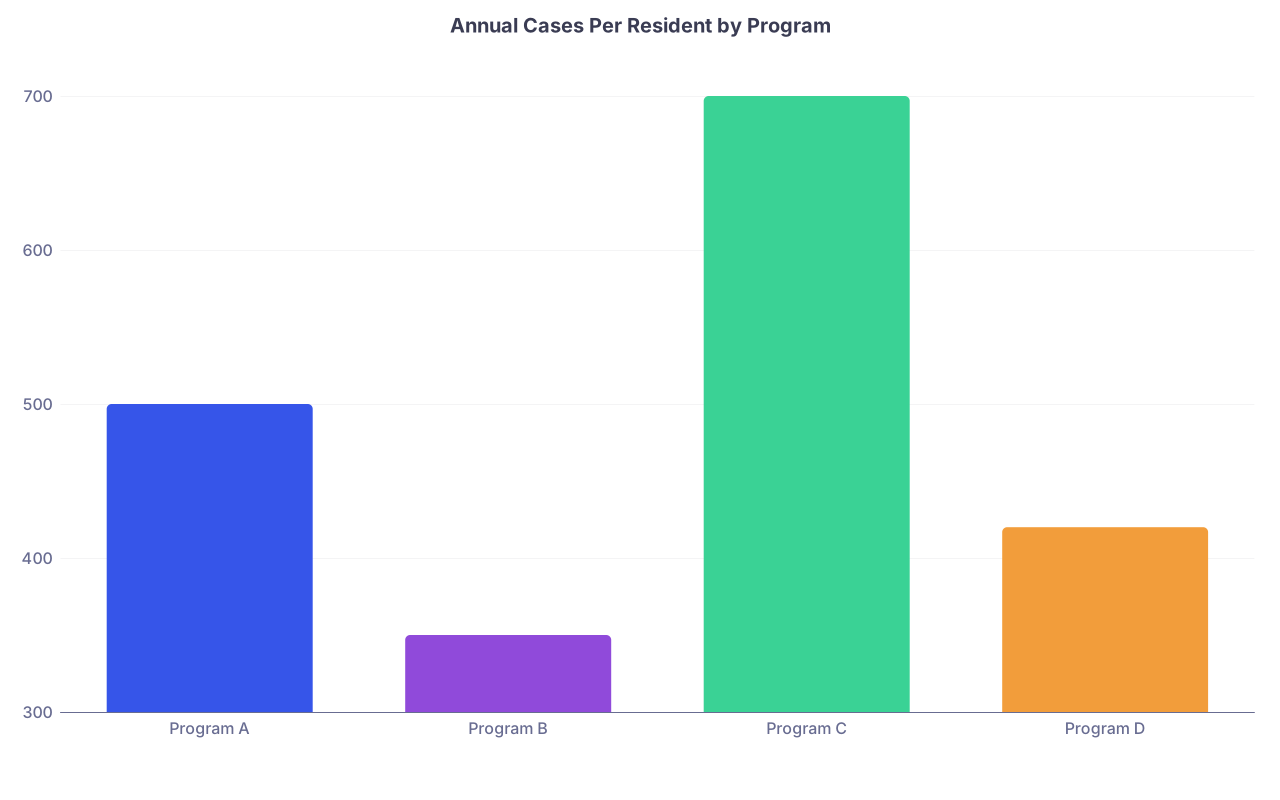
| Category | Value |
|---|---|
| Program A | 500 |
| Program B | 350 |
| Program C | 700 |
| Program D | 420 |
If programs do not give resident-level numbers, estimate: total departmental volume ÷ number of residents × your time spent on that service. Crude, but it quickly separates “truly high volume” from marketing fluff.
2.2 Dissecting case mix, not just volume
High volume is useless if it is the wrong kind of volume for your goals.
You need to think in buckets:
- Core bread-and-butter (what you must be good at on day one as an attending)
- Subspecialty depth (what you might want for fellowship or niche practice)
- Complexity spectrum (simple vs sick, routine vs rare)
Let me give a few concrete examples.
Internal medicine:
What percentage of your admissions are:
- Decompensated heart failure, COPD, pneumonia, sepsis (good; bread and butter)
- “Social admits,” placement issues, low-acuity cases (less useful)
- Oncology, transplant, advanced heart failure, HIV, rheumatology, etc.
How many ICU months? Are you running the unit or just “following along” while fellows do the work?
General surgery:
Approximate numbers of:
- Basic lap cases (chole, appy, hernias)
- Colorectal resections
- HPB cases
- Vascular, thoracic, endocrine
- Trauma operative vs non-operative
Do fellows take the key portions of big cases? Or are residents primary operator with faculty assist?
Emergency medicine:
- ED census per year
- Trauma vs non-trauma
- Peds percentage
- ICU-level care done in the ED vs shipped out
- Procedures: central lines, intubations, chest tubes, reductions, sedations
OB/GYN:
- Deliveries per year
- Vaginal vs C-section ratio, VBAC rates
- Gyn surgery case breakdown: minimally invasive vs open, oncology exposure, urogyne
Anesthesia:
- Mix of outpatient / inpatient / ICU / OB
- Regional vs general volume
- Cardiac, neuro, peds exposure
- Do CRNAs dilute your case ownership or are you supervised but primary?
You are trying to answer: “If I graduate from here, can I confidently and independently do the thing I picture myself doing in 5 years?” If you want community general surgery and you barely touch bread-and-butter hernias and gallbladders, red flag. If you want to be an intensivist and your “ICU time” is just you writing notes while fellows do every procedure, red flag.
3. Using ACGME Minimums as a Reality Check
Most specialties publish minimum case requirements. Programs love to say “our grads are well above ACGME minimums.” That sentence is meaningless without numbers.
You want to know: by how much, and in what categories?
| Case Type | ACGME Minimum | Program X Median | Program Y Median |
|---|---|---|---|
| Total Major Cases | 850 | 1050 | 900 |
| Endoscopy | 85 | 200 | 90 |
| Lap Chole | 85 | 140 | 88 |
| Hernia | 100 | 180 | 105 |
| Colon Resection | 70 | 110 | 75 |
This kind of comparison is what you are after. You likely will not get a perfect table, but you can ask directly:
“Where do your graduating residents usually land relative to ACGME minimums in key categories?”
If the PD hand-waves or cannot answer broadly for bread-and-butter categories, I get concerned. At minimum they should be able to say something like: “Our graduates typically log about 1.5–2x the minimums in core categories like X, Y, Z.”
For EM / anesthesia / OB, same idea. How many intubations? Lines? Vaginal deliveries? C-sections? Epidurals? Even rough numbers matter.
If you have multiple programs with data, build yourself a simple comparison.
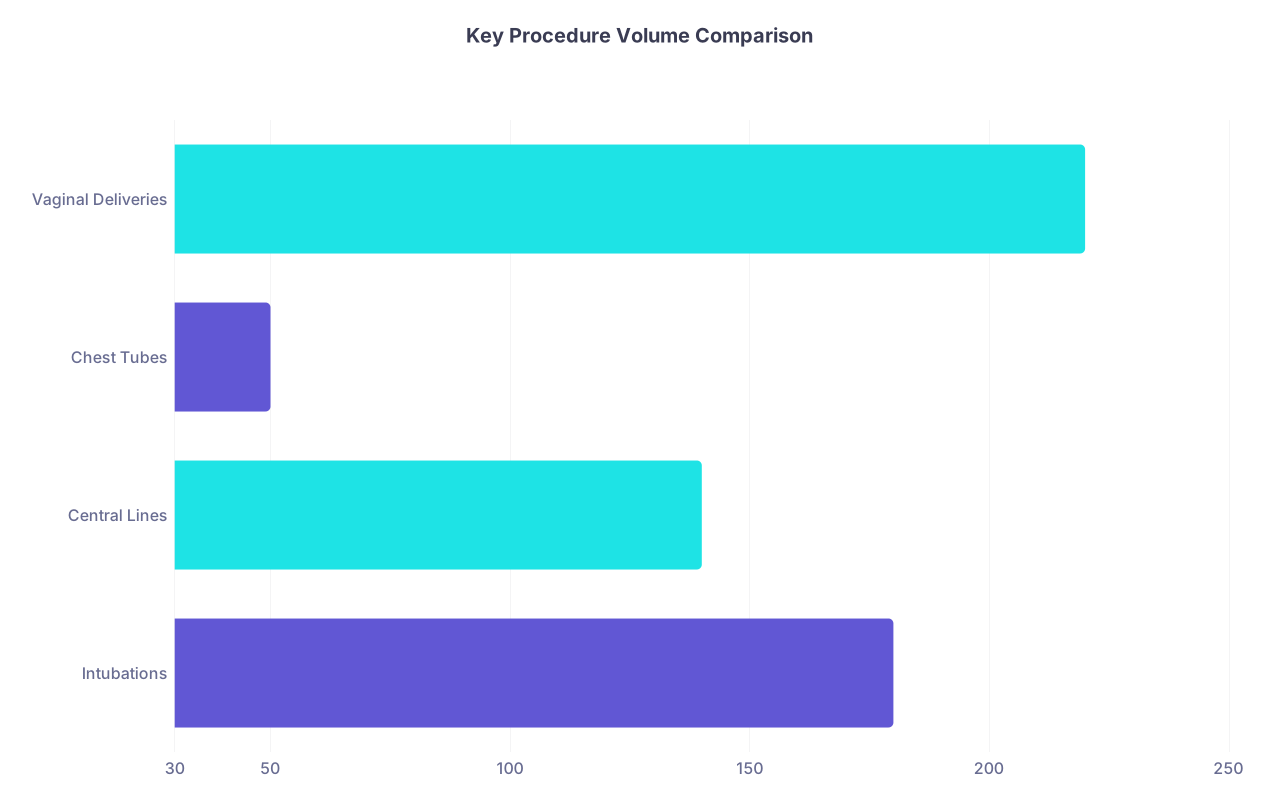
| Category | Value |
|---|---|
| Intubations | 180 |
| Central Lines | 140 |
| Chest Tubes | 50 |
| Vaginal Deliveries | 220 |
Even using estimated values from PD/ residents, this clarifies quickly: Program A = more procedures, Program B = lighter hands-on experience.
4. Fellows: Asset or Competition?
One of the most misunderstood pieces in case mix analysis is fellowship presence.
Here is the blunt version:
- Good fellowship integration: Fellows do high-end, niche work and teach you, while you still get a ton of bread-and-butter and a fair share of complex cases.
- Bad fellowship integration: Fellows take every interesting case, residents push the stretcher and write the note.
You need to figure out which scenario you are walking into.
Questions to ask residents (not faculty):
- “On big cases (trauma, complex onc, transplant, etc.), who is usually primary at the table?”
- “Do you feel like fellows crowd you out of the cases you want, or is there enough volume for everyone?”
- “If I want to do [your interest], is this a place where residents actually get those cases?”
If you hear: “Well, you can get those cases if you really advocate for yourself,” translation: you will be fighting a constant uphill battle.
One pattern I have seen repeatedly:
- At very high-volume, quaternary centers, even with multiple fellowships, the pie is simply so big that everyone eats.
- At smaller programs with one or two signature fellowships, the fellows often end up monopolizing the marquee cases.
So do not just label “fellowships present = bad for residents.” It is more nuanced. Push for specifics.
5. How to Read Between the Lines on Case Mix
You are not going to get a perfect spreadsheet. That is fine. You want pattern recognition.
- Residents say, “We meet ACGME minimums, but it is tight in category X.”
- Senior residents “supplement” their cases by moonlighting elsewhere to feel comfortable.
- Overemphasis in marketing on “rare, complex” cases with very little mention of basic work. That usually means you will be good at a narrow high-end slice and mediocre at what you actually do most of your week.
Green flags:
- Seniors casually give you real numbers: “By the end you will have done ~200 C-sections, 50–60 forceps/vacuums, 300+ vaginal deliveries, zero stress about minimums.”
- Residents at all levels say: “You will be sick of X by PGY-3. You get tons.” That is what you want for your bread-and-butter.
6. Call Schedule: What the Brochure Will Not Tell You
Now the second half of the equation: call.
If you screw this part up, it does not matter how good the cases are. You will be too exhausted or burned out to learn from them.
6.1 Ignore labels; get numbers
Programs love words like “q4”, “night float”, “home call”, “24+4”, “short call”, “long call”. These are branding, not data.
You need:
- Number of 24-hour (or >24) calls per month, by PGY year and by rotation
- Number of in-house nights on night float per month
- Average weekly hours on busy rotations (from residents, not PDs)
- Home call: how often you actually get called in, how many times per night
Ask seniors:
- “On your worst months this year, how many hours per week were you working?”
- “What is the actual number of 24-hr shifts per month as PGY-2 on [toughest service]?”
- “Does the schedule change a lot last-minute?” (chaos > raw hours)
- “How often do you violate 80 hours here? And what happens when you do?”
You are trying to approximate two things:
- Total hours and sleep disruption
- Predictability and fairness

| Step | Description |
|---|---|
| Step 1 | PGY-1 |
| Step 2 | PGY-2 |
| Step 3 | PGY-3 |
| Step 4 | PGY-4+ |
Not every specialty has this exact shape, but the idea holds: your life will wax and wane with rotation mix. You want to know the spikes.
6.2 Night float versus traditional call
Everyone parades “night float” as resident-friendly. Sometimes it is. Sometimes it is a bait-and-switch.
Questions:
- Length of night float blocks (one week? four? multiple times per year?)
- Hours per shift (are you leaving at 7 am or charting until 10?)
- How admissions and cross-cover are split between day and night teams
- Whether you get any meaningful post-call day off, or if “post-call clinic” is a thing
Traditional q4 24-hour call can actually feel better than a brutal night float if:
- Post-call days are strict
- Volume is manageable
- You get real operative/clinical exposure overnight
I have seen programs with “night float” where residents were at the hospital 15–16 hours per night, six nights a week, for four weeks. That is far worse than honest q4 call with hard post-call.
Do not fetishize labels. Ask about lived reality.
7. Home Call: The Most Misleading Phrase in Residency
“Home call” sounds soft. It often is not.
The spectrum:
- True light home call: phone calls, rare trips in
- Functional in-house call: you are in so often, for so long, you might as well have slept there
Questions you must ask if home call is a big part of the schedule (OB, some surgical services, radiology, etc.):
- “On a typical home call night, how often are you actually physically in the hospital?”
- “What does a bad night look like? How many times in and out?”
- “Are there guaranteed post-call days if you were up all night?”
- “Are you logged for duty hours for time you are at home but actively working (calls, EMR, etc.)?”
If residents chuckle before answering, assume it is heavier than described.
8. Quantifying and Comparing Call Intensity
At some point you need to compare apples to apples across programs.
You can build a simple mental model across PGY-1 and -2, where pain is highest.
For each program:
- Identify the 3–4 heaviest rotations (ICU, ED, trauma, L&D, heavy inpatient).
- For each rotation, estimate:
- Weekly hours
- Calls/nights per month
- Multiply by number of months per year.
Then you can create an approximate “call burden index” for yourself. Even back-of-the-envelope is helpful.
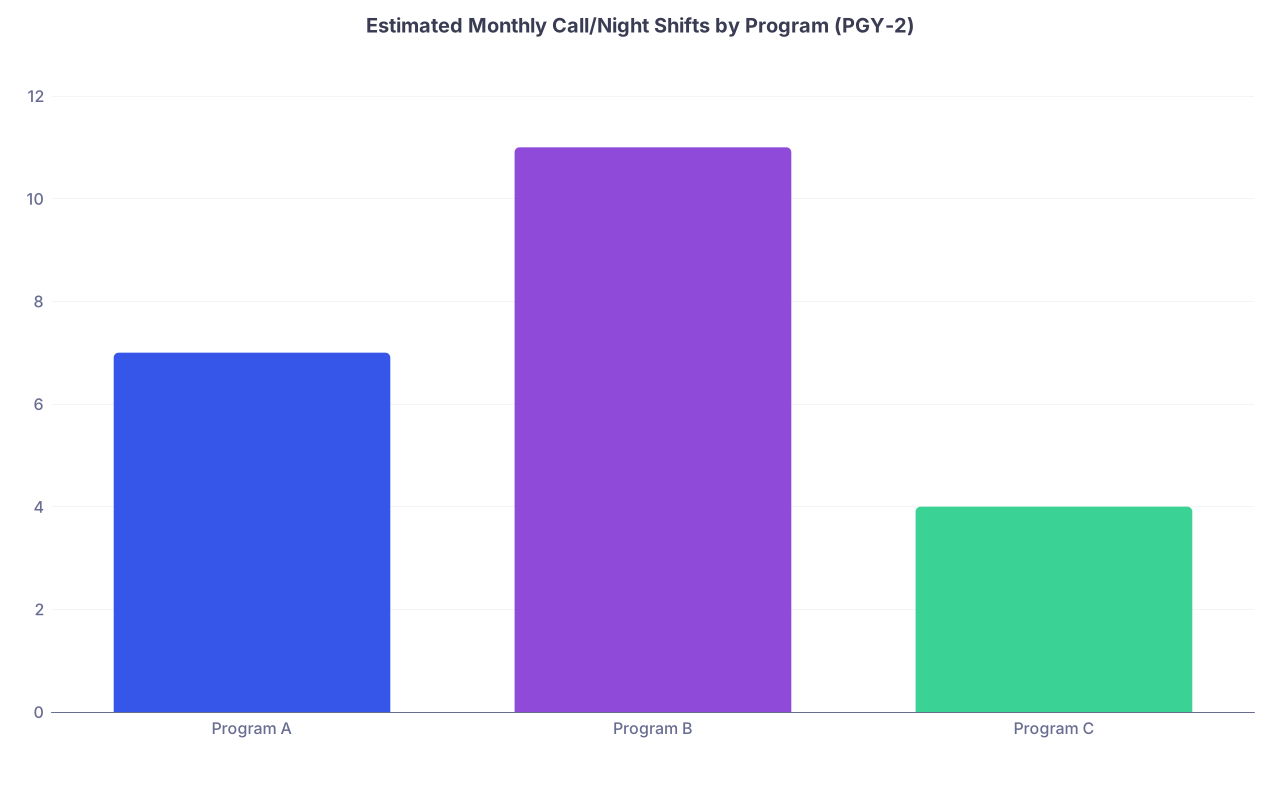
| Category | Value |
|---|---|
| Program A | 7 |
| Program B | 11 |
| Program C | 4 |
This kind of comparison helps you answer:
- Program A: moderate volume, moderate call
- Program B: high volume, punishing call
- Program C: perhaps lower volume but much more humane schedule
There is no right answer. Some people want maximum intensity and are fine with 80-hour weeks. Others know they will break at 65–70. Be honest with yourself.
9. Reality Check: What Residents Say vs What PDs Say
You already know this, but let me state it cleanly: PDs almost always under-describe the pain points and over-describe the opportunity. They are not lying; they are selling.
Residents will give you the truth, if you ask in the right way.
- “What are the worst 2–3 months of the year here, and how bad are they really?”
- “When are you most likely to regret matching here?” (You will get gold with this one.)
- “If you had to change one thing about the call structure, what would it be?”
- “What percentage of your class has seriously considered leaving or switching programs?”
Also pay attention to:
- Whether senior residents show up to pre-interview socials. If they all “had to work” every time, that may reflect chronic understaffing.
- If residents appear exhausted and cynical versus tired but engaged. There is a difference.
10. How Case Mix and Call Interact (This Is Where People Miss)
You cannot evaluate these two domains separately. You need to multiply them.
Scenario A: Huge case mix, intense call, but chaos and no education. You are simply service.
Scenario B: Moderate call, okay case mix, but excellent teaching and high resident autonomy. You learn more with less volume.
Scenario C: Massive volume, slightly illegal hours, residents tired but clearly skilled and confident, and they do the work themselves. For some, that is worth the grind.
Ask:
- “On your busy services, do you still get teaching, or is it survival mode?”
- “During call, are you actually doing procedures and decision-making, or just scut?”
- “By PGY-3, are you running the show on nights for X/Y/Z?”
I have seen small community programs with no fancy pathologies produce superb clinicians because residents truly ran the place and got every case. I have also seen high-prestige quaternary centers turn residents into note-writing assistants while fellows did all the meaningful work.
You are not buying prestige. You are buying reps and responsibility.
11. A Practical Step‑by‑Step Before You Rank
Let me lay out a simple process so you do not just “go with your gut.”

| Step | Description |
|---|---|
| Step 1 | List Programs |
| Step 2 | Collect Case Data |
| Step 3 | Estimate Case Mix Fit |
| Step 4 | Gather Call Details |
| Step 5 | Talk to Residents |
| Step 6 | Score Case Mix & Call |
| Step 7 | Integrate with Other Factors |
| Step 8 | Finalize Rank List |
Concrete steps:
For each program, write down:
- Bread-and-butter case volume in your top 2–3 areas of interest
- Presence and role of fellows on those services
- Approximate key procedure numbers by graduation (from PD or residents)
Overlay ACGME minimums for your specialty and decide:
- Are you clearly above, just at, or dangerously near minimum in important categories?
Map the call:
- Max hours rotations, worst call month, typical nights per month PGY-1/2
- Nature of nights (float vs 24 hr vs home call)
Rate each program for yourself on two 1–5 scales:
- Case Mix Fit (1 = weak/unbalanced, 5 = excellent for your goals)
- Call Sustainability (1 = likely burnout, 5 = very manageable)
Use a small table to keep yourself honest:
| Program | Case Mix Fit (1–5) | Call Sustainability (1–5) | Notes |
|---|---|---|---|
| A | 5 | 2 | Incredible cases, brutal call |
| B | 4 | 4 | Strong all-around, sane hours |
| C | 3 | 5 | Lighter, might need fellowship |
Once you see it like this, the tradeoffs are obvious. Most people’s “gut” ranking will track with these scores once they sit down and admit it.
12. A Few Specialty-Specific Pitfalls (Rapid Fire)
I will keep this tight but specific.
Internal Medicine:
- Beware programs drowning in low-acuity admits and “social admissions.” You will write notes all day and barely manage complex physiology.
- Look for:
- True ICU exposure
- Subspecialty rotations where you run the service, not just trail fellows
- Continuity clinic with real disease breadth, not just “refill visits”
General Surgery:
- Beware “we are very busy” but graduates scramble to log last-minute endoscopy or vascular cases.
- Look for:
- Chief year autonomy (are chiefs actually running major cases?)
- Bread-and-butter general surgery saturation
- Trauma operative volume, not just “we get a lot of blunt trauma that we observe”
Emergency Medicine:
- Beware “Level 1 trauma” where EM residents barely see the trauma because surgery owns it.
- Look for:
- True resuscitation leadership by EM
- Peds coverage breadth
- Procedure numbers checklist from senior residents
OB/GYN:
- Beware programs where family practice or midwives handle most uncomplicated deliveries and residents only see the disasters.
- Look for:
- High overall delivery volume with resident primary
- Balanced gyn, gyn-onc, REI exposure
- Reasonable home call that is not covert in-house
Anesthesia:
- Beware heavy CRNA coverage where residents are second-class citizens.
- Look for:
- Cardiac, neuro, peds, OB blocks with resident-first policy
- Regional numbers that are competitive
- Evidence that graduates match into strong fellowships and can do solo general work
13. What To Do If You Cannot Get Good Data
Some programs are opaque. Two moves:
Infer from match outcomes and alumni
- If graduates consistently match solid fellowships and take jobs you want, you can assume the training is at least adequate.
- Ask alumni privately: “Were there any categories where you felt weak entering fellowship/practice?”
Discount opacity
- If a program will not or cannot describe its case mix and call structure in concrete terms, I rank it lower.
- Transparency correlates with resident advocacy in my experience.
FAQ (Exactly 5 Questions)
1. How much should I weigh case mix and call schedule versus “prestige” when ranking?
For clinical specialties, I put case mix and day-to-day responsibility above prestige almost every time. A mid-tier program with strong hands-on training and reasonable call will produce a more competent, happier physician than a famous name where you are an overworked scribe. The one exception is highly competitive fellowships where certain name brands open doors, but even there, programs with better operative/clinical experience often send more graduates to those fellowships than the “famous but weak training” places.
2. If a program’s call seems brutally hard but the case mix is phenomenal, should I still rank it highly?
It depends on your stamina, your support system, and your long-term goals. If you want a cutting-edge surgical subspecialty and a program will clearly give you unmatched operative volume even at the cost of a miserable PGY-2 year, many people would accept that tradeoff. If you already have health issues, kids, or low tolerance for sleep deprivation, you are gambling with your ability to finish the program. I advise people to avoid programs where multiple residents per class are burning out or leaving; that is not “hard but good training,” that is structural dysfunction.
3. How many resident opinions do I need before I trust what I am hearing about call?
At least two, ideally three, and from different PGY levels. A single happy PGY-1 on an easy rotation is not representative. Talk to: one intern, one mid-level (PGY-2/3), and one senior. If the PGY-2 and PGY-3 both say the same thing about ICU call being crushing, believe them. If stories conflict wildly, assume variability and less predictability, which I count as a negative.
4. What if a program says, “We meet all duty hour requirements, no violations,” but residents hint that they actually work more?
Every program bends reality a bit with duty hours. I pay attention to degree and attitude. If residents openly say, “Look, we are often around 75–80 hr on heavy months, we log honestly, and leadership tries to fix patterns,” that is honest. If residents smirk and say, “We never log over 80 because we are told not to,” that is a red flag. That usually means workload is excessive and culture is punitive. I would drop that program on my list unless the training benefits are truly exceptional and you know what you are signing up for.
5. How do I handle programs where fellows might take cases I want, but the name and fellowship pipeline are outstanding?
You decide whether you want to be primarily a service line for fellows or a primary operator yourself. Some people use those big-name, fellow-heavy programs as a stepping stone to competitive fellowships and accept lower operative autonomy as the tradeoff. Others prefer smaller or community-heavy programs where they are primary on almost everything and then still match strong fellowships because their skills are obvious. If you want technical mastery and confidence, I lean toward programs where residents are not consistently sidelined by fellows. If your top priority is a specific rarefied fellowship where Program X has a 20-year pipeline, you might tolerate less operative ownership for that ticket.
Key takeaways:
- Do not trust vague descriptors. Force every program into numbers: case categories, procedure counts, call nights, ICU months.
- Weigh case mix and call schedule together; great training with intolerable workload or easy hours with anemic exposure both fail you in different ways.
- Residents’ concrete stories—about their worst months, their case logs, and their true autonomy—are the most reliable data you will get. Use them.