
It is late November. You are sitting with a half-finished rank list, fifteen programs circled, and too many tabs open: Instagram accounts, old virtual open house recordings, a couple of Reddit threads you probably should not trust, and a GroupMe link that gives you the creeps. You keep hearing, “Go where the residents are happy.”
You look at a feed full of pumpkin carving, wellness Wednesdays, and “we’re so honored to be…” captions and think:
Ok. But are these people actually happy, or is this just performative wallpaper?
Let me walk through how to read between the lines. Because there are specific, concrete signals—on social media and in open houses—that tell you far more about resident culture than any glossy brochure or “we’re a family” speech.
Step 1: Basic Reality Check – What Kind of Social Media Footprint Is This?
Before you start psychoanalyzing their Halloween party photos, you need a simple map of what you are looking at.
Most residency programs fall into a few recognizable patterns.
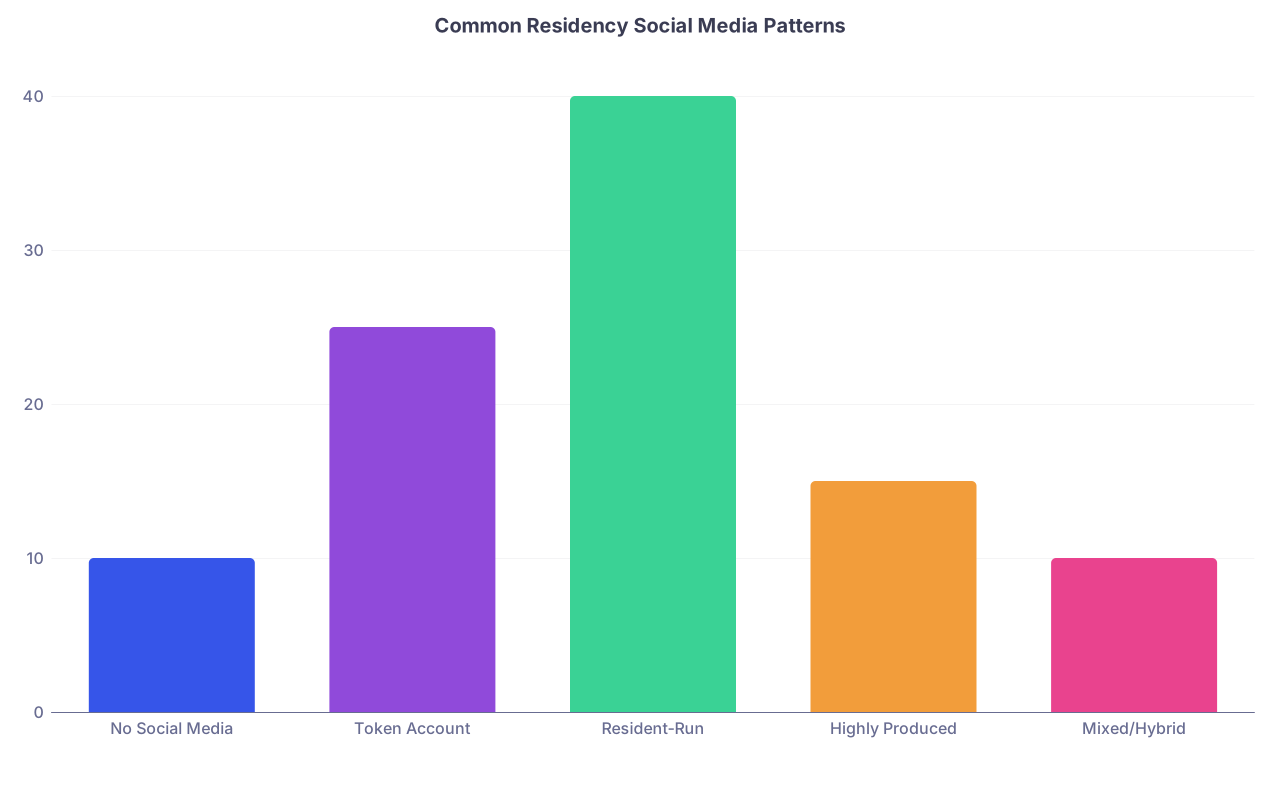
| Category | Value |
|---|---|
| No Social Media | 10 |
| Token Account | 25 |
| Resident-Run | 40 |
| Highly Produced | 15 |
| Mixed/Hybrid | 10 |
Roughly speaking (from what I have seen and what PDs quietly admit):
- No social media
- Token, rarely updated account
- Resident-run, lively accounts
- Highly produced, marketing-driven accounts
- Hybrid: official + informal/side accounts
Here is how to read each.
1. No social media presence
This is not automatically bad. But it tells you a few things:
- Leadership may be older, less digitally engaged, or simply not interested.
- Recruitment strategy is old-school: word of mouth, reputation, program website.
- Culture signal: either “we are busy doing the work and do not care about optics” or “we are not great at transparency.”
You cannot conclude much about resident happiness from absence alone. You just know you will need other data: current resident Zooms, alumni, faculty you trust. Treat media silence as a diagnostic blind spot, not a red flag by itself.
2. Token account, updated twice a year
Example: Last post is “Welcome Class of 2022” and then one “Match Day 2023” group photo. Captions sound like a departmental secretary wrote them.
This usually means:
- Social media is a checkbox, not a priority.
- No resident energy behind it.
- Culture: can be perfectly fine clinically, but not a place that is intentionally cultivating community or branding.
I would not rank or derank purely on this, but I would assume: more traditional, less “we think about how we present ourselves to trainees.”
3. Resident-run, obviously authentic account
You can usually spot this quickly:
- Casual photos
- Inside jokes
- “Roasted our co-resident on their birthday”
- Posts at off-hours, meme use, unpolished but real
This is where you start getting genuine culture data. When residents own the account, you see what they actually think highlights the program: do they show camaraderie, teaching, silly moments on night float, or just mandatory “DEI month” content someone forced them to create?
These accounts are gold if you know how to read them. We will go deep on that.
4. Highly produced, marketing-driven account
You will see:
- Uniform color schemes
- Clean graphics
- Regular scheduled posts
- Professional photos
- Captions sound like a PR office: “We are committed to excellence…”
These accounts are not useless, but they are controlled. You are looking at what leadership wants you to see, not necessarily what residents feel.
Signal here is not “they are lying.” It is “you must supplement this with off-script interactions.”
5. Hybrid: official + informal
Sometimes you will find:
- Official department account
- Separate resident-run account
- Maybe a “Residency Wellness Committee” account
- Plus resident class Instagram or private group
This is ideal from a data standpoint. You can triangulate:
- What leadership emphasizes
- What residents emphasize
- What residents share when they are not being supervised
Step 2: What To Scan FIRST – High-Yield Pass Over Any Program Feed
Before you scroll back 3 years, do a quick structured scan. Ten minutes, maximum, per program.
Here is the checklist I would use for that first pass.
| Item to Check | What You Are Looking For |
|---|---|
| Posting frequency | Dead vs steady vs manic posting |
| Who appears most (res vs faculty) | Power balance, resident visibility |
| Diversity in photos | Gender, race, age, non-traditional backgrounds |
| Night/weekend content | Tone about workload and call |
| Response to crises | COVID, social unrest, institutional controversies |
1. Posting frequency and pattern
You are not judging them on “busyness.” You are judging consistency and tone.
- Dead for a year, then massive surge in September–January: panicked recruitment mode. Often new PD or trying to repair reputation.
- Steady, light presence year-round: recruitment is one piece, but not an emergency.
If the account only wakes up for interview season, assume you are seeing a performance, not daily life.
2. Who is visible, and how often?
Quick count on the last ~20 posts:
- How many are resident-centered (faces, quotes, takeovers)?
- How many are faculty / department / awards / “our chair gave a talk at…”?
- How many are abstract graphics or announcements only?
Programs that talk nonstop about their chair’s R01 grants but barely show residents typically have a faculty-centric culture. That is not necessarily malign, but it usually means: you are there to run the machine and maybe plug into research, not to be the core of the ecosystem.
3. Diversity: not as a checkbox, but as a pattern
Look at several months of content:
- Are URiM residents there consistently, or only in one “DEI post” during a themed month?
- Do you see residents with kids, older residents, visibly diverse identities, or does everyone look like the same 3 template people?
- If it is a region with diverse demographics but the residency photos look extremely homogeneous, that disconnect means something.
No program will show you everything. But if diversity only shows up as slogans, not as actual faces in everyday posts, that is a culture tell.
4. Night, weekend, and call content
Here is where programs accidentally tell on themselves.
- Do they post “look at our team grinding overnight!” content with residents clearly exhausted but framed as heroism?
- Are there subtle digs like “another 28-hour shift but we survived!” or “we live here now lol”?
- Or do they intentionally avoid glamorizing misery, and instead show: cross-cover team dynamics, night attending teaching, protected post-call time?
If every night float post is “we’re dying but at least there’s cookies,” assume a normalized overwork culture. Residents joke about suffering; that is normal. But if the program’s official account amplifies that as brand identity, they are not pushing back against it.
Step 3: Reading the Subtext – What Resident-Run Feeds Reveal
Now we get specific. You are looking for subtext, not just pretty photos.
A. The ratio that matters: staged vs spontaneous
Staged:
- White coat ceremony photos
- Graduation
- Formal headshots
- Required wellness retreats
Spontaneous:
- Group text screenshots (sanitized, obviously)
- Kitchen selfies
- On-call birthday celebration at 2 a.m.
- “Caught in the workroom” candids
You want at least some spontaneous content. Programs with only staged “professional” shots either:
- Have residents who are too exhausted or disengaged to bother
- Or have leadership that discourages informal posting
Neither is ideal.
B. Humor style: self-aware vs toxic
People underestimate how diagnostic humor is.
Pay attention to:
- Self-deprecating but supportive: “We made it through four nights together and somehow still like each other.”
- Dark but bonded: “Code in the cafeteria but at least I had backup.”
- Versus mean-spirited: jokes at the expense of co-residents, other services, or patients.
If you see residents publicly mocking each other or other specialties in a sharp, demeaning way, that usually reflects an underlying culture problem that will be 10x louder in the workroom.
C. Resident autonomy: who is “speaking”?
Look at the captions and story takeovers:
- Do you see “Hi, I’m X, PGY-2, and this is my day on wards,” filmed vertically, a bit chaotic, but real?
- Or are most “resident quotes” obviously scripted: “I chose Program X because of the supportive environment and unparalleled training”?
Authentic autonomy looks a bit messy. Scripted autonomy looks like a promo video. You want the first.
Step 4: Content Categories That Tell You Way More Than They Think
Let me break down specific content types and how to decode them.
1. Wellness and social events
Pumpkin carving. Escape rooms. Yoga in the park. Everyone posts this. The trick is reading how it is framed.
Questions to ask yourself:
- Is wellness only shown as big, infrequent, photo-op events? Or are there many small, organic moments—residents getting coffee together, lunchtime walks, low-key hangouts?
- Do they look like they actually like each other, or like they were ordered to stand together for a photo and then scatter?
I have seen programs where the wellness retreat photos looked fantastic, but every resident I talked to privately used phrases like, “Yeah, forced fun. They think that fixes everything.”
Contrast that with feeds where you see simple, low-production photos from the workroom: “PGY-1s brought in pastries for the team today” or “Senior teaching on signout.” That is real.
2. Education and academic posts
Look for:
- Regular conference / morning report shots
- Board review sessions
- Journal clubs that look attended and engaged
- Every “education” photo is an empty conference room with faculty lecturing, no residents visible.
- All academic posts are about faculty grants, not resident achievements.
Healthy culture: residents’ scholarly work gets spotlighted, their talks and posters are celebrated, and you see some personalization: “Proud of Sara for presenting at SGIM!”
Program where residents are worker bees: faculty are the heroes, residents vanish into the background.
3. How they talk about hard things
Scroll around major events:
- Early COVID (2020–2021)
- George Floyd / 2020 protests
- Any local hospital scandal or major community trauma
Did they:
- Say nothing, ever?
- Post a generic statement and then immediately go back to “we love our work family”?
- Or did you see resident-led town halls, book clubs, journal clubs, paired with visible DEI leadership, ongoing effort?
Again, this is pattern, not a single post. A program that actually takes resident voice seriously will show ongoing initiatives, not a 48-hour symbolic response and silence.
Step 5: Open House and Virtual Meet Signals – What They Won’t Put in Writing
Social media shows the curated narrative. Open houses show how people behave live when they are trying to impress you but do not fully control the medium.
Here is the key: you are watching how they structure the open house as much as what they say.
A. Who controls the room?
If the PD talks for 40 minutes and residents get 5 minutes for “Q&A,” that tells you the power structure.
Strong culture moves:
- Residents lead at least part of the session.
- PD speaks, then leaves for a resident-only Q&A breakout.
- Chiefs speak candidly about what has improved and what still needs work.
Weak culture:
- PD or APD insists on staying in every breakout.
- Residents visibly hesitate or look over their shoulder before answering anything negative.
- Questions about workload or problem residents get brushed off as “we will address that later.”
You want spaces where residents can talk free of faculty presence. If the program refuses to create that, they either do not trust residents or know there are issues residents would reveal.
B. How residents talk about call, nights, and workload
You are not asking for exact census numbers. You are listening for tone and specificity.
Good answers sound like:
- “On wards we typically cap at X, and when we hit cap we redistribute to the float. You feel busy, but not unsafe. Nights are front-loaded in PGY-1 but you get weekends off post-call. I probably average X–Y hours a week on that rotation.”
Shady answers sound like:
- “We work hard, but we are like family, so it is fine.”
- “You will learn a ton, but yeah, it is busy. I would rather be busy than bored.”
- “Hours? It varies a lot, hard to say.”
If nobody can give a concrete sense of schedule or caps, either they are lying or too shell-shocked to count.
C. How they handle “What would you change?” questions
Always ask some version of: “If you could change one thing about the program, what would it be?”
Strong cultures:
- Offer a real complaint, plus evidence it is being worked on: “For a long time, the ICU schedule was rough. They just changed it last year—still not perfect, but much better than when our seniors were interns.”
- Residents do not all parrot the exact same safe answer.
Toxic or excessively controlled cultures:
- “Honestly, nothing. We really love it here.”
- Or multiple residents give the same canned line: “Parking, haha” or “The weather.”
Some uniformity is inevitable, but if every answer sounds rehearsed, they have been coached.
Step 6: Body Language and Micro-Interactions During Open Houses
This is the part most applicants miss. You are not just evaluating what they say; you are reading behavior.
Watch for:
- Who talks over whom?
- Does the PD interrupt residents often?
- Do residents cut off juniors?
- Do juniors ever speak up spontaneously, or only when called on?
- Whose cameras are on?
In virtual sessions:
- Do residents keep cameras on voluntarily and look engaged, or do they look like hostages?
- Does anyone look actively irritated or burnt out when faculty are speaking, then relax when faculty leave?
- How do they react to “uncomfortable” questions?
For example: “How do you handle a co-resident who is not pulling their weight?”
Healthy answer:
- “We have a coaching and remediation structure. It is uncomfortable but we have a process. We do not just dump work on others.”
Unhealthy reaction:
- Long awkward silence. Residents exchanging glances.
- PD jumping in quickly: “We maintain only the highest standards, that is not an issue here.”
That last line is almost always false. Every program has struggling residents. How they say they handle it tells you whether you will be protected or exploited when it happens.
Step 7: Correlating Signals – Social Media vs Open House vs Word of Mouth
You should not treat any one signal as gospel. What matters is convergence.
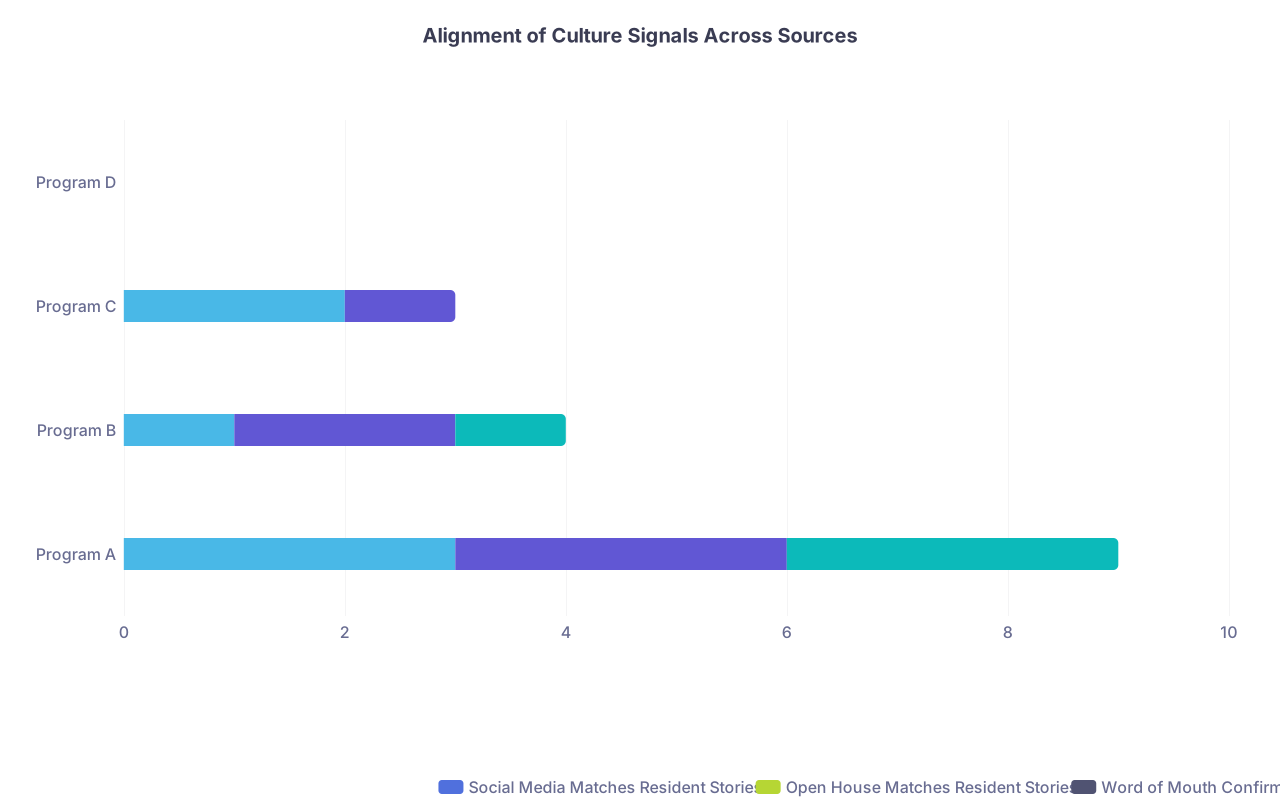
| Category | Social Media Matches Resident Stories | Open House Matches Resident Stories | Word of Mouth Confirms |
|---|---|---|---|
| Program A | 3 | 3 | 3 |
| Program B | 1 | 2 | 1 |
| Program C | 2 | 1 | 0 |
| Program D | 0 | 0 | 0 |
Think of three major data streams:
- Social media presence
- Open house / interview day behavior
- Off-line word of mouth (alumni, mentors, current residents at your med school, fellows)
You trust programs when:
- The fun, supportive vibe on Instagram matches what residents say privately.
- Open house comments about workload align with what fellows and grads describe.
- Issues mentioned on message boards are acknowledged by current residents and framed with “here is what changed.”
You worry when:
- Social media: “We’re family!”
Word of mouth: “People are leaving or going part-time because they are exhausted.” - Open house: “We average 60–70 hours and are compliant.”
Private: “We are constantly ‘averaging down’ off-service rotations to hide real hours.” - Social media: wall-to-wall diversity content.
Private: “There were major racism/sexism issues swept under the rug last year.”
If two of the three streams contradict each other strongly, downgrade. There is almost always a reason.
Step 8: Red Flags That Should Make You Very Cautious
Let me be explicit about some patterns that, in my experience, usually correlate with unhappy trainees.
Only group photos, no close-ups or individual recognition
Everyone is just “the class.” No one is highlighted for achievements, milestones, or even birthdays. That often reflects a culture where individuals are interchangeable work units.“Look how much we work” as a brag
Reels and posts glorifying 28-hour shifts, residents “crushing” insane lists, meme after meme about burnout, and the tone is pride, not concern. That is not grit. That is normalization of exploitation.Disappearing residents
You see big “Welcome PGY-1 Class of 2021!” posts, but by the time you scroll to mid-PGY-2 posts, someone has essentially vanished, never appears again, never mentioned as transferring or changing paths. That can mean a hostile response to attrition or illness, or just no transparency about resident departures.Excessive defensiveness in Q&A
Ask about program weaknesses and get immediate spin, no reflection, no “this is something we are improving.” That tells you leadership is image-obsessed, not growth-oriented.No resident-only spaces during recruitment
If they refuse to give you a room (or Zoom) where residents can talk without faculty, you should assume there are things they do not want you to hear.
Step 9: Green Flags That Actually Mean Something (Not Just Buzzwords)
On the positive side, here are signs that the culture is probably functional and not just well-marketed.
Residents publicly pushing for change—and not punished
Posts like: “Proud to see our residents advocate for better lactation spaces” or “Resident QI project led to redesigned call rooms.” That means resident voice has real impact.Honest, specific discussions of past problems
In open house: “Three years ago, our ICU schedule was brutal. Residents complained, and leadership changed X, Y, Z.” Programs that admit faults and show a timeline of change are usually safer than those that claim perfection.Micro-joys in the feed
Not just big retreats. Little things: “Our senior brought breakfast tacos for the team,” “Secret Santa in the workroom,” “Night float team’s puzzle corner.” These are not staged. People who are utterly miserable do not create these small traditions.Chiefs and seniors visibly mentoring interns
Photos or stories of chiefs teaching, social posts celebrating interns’ progress: “Cannot believe how far our PGY-1s have come.” That tone is mentorship, not hazing.Reasonable boundaries around work shown online
You do not want a program that glamorizes “charting at home at midnight.” Healthy ones avoid romanticizing after-hours grind and emphasize unplugging, PTO use, non-work identities.
Step 10: A Simple Framework To Score Programs on “Culture Signal”
If you want to be systematic—and you should—build a quick scoring grid for yourself. Nothing fancy. Something like this:
| Domain | Score 1 (Bad) | Score 3 (Neutral) | Score 5 (Strong) |
|---|---|---|---|
| Resident Visibility | Barely present | Mixed with faculty-heavy content | Central, frequent, authentic |
| Transparency About Work | Vague / performative | Basic info, little detail | Specific, consistent, matches word-of-mouth |
| Resident Voice in Events | None / tightly controlled | Limited but present | Resident-led segments, faculty step back |
| Handling of Problems | Denial, defensiveness | Acknowledge vaguely | Honest about issues + clear improvements |
| Social Media Authenticity | Polished, corporate only | Mixed | Clear resident-run, real humor and posts |
Then, for each program you care about, quickly score 1–5 in each domain based on:
- Social feeds
- Open house
- Off-line conversations
Any program averaging under 3 should drop on your rank list unless there is a very compelling reason (location, family, dual-career issues). Programs averaging 4–5 are rare, but when culture signals are that strong and consistent, I would move them up even if other metrics (name brand, prestige) are slightly lower.
Final Thoughts
You are not trying to read their soul from Instagram. You are doing pattern recognition across controlled and semi-controlled environments.
Three key points to keep in mind:
- Look for alignment, not perfection. Social media, open houses, and private conversations should tell broadly the same story. When they diverge sharply, believe the least polished source.
- Reward specifics and humility. Programs that give you concrete schedules, acknowledge past problems, and show residents as real people—not props—are usually safer, healthier places to train.
- Trust your discomfort. If the vibe on feeds and open houses feels fake, over-rehearsed, or aggressively “we’re a family,” do not gaslight yourself. You are seeing something. Factor it into your rank list.
You only get one residency experience. Do not let a few glossy posts or a slick virtual open house talk you out of listening to what the signals are actually telling you.