You are staring at your ERAS personal statement draft. Version 6. The first line still says, “I have always wanted to be a surgeon,” but you are no longer applying in surgery. You already did a full application cycle in one specialty, interviewed, maybe even matched prelim. Now you are pivoting. Different field. Different story. Same person.
And you are stuck on the same problem every applicant in your position hits:
“How do I explain this without sounding flaky, impulsive, or like I have no idea what I am doing?”
Let me be blunt. Programs are not afraid of applicants who switched once. They are afraid of applicants who look like they will switch again. Your entire job is to convince them you are not that person.
Let me break this down, specifically.
What Programs Actually Worry About When You Switch
Before you write a single sentence, you need to understand what is in the back of the PD’s mind when they see a specialty switch.
It is not “this person is evil.” It is:
- Will this resident quit or switch out again?
- Are they running away from something (lifestyle, difficulty, personality conflicts) rather than running toward something?
- Are they going to be miserable and burn out halfway through?
- Does their story make sense, or are they just chasing perceived “easier” or “more competitive” fields?
They will scan your application and unconsciously ask:
- Timeline: When did this switch happen? Sudden or gradual?
- Evidence: Is there a clear pattern that aligns with the new specialty?
- Ownership: Do they take responsibility for prior choices, or do they blame everyone else?
- Trajectory: Does this person look more focused now, or just scattered?
You cannot fix everything, but you can control those four themes in your narrative.
The Core Framework: From Confusion to Coherence
Here is the cleanest structure I have seen work, again and again, for a specialty switch narrative. It works in your personal statement, in your ERAS experiences, and when answering “So, why the switch?” on interview day.
Four phases:
- Initial attraction to first specialty (short, factual, not romanticized)
- Real exposure + dissonance (what did not fit, specifically)
- Discovery of the new specialty (where the alignment became obvious)
- Current commitment and proof (actions you have taken that lock in the choice)
The order matters. The proportions matter more.
If your current draft spends 60% of the PS on your old specialty and 2 sentences on your new one, you are doing it wrong. Flips the emphasis: old specialty gets context, new specialty gets conviction and detail.
Step 1: Own the First Choice Without Over-selling It
You do not need to pretend you never liked your original specialty.
You also absolutely should not say you “always knew” you wanted your new specialty, when your CV clearly screams “I did two years of neurosurgery research.”
You are walking a narrow line: acknowledge your prior interest, but do not oversell it into a lifelong calling. Make it understandable but limited.
Weak version (what I see constantly):
“From the first day of my surgery rotation, I knew I had found my passion. The OR felt like home…”
You cannot write that if you are now switching into psychiatry. It makes you sound melodramatic and unreliable.
Stronger version:
“Early in medical school, I was drawn to surgery. I liked the clear problems, the technical challenge, and the structure of the OR. My sub-internship and early research projects naturally followed that interest, and I entered the residency application cycle fully expecting to become a surgeon.”
Notice what that does:
- It is honest.
- It does not make big “forever” claims.
- It shows you made a rational decision based on real preferences at the time.
You want the reader to think: “Okay, that makes sense. I might have made that choice too, with that exposure.”
Step 2: Describe the Mismatch Without Trashing Anyone
Now the part people routinely screw up: explaining why the first path was wrong without sounding bitter, blaming, or evasive.
This is where PDs look for red flags. If your explanation is:
- “The hours were awful.”
- “The culture was toxic.”
- “They did not appreciate my strengths.”
…you immediately trigger a “will this person say the same thing about us in a year?” response.
The trick:
- Focus on fit, not fault.
- Be specific about activities and cognitive tasks, not vague about “vibes”.
- Tie the mismatch to enduring traits (what energizes vs drains you).
Example – weak:
“On my sub-internship, I realized the lifestyle and culture of surgery were not compatible with how I wanted to practice medicine.”
This is boilerplate and sounds like a lifestyle complaint. Also, it tells them nothing about you.
Example – strong:
“During my surgical sub-internship and later as a prelim, I found myself most engaged when I was in pre-op and post-op visits, talking through patients’ fears, expectations, and long-term plans. In the OR itself, I enjoyed the technical work, but I missed the longitudinal, problem-solving conversations that had initially drawn me to medicine. Over time, the mismatch between where I spent most of my hours and what I found most meaningful became harder to ignore.”
See the difference? You are not saying, “Surgery is bad.” You are saying, “My energy and satisfaction kept clustering around different kinds of work.”
You can be even more explicit with contrasts:
- Procedures vs longitudinal care
- Acute vs chronic problem-solving
- Team structures and communication
- Type of thinking: protocol-driven vs hypothesis-driven vs narrative-driven
Programs want to see this level of introspection. It signals maturity, not indecision.
Step 3: Show How You Found The New Specialty (Not That It Fell from the Sky)
The worst narrative move is: “Then I did a rotation in [new specialty] and loved it,” with no further explanation. It reads like you just went with whatever the last rotation was.
You need a chain of events that looks retrospective but logical.
Patterns that work well:
- Exposure during a consult service that kept calling you back
- Longitudinal follow-up of a patient population that made you re-think what you found fulfilling
- A mentor whose work style and patient interactions you kept admiring
- An elective you took “to broaden perspective” that ended up clarifying everything
Example:
“During my prelim year in internal medicine, I requested extra time on the inpatient consult service, partly to broaden my skills while I sorted through my unease about a surgical career. The consult days that stood out most were those in which we were asked to help manage complex heart failure and arrhythmia patients. I found myself reading late into the night about guideline updates, imaging, and risk stratification, not out of obligation but curiosity. By the end of that month, I realized that the questions I enjoyed wrestling with—how to optimize long-term cardiac function, how to individualize therapy—aligned far more closely with cardiology than with any surgical field.”
Translate that same structure into, say, psychiatry, radiology, anesthesia, EM. The specifics change. The logic does not.
What you are communicating:
- The shift was gradual, not impulsive.
- You paid attention to what energized you.
- Your new choice is grounded in real clinical exposure.
Step 4: Prove Commitment with Concrete Actions
Words are cheap. Program directors know how easy it is to write a beautiful personal statement. They are looking for congruence between what you say and what you did.
Once you realized the new specialty fit you better, what did you actually do?
Here is where you list specifics, not vibes:
- Took on a new research project in the new field
- Asked to join QI or curriculum work in that department
- Arranged an away rotation or extra elective
- Found a mentor in the specialty and met regularly
- Joined specialty interest groups, conferences, or virtual didactics
- Updated your Step 2/CK timeline to support the switch
| Domain | Strong Evidence Example |
|---|---|
| Clinical | Extra elective or sub-I in new specialty |
| Research | New project with faculty in target specialty |
| Mentorship | Regular meetings with attending in new field |
| Scholarship | Poster/abstract at specialty-specific meeting |
| Service/QI | QI project in target department |
You do not need all of these. But you need some. And you need to actually highlight them in your narrative.
Example paragraph:
“Once I recognized that my interests and strengths were best aligned with psychiatry, I met with Dr. S, our inpatient unit director, to discuss a potential transition. With her guidance, I arranged an additional month on the CL service, joined an ongoing QI project focused on reducing 30-day readmissions for patients with co-occurring substance use, and began attending our department’s weekly case conferences. These experiences confirmed that the aspects of medicine that most engage me—understanding patients’ stories over time, integrating biological and psychosocial data, and working in interdisciplinary teams—are central to psychiatric practice.”
That reads like someone moving toward something, not drifting.
How to Sound Decisive in the Personal Statement
Let’s get surgical about the actual PS structure. You want to front-load clarity and minimize confusion. A PD skimming your first paragraph should not have to guess that you switched.
A simple, high-yield structure:
- Opening with present-tense clarity about your current choice.
- Brief retrospective: what you thought you wanted before.
- Specific experiences that revealed the mismatch.
- Key moments and experiences that illuminated the new specialty.
- Concrete evidence of preparation and fit.
- Closing paragraph: clear, forward-looking statement of your career goals in the new field.
Do not bury the switch in paragraph 4 like a confession. State it freely and confidently.
Example of a strong opening for a switcher:
“I am applying to internal medicine because I want a career built around longitudinal reasoning, complex problem-solving, and sustained relationships with patients over time. Reaching this clarity has not been linear. I entered medical school convinced I would be a surgeon, pursued that path through my sub-internship, and began residency as a prelim. Yet as my clinical responsibilities expanded, the work that consistently felt most meaningful—and that best matched my strengths—was rooted in internal medicine.”
Notice:
- Present tense, decisive first sentence.
- Acknowledges the non-linear path immediately.
- No apology, no drama. Just facts and reflection.
What you absolutely avoid:
- Vague language: “My path has been winding” with no specifics.
- Over-explaining every twist and turn.
- Self-flagellation: “I made a huge mistake initially…”
You are not on trial. You are presenting a refined, upgraded version of your professional self.
ERAS Application: Aligning the Rest of the Story
Even a great personal statement will not save you if the rest of ERAS screams “identity crisis.”
Three places you must be brutally intentional:
- Experiences section
- LoRs
- Program signaling / list composition
Experiences: Re-framing Your Past
You do not hide your previous specialty experience. You reinterpret it.
Research in the prior specialty? Fine. Reframe the skills and thought processes that map to your new field.
Example: switching from ortho to PM&R:
- Old description: “Assisted with retrospective chart review of operative outcomes in total knee arthroplasty.”
- New framing: “Analyzed functional outcomes and long-term recovery trajectories after total knee arthroplasty, which sparked my interest in optimizing patients’ post-operative function and quality of life—questions that ultimately drew me toward PM&R.”
Same project. Different angle.
Clinical experiences: emphasize parts that match the new field’s core identity. Do not write about how much you loved the OR if you are applying radiology now. Highlight pattern recognition, cross-sectional anatomy, collaborative decision-making.
Letters of Recommendation: Choose Strategically or Risk Damage
You want at least:
- 1–2 strong letters from faculty in the new specialty
- 1 letter from prior specialty or prelim year that explicitly frames you as thoughtful, mature, and well-suited to your new direction
What you avoid:
- Letters that are clearly written for a different specialty and lazily repurposed
- Letters that emphasize traits not central to your new field (e.g., “amazing in the OR” for a psych applicant)
- Vague “good worker, shows up, pleasant” letters
If you are asking a prior specialty mentor for a letter, you coach them (respectfully) on the narrative:
“Dr. X, as you know, I have decided to apply in [new specialty] this year. Would you feel comfortable commenting on my clinical work ethic and professionalism, and perhaps on how you have seen me think through this decision?”
If they hesitate or push back, that is your answer: do not use that letter.
Interview Day: Answering “Why the Switch?” Without Flinching
You will get this question. Repeatedly. Sometimes kindly, sometimes almost accusatory:
“So… tell me about your path. Why the change?”
If you look ashamed or overly apologetic, interviewers will feel awkward and skeptical. You need a calm, practiced, 60–90 second version of your story that hits the same structure as your PS, without memorized-speech vibe.
Framework:
- 1 sentence: old path (neutral)
- 2–3 sentences: what you learned / what was missing
- 3–4 sentences: why new specialty fits better, with specific features
- 1–2 sentences: what you have done to commit and what you are looking for now
Example answer:
“I initially pursued general surgery. I liked the decisiveness of the OR and had positive early mentors, so I did my sub-I and went into a prelim year on that track. As I took on more responsibility, I realized the parts of my job I looked forward to most were the complex pre-op evaluations, managing co-morbidities, and following patients through their recovery on the floor and in clinic. I missed the kind of longitudinal reasoning and diagnostic work I had enjoyed as a student on medicine wards. Over the last year, I have refocused on internal medicine—doing additional ward months, joining a QI project on heart failure readmissions, and meeting regularly with our IM program leadership. I am confident now that this is the environment where I can bring my best strengths to patient care long-term.”
No drama. No self-flagellation. Clear trajectory.
What you never say:
- “I realized I hated surgery.”
- “The lifestyle just was not for me.”
- “I did not match, so I decided to try something else.”
Even if those statements have some truth, you must translate them into a professional, thoughtful narrative focused on fit and strengths.
Timing Problems and Awkward Realities (Yes, You Still Have to Address Them)
Sometimes the story is not clean. Maybe:
- You did not match in your original specialty and are now switching.
- You started PGY-1 in one specialty and resigned.
- You have a gap year with vague “re-evaluating my goals” on the calendar.
You cannot just hope no one asks. They will.
Here is how you handle each.
Scenario 1: Did Not Match, Then Switched
Programs will wonder: are you coming here because we are your second choice? Or because we are safer?
Your approach:
- Acknowledge the non-match in one line. Do not linger.
- Emphasize that the non-match forced you to reflect more deeply, and that reflection clarified that the new specialty is a better fit.
- Show that your current choice is not “backup” but better alignment.
Example:
“I applied to orthopedic surgery initially and did not match. During my subsequent transitional year, I had time—and clinical exposure—to reassess what parts of medicine were most sustaining for me. Working on inpatient medicine and rheumatology electives, I realized that the cognitive, diagnostic, and longitudinal aspects of care were what I most enjoyed, more than the operative focus that had initially attracted me to orthopedics. That experience led me to internal medicine, not as a fallback, but as a better match for how I actually like to think and work.”
Do not hide it. Do not dramatize it. Acknowledge and pivot.
Scenario 2: Resigned from a Residency
This is sensitive. Program directors will worry about repeat behavior.
You must:
- Take clear responsibility for your decision.
- Avoid blaming the program or individuals.
- Show you left early enough and professionally enough to minimize downstream harm.
- Highlight how you used the time constructively.
For example:
“I started residency in OB/GYN and completed six months before deciding to resign. That decision was extremely difficult, and I made it in close discussion with my program director and mentors. I realized that the aspects of my work that consistently engaged me—complex medical management, longitudinal counseling, and inpatient problem-solving—were not central to my role as an OB/GYN resident, and that my fit was better in internal medicine. I left on good terms, have continued to work clinically as a prelim in medicine, and have used this past year to develop the skills and experience that confirm this is the right path.”
You do not need to share every detail. But you cannot be vague to the point of suspicion.
Example: Before and After Narrative Snippets
Let me show you a concrete transformation. Same applicant, switching from EM to anesthesia.
Weak, indecisive-sounding version:
“I enjoyed my emergency medicine rotation and applied in EM, but over time I realized it was not exactly what I wanted. I like procedures and critical care, but I also like physiology, so I decided to switch into anesthesia, where I can do all of these things. I hope to find a program that will help me explore my interests further.”
Problems:
- Vague “not exactly what I wanted.”
- Reads like shopping for features, not deep fit.
- Zero evidence of action.
Stronger version:
“I entered residency in emergency medicine because I enjoyed acute care and rapid decision-making as a student. As an intern, however, I noticed a clear pattern in the shifts that left me most energized: resuscitations in which I was managing the airway, titrating vasoactive drips, and thinking moment-to-moment about hemodynamics. I found myself staying late to help in the trauma bay or to observe intubations, while feeling less engaged by lower-acuity patient flow and disposition planning. After several months of discussion with my program leadership and mentors in anesthesia and critical care, I recognized that anesthesiology aligned more closely with my interest in physiology-driven management and procedural work. Since then, I have completed two dedicated anesthesia electives, begun a QI project with the PACU team, and sought out mentorship with Dr. R in our department, all of which have confirmed that this is the environment in which I do my best work.”
Same facts. Entirely different impression.
Visualizing the Shift: How Your Time and Focus Change
Sometimes it helps to literally think about how your professional time has reallocated between “old” and “new” specialty activities in the last year.
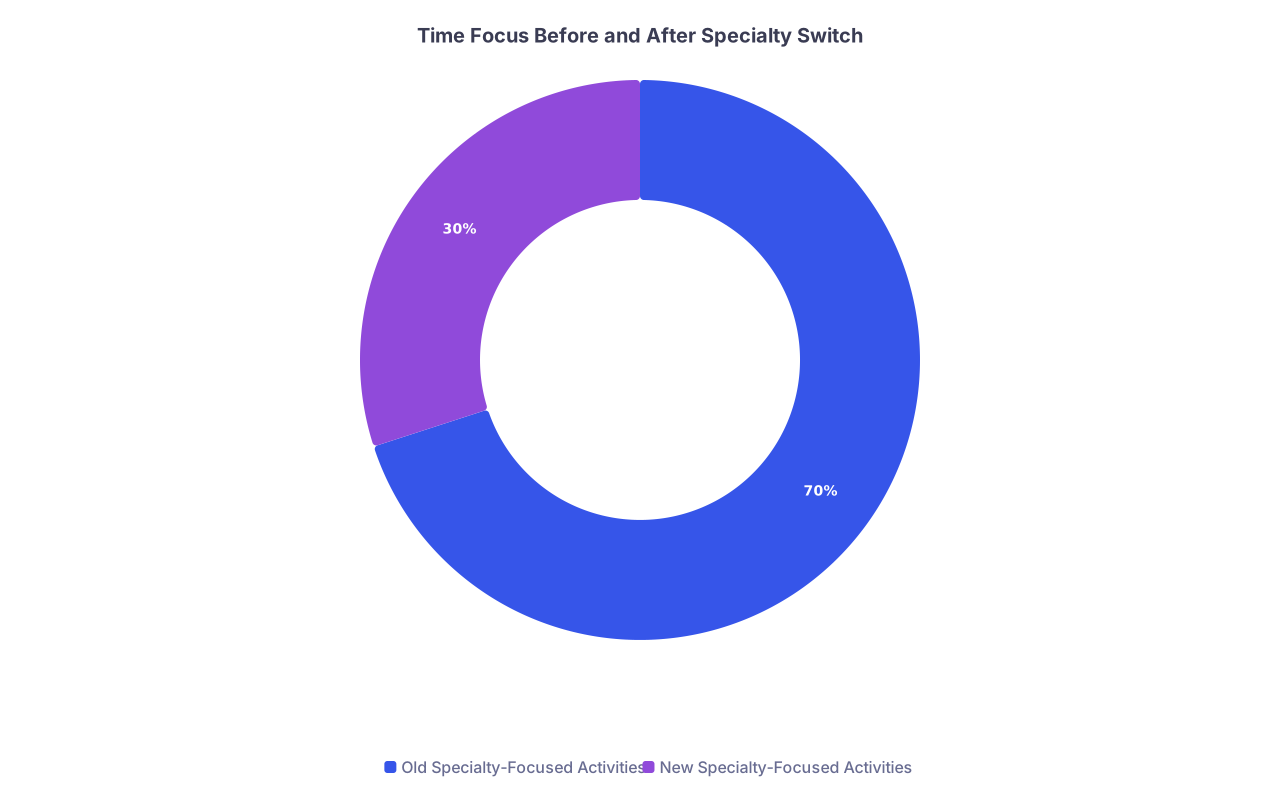
| Category | Value |
|---|---|
| Old Specialty-Focused Activities | 70 |
| New Specialty-Focused Activities | 30 |
If your life still looks like 90% old specialty, 10% new on paper, your narrative will sound hollow. Your goal—before application season—is to move that ratio by taking very deliberate steps.
Even small choices matter:
- Which clinics you moonlight in
- What journal clubs you attend
- Whose projects you say yes to
All of those become data points that back up your story.
A Quick Process Map for Your Switch Narrative
Here is how I would structure your self-work before you write:

| Step | Description |
|---|---|
| Step 1 | Clarify Current Choice |
| Step 2 | Map Old vs New Specialty Tasks You Enjoyed |
| Step 3 | Identify 2-3 Key Mismatch Themes |
| Step 4 | List Concrete New Specialty Experiences |
| Step 5 | Draft 4-Phase Personal Statement Story |
| Step 6 | Align ERAS Experiences & LoRs |
| Step 7 | Rehearse 60-90s Interview Answer |
If you skip A–D and just jump to “let me write something heartfelt,” you end up with vague, indecisive prose. Do the thinking work first; the writing becomes dramatically easier.
Common Mistakes That Make You Sound Indecisive
Let me call out the patterns that tank otherwise strong applications:
Over-emotional language
- “I was devastated… I felt lost… I was completely unsure…”
- You can mention disappointment once. Do not build a whole paragraph on it.
Overly detailed blow-by-blow of your crisis
- Nobody needs three paragraphs about the day you realized you were unhappy.
- Pick a couple of representative experiences. Move on.
Throwing your old specialty under the bus
- “The culture was toxic… the attendings were unsupportive…”
- Even if true, it brands you as potentially difficult.
Swinging too hard into destiny-talk about the new specialty
- “This is where I was always meant to be.”
- No, you literally were not; your CV says otherwise. Aim for grounded conviction, not mythology.
Lack of forward focus in the conclusion
- Ending your PS talking about your past confusion rather than your future goals.
- Last paragraph should sound like a clean, confident step into the new field.
One More Layer: Tailoring to Specific Specialties
The “fit” language should be specialty-specific. Generic statements are a missed opportunity.
A few examples of what to emphasize:
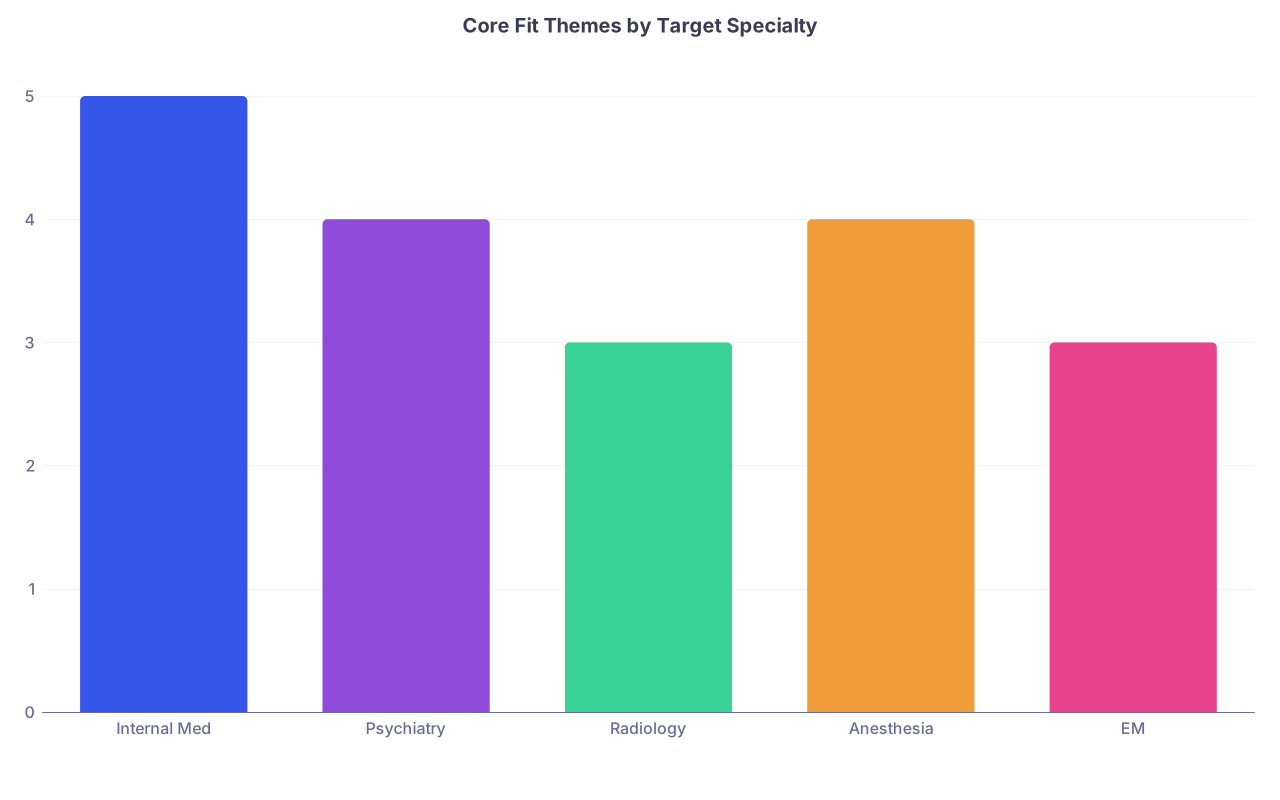
| Category | Value |
|---|---|
| Internal Med | 5 |
| Psychiatry | 4 |
| Radiology | 3 |
| Anesthesia | 4 |
| EM | 3 |
Ignore the numbers; focus on the themes:
- Internal Medicine: longitudinal relationships, diagnostic reasoning, management of complexity, evidence integration.
- Psychiatry: narrative thinking, empathy, team-based care, interest in biopsychosocial models, comfort with ambiguity.
- Radiology: pattern recognition, anatomy, desire for broad exposure across specialties, love of technology and image-based diagnosis.
- Anesthesia: acute physiology, procedures, real-time decision-making, calm under pressure, team coordination in OR.
- EM: breadth, rapid triage, comfort with uncertainty, shift-based intense work, procedures across systems.
Your narrative should sound like it could only be applying to that field, not five different ones.
A Brief Snapshot Example: Full Arc in ~250 Words
Just to show it can be done tightly.
“I am applying to psychiatry after starting my training in internal medicine, because I have learned that the most meaningful part of my work is understanding how patients’ stories, symptoms, and environments intersect over time.
As a medical student, I chose internal medicine for its complexity and the opportunity for longitudinal care. During my intern year, I enjoyed managing heart failure, diabetes, and COPD, and I valued the relationships I developed with patients across multiple admissions. Yet I noticed that the encounters that stayed with me were those in which psychiatric and social factors dominated: the patient with recurrent overdoses whose mood symptoms never quite met clear criteria; the man with cirrhosis whose delusions made adherence impossible; the young woman whose medical workup was negative but whose panic left her unable to leave her house.
I began spending more time on the consult-liaison service, meeting regularly with our psychiatry attendings, and attending their weekly case conference. I joined a QI project aimed at improving transitions of care for patients with co-occurring severe mental illness, and I sought out an elective in our inpatient unit. In these settings, I found the mix of narrative, biology, and systems-level thinking that had felt missing from my daily work.
I now seek a psychiatry residency that values strong medical training, emphasizes collaborative care across disciplines, and will prepare me to work with patients whose psychiatric illness and medical complexity are deeply intertwined.”
Clean. Reflective. Not hand-wringing.
Key Takeaways
Your goal is not to erase your past choice; it is to reinterpret it as a step toward a better fit. Own the first specialty, define the mismatch, then show how the new field aligns with your actual strengths and satisfactions.
Words without actions sound hollow. Back your narrative with concrete steps: new rotations, mentors, projects, and responsibilities in the target specialty that prove this is a thoughtful, committed switch.
On paper and in person, speak with calm clarity. No drama, no bitterness, no grand destiny arcs. Just a coherent, specialty-specific story that shows you are moving toward the right work for the right reasons—and that you are not going to pivot again in two years.