
Most ERAS activity bullets are generic, bloated, and completely forgettable. Yours do not have to be.
You are not competing only on scores anymore. You are competing on clarity. On how fast a tired PD can scan your ERAS page and say: “I get this person. They’ve actually done things.”
Let me break this down very specifically: impact statements that sound like you have three jobs at once:
- Show what you did (concrete, verifiable).
- Show why it mattered (impact, scale, or difficulty).
- Sound like a real human, not ChatGPT or a CV generator.
Most people hit one of those, sometimes two. Hitting all three is what gets your application remembered.
1. The ERAS Bullet Problem: Why Most Entries Fail
I have read thousands of ERAS applications. Across IM, EM, peds, psych, even neurosurgery. The same garbage phrases show up over and over:
- “Actively participated in…”
- “Gained exposure to…”
- “Worked closely with attendings and residents to…”
- “Responsible for various tasks including…”
These tell me almost nothing. It sounds like you copied an old CV template and sprinkled in a few buzzwords.
The classic ERAS bullet failure modes:
Vague verbs
“Helped,” “assisted,” “participated,” “involved in.” These hide what you actually did.No numbers, no scope
“Presented multiple times.” How many? To whom? Over what time?Fake formality
“Leveraged interdisciplinary communication to optimize patient care.” Nobody talks like this. It screams “overcoached” and “generic.”Duty-dumping
A laundry list of tasks with no hint of outcome, skill, or significance.Not tailored to residency
Describing things in language that might impress a college advisor but means nothing to a PD looking for future interns.
Your ERAS bullets are not a legal document. They are short, evidence-backed arguments that you are capable, productive, and aligned with the specialty you are applying to.
2. The 3-Part ERAS Impact Bullet Formula
You need a structure. Not a rigid template that makes everything sound the same, but a backbone.
Here is the formula I recommend:
Strong verb + concrete what + scoped details (numbers, size, frequency) + brief impact or purpose
In shorthand:
Verb + What + How much / how often / with whom + Why it mattered
Example transformation.
Bad:
- “Helped with quality improvement projects on the wards.”
Better:
- “Led a QI project tracking 120+ admissions over 6 months to reduce telemetry overuse, contributing to a 15% decrease in non-indicated orders.”
You see the pattern:
- “Helped” → “Led”
- “Projects” → one specific project
- No data → specific numbers and timeframe
- No impact → discrete outcome
Here is the formula applied in different contexts:
Clinical:
- “Managed a 12–16 patient internal medicine census daily on sub-I, pre-rounding independently and presenting concise plans on rounds.”
Research:
- “Coordinated a retrospective chart review of 438 ED visits, cleaning and analyzing data in R to identify predictors of 72-hour returns.”
Teaching:
- “Designed and delivered 4 small-group sessions for 15 M2 students on EKG interpretation, improving mean quiz scores from 62% to 84%.”
Volunteer:
- “Supervised a team of 10 volunteers during weekly mobile clinic sessions, streamlining intake workflow to cut average check-in time by ~30%.”
The structure is the same, but the language can still sound like you.
3. Sounding Like You (Without Sounding Unprofessional)
Program directors are now explicitly wary of AI-generated text. So you have two tasks:
- Avoid generic, over-polished corporate language.
- Avoid lazy, underdeveloped, “I winged this at 1 a.m.” language.
You want clean, direct, specific sentences that could plausibly come out of your mouth in an interview.
Signals that your bullets do not sound like you:
- They are stuffed with corporate verbs: “leveraged,” “synergized,” “optimized,” “facilitated communication to improve…”
- Every bullet has the exact same rhythm: “Did X to do Y resulting in Z.”
- You would feel ridiculous saying the line out loud to your attending.
Stress test every bullet like this:
- Read it aloud, in your normal tone.
- Ask: “Would I actually talk this way to a chief resident on my sub-I?”
If the answer is “absolutely not,” then rewrite.
Here is how to keep impact but preserve your voice:
Over-polished:
- “Leveraged interdisciplinary collaboration to drive impactful quality improvement in patient care delivery.”
More human, still strong:
- “Worked with nurses, pharmacists, and case managers to redesign our discharge checklist and cut 7-day readmissions on our service.”
Overly casual:
- “Got to work closely with different team members to improve how we do discharges.”
Bring that to a professional level:
- “Collaborated with nurses and social work to revise discharge instructions and improve follow-up clarity for high-risk patients.”
You are not writing a novel. You can be straightforward and still sound like a person.
4. The Big Three Activity Types: How to Write Each
Let us go category by category. Because ERAS “experience” buckets are not actually equal.
4.1 Clinical Experiences (Including Sub-I’s and Longitudinal Clinics)
This is where program directors look for: responsibility, reliability, and clinical thinking.
Do not waste bullets on things every med student does:
- “Pre-rounded on patients.”
- “Presented on rounds.”
- “Wrote notes and placed orders under supervision.”
That is the baseline. You only mention these if you add scope, complexity, or initiative.
Use bullets to highlight:
- Volume or complexity
- Autonomy (with supervision, obviously)
- Communication and team role
- Ownership of specific tasks (follow-up calls, family meetings, transitions of care)
Examples:
Weak:
- “Participated in inpatient internal medicine rotation, seeing patients and presenting in rounds.”
Stronger:
- “Ran a 10–12 patient list during my IM sub-I, pre-rounding independently and presenting focused assessments and plans on daily attending rounds.”
Weak:
- “Worked with multidisciplinary team to care for patients.”
Stronger:
- “Coordinated with nursing, PT, and case management to align discharge planning for complex older adults, ensuring equipment and home services were in place before discharge.”
Weak:
- “Learned to manage common conditions like COPD, CHF, and diabetes.”
Stronger:
- “Followed 8–10 patients with decompensated CHF or COPD exacerbations from admission to discharge, adjusting diuresis and inhaler regimens under supervision and counseling patients on triggers and follow-up.”
If you did something “above baseline”:
- Call families regularly
- Led or co-led a teaching session
- Owned a QI idea and implemented part of it
Those belong in bullets, explicitly.
4.2 Research Experiences
Research bullets are often a mess. Either they oversell (“pioneered a novel approach…”) or undersell (“worked in a lab”).
You want three things:
- Your specific role (what you did, not what the lab did).
- The type of project and methods in practical, non-pretentious language.
- Tangible outputs (posters, abstracts, manuscripts, IRB, databases built).
Avoid this:
- “Conducted innovative research on sepsis biomarkers, leading to meaningful insights and contributions to the field.”
Use something like:
- “Reviewed 320 ICU admissions with suspected sepsis, extracting data on vitals and lactate trends for a study on early biomarker-based risk stratification.”
Then, if relevant, add impact:
- “Co-authored 1 first-author abstract presented at CHEST and 1 manuscript in revision for submission to Critical Care Medicine.”
Notice the lack of fluff words like “innovative” and “meaningful.” Let the data speak.
Another pattern:
Weak:
- “Worked in cardiology lab learning basic science techniques and presenting data at meetings.”
Stronger:
- “Ran western blots and qPCR on murine myocardial samples for a study on post-MI remodeling, maintaining a detailed lab notebook and presenting quarterly data updates to a 10-person research group.”
If you mostly did data entry:
- Say so, but be specific. Do not pretend you designed the trial.
Example:
- “Abstracted chart data for 412 stroke admissions, ensuring accurate entry of NIHSS scores and imaging findings into a REDCap database for an outcomes study.”
That is still real work. Program directors care more about reliability and attention to detail than inflated titles.
4.3 Leadership, Teaching, and Volunteer Work
These are often undersold. People write them like fluff when they could be gold.
Common mistake: only describing what the organization does, not what you did.
For example:
Weak:
- “SNMA: Organization focused on supporting URM students and serving the community with various outreach events.”
This is useless. The PD can Google SNMA.
Stronger:
- “SNMA chapter vice-president, coordinating 6 pipeline events per year with local high schools and overseeing a 12-student committee.”
Or:
Weak:
- “Served food to patients at free clinic and helped with paperwork.”
Stronger:
- “Volunteered twice monthly at a free primary care clinic, managing intake for 10–15 patients per shift and helping Spanish-speaking patients complete forms and understand discharge instructions.”
Teaching example:
Weak:
- “Tutored medical students in anatomy and helped them study for exams.”
Stronger:
- “Led weekly 1-hour review sessions for 8–10 M1 students in gross anatomy, focusing on clinical correlations and exam-style questions.”
The pattern holds: role, scale, frequency, and concrete actions.
5. Calibrating Detail: You Have 1020 Characters, Not a Novel
ERAS gives you up to 1020 characters per description. Most people either:
- Fill it with fluff until it feels like a personal statement paragraph, or
- Leave it underused with 1–2 anemic sentences.
The sweet spot is usually 3–5 tight bullets or short paragraphs that together show:
- What the activity is
- Rough time frame and commitment
- Your role and responsibilities
- Evidence of initiative or growth
You do not need bullet formatting in ERAS (and sometimes it looks clunky), but you should write as if each sentence has to stand on its own.
A practical structure per experience:
- One line that defines the activity and your role.
- One to three lines that show what you actually did, with numbers/scope.
- Optional: one line of impact or reflection if it adds something real.
Example – a strong ~4–5 sentence description:
“Fourth-year sub-internship on the inpatient medicine service at XYZ Medical Center, acting at intern level under supervision. Managed a 10–12 patient census, pre-rounding independently and presenting plans on daily attending rounds. Entered orders, drafted notes, and followed up on labs and imaging with direct feedback from the senior resident. Coordinated family meetings for 3 complex patients to discuss goals of care and discharge planning.”
This uses almost no “fluff” adjectives yet clearly conveys high responsibility.
6. Numbers: Your Secret Weapon Against Vagueness
If your bullet has “some,” “many,” “multiple,” or “various,” it is probably weak.
You need:
- Frequencies (weekly, monthly, per shift)
- Counts (number of patients, sessions, team members)
- Durations (6 months, 3 years, 10-week program)
- Outcomes when you genuinely have them
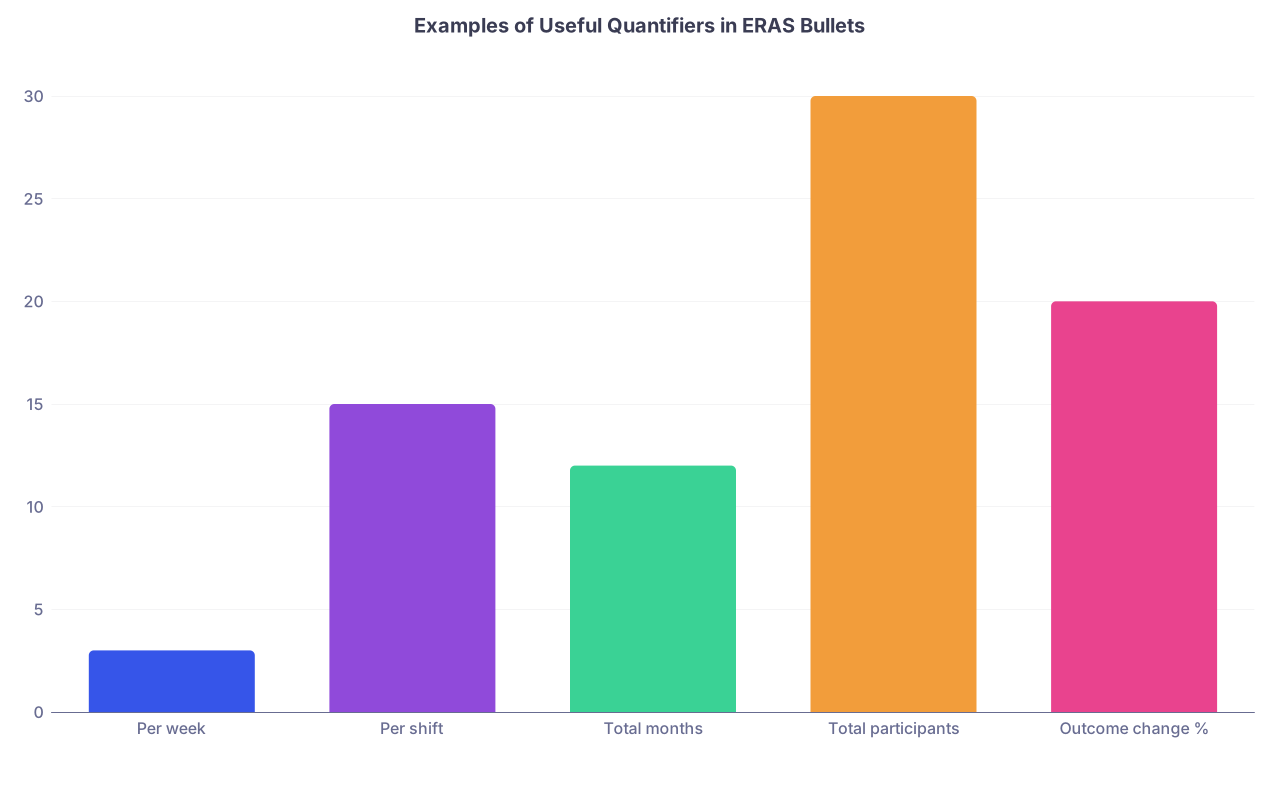
| Category | Value |
|---|---|
| Per week | 3 |
| Per shift | 15 |
| Total months | 12 |
| Total participants | 30 |
| Outcome change % | 20 |
Some concrete templates:
- “Volunteered twice monthly over 3 years, logging ~120 hours at…”
- “Followed 15 longitudinal patients with diabetes in continuity clinic over 18 months.”
- “Coordinated a team of 8 volunteers to run weekly vaccine drives, administering 400+ doses across 4 events.”
- “Analyzed 438 charts as part of a retrospective review.”
If you do not know exact numbers, estimate reasonably and use language like “~10–12,” “about 40,” “over 6 months.”
What you never do: invent fake percentages or made-up data to look impressive. People get caught when interviewers dig.
7. Specialty Signaling: Same Experience, Different Framing
Here is how a single free-clinic experience might shift framing for three fields.
| Specialty | Example Focus |
|---|---|
| Internal Medicine | Complexity, continuity, chronic disease management |
| Emergency Medicine | Triage, acuity, rapid assessment, procedures |
| Pediatrics | Communication with families, development, preventive care |
Base experience:
- Volunteered weekly at a student-run free clinic seeing adult and pediatric patients.
Internal Medicine framing:
- “Volunteered weekly at a student-run free clinic, managing 4–6 adult patients per evening with uncontrolled chronic diseases such as diabetes and hypertension, adjusting meds with supervision and counseling on diet and adherence.”
Emergency Medicine framing:
- “Volunteered weekly at a student-run free clinic, performing triage and focused H&Ps on 5–8 patients per shift presenting with acute concerns (chest pain, shortness of breath, lacerations), escalating care appropriately to supervising physicians.”
Pediatrics framing:
- “Volunteered weekly at a student-run free clinic, seeing 3–4 pediatric patients per shift for well-child visits and acute complaints, counseling parents on vaccines, nutrition, and development milestones.”
You are not lying. You are selectively highlighting the aspects that speak to the specialty.
8. Red-Flag Phrases to Purge From Your Bullets
If these words or phrases are all over your ERAS, your writing is bloated:
- “Actively participated in…” (what does passively participating look like?)
- “Various responsibilities including…” (lazy preface to a list)
- “Exposed to…” / “Gained exposure to…” (describe what you actually did instead)
- “Had the opportunity to…” (wasting space)
- “Helped with…” (unless you then define your exact role)
- “Utilized” when “used” is enough
- “Leveraged,” “optimized,” “synergized,” unless you are truly describing a process redesign in a QI-heavy context, and even then, usually still unnecessary
Replace them with:
- “Managed”
- “Led” (if you genuinely did)
- “Coordinated”
- “Organized”
- “Created” / “Developed”
- “Analyzed”
- “Taught” / “Mentored”
- “Counseled”
- “Documented”
- “Followed” / “Tracked”
Short, concrete verbs keep you honest.
9. A Quick Rewrite Clinic: Before and After
Let me show you several common weak bullets and how I would fix them.
Clinical example:
Before:
- “Participated in rounds and helped manage patients with my team on internal medicine service.”
After:
- “Managed a 10–12 patient list on my IM rotation, presenting daily on rounds and updating notes and orders with supervision from the senior resident.”
Research example:
Before:
- “Worked on a research project studying asthma in children. Responsibilities included data collection and analysis, presentations, and writing.”
After:
- “Collected and entered data from 210 pediatric asthma visits into a REDCap database, ran basic descriptive statistics in SPSS, and presented preliminary findings at our department’s research day.”
Leadership example:
Before:
- “Medical student council member, helping organize events and advocate for student needs.”
After:
- “Served as one of 4 elected M3 representatives on the student council, gathering feedback from a 120-student class and co-organizing 3 town halls per year with the Dean of Students.”
Volunteer example:
Before:
- “Volunteered at homeless shelter providing food and support to residents.”
After:
- “Volunteered monthly at a homeless shelter, distributing meals to ~80 residents per shift and helping connect 5 clients with primary care appointments through our student-run clinic.”
See the pattern. Same activity, radically clearer story.
10. Workflow: How to Actually Rewrite Your ERAS Activities
Here is a pragmatic, stepwise process. Not theory. How you sit down and fix this in an afternoon.

| Step | Description |
|---|---|
| Step 1 | Draft Plain-English Description |
| Step 2 | Underline Concrete Actions |
| Step 3 | Replace Vague Verbs with Strong Ones |
| Step 4 | Add Numbers, Scope, Timeframe |
| Step 5 | Trim Fluff Words and Buzz Phrases |
| Step 6 | Read Aloud for Voice Check |
| Step 7 | Adjust for Specialty Emphasis |
Step 1: For each activity, write 2–3 sentences in plain, spoken English. No concern for style. Just what you did, how often, for how long.
Step 2: Underline the real actions and responsibilities.
Step 3: Swap generic verbs for specific, strong ones.
Step 4: Add missing numbers: patients, hours, months, size of team.
Step 5: Delete filler words and corporate-speak.
Step 6: Read it out loud. If it sounds like a brochure or a robot, simplify.
Step 7: For your top 5–10 experiences, tweak emphasis to align with your chosen specialty.
That is it. Mechanical, repeatable, effective.
11. Visualizing Your Activity Mix (Are You Lopsided?)
Program directors do a quick pattern-recognition scan: clinical vs. research vs. leadership vs. service. If everything you have is research and almost no clinical or service, it raises questions. Same if you have tons of volunteering but zero evidence of sustained responsibility.
Rough guideline of a healthy-looking mix (not a rule, but a sanity check):
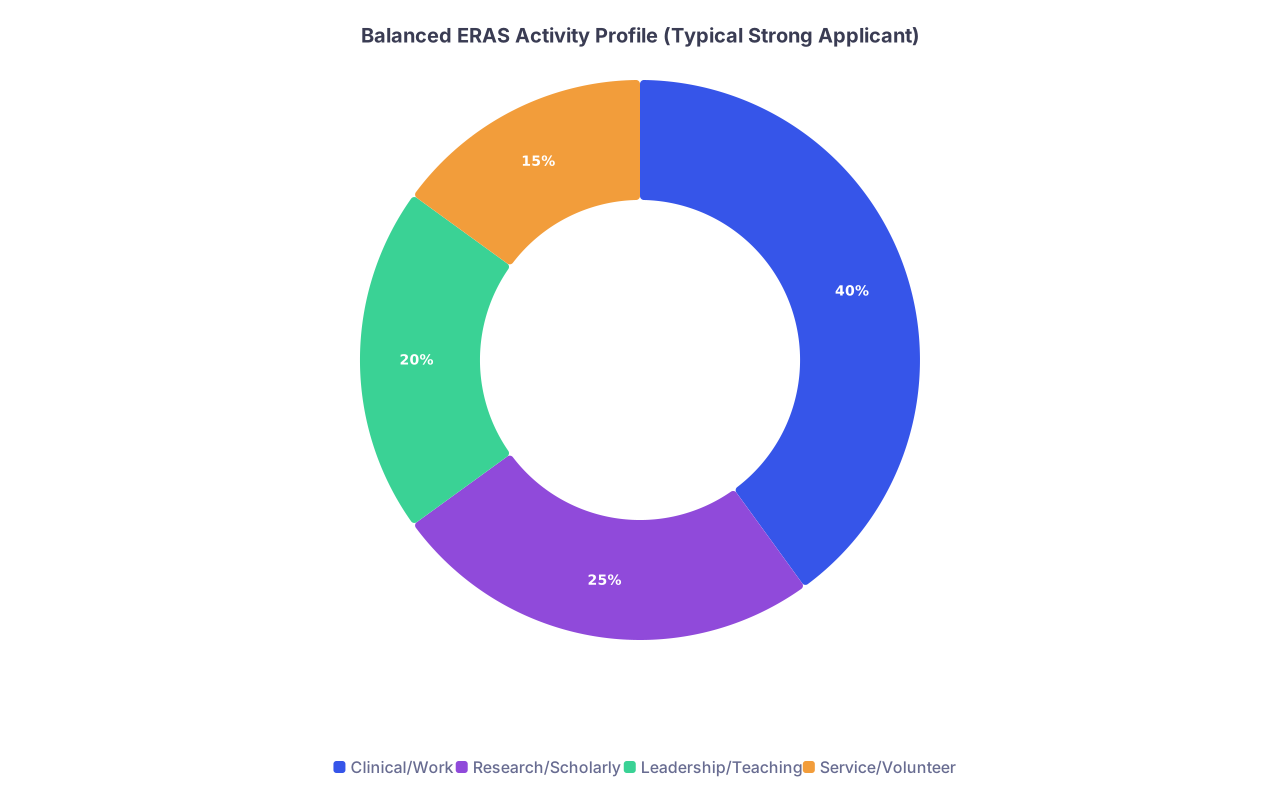
| Category | Value |
|---|---|
| Clinical/Work | 40 |
| Research/Scholarly | 25 |
| Leadership/Teaching | 20 |
| Service/Volunteer | 15 |
You cannot change history at this point in the cycle. But you absolutely can:
- Highlight leadership aspects inside “clinical” roles.
- Emphasize teaching moments in research or volunteer work.
- Show continuity and depth where you do have it.
12. Key Takeaways
Let me strip this down to the essentials.
- Specific beats fancy. Concrete verbs, numbers, and clear roles will always beat buzzwords and fluff.
- Your bullets should sound like you on your best prepared day, not like a corporate press release. Read them aloud and cut what feels fake.
- Every bullet must earn its space. If it does not show responsibility, scope, or impact, either fix it or cut it.
FAQ (Exactly 6 Questions)
1. How many bullets or sentences should I use per ERAS experience?
Aim for 3–5 focused sentences. Enough to define the activity, your role, scope, and a touch of impact. One-liners are usually too thin; giant paragraphs blur everything.
2. Is it okay to reuse wording from my CV or medical school application?
You can reuse ideas and facts, but you should rewrite the language. ERAS is read differently than a college application; PDs want quick, scannable impact. If something sounds like it was copied from a premed CV template, rework it.
3. Can I include reflective or emotional statements in my bullets?
Very sparingly. One short line of reflection can work in a major, meaningful activity (“This experience reinforced my interest in…”) but most bullets should be action- and evidence-focused. Save deeper reflection for your personal statement.
4. What if I do not have exact numbers for patients, hours, or events?
Estimate reasonably using your schedule and memory, and signal approximation with “~” or ranges: “10–12,” “about 40,” “over 6 months.” Do not fabricate precise-sounding data that you cannot defend if asked.
5. Should I use first person (“I”) in ERAS activity descriptions?
No. ERAS entries are usually written in third-person style without pronouns: “Managed a 10–12 patient list…” not “I managed…”. This keeps things concise and aligned with typical CV conventions.
6. How do I handle group projects or shared leadership roles?
State your title and then make it crystal clear what you personally did. “As one of 3 co-leads, I coordinated X, while others handled Y.” Program directors are very good at detecting when someone is claiming entire-group credit; avoid the vague “we” without specifying your contribution.