
Most students choose subinternships backwards—and it quietly costs them interview invites.
You do not pick a sub-I because “everyone does medicine at Home in July” or because “that’s when my friends are doing them.” You pick subinternships like you are building a surgical plan: know the indication, know the anatomy, and know exactly what you want to achieve.
Let me break this down specifically.
1. What a Subinternship Actually Signals to Programs
Before you choose dates or locations, you need to be crystal clear about what a subinternship (AI, acting internship) actually does for your application. Not the brochure version. The real version.
At a competitive categorical program, a sub-I can do three high‑yield things:
- Generate a specialty‑specific, high‑credibility letter of recommendation.
- Function as a month‑long interview and audition for that institution.
- Signal seriousness and trajectory in your chosen specialty through your schedule pattern.
That is it. Everything else—extra “clinical exposure”, “confirming interest”, “learning the ropes”—is secondary from an application standpoint.
The 3 Outcomes That Matter
You want every sub-I to do at least two of the following:
Produce 1 LOR from a faculty member who:
- Knows your name without a list.
- Has watched you pre‑round, call consults, and handle cross‑cover.
- Will describe you as “functions at the level of an intern.”
Improve your rank in a PD’s mental stack:
- “We saw her on our inpatient team in August. She was one of the strongest students we had this year.”
- Or at minimum: “Our faculty really liked him; he rotated here.”
Close a gap or explain a story:
- Lower Step 2? Strong sub-I with explicit comment on clinical performance.
- Switching specialties late? Back‑to‑back sub-Is showing rapid, focused commitment.
- Weak early clinical evals? Strong senior‑year performance with concrete examples.
If a sub-I is not plausibly going to hit one of those, you should question why you are doing it.
2. Home vs Away: Where Each Sub-I Should Live
Most students ask, “How many aways do I need?” Wrong question.
The correct question: “Where does each sub-I give me the biggest marginal gain in perceived value compared with not doing it?”
Let’s separate home vs away logically.
Home Sub-I: Your Baseline Move
In almost every specialty, you want one strong home sub-I in the core area of that specialty.
Examples:
- Internal medicine → inpatient wards sub-I at home
- General surgery → general surgery or acute care surgery at home
- Pediatrics → inpatient peds or NICU at home
- OB/GYN → L&D or combined OB/GYN sub-I at home
Why home first?
- You are known. Clerkship directors, residents, and faculty have a frame of reference: “massive growth since third year,” “consistently strong,” etc.
- You understand the EMR, paging system, workflow. Less time floundering = more time looking like an intern.
- Programs elsewhere heavily weight your home performance. They assume your home institution knows you best.
You want this home sub-I:
- Early enough that the letter is ready by ERAS submission.
- Late enough that you are not still figuring out how to preround.
Away Sub-I: Use Them Like Scalpel, Not Shotgun
Away rotations (auditions, visiting electives) are expensive, logistically painful, and high stakes. They are also overused and misused.
You should seriously consider an away sub-I if:
- You are applying to an ultra‑competitive field (ortho, derm, ENT, plastics, neurosurgery, urology, some radiology and EM markets).
- Your home institution does not have that specialty or is significantly weaker/prestigious than the places you are targeting.
- You need to shift geographic regions and your current region is a poor match for your goals.
You probably do not need an away if:
- You are applying to internal medicine, pediatrics, psych, or family, and your home is reasonably strong.
- Your Step 2, clinical evals, and home letters are already excellent and you are content matching in your current region/tier.
Here is what the marginal value looks like:
| Specialty | Typical Impact of Away Sub-I | Often Necessary? | Priority Level |
|---|---|---|---|
| Orthopedic Surg | Very High | Yes | Critical |
| Dermatology | Very High | Yes | Critical |
| Internal Med | Moderate | No | Optional |
| Pediatrics | Low–Moderate | No | Low |
| EM (competitive markets) | High | Often | High |
If you do an away, you must treat it as a month‑long interview. No coasting. No “just seeing what X city is like.” That mindset gets noticed—and not in the way you want.
3. The Calendar: Timing Your Sub-Is Around ERAS and Step 2
Subinternship choice without timing strategy is like choosing antibiotics without checking the antibiogram. You might get lucky. You also might tank your coverage.
Core Reality: Letter Timing Runs Everything
Programs do not care that you “performed amazingly” on a November sub-I that never showed up as a letter. They care what they can read by the time they review your file.
ERAS submission is mid‑September. Most programs start reviewing applications shortly after. You want your strongest sub-I letters in by then.
This means:
- Optimal months for high‑impact sub-Is:
June, July, August (sometimes May if your school allows early start). - Acceptable but lower leverage:
September (some letters will be late but still read by many programs). - Low leverage for application cycle:
October–January (good for you as a clinician, modest impact on this year’s match).
So structure your senior fall/winter sub-Is for skill and career development. Structure May–September for letter production and exposure.
Balancing Step 2 CK, Sub-Is, and Sanity
The other major variable is Step 2. Too many students wedge a sub-I right before Step 2 and do both poorly.
General patterns that actually work:
If your Step 1 was solid and you are gunning for a strong Step 2:
- Study dedicated early summer.
- Take Step 2 in late June.
- Start first sub-I in July with one major stressor already done.
If Step 1 was weak and Step 2 must redeem you:
- Front‑load Step 2 earlier (May/early June).
- Use a July/August sub-I to show “clinical performance >> numerical score.”
If you are late to choosing a specialty:
- Use an early “exploratory” rotation (late third year / early fourth) in two fields.
- Commit, then stack 1–2 sub-Is in that chosen field in June–August with the story: “late but decisive pivot, strong performance, clear fit.”
For many students, the highest yield pattern looks like:
- May–June: light elective + Step 2 prep / exam
- July: Home sub-I in chosen specialty
- August: Away sub-I at realistic target program / region of choice
- September: Research, interview prep, backup elective, or second away (only if strategically justified)
Do not overload June–September with back‑to‑back sub-Is plus Step 2 studying on top. You will burn out and perform at 75% everywhere.
4. Where to Rotate: Tiers, Targets, and Geographic Strategy
“Should I do an away at a top‑10 program?” Sometimes. Often not.
You need to match the level of the away site to your realistic match tier and your story. There is no prize for collecting rejections from institutions that were never going to rank you highly.
Think in Three Tiers
Forget the specific rankings for a moment. Think in program tiers:
- Tier 1: National name, heavy research, highly competitive (MGH, UCSF, Mayo, Penn, etc.).
- Tier 2: Strong regional academics / flagships (state flagships, large university hospitals, strong community academic hybrids).
- Tier 3: Solid community, lesser research footprint, heavily clinical.
Away rotations work best when they slightly stretch you, not when they totally outstrip your paper credentials.
Rough guidelines:
If your Step 2 is > 245 with solid research and honors, and you are targeting competitive specialties:
A Tier 1 or strong Tier 2 away can make sense.If your scores are 225–240, average research, mostly HPs:
Focus on strong Tier 2 and good Tier 3 academic programs rather than moon‑shot Tier 1s.If you are below 220 or have red flags:
Use aways very selectively at realistic Tier 2/3 programs that historically take applicants like you, especially in regions where you want to live.
Geographic Targeting: Whose Radar Are You Trying to Get On?
If you want to get out of your current region—say, Midwest med school, West Coast residency—then your away choices matter a lot more.
Sub-I strategy for geographic shift:
Do at least one away in the region you want to end up in, at a program that:
- Actually interviews people like you (check their current resident profiles for school types and scores if available).
- Has multiple peer programs nearby (so that “we liked this student from X med school” can diffuse).
Lean into your story in your application:
- “Family in the region,” “Spouse’s job,” or “Long‑term life plan on the West Coast” are standard, acceptable reasons.
Programs are risk‑averse. You are telling them:
“I am willing to fly across the country and work your call schedule for a month. I am serious about your region.”
5. Choosing Which Sub-I within a Specialty
Within a specialty, the question often becomes: Which service?
Medicine: wards vs ICU vs subspecialty.
Surgery: general vs trauma vs subspecialty.
Peds: wards vs NICU vs PICU.
EM: standard adult ED vs specialized tracks.
Here’s how I think about it.
Choose the Rotation That Shows You as an Intern
Programs want to know: Can you:
- Pre‑round on 4–8 patients reliably.
- Present concisely to an attending in a hallway.
- Call a consult without embarrassing the team.
- Write reasonable orders, recognize sick vs crashing, and escalate early.
That is mostly tested on:
- Medicine / peds inpatient wards
- General surgery / acute care / trauma services
- Standard ED shifts with longitudinal continuity
- L&D / general OB/GYN call
ICU, highly specialized consult services, or elective subspecialties are nice, but they often give a narrower view of your “intern‑like” functioning and in some places, less opportunity to run your own patients.
If you have only one sub-I: choose the core inpatient service that most resembles actual PGY‑1 work in that specialty.
If you have two sub-Is in the same field:
- First: bread‑and‑butter inpatient or heavy‑call service.
- Second: either ICU or a service in a region/program you are targeting, depending on your goals.
Risk Management: Avoiding Under‑Supervised Disaster
Some “prestige” services are poorly structured for student growth: minimal teaching, fatigued residents, attendings who barely know you exist. You might see exotic disease but get a terrible evaluation because no one bothered to observe you.
Ask specific questions to recent alumni:
- “On this service, does a single attending work with students for the whole month?”
- “Who usually writes the sub-I evaluations?”
- “How many students are on that team at once?”
You want:
- 1–2 attendings likely to actually know you.
- 1–3 students total, not 6.
- A culture where students present and write notes, not just “shadow and smile.”
6. Making the Sub-I Count: Performance That Translates into Letters
You can pick perfect rotations and still get a bland letter that reads, “Pleasure to work with. Would make a good resident.” Death by faint praise.
The way you work a subinternship directly shapes your letters. I have seen mediocre Step 2 applicants match high because their letters practically shouted, “We would have happily taken her.”
Week 1–2: Lay the Foundation
Your goals in the first half:
- Be clinically safe. Know when to ask for help.
- Master the local EMR workflow. Templates, order sets, discharge process.
- Signal reliability: early to rounds, never lose track of a task, follow through.
Phrases you want said about you in resident rooms:
- “She’s on top of everything.”
- “If I ask him to call a consult, I know it will get done right.”
You do not need to be a genius diagnostician. You need to decrease friction for the team.
Week 3–4: Step Up and Be Explicit About Your Ask
Once residents and attendings trust you, start acting like a supervised intern:
- Volunteer to cross‑cover for stable patients when the resident is stuck in a code or ED.
- Propose actual plans rather than asking what to do for every detail.
- Offer to handle “dispo work” (discharge summaries, follow‑up arrangements) efficiently.
Then, around the end of week 3, you explicitly ask for a letter from the right person:
Wrong: “Could you maybe write me a letter?”
Better: “I am applying to internal medicine and this has been my main medicine sub-I. I would be grateful if you felt comfortable writing a strong letter commenting on how I functioned at an intern level. Do you feel you saw me enough for that?”
Give them a graceful exit if they hesitate. You only want letters from people genuinely enthusiastic.
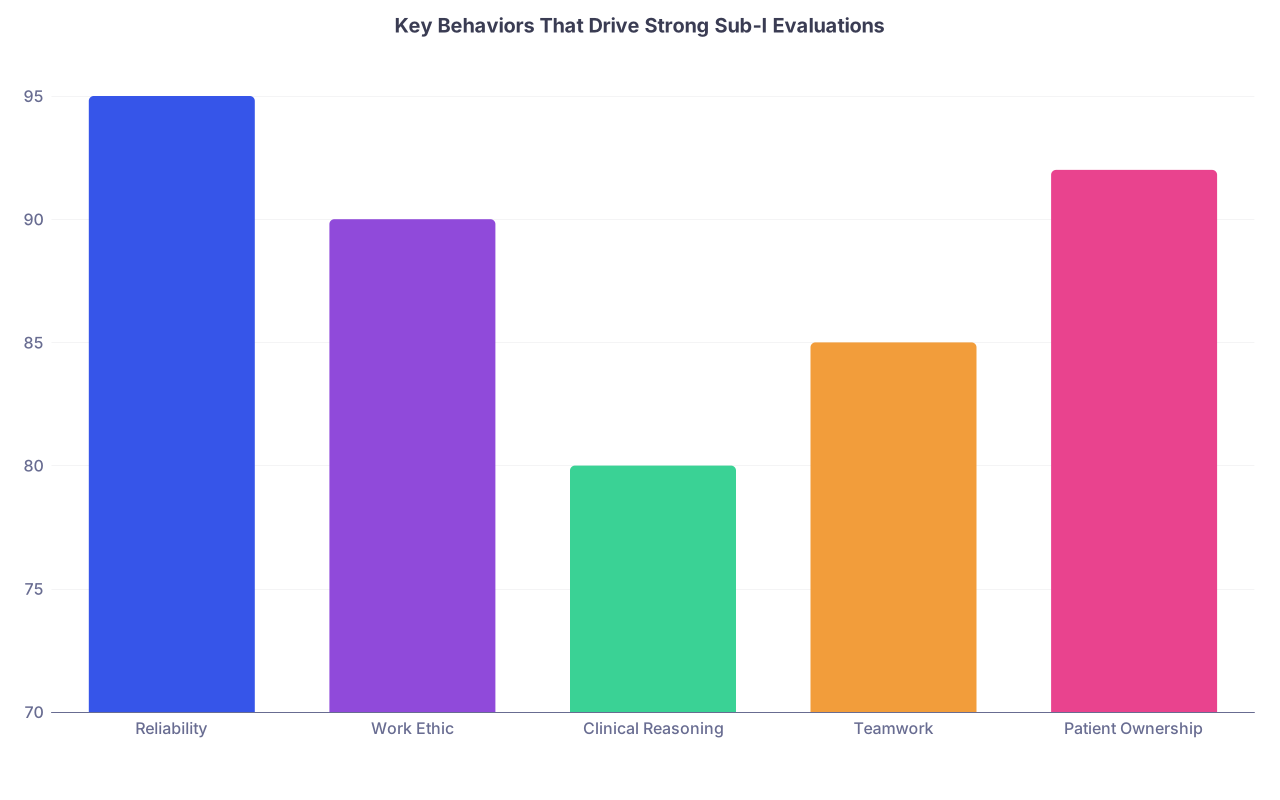
| Category | Value |
|---|---|
| Reliability | 95 |
| Work Ethic | 90 |
| Clinical Reasoning | 80 |
| Teamwork | 85 |
| Patient Ownership | 92 |
The numbers here are not formal data; they represent how often faculty explicitly cite these domains in “top” evaluations compared with others. Reliability and ownership dominate.
7. Risky Scenarios and How to Play Them
Some of you are not coming in with clean, straightforward records. Let us be direct about that.
Scenario 1: Low Step 1 / Step 2, Strong Clinical Performance
Your sub-I strategy:
Do at least one high‑visibility sub-I where your eval can say something like:
“Despite standardized test scores below our usual threshold, she consistently demonstrated superior clinical judgment, work ethic, and communication skills, performing at the level of our interns.”Target programs that repeatedly mention “holistic review” and have a track record of taking applicants from a wide spread of schools and scores.
Avoid over‑relying on Tier 1 aways; they tend to be brutally score‑filtered.
Scenario 2: Switching Specialties Late
Example: You did most of third year aiming for anesthesia, then fell in love with IM. Or you spent time in gen surg, then pivoted to EM.
Your sub-I plan:
- Two back‑to‑back sub-Is in your new specialty, as early as possible (June–August).
- One must be home if possible so your MSPE and home letters align with your new story.
- The second could be an away in a region/program tier that is actually plausible.
Your narrative becomes:
- “I originally explored X specialty seriously, including clinical rotations, then realized that what I valued most was Y aspect of medicine, which aligns with [new specialty]. My subinternships in June and July on [specific services] confirmed that choice, and you can see that reflected in my letters and evaluations.”
Programs are fine with pivots. They are not fine with candidates who look indecisive or opportunistic. Sub-I pattern plus letters solidifies that you are neither.
Scenario 3: Red Flag on File (Leave, Remediation, Failed Exam)
You are not hiding this. It will show up.
You use sub-Is to show current, sustained, high‑level functioning:
- Choose services with strong, honest faculty who will advocate when you do well.
- Ask for letters that address the red flag head‑on:
“After returning from a leave of absence for [reason], he has consistently performed at or above the level of his peers, with no concerns about reliability or professional behavior.”
Do not scatter yourself across five aways trying to outrun your past. It follows you. You address it, and you prove your current level.
8. Putting It Together: Sample Sub-I Blueprints
Let me give you a few concrete patterns. These are not templates; they are starting points.
Example A: Competitive IM Applicant at Mid‑Tier Med School
- Step 1: Pass / mid‑230s.
- Step 2: Projected high‑240s.
- Goal: Strong academic IM in a different region.
Plan:
- June: Light outpatient elective + Step 2 exam mid‑June.
- July: Home IM wards sub-I, ask for letter from firm attending with strong reputation.
- August: IM sub-I at strong regional academic center in target region (not top‑10, but solid).
- September: Research month, finalize ERAS, maybe a half‑month consult elective for breadth.
Outcome: 2 strong IM letters (home + away), plus home PD/MSPE support, plus regional exposure.
Example B: Ortho Applicant With Average Scores
- Step 2: 240.
- Some research; no home ortho department with strong reputation.
Plan:
- Early spring: Short ortho elective at home to confirm interest and get one local champion.
- June: Ortho away at realistic academic program with history of taking students from similar schools.
- July: Second ortho away, possibly in different region with similar tier.
- August: Home “sub-I” or equivalent on general surgery/trauma to show surgical work ethic and intern‑like performance; ask for letter that comments on OR behavior, teamwork, and resilience.
You are not aiming for HSS. You are building a credible, grounded application at places that actually interview people like you.
Example C: Psych Applicant With Lower Scores, Excellent Clinical Ratings
- Step 2: 218.
- Very strong narrative comments on clerkships.
Plan:
- July: Home psych sub-I on inpatient unit with known student‑friendly attending.
- August: Psych sub-I at a community‑academic hybrid in region of interest that is not obsessed with board scores.
- September: Outpatient psych or consult‑liaison psych at home, letter from CL attending focusing on clinical insight and patient connection.
Psych reads letters carefully. They do actually care how you come across in team dynamics. Sub-Is are your advantage here.
9. Decision Framework: How You Choose, Step by Step
If you are still feeling scattered, use this simple decision flow.

| Step | Description |
|---|---|
| Step 1 | Choose Specialty |
| Step 2 | Schedule Home Core Sub-I Jun-Aug |
| Step 3 | Plan At Least One Away in Specialty |
| Step 4 | Add 1-2 Targeted Away Sub-Is |
| Step 5 | Consider 0-1 Away for Geography |
| Step 6 | Align With Step 2 Timing |
| Step 7 | Check Letter Timing Before ERAS |
| Step 8 | Home Program Strong? |
| Step 9 | Competitive Specialty? |
If the rotation does not help with:
(1) home support,
(2) targeted away exposure, or
(3) letter timing,
then it is probably elective fluff from a match standpoint.
FAQ: Subinternship Choice Strategy
1. How many subinternships do I actually need to be competitive?
For most core specialties (IM, peds, psych, FM), one strong home sub-I plus possibly one away is sufficient. Competitive fields (ortho, ENT, neurosurgery, derm, EM in crowded markets) often expect 2–3 rotations in the specialty, including aways. Beyond that, returns diminish. Three sub-Is are rarely better than two well‑chosen ones with strong letters.
2. Is it a mistake to do a sub-I after ERAS is submitted?
It is not a mistake, but its primary benefit shifts. A late sub-I (October–January) is unlikely to influence initial interview offers, but it can help for:
- Post‑interview updates and letters of interest.
- Strengthening your skill set before starting residency.
- Providing an additional letter for SOAP or a reapplication if needed.
For this cycle, though, May–September sub-Is are where the real leverage lies.
3. Should I pick “easier” services to guarantee honors and a good letter?
Choosing an easier but lower‑visibility service can backfire. Programs respect honest, specific praise from demanding rotations more than generic compliments from a cushy month. You want the hardest rotation where:
- Faculty actually know students.
- You can still realistically succeed with effort.
If your school’s “malignant” service routinely crushes students and yields mediocre evals, that is not your proving ground. Choose rigorous but functional teams, not dysfunctional misery.
4. What if my sub-I goes badly—am I doomed?
One rough evaluation does not destroy an otherwise strong record. If a sub-I does not go well:
- Do not request a letter from that attending.
- Reflect concretely on the problems (organization, knowledge gaps, communication) and fix them before the next sub-I.
- Aim for a second sub-I where you can clearly rebound.
Programs look at patterns. A later, strong sub-I with comments like “remarkable growth since early M4” can blunt earlier missteps.
5. How do I rank home versus away letters in ERAS?
In most cases, you want at least one letter from your home specialty leader (PD, chair, or core clerkship director) because it anchors your MSPE. If you have multiple strong away letters, you can submit a mix, but:
- Prioritize letters that know you best and speak concretely to intern‑level functioning.
- For highly competitive specialties, at least one letter from a “name” program can help.
The order letters appear in ERAS is not especially critical; their content is. Do not overthink the ranking.
6. What if I still do not know my specialty by the time sub-Is are opening?
Then your priority is to compress exploration without faking commitment. Strategy:
- Do 2–3 short “test” rotations late M3 / early M4 in your top candidates.
- Decide by early spring at the latest.
- Stack two sub-Is in your chosen field June–August, one home and one away if needed.
Your application will tell a tighter story: “I took extra time to decide, then committed and performed at a high level once I made that choice.” Indecision is not the problem. Drift is.
With this, you are no longer picking subinternships because someone ahead of you did it that way. You are picking them like a strategist: by impact, by timing, by letter yield, and by how they support the story you want your application to tell.
You have one more step after this: translating those months of work into a personal statement, program list, and interview performance that sound like the same person your attendings wrote about. With your sub-I plan in place, you are finally ready to do that—but that is a conversation for another day.