Only 27% of residency applicants correctly interpret the strength of phrases like “excellent” or “outstanding” in their own MSPE.
That gap costs interviews. Every year.
Let me break down what program directors actually see when they read your MSPE, and why “excellent” and “outstanding” are not synonyms once they are buried in a dean’s letter rubric.
The MSPE Is Not Written in English. It Is Written in Code.
The Medical Student Performance Evaluation (MSPE) looks like English. It reads like English. It is not.
It is a semi-coded document where “excellent” might mean 60th percentile at one school and 90th percentile at another. Where “outstanding” may be reserved for the top 5% or tossed around for half the class. And residency programs know this.
Here is the key:
Most programs do not read your MSPE the way you do. They read it in three passes:
- The global summary / comparative statement
- The key adjectives and ranking phrases
- The clerkship narratives for consistency or red flags
Everything else is noise.
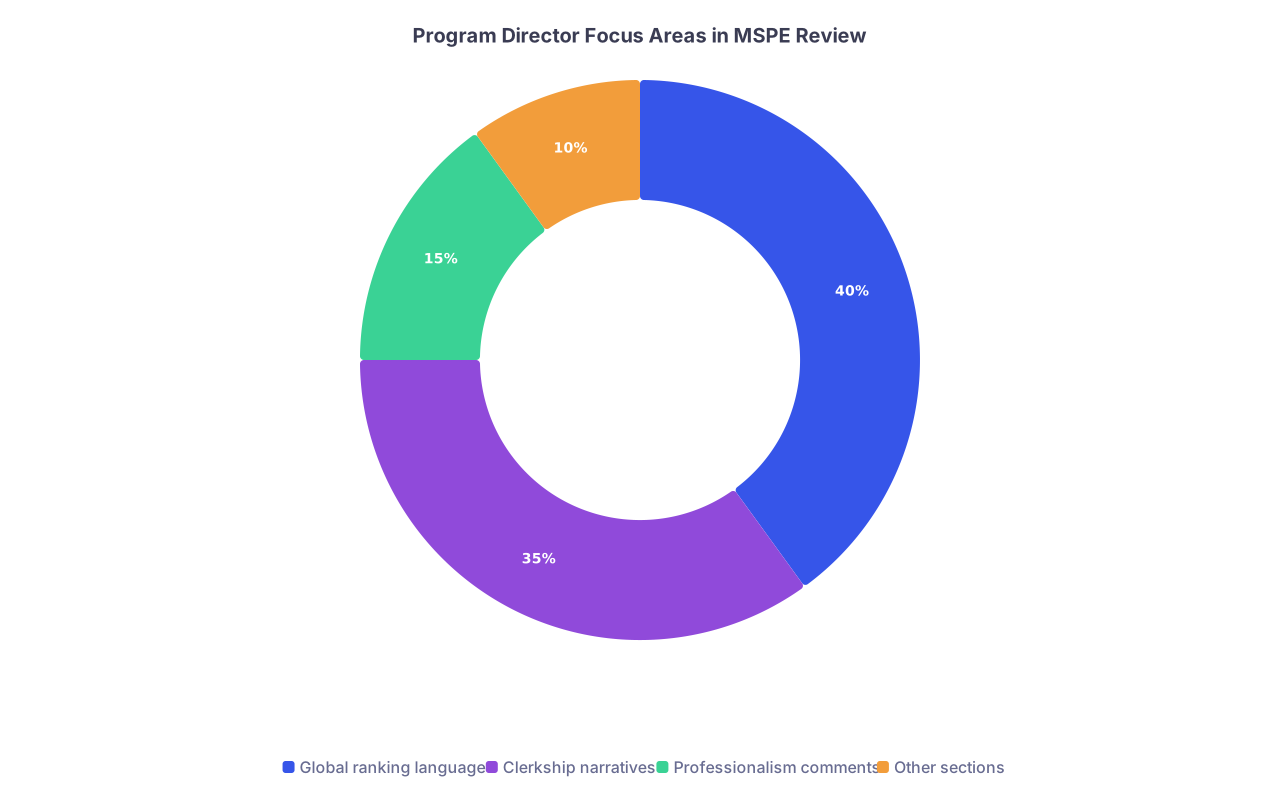
| Category | Value |
|---|---|
| Global ranking language | 40 |
| Clerkship narratives | 35 |
| Professionalism comments | 15 |
| Other sections | 10 |
Your job is to understand how those adjectives map to rank. Because “excellent” vs “outstanding” is often literally the difference between “probably interview” and “maybe alternate list.”
How MSPE Language Is Structured Behind the Scenes
Most U.S. schools use some version of a tiered language system in the summary section of the MSPE. The exact words vary, but the logic is the same.
Typical tiers look something like this:
| Tier Word(s) | Rough Percentile Range | Typical Use Case |
|---|---|---|
| Outstanding / Exceptional | Top 5–15% | True stars, strongest performance |
| Excellent | Top 15–40% | Strong, solid, above-average |
| Very Good | 40–70% | Competent, above median |
| Good | 70–90% | Adequate but not competitive specialty |
| Satisfactory / Solid | 90%+ or lower tier | Barely passing or concern flags |
A few realities from actual MSPE committees:
- At some schools, “outstanding” literally caps at a fixed percentage (e.g., top 10% of class).
- At others, the dean’s office maintains a quota for each tier by AOA status, numerical rank, or a composite score.
- A minority of schools pretend there is no rank, then quietly encode it in phrases like “among the best students I have worked with” vs “among the many capable students I have worked with.”
So when you see “excellent,” you have to ask yourself: in this school’s dictionary, is “excellent” the highest tier, or is there something above it?
Because residency PDs are asking exactly that.
Where “Excellent” and “Outstanding” Usually Sit in the Hierarchy
Let’s talk specifically about these two words.
Scenario 1: Both “Excellent” and “Outstanding” Exist
This is the most common modern structure. At many schools, the global ranking language falls roughly into this hierarchy:
- Outstanding
- Excellent
- Very good
- Good
- Satisfactory / other
If “outstanding” and “excellent” both appear in the MSPE template, they are not interchangeable. They are explicitly ordered tiers.
Typical distributions I have seen across multiple schools:
- Outstanding: top 10–15% of class
- Excellent: next 25–35%
- Very good: middle 30–40%
- Good: bottom 10–20% (but still passing; often not for competitive specialties)
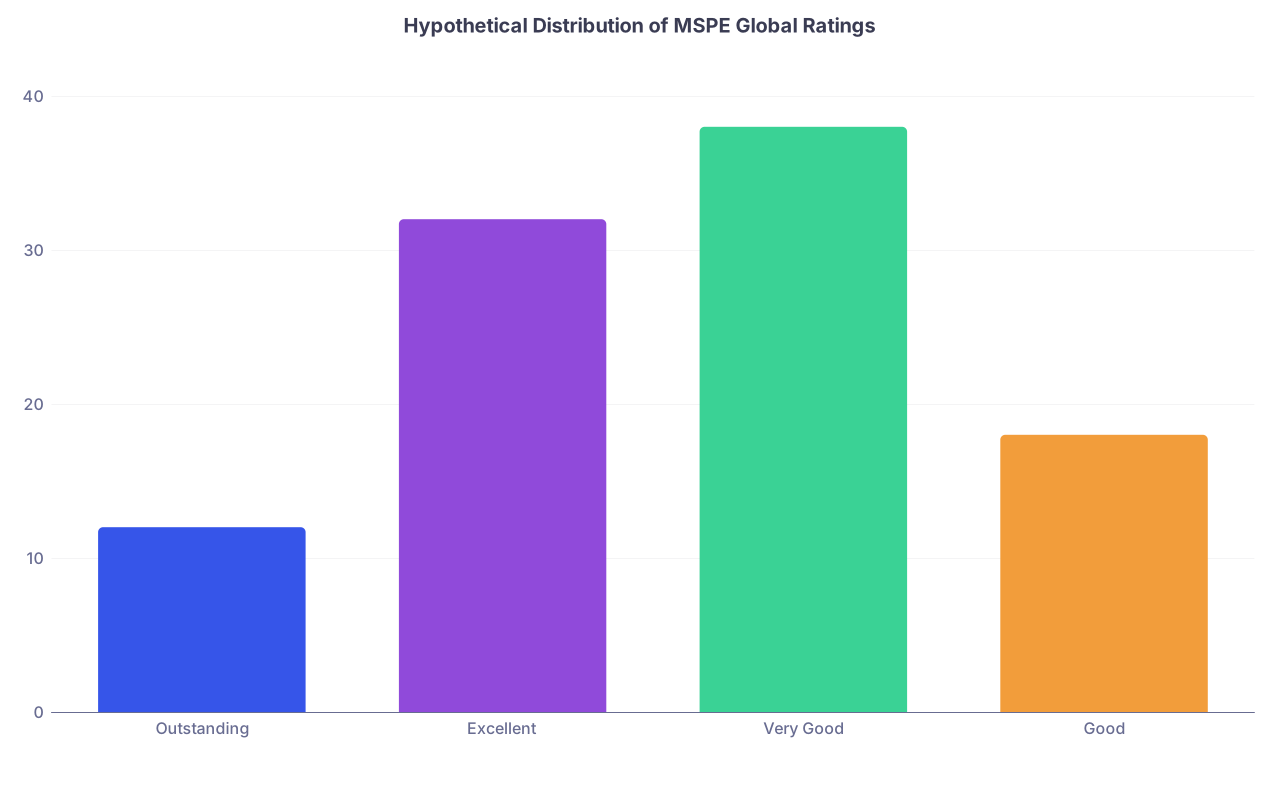
| Category | Value |
|---|---|
| Outstanding | 12 |
| Excellent | 32 |
| Very Good | 38 |
| Good | 18 |
So if your MSPE says you are an “excellent” student, and the same document’s key explains that “outstanding” is a higher category, the PD sees you as “strong but not top-tier at your school.”
For competitive fields (derm, ortho, ENT, plastics, neurosurgery), those programs often disproportionately interview “outstanding” level students from your school. The “excellent” cohort may get screened harder for board scores, research, and strong narratives.
Scenario 2: Only “Excellent” Exists, No “Outstanding”
Here the dean’s office might have deliberately softened the top word. They do not want to say “outstanding,” so they let “excellent” cover the top 20–30%. In this case:
- “Excellent” may be the true top tier
- “Very good” or “strong” becomes the middle
- “Good” or “solid” is lower tier
How do PDs figure this out?
They look at the comparative data table that almost every MSPE now includes: percentile bars, quartile breakdown, or language like “This evaluation places the student in the top 15% of the class.”
If that table shows you in the top 15%, and your text label is “excellent,” PDs will often internally translate that to “this school’s version of outstanding.”
Scenario 3: “Outstanding” Used Everywhere
Occasionally you hit a school or specific clerkship where everyone is “outstanding,” “superb,” or “among the best I have worked with.” There is a PD term for this: inflation.
This is where details matter:
- Global MSPE summary tier > individual rotation hyperbole
- Hard data (quartiles, AOA, exam percentiles) > adjectives
If your school’s clerkship narratives are uniformly effusive, PDs lean more heavily on the single global phrase in the dean’s letter and the numerical context.
So in that context, “outstanding” in one rotation comment may be weaker than “excellent” as a global summary at another school that keeps adjectives under control.
How Program Directors Actually Decode the Words
Program directors are not reading your MSPE like literature. They are scanning. Fast. Pattern-matching for signals they trust.
Here is the typical thought process when they hit those adjectives:
- Check if the MSPE includes a key or graphic explaining global rankings.
- Map your global adjective to a percentile or quartile.
- See whether your clerkship comments are consistent with that ranking.
- Look for negative or hedged phrases that contradict the global label.

| Step | Description |
|---|---|
| Step 1 | Open MSPE |
| Step 2 | Map adjective to percentile |
| Step 3 | Scan for comparative phrases |
| Step 4 | Read key clerkship narratives |
| Step 5 | Closer scrutiny or red flag |
| Step 6 | Proceed with normal screen |
| Step 7 | Global ranking visible? |
| Step 8 | Any professionalism flags? |
A few patterns I have watched PDs use:
- “Outstanding” + top quartile + strong comments → green flag, especially with strong board scores.
- “Excellent” + second quartile → solid, likely to be ranked if the rest of the application supports it.
- “Very good” + no comparative table → ambiguous, often pushed lower in the review pile for competitive programs.
- “Good” in the global summary → usually a significant relative weakness at that school.
The nuance: they care more about relative performance than the exact adjective. They are asking, “How did this person do compared to peers at their own institution?”
“Outstanding” is just shorthand for “top slice.” “Excellent” is shorthand for “strong but not top slice.”
Where Applicants Misinterpret “Excellent” and “Outstanding”
You are biased about your own file. Everyone is. A few classic mistakes:
1. Assuming “Excellent” = Top Tier Everywhere
If you have spent four years with attendings saying you are “excellent,” you hear that as top tier. But in the MSPE global summary, “excellent” might literally be the second tier. PDs know that. Many students do not.
If your school uses both “outstanding” and “excellent,” and you are in the “excellent” group, PDs at competitive programs usually assume:
- You were good, maybe very good, but not the absolute top of your class.
- If your board scores are average, you are less likely to beat out “outstanding” students from the same or similar schools.
That does not kill your application. But it puts pressure on everything else: research, letters, interview performance.
2. Ignoring the Code Phrases in Narrative Sections
Attendings often avoid blunt criticism. They shade it with language. “Excellent” sometimes shows up as a damper, not a compliment, in a rotation where the attending uses “outstanding,” “superb,” or “truly exceptional” for their favorites.
Watch for these narrative signals:
- “Met expectations” vs “consistently exceeded expectations”
- “Reliable, pleasant, and hardworking” without reference to clinical reasoning or ownership
- “Developing” attached to core skills in fourth year
When that tone diverges from your global “excellent” label, PDs notice the inconsistency.
3. Overvaluing Single Rotation “Outstanding” Phrases
If one surgeon calls you “outstanding” in a surgery clerkship, but the MSPE global tier is “very good,” PDs do not promote you to the outstanding tier in their mind. They flag that one rotation as particularly strong, but they interpret you as middle-high overall.
Applicants frequently cling to that one glowing line and mentally upgrade their competitiveness. Programs do not.
How to Find Out What Your School’s Words Actually Mean
You will not find this on the public website in clear language 90% of the time. But there are ways.
Step 1: Look at the MSPE Template and Appendices
Most schools attach a page to the MSPE explaining:
- Grading distributions
- Quartile or quintile definitions
- A bar graph of your performance vs class
Find the table or paragraph that says something like:
- “Students described as ‘outstanding’ typically fall within the top 15% of the class.”
- “Global descriptive adjectives are assigned based on each student’s final medical school performance index.”
If you do not have a copy of your MSPE yet, ask the dean’s office or student affairs for last year’s template and explanation.
Step 2: Talk to Recent Graduates in Your Specialty
This is the real-world decoder.
Ask a recent grad from your school who matched into your specialty:
- What global language did you get?
- What quartile or percentile were you in?
- Did anyone you know get “outstanding”? What were their stats like?
Most schools have informal folklore about this. You will hear things like:
- “Only AOA and top quartile get ‘outstanding.’”
- “If you had any clerkship below honors, you rarely got ‘outstanding’.”
- “Research stars sometimes got bumped up from ‘excellent’ to ‘outstanding’ even if their raw grades were slightly lower.”
That folklore is more operationally accurate than the sanitized official line.
Step 3: Ask Directly During Your MSPE Meeting
You usually get a one-on-one MSPE review or draft discussion with a dean. Use it.
Be precise:
- “How is the global summary term (‘excellent’) assigned here?”
- “What proportion of the class typically receives ‘outstanding’ vs ‘excellent’?”
- “Am I in the same tier as AOA students, or a different one?”
Deans choose their words carefully, but you can usually extract the rough structure. I have literally watched students ask, and the dean say, “Outstanding is roughly the top 10–15%, excellent is the next 30–40%.”
Once you have that, you know exactly what “excellent” or “outstanding” means in your file.
Strategy: How to Use This Information in Your Application
You cannot rewrite the MSPE, but you can frame the rest of your application intelligently.
If Your Global Tier Is “Outstanding”
You are in the top group at your school. Use that.
- For competitive specialties, it confirms you are in the right range to be taken seriously, assuming your scores are not catastrophic.
- In your personal statement or interview, you do not need to “prove” basic clinical competence; focus on fit, goals, and what differentiates you from other top performers.
- Make sure letters of recommendation do not undersell you (e.g., “solid” or “very good” letters attached to an “outstanding” global rating create doubt).
If Your Global Tier Is “Excellent”
You are strong, but you are not in the very top tier. That is most applicants. Now nuance matters.
- Competitive specialties: pair this with above-average board scores, evidence of commitment (research, electives), and stellar specialty-specific letters.
- Less competitive specialties: “excellent” is usually more than enough, and the rest of your application (fit, geography, background) matters more.
- If your school’s explanation shows “excellent” includes up to, say, top 30–40%, programs recognize there are many strong applicants in that band.
If Your Global Tier Is “Very Good” or Lower
Now you are below the “strong” group at your own school.
That does not end your career. But:
- Very competitive specialties become significantly harder from U.S. MD schools, and borderline to unrealistic from DO/IMG depending on other metrics.
- You should seriously consider where your file has compensatory strengths: non-clinical years, leadership, prior career, unique background.
- You may need to apply more broadly and include backup specialties with more generous thresholds.
This is where honest advising matters. Too many students with “very good” global language and mid-range scores get told “apply and see what happens” in ultra-competitive fields. Then scramble.
A Quick Reality Check Across Schools
Not all “outstanding” is created equal, and not all “excellent” is second tier.
Here is a simplified comparison to make this concrete:
| School | Top Tier Word | Second Tier Word | Top Tier Size | Notes |
|---|---|---|---|---|
| School A | Outstanding | Excellent | 15% | Clear key, strict distribution |
| School B | Excellent | Very Good | 25% | No “outstanding” word used |
| School C | Exceptional | Outstanding | 10% | Three-tier top: exceptional > outstndg |
| School D | Outstanding | — | 40% | Word used loosely, high grade inflation |
At School B, “excellent” really is the top tier and reads stronger than “excellent” at School A. At School D, “outstanding” may be devalued because it includes nearly half the class.
Program directors know this. They have years of experience comparing MSPEs from the same schools. The only person who is usually confused is the applicant.
How This Plays With Other Application Components
A few combinations that PDs mentally weigh:
- Outstanding + high Step 2 score + strong specialty letter → probable interview at most programs in that specialty.
- Excellent + average Step 2 score + strong research → competitive but more variable; programs dig into narratives and fit.
- Very good + strong Step 2 score + outstanding narrative comments → some PDs will “upgrade” their impression, especially in less numbers-obsessed fields like psych or FM.
- Outstanding but with professionalism concerns explicitly mentioned → huge red flag; the positive word does not override the concern.
Your MSPE language is a weight on the scale. Not the entire scale.
What You Should Actually Do Next
If you are anywhere in the application cycle where you can still act:
- Get your actual MSPE or draft.
- Identify the global summary language (outstanding, excellent, etc.).
- Find or request the school’s explanation of that word’s tier.
- Cross-check with your quartile or percentile distribution.
- Talk to one recent grad in your intended specialty from your school. Ask them what they had.
- Adjust your school list and expectations accordingly.
If that feels clinical or cold, good. This part of the process is.
FAQ: MSPE Language, “Excellent” vs “Outstanding”
If my MSPE says “excellent,” can I still match into a competitive specialty like derm or ortho?
Yes, but it depends heavily on your other metrics. At many schools, “excellent” is the second tier, which is still very strong. For derm/ortho/ENT/plastics, you likely need high Step 2 scores, solid or exceptional research in the field, and strong specialty-specific letters to offset not being in the absolute top group. Programs will interview plenty of “excellent” students, but you will be competing directly with “outstanding” students from similar schools.What if my school only uses “excellent” and never uses “outstanding” in the global summary?
Then “excellent” is probably the top formal tier, even if faculty throw “outstanding” around in individual comments. Check the MSPE appendix or explanation: if “excellent” correlates with top 20–25% or “highly successful student,” PDs will interpret it as that school’s top descriptor. In that context, your “excellent” may actually be stronger than an “excellent” from a school that also has an “outstanding” tier above it.Do program directors literally look at the adjectives, or mostly at quartiles and scores?
They look at both, but in different ways. The global adjective (“outstanding,” “excellent,” etc.) gets mapped quickly to quartile/percentile. That gives them a gut-level impression of your relative standing. They then cross-check that with Step 2, clerkship grades, and narratives. In schools with clear quartile graphics, the hard data matters more than the exact word, but the word still acts as a shorthand anchor.My narrative comments use “outstanding” multiple times, but the global summary says “very good.” Which carries more weight?
The global summary. Program directors know individual attendings have different grading cultures. A single enthusiastic attending might call half the students “outstanding.” The dean’s office is much tighter with the global tier, because it must be consistent across the class. Multiple strong comments can still help, especially if they are from your specialty and are specific, but they rarely override a clearly lower global tier.If I think my MSPE language underestimates me, can I ask for it to be changed?
Sometimes, but only at the margins. You can and should correct factual inaccuracies. You can flag truly outlier or misrepresentative comments. You can occasionally negotiate rephrasing vague or misleading sentences. But global tier labels like “excellent” vs “outstanding” are usually tied to an internal formula (grades, evaluations, maybe AOA). Those do not move because you ask. Focus your energy on strengthening other parts of the application and explaining any outlier issues in your personal statement or advisor letters.How should I talk about my MSPE language in interviews, if at all?
Do not bring it up unprompted. Interviewers have read it. If they ask directly (“Your MSPE describes you as ‘excellent,’ how do you see that?”), answer with calm self-awareness: acknowledge the description, note areas you are proud of (consistently strong clinical evaluations, improvement over time, particular strengths), and, if relevant, briefly contextualize any lower grades or trends. The worst move is defensiveness; the best move is to show you understand your own record and have grown from it.
Key takeaways:
“Excellent” and “outstanding” are not generic compliments in the MSPE; they are coded tiers linked to relative class performance. Your real leverage comes from understanding exactly how your school defines those words, then building the rest of your application strategy around that reality.