
The worst thing you can do with a red flag in your application is pretend it does not exist.
For residency programs, unexplained gaps and unexplained problems are usually more damaging than the problem itself. That is exactly where a targeted ERAS personal statement addendum becomes useful—when it is done correctly. Most applicants either overshare and sound defensive, or under-explain and sound evasive. Both are fixable.
Let me break this down specifically.
1. What an ERAS Personal Statement Addendum Actually Is (And Is Not)
First, some blunt clarity.
There is no official “ERAS addendum” text box. You are repurposing existing spaces in a smart, controlled way. When people say “ERAS personal statement addendum,” they usually mean one of three things:
- A short explanatory paragraph built into the personal statement itself.
- A separate, program-specific personal statement focusing on a red flag (used only for select programs).
- A “Communication with Programs” / email explanation (rarely ideal, but sometimes necessary late in the cycle).
The best version for 95% of applicants: a concise, targeted paragraph within your main personal statement that addresses the gap or red flag and then moves on.
The goal is simple:
- Acknowledge the issue directly.
- Provide just enough context to make it understandable.
- Demonstrate insight and growth.
- Re-center the reader on your current readiness for residency.
If your “addendum” does anything else—argues, blames, overshares medical details, or eats half the page—it is hurting you.
2. Which Red Flags Actually Need an Addendum?
Not every ugly thing in your record requires narrative repair. Programs know humans are messy. They are scanning for patterns and risk, not perfection.
You normally consider an addendum for:
Major Leaves or Gaps
3 months away from training or school
- Explaining an LOA (medical, personal, academic, parental)
- Long gap between graduation and application (especially > 2 years)
Academic Problems
- Step 1 or Step 2 CK failures
- Multiple NBME/clerkship exam failures
- Repeating a year or being placed on academic probation
- Significant downward trend after earlier strong performance
Professionalism / Disciplinary Issues
- Formal professionalism citation in the MSPE
- Conduct or professionalism probation
- Dismissal and readmission policies referenced in your dean’s letter
Career Trajectory Red Flags
- Switching from one specialty after a failed match or resigning from a residency
- Significant time in a non-clinical job with no explanation
- Prior match violation or NRMP issue (these absolutely need careful framing)
Things that usually do not need a formal addendum paragraph:
- One mediocre clerkship grade with no narrative mention.
- Being “average” on Step 2 after a strong Step 1.
- A single failed quiz, or basic remediation that never hit the MSPE.
- Small timing quirks (graduating in December, etc.) if already clear in your CV.
If the red flag is already fully and neutrally explained in your MSPE, sometimes you just need a one- or two-line acknowledgment in your statement. Overwriting the defense is a common mistake.
3. Where to Put the Explanation: Strategy First
Your options are limited, so placement matters. Here is how programs practically see this:
| Location | Visibility to PDs | Typical Use Case |
|---|---|---|
| Main personal statement paragraph | High | Most red flags/gaps |
| Specialty-specific PS version | High (selected) | Prior residency, re-applicants |
| MSPE / Dean’s Letter only | Medium | Minor issues already documented |
| Email to program (rare) | Variable | Late-breaking or complex situations |
| Interview day verbal explanation | High | Nuance, follow-up questions |
Best default: One integrated paragraph in the main personal statement
Place it:
- After your core “why this specialty” and initial narrative,
- Before the closing section where you pivot to your strengths and future goals.
That way:
- You have already established yourself as a real person with motivation.
- You acknowledge the issue once the reader has some context.
- You end on your strengths, not your deficits.
When to use a separate version of the personal statement
Use a modified PS (for some or all programs in a specialty) if:
- You are a re-applicant after a catastrophic first match cycle (many no-interviews, overt red flags).
- You withdrew or were let go from a prior residency and are reapplying.
- You switched specialties and the reason is intimately tied to your red flag (e.g., burnout in surgical residency, now applying to psych).
In that situation, you might have:
- A standard PS for programs you are less worried about, and
- A version with a slightly more robust explanatory paragraph for programs that are likely to dig harder or are more competitive.
When not to lead with it
Do not open your personal statement with the red flag unless you have something dramatic and truly central (e.g., major illness that completely shaped your career path). Most of the time, starting with “I failed Step 1” just tells the reader that you define yourself by your worst moment.
4. Core Principles: How Program Directors Read These Explanations
I have heard versions of this from multiple PDs on selection committees:
“I do not care that you had a problem. I care whether you learned something and whether I am going to be cleaning up the same problem at 2 a.m. when you are my intern.”
They are reading your addendum to answer three questions:
- Is this risk likely to repeat during residency?
- Does this applicant have insight, or are they still in denial/blaming mode?
- Did they use the time/problem to grow in a way that now benefits my program?
Your paragraph must signal:
- Ownership, not excuses.
- Stability now, not ongoing chaos.
- Concrete change, not vague “growth.”
Common mistakes that instantly raise red flags:
- Long explanations (half a page) for a single exam failure.
- Blaming “unfair attendings,” “unsupportive administration,” or “toxic culture.”
- Overly intimate psychological or medical disclosure with no clear resolution.
- Trying to litigate the fairness of an MSPE comment in your PS.
If the reader finishes your paragraph and thinks, “This is still raw,” or “I am not sure they are okay now,” you just lost ground.
5. Exact Structures and Phrases That Work
Let us get concrete. The structure of an effective addendum section is surprisingly standard.
Think: 4–6 sentences, 3 moves.
- Name the problem plainly and factually.
- Provide brief context without excuses.
- Show the corrective actions and current status.
Then you move on. You do not circle back to it three more times.
Template skeleton you can adapt
You obviously should not copy this verbatim, but the bones are solid.
- “During [timeframe], I [experienced/encountered] [briefly name the issue: exam failure, leave of absence, professionalism concern].”
- “This occurred in the context of [1–2 sentences of neutral context: health, family, adjustment, overcommitment].”
- “I took responsibility by [specific steps: meeting with faculty, changing study habits, engaging in counseling, restructuring schedule].”
- “Since then, I have [evidence of improvement: passed on first attempt, honored subsequent clerkships, maintained consistent performance].”
- “This experience has made me [focused insight, not cliché: more proactive in seeking feedback, more realistic about limits, more organized].”
Let me show you specialty-level examples.
6. Examples by Red Flag Type
A. Step 1 or Step 2 CK Failure
This is one of the most common reasons people ask about an “addendum.” Over-defending this is almost as bad as ignoring it.
Weak version (what I often see):
“I failed Step 1 because the exam was poorly written and I was dealing with a lot in my personal life. I had been a strong student all along and believe that this failure does not reflect my true abilities. Unfortunately, my school did not provide me with adequate support or study resources, which further contributed to my difficulties at that time.”
Problems: defensive, blames exam and school, no concrete change, no clear resolution.
Stronger version:
“During my second year of medical school, I failed USMLE Step 1 on my first attempt. I underestimated the adjustment required when transitioning from classroom-based learning to independent board preparation and did not adapt my study strategy quickly enough. After this result, I met regularly with our academic support office, created a structured daily schedule, and significantly increased my use of question banks and timed practice exams. I passed Step 1 on my second attempt and later passed Step 2 CK on the first attempt with a score consistent with my clinical performance. This experience taught me to seek feedback early, build realistic study plans, and monitor my progress more systematically.”
Notice what this does:
- Names the failure once.
- Takes responsibility.
- Describes clear behavioral changes.
- Provides outcome data (subsequent passes) to reassure.
- Ends on a skill (structured preparation) that is directly relevant to residency.
If your Step 2 is also weak, you need to emphasize trend in clinical performance, not just scores: strong clerkship grades, strong sub-I, solid letters.
B. Leave of Absence (Medical, Personal, Mental Health)
You do not owe your entire psychiatric history to a PD. You owe them a coherent, honest outline of what happened and evidence that you are stable and reliable now.
Over-disclosure (what I have seen go badly):
“During my second year, I was hospitalized for severe depression and suicidal ideation, which stemmed from years of unresolved childhood trauma. I tried multiple antidepressants that did not work, and I struggled to maintain my course load. After several months away, I came back but still felt very unstable…”
This makes most PDs nervous. Not because they lack empathy—but because they are thinking about call schedules, patient safety, and how recent/unstable this sounds.
Better framing:
“I took a medical leave of absence during the second half of my second year. At that time, I was dealing with a combination of longstanding mental health concerns and acute family stressors that affected my ability to perform consistently. With support from my physicians, family, and school, I stepped away to focus on treatment and recovery. I returned the following academic year and completed the curriculum on schedule, earning [mostly High Pass/Honors] in my core clerkships and strong evaluations from faculty. I remain engaged in ongoing outpatient care and have developed reliable routines to maintain my health. This experience has made me more attentive to burnout, more empathetic toward patients facing mental health challenges, and more deliberate in how I manage my time and energy.”
Key moves:
- “Medical leave of absence” – enough detail without listing diagnoses.
- Clear timeline and completion.
- Explicit statement that you are in ongoing, stable care.
- Evidence from after the leave that you function at a residency-appropriate level.
If the leave was purely for a physical condition that is fully resolved (e.g., surgery, pregnancy, major accident), you can be more concrete but still avoid melodrama.
C. Professionalism Citation / Probation
These are the landmines. You cannot ignore them if they appear in the MSPE. You also cannot argue with the dean’s office in your PS. PDs hate that.
You need to do three things:
- Acknowledge the behavior.
- Show that you understood the impact.
- Demonstrate a clean record and changed behavior since.
Poor version:
“I was unfairly placed on professionalism probation after a misunderstanding with a team regarding my hours and availability. My school has a very rigid policy, and despite my attempts to explain my side, they would not listen. This was a frustrating experience and I still believe it was handled inappropriately.”
This screams: “This will be your problem later.”
Stronger version:
“In my third year, I was placed on professionalism probation after concerns were raised about my punctuality and responsiveness on one of my clerkships. At that time, I was struggling to balance clinical duties, commuting, and family responsibilities, and I did not communicate effectively with my team or ask for help early enough. I met with the clerkship director and student affairs to review expectations, adjusted my schedule, and implemented specific strategies (arriving early, structured task lists, and clear check-ins with residents). Since then, my subsequent clerkship evaluations have consistently commented on my reliability and teamwork, and I have not had any further professionalism concerns. This experience has made me more proactive and transparent in my communication with colleagues.”
You do not have to love what happened. You have to show that you changed. That is what PDs care about.
D. Gap Year(s) or Long Interruption Between Graduation and Application
Unexplained time is one of the simplest, yet most damaging, red flags. “What were they doing?” is not a good question to leave hanging.
Your job: show that the gap was:
- Intentionally used,
- Logically connected to your path, and
- Not a sign you were drifting aimlessly or unable to function clinically.
Example: 2-year gap for research and family care
“After graduating from medical school in 2021, I spent two years away from formal training. During this period, I worked as a full-time research fellow in cardiology at [Institution], contributing to projects on heart failure outcomes and co-authoring two manuscripts under review. At the same time, I was the primary support for a close family member with serious illness, which required flexibility in my schedule. These experiences deepened my interest in academic internal medicine and strengthened my skills in data analysis, scientific writing, and longitudinal patient advocacy. Over the past year, I have also maintained clinical exposure by volunteering in a student-run free clinic and completing observerships in internal medicine.”
This addresses:
- What you did.
- Why it made sense.
- How you stayed clinically adjacent.
If the gap came from an initial failed match or no interviews, you also need to show you did not just sit and wait.
E. Prior Residency or Specialty Switch
This absolutely requires careful explanation. PDs will assume: “Could they quit our program too?” unless you show a coherent arc.
Example: Leaving a surgical residency after 1 year, applying to IM
“After graduating in 2022, I matched into a categorical general surgery residency. During my intern year, I realized that although I enjoyed operating, I was consistently more engaged in the longitudinal management of complex medical patients and in discussions on evidence-based perioperative care. After multiple conversations with my mentors and program leadership, I made the difficult decision to resign in good standing at the end of my PGY-1 year to pursue internal medicine training. I have since worked as a surgical hospitalist extender, managing perioperative medical issues and collaborating closely with internal medicine consultants. This experience clarified that I am best suited to a career focused on comprehensive medical care and long-term patient relationships, and I am now fully committed to training in internal medicine.”
You should:
- State that you left in good standing (if true).
- Avoid blaming your prior program.
- Emphasize what you learned about your own fit and values.
7. Tone: What Helps and What Hurts
Tone is where most addenda go sideways. The content may be fine, but the emotional register screams either “I am still angry” or “I am still fragile.”
Helpful tone characteristics:
- Brief, controlled, and matter-of-fact.
- Precise verbs: “I met,” “I changed,” “I implemented,” “I completed.”
- Calm acknowledgement of difficulty without drama.
Hurting tone characteristics:
- Repetition of emotional words: “devastated,” “shattered,” “humiliated” (once is enough, if at all).
- Legalistic language: “unjust,” “unfair,” “wrongly accused.”
- Excessive self-flagellation: “I was completely irresponsible and immature…”
You are not writing a legal appeal or a confessional. You are presenting a professional narrative of a problem and its resolution.
8. How Long Is Too Long? Word Count and Placement
As a rule of thumb:
- In a 650–800 word personal statement, your “addendum” portion should rarely exceed 120–150 words.
- For simpler issues, you can address it in 3–4 sentences (60–90 words).
If the paragraph is visually dominating the page, you are oversharing.
Where it should sit:
- Opening: who you are, why this specialty, one or two key formative experiences.
- Middle: skills, strengths, specific clinical stories that show fit.
- Addendum paragraph: red flag explanation.
- Closing: what you bring now and what you want from training.
That way, the red flag is enclosed inside a larger, coherent story of competence and direction.
9. Coordinating the Addendum with Other Application Parts
Your explanation cannot contradict or clash with:
- MSPE narratives
- Dean’s letter phrasing
- Letters of recommendation (LORs)
- Your ERAS CV timeline
You want a coherent story, even if the wording varies.
A few specifics:
- If the MSPE already frames the leave as “medical,” you do not need to dance around it with “personal reasons.” Accept the term, but you do not need diagnostic codes.
- If your school used strong language (“serious concerns about professionalism”), you do not try to prove them wrong; you show how you responded and improved.
- If an attending specifically praises your recovery from a setback in a letter (“I supervised them after their Step 1 failure…”), align your PS explanation with that arc.
10. When to Consider NOT Using an Addendum
There are limited cases where silence is better, assuming the issue is minor and not flagged in the MSPE:
- You scored 225 on Step 2 after 255 on Step 1. That is a drop, not a red flag. You do not write an essay about your uncle’s illness as justification.
- You had one outpatient clerkship grade that dipped to Pass while everything else is HP/Honors and no one mentioned it narratively. Most PDs will ignore this.
- Very short gaps between activities (1–2 months between graduation and starting a job); ERAS already shows dates.
In those cases, pushing an addendum actually creates a red flag where there was only noise.
Rule: If a reasonable PD might not have noticed or cared—and it is not documented elsewhere—consider leaving it alone.
11. Quick Process: How to Draft Your Addendum Paragraph
Here is a straightforward, no-nonsense process I recommend:

| Step | Description |
|---|---|
| Step 1 | Identify Red Flag |
| Step 2 | Check MSPE/CV Wording |
| Step 3 | Decide If Explanation Needed |
| Step 4 | Write 4-6 Sentence Draft |
| Step 5 | Skip Addendum |
| Step 6 | Remove Blame/Legalistic Language |
| Step 7 | Add Evidence of Improvement |
| Step 8 | Place in Middle of PS |
| Step 9 | Have 1-2 Mentors Review |
Two people you should try to get feedback from:
- Someone on faculty or advising who has seen lots of applications.
- Someone who knows your actual situation personally and can check for honesty and comfort.
If both agree the paragraph feels:
- Brief
- Clear
- Mature
You are probably where you need to be.
12. A Few Specialty-Specific Nuances
Certain specialties are more sensitive to particular red flags.
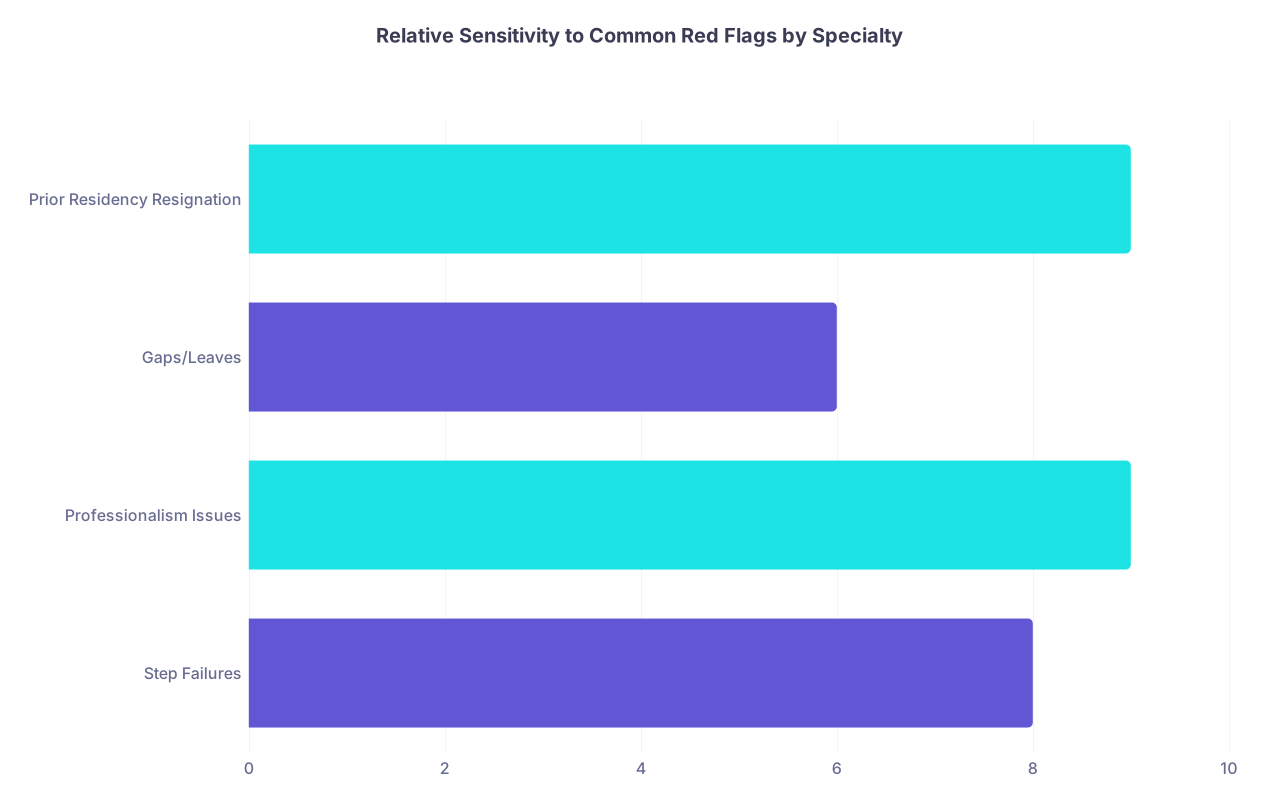
| Category | Value |
|---|---|
| Step Failures | 8 |
| Professionalism Issues | 9 |
| Gaps/Leaves | 6 |
| Prior Residency Resignation | 9 |
(Scale 1–10; surgical fields and very competitive specialties tend to treat professionalism and prior resignation with especially high concern.)
Some quick nuance:
- Surgery / Ortho / ENT: Extremely sensitive to professionalism and perceived “grit.” Any hint you may not tolerate intense schedules requires very careful framing emphasizing resilience and support systems.
- Psychiatry: More accepting of mental health leaves, but very attuned to whether you are stable and self-aware now. Overly chaotic narratives are a problem.
- Internal Medicine / Pediatrics: Often more flexible about an exam failure if trends improve and narrative is strong.
- Radiology / Anesthesia: Heavily score-driven at many places. Step failures will need both explanation and strong subsequent evidence.
Adjust the emphasis, not the honesty.
13. One Thing You Must Avoid: Making the Red Flag Your Identity
If your entire personal statement could be summarized as “I failed Step 1, but then I grew,” you have written a rehabilitation essay, not a residency personal statement.
Your red flag is a chapter, not the book.
The core of your PS still has to be:
- Why this specialty.
- What kind of resident you will be.
- Concrete experiences that show your clinical maturity and interests.
The addendum is a targeted patch on the hull, not a repainting of the whole ship.
14. Putting It All Together: A Compact Before-and-After Example
Imagine an internal medicine applicant with:
- Step 1 fail, passed on second attempt
- Step 2 pass on first attempt, decent score
- Strong clinical performance and letters
Old statement fragment (ineffective):
“I want to address my Step 1 failure, which has been a significant source of shame and difficulty for me. I studied very hard for this exam but unfortunately the testing environment and personal stress interfered with my performance. My school was not very understanding and I felt unsupported throughout the process. This experience was devastating, but I pushed through and eventually passed. I hope you will see beyond this one score and recognize my true potential.”
Issues: shame-heavy, blames environment and school, no concrete change, no evidence trend.
Rewritten integrated addendum (effective):
“During my second year, I failed USMLE Step 1 on my first attempt. I underestimated the adjustment required for independent board preparation and did not recognize early enough that my study plan was not effective. After this result, I met with our academic support faculty, increased my use of question banks and timed practice exams, and followed a structured daily schedule with weekly self-assessment. I passed Step 1 on my second attempt and subsequently passed Step 2 CK on the first attempt with a score consistent with my clerkship performance. This experience forced me to become more systematic, reflective, and proactive in seeking feedback—skills that now shape how I prepare for rotations and how I approach patient care.”
That is the difference between “damaged” and “matured.”
15. Final Takeaways
Three things to keep firmly in mind:
- A red flag does not sink you by itself; an unacknowledged or poorly explained red flag often does.
- The best ERAS “addendum” is a short, specific, ownership-focused paragraph embedded in a strong, forward-looking personal statement.
- Your job is not to erase the past. Your job is to show that you understand it, have learned from it, and are now stable, reliable, and ready to function as a resident physician.