
Step 1 failure is not an automatic Match death sentence. The myth survives because people keep repeating old data and worst‑case anecdotes instead of reading what the numbers actually show.
If you just failed Step 1, you are not “done.” You are, however, now playing on hard mode. Those are very different things.
Let’s break this down using current data, not hallway gossip.
What the Data Actually Shows About Step 1 Fails
First, stop listening to the “my cousin’s roommate failed Step 1 and never matched” stories like they’re epidemiologic data. They’re not.
Here’s what the more recent evidence and match trends show.
| Group | Match Chance (Recent Cycles) |
|---|---|
| US MD seniors, no fail | ~92–94% |
| US DO seniors, no fail | ~89–91% |
| US MD/DO with any USMLE fail (1 or 2) | ~55–70% |
| IMGs (no fail, complete app) | ~58–65% |
| IMGs with a USMLE fail | Often <40% |
Those are blended estimates from NRMP Charting Outcomes and IMG data over recent cycles. Numbers vary by year and category, but the pattern is crystal clear:
- A fail crushes your odds compared to a clean record
- A fail does not drop your odds anywhere near zero
- Many applicants with a fail still match each year, especially US MD/DO who fix the narrative and apply strategically
Programs do care. But they do not have some automatic “fail = trash” trigger for all applicants. They have different tolerances depending on:
- Specialty competitiveness
- Applicant type (US MD > DO > US‑citizen IMG > non‑US IMG, in pure probability terms)
- Whether the exam was later passed solidly
- What you did after the fail
The old world where a fail = red stamp of doom came from a time when Step 1 was 3‑digit, hyper‑screened, and programs were drowning in 260s. That world is gone. Pass/fail has shifted attention elsewhere.
Does that mean the fail doesn’t matter? No. It means the story you build around it matters even more.
The Pass/Fail Era: Did It Save You or Hurt You?
The laziest take I still hear from students: “Now that Step 1 is pass/fail, my old fail doesn’t matter as much.”
Wrong. In some ways, it matters more.
Here’s the updated reality:
Programs lost their favorite numerical filtering toy (Step 1 score), so they:
- Lean harder on Step 2 CK
- Lean harder on failures (anything binary is now prime filter territory)
- Lean harder on school reputation and class rank
A fail stands out even more on a report that no longer has any 3‑digit context. Your performance is now:
- Fail → Pass, or
- Pass on first attempt
Faculty I talk to in IM and surgery repeatedly say some version of:
- “With P/F, the only Step 1 thing that signals risk now is a fail.”
So no, pass/fail Step 1 did not erase the stigma. It concentrated it.
The good news? Programs have largely shifted to asking:
- Did you crush Step 2 CK?
- Does your transcript/clinical performance suggest the fail was an outlier or part of a pattern?
- Do you own the fail and show growth, or do you avoid it like a landmine?
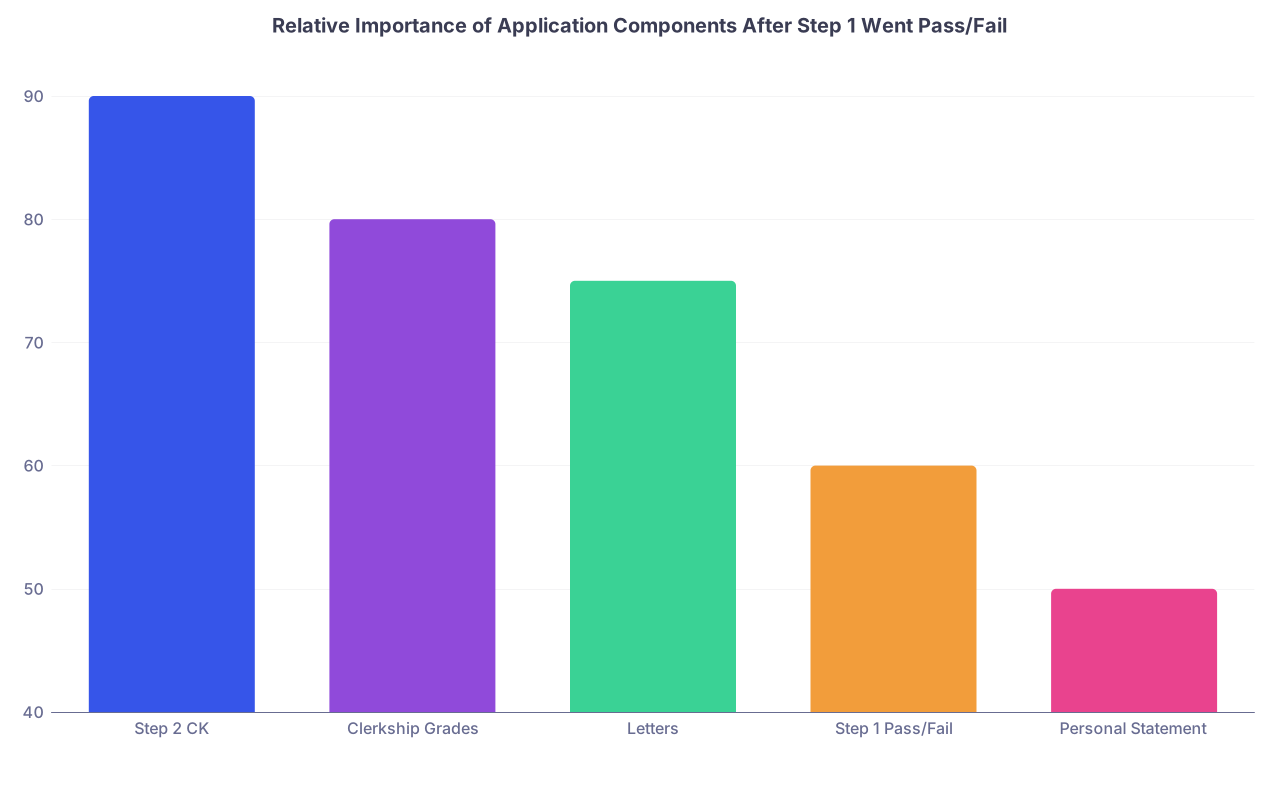
| Category | Value |
|---|---|
| Step 2 CK | 90 |
| Clerkship Grades | 80 |
| Letters | 75 |
| Step 1 Pass/Fail | 60 |
| Personal Statement | 50 |
Those values are rough “importance scores” based on what PDs report in NRMP Program Director Surveys and in actual conversations. Not precise, but directionally correct.
You do not fix a Step 1 fail with vibes and a “growth mindset.” You fix it with a clean pass, a strong Step 2 CK, tight clinical performance, and an honest – not dramatic – narrative.
How Programs Actually Screen a Step 1 Fail
Let me walk through how this goes in real life, because I’ve watched it happen in PD offices.
Imagine a mid‑tier IM program with 4,000 applications for 12 spots.
Initial filter screens might look like:
- Incomplete apps: auto‑out
- Non‑US grads without ECFMG: auto‑out
- Step 2 CK < some threshold (ex: 220–230 US MD/DO, 235–240 for IMGs): high risk
- Any unexplained failures: flagged
Here’s the subtlety: “flagged” is not the same as “deleted.”
Typical conversation scanning a file:
“OK, Step 1 fail, then pass, Step 2 242, high pass in medicine, strong IM letter. What happened here?”
“Personal statement says family death and depression during that window, got treated, upward trend since. Looks legit.”
“Fine, keep. We’ve got residents like this who’ve done great.”
Swap the scenario:
“Step 1 fail, then low pass, Step 2 barely passing, marginal clerkship comments, generic letters.”
“We’ve got enough safer choices. Pass.”
The fail is not the only data point. It’s a stress test of your whole story.
The more competitive the specialty (derm, ortho, plastics, IR, ENT, neurosurg), the less patience they have for academic red flags, including Step 1 fails. That’s just reality. But even there, internal candidates, research‑heavy candidates, or people with strong mentorship sometimes make it through. It’s not common, but it’s also not impossible.
For primary care, psych, peds, FM, pathology, and many IM programs, the conversation is more nuanced. They see:
- People with life events
- People who were terrible standardized test‑takers early and then figured it out
- People with ADHD/anxiety who finally got treated and improved
But they need clear, documented evidence that your fail is old news, not a preview.
What Actually Moves the Needle After a Step 1 Fail
Let me be direct. After a Step 1 fail, these things matter far more than whatever inspirational quote you stick on your wall.
1. A Convincing Retake and Strong Step 2 CK
Bare minimum: you must pass Step 1 on the second attempt. No program is going to entertain multiple Step 1 fails unless they are incredibly desperate or you are a unicorn in some other way (already known to the department, strong research fit, etc.). Even then, it’s rough.
You want your sequence to look like this:
- Step 1: Fail → Pass (earlier in med school, not dragging to M4)
- Step 2 CK: Clearly above minimum cutoffs, ideally comfortably so
Is 240+ mandatory? No. Helpful? Absolutely.
Is 260+ required? No. But it does change how people read your fail.
The Step 2 CK score is the easiest way to say: “Whatever happened before, I can crush a clinical‑relevant exam now.”
2. Clinical Performance That Doesn’t Match the “Struggling Student” Story
If your MS3 (or core DO rotations) grades show:
- Mostly passes, a couple of marginal evals, “needs direction” comments
…then your fail looks like part of a bigger pattern.
But if they show:
- High passes/honors in medicine, surgery, psych, etc.
- Comments like “reads beyond expectations,” “takes ownership,” “excellent reasoning”
…then the fail reads more like a one‑off, contextualized weakness.
Programs care less about past failure when the current version of you is clearly functioning at or above the level they need.
3. Letters That Indirectly Reassure About Reliability
No one writes: “We’re not worried about their Step 1 fail.” That’d be weird.
What they write instead (the good ones) is:
“One of the top 10% of students I’ve worked with in the past 5 years.”
“Extremely reliable, always prepared, asks excellent questions, calm under pressure.”
“I would be thrilled to have them as a resident in our program.”
Those kinds of statements override a lot of anxiety about a past fail.
If you’ve got even one letter from a program director or well‑known faculty in your target specialty saying they’d rank you heavily, the Step 1 fail falls several rungs down the worry ladder.
4. A Brief, Clear, Non‑Dramatic Explanation
Here’s where people blow it. They either:
- Never mention the fail and hope no one sees it (they will), or
- Write a 900‑word trauma narrative in the personal statement
What works better:
- One short, direct paragraph in your personal statement or an ERAS “additional info” section
- Own the mistake, own the situation, show what changed, then get out
Example framework (edit to your reality):
During my second year I failed Step 1 on my first attempt. At that time I was dealing with [brief, specific: unmanaged anxiety / a family crisis / poorly treated ADHD] and did not yet have effective support or strategies in place. After addressing this with [treatment/support specifics], I passed the exam on my second attempt and have since shown consistent improvement, including [Step 2 score / clerkship performance]. That experience forced me to confront how I handle stress and failure, and I now approach challenges with more structure, humility, and resilience.
Then stop. Move on to why you want the specialty.
Programs do not want a pity essay. They want to see adult self‑reflection and evidence of change.
5. Strategic Specialty and Program Choice
If you failed Step 1 and still aim straight at neurosurgery, derm, plastics, or ortho at brand‑name academic centers, you are not being “resilient.” You’re being delusional.
You can absolutely still aim high within reason:
- Target less competitive specialties or slightly lower‑tier academic/community programs
- Apply extremely broadly (yes, 60–100+ programs if you can afford it)
- Use away rotations and home rotations to become a known quantity
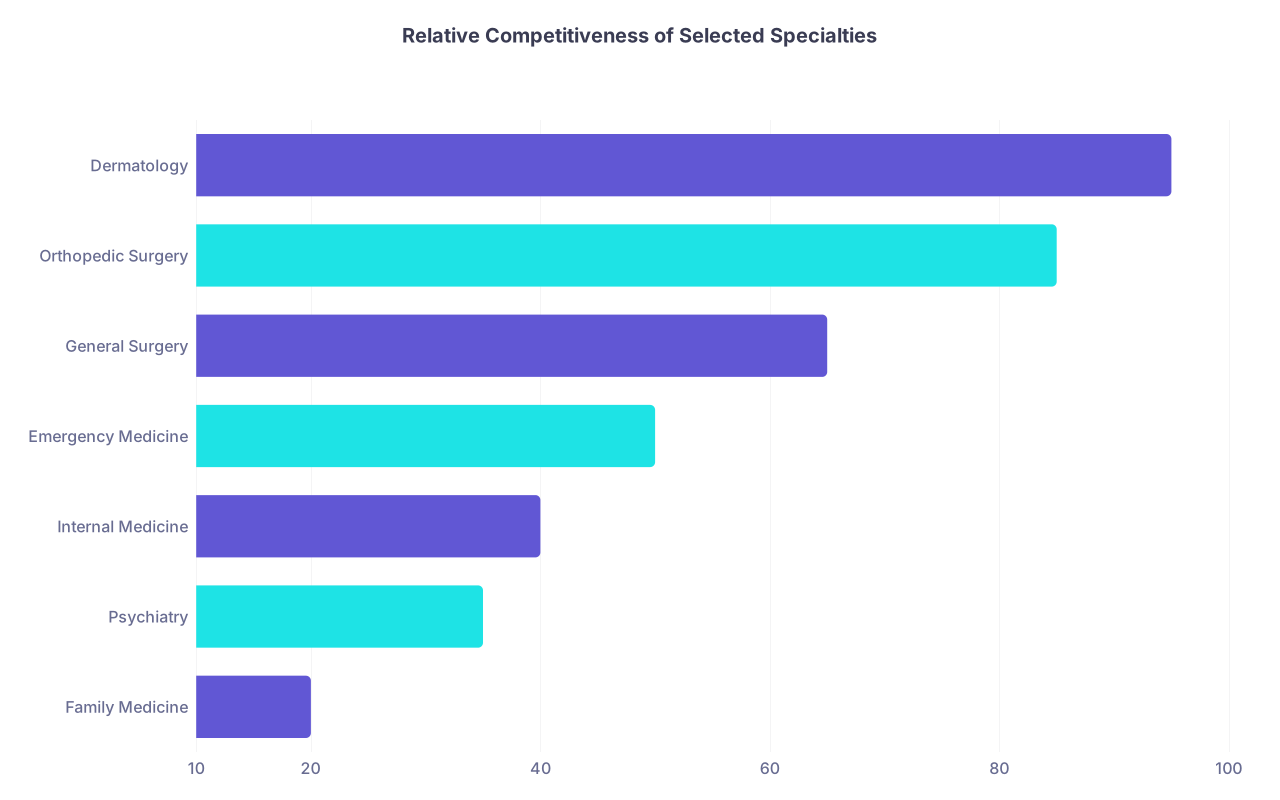
| Category | Value |
|---|---|
| Family Medicine | 20 |
| Psychiatry | 35 |
| Internal Medicine | 40 |
| Emergency Medicine | 50 |
| General Surgery | 65 |
| Orthopedic Surgery | 85 |
| Dermatology | 95 |
Those scores are not match rates; they’re relative “pain level” if you have a red flag. Higher number = more punishing of any academic blemish.
Bottom line: after a Step 1 fail, your best targets are specialties and programs that have historically been more forgiving and that need hard‑working, reliable residents more than they need a wall of perfect transcripts.
US MD vs DO vs IMG: The Truth About How Much a Fail Hurts
Another myth: “A fail hurts everyone equally.”
No. The baseline risk is very different across applicant types.
US MD with a Step 1 fail:
- Still has a realistic shot at matching into IM, FM, peds, psych, path, many prelims, and some EM or community general surgery with strong Step 2/clinical work
- Needs a wider net and earlier Step 2 but is very much not dead
US DO with a Step 1 fail:
- More vulnerable in competitive ACGME spots, especially now that many programs are still figuring out how DO/COMLEX + USMLE fits into their screen
- Strong COMLEX + USMLE Step 2 CK and good clinical performance can rescue many applications, but surgical and uber‑competitive fields become very unlikely
- FM, IM, psych, peds, and some EM remain achievable
IMG (US citizen or non‑US) with a Step 1 fail:
- This is where the damage is biggest
- Many programs quietly auto‑screen IMG applications with any USMLE fail, especially in competitive regions or specialties
- Matching is still possible, but now you’re in the land of:
- IM or FM almost exclusively
- Very broad applications (100+ programs is not crazy)
- Heavy networking, alumni support, research years, or US clinical experience
So no, the fail is not an equal‑opportunity problem. The less “protected” your applicant category, the more brutal the arithmetic.
If You Just Failed Step 1: Concrete Next Moves
You do not fix this by spiraling on Reddit. You fix it by execution.
Deal with the root cause before re‑testing:
- If it was mental health, get treated.
- If it was test‑taking strategy, work with a real tutor or dedicated advisor, not just random Anki decks.
- If it was time management, restructure your schedule brutally.
Pass the retake decisively:
- You don’t need a phantom 260. You need a clean pass with fewer holes in the basic sciences.
- Treat this as Step 2 prep groundwork. The content overlaps more than you think.
Get Step 2 CK done early and do well:
- Having a strong Step 2 CK reported by the time you apply is non‑negotiable with a fail on record.
- Delaying Step 2 because “I don’t feel ready” while having a Step 1 fail is basically self‑sabotage.
Crush core clerkships:
- Think: honors/high pass in IM, surgery, psych, peds if your school uses those.
- Be the student attendings mention by name when PDs ask, “Who should we keep an eye on?”
Line up letters that make you undeniable:
- At least one from your target specialty’s PD or core faculty who actually knows you, not the attending who saw you twice and wrote a generic paragraph.
Be brutally honest in your specialty choice:
- If you cannot realistically tolerate the risk of a re‑application year, choose a specialty with more forgiving odds.
- If you are dead‑set on something competitive, at least have a Plan B you’d genuinely be willing to do.
Years from now you are not going to remember your exact Step 1 percentile. You will remember whether you folded or treated the fail as a turning point.