
Last fall, a fourth-year from a midwest med school sat in my office with a problem she did not expect. She’d just come back from a four-week surgery rotation in Kenya that completely changed how she saw medicine. Then her advisor looked at her ERAS draft and said, “Right now, programs are going to see this as medical tourism.”
If that sentence makes your stomach drop a little, this is for you.
You did an international away rotation. You scrubbed into cases you’d never see at your home institution. Maybe you worked with limited resources, maybe you saw pathology that only shows up as a paragraph in First Aid. Now you’re staring at ERAS and wondering: Where does this go? How do I talk about it without sounding like a missionary brochure or a tourist with a stethoscope?
Let’s be specific.
Step 1: Decide What Your International Rotation Is on ERAS
Programs are going to look for three things right away:
- Was this real clinical work or shadowing with selfies?
- Did you learn anything that actually matters for residency?
- Were you supervised and evaluated in a legitimate way?
You have three main places to put an international away rotation in ERAS:
| Option | Best Fit When |
|---|---|
| Experiences (Work/Activities) | Short rotation, no graded eval, more observership-style |
| Medical School Transcripts/MSPE | Official school-approved elective with course number |
| Publications/Presentations | Rotation led to research, QI, or poster |
Here’s how to decide.
A. Check how your school classified it
If your med school officially listed it as:
- A for-credit elective with a course number, or
- A “visiting student” rotation through VSLO/VSAS, or
- An official “International Health Elective” that shows on your transcript
Then that core fact doesn’t belong in Experiences. That’s part of your education, and programs will see the course name and description through your transcript and MSPE.
You still might add an Experience entry if:
- You had a distinct role (e.g., “Student Coordinator,” “Project Lead”), or
- You did significant work beyond the clinical days (building protocols, teaching, QI, research).
If it was not on your transcript at all, or it was mostly observation, it belongs as an “Experience” under Work/Activities, similar to:
- Clinical Experience – International
- Volunteer – Medical/Clinical
- Global Health / International Elective
B. If asked “Was this paid?” answer correctly
If it was part of med school: it’s neither a traditional job nor paid work. Select unpaid/volunteer or educational as appropriate. Do not try to pass this off as employment.
Step 2: How to Enter It Under “Experiences” Without Making Program Directors Roll Their Eyes
Let’s say you’re going to put this rotation under “Work, Research, or Volunteer Experience.” Here’s how to structure it so it helps you instead of hurting you.
Use this pattern:
- Position/Title: Be literal and clean
- Organization Name: Real institution, city, country
- Experience Type: Usually “Volunteer” or “Clinical – Non-US / International”
- Average Hours/Week, Dates: Be honest
Bad entry:
- “Global Health Mission – Changed My Life!!!”
Better:
- “Visiting Clinical Student – Internal Medicine”
- “International Elective Student – Obstetrics & Gynecology”
- “Clinical Observer – Emergency Medicine”
In the description (you do not have many characters), focus on:
- Role
- Supervision
- Clinical skills or systems exposure
- Tied to residency-relevant competencies
Here’s a before/after.
Weak, red-flag version:
Spent 4 weeks in rural Guatemala helping underserved patients; saw a lot of advanced pathology and learned to be grateful for resources at home. Helped in many procedures and was exposed to tropical diseases.
That sounds like a mission trip sales pitch. Programs have seen a thousand versions of this and tune it out.
Stronger, residency-oriented version:
4-week internal medicine elective at [Hospital], supervised by local faculty; participated in daily ward rounds, admission H&Ps, and case discussions. Managed patients with rheumatic heart disease, TB, and HIV in a low-resource setting, adjusting diagnostic and treatment plans under limited lab and imaging availability. Presented 2 cases at weekly teaching conference.
Notice the differences:
- Concrete tasks (ward rounds, H&Ps, presentations).
- Clear supervision.
- Specific pathology.
- Implicit systems awareness (low-resource, limited labs).
That’s how you keep yourself out of the “medical tourism” bucket.
Step 3: How Much Should You Talk About It in Your Personal Statement?
This is where a lot of people mess up.
You spent thousands of dollars, traveled across the world, had a profound experience. You’re tempted to make it the centerpiece of your personal statement. Sometimes that works. Often it doesn’t.
Here’s the rule of thumb:
- If your rotation is the only serious global health thing you’ve done, don’t build your whole identity around it.
- If your application shows a consistent thread (global health interest, language skills, prior work with similar populations, maybe a related MPH project), then yes, you can feature it more.
Good ways to use it in a personal statement
- As a short, concrete story that shows how you think
- To illustrate adaptability, humility, systems thinking, or resourcefulness
- To connect to serving underserved populations back home
Example (for IM):
During a one-month medicine elective at a public hospital in Eldoret, I followed a 32-year-old man with decompensated rheumatic heart disease. We had no immediate access to echocardiography, tele-cardiology, or a cath lab. Daily, my attending walked us through “Plan A if we had everything; Plan B with what we actually have.” That routine—thinking through the ideal, then adjusting to reality—changed how I approach clinical decision-making on my home wards as well. I now think automatically in contingencies and cost, not just guidelines.
Short. Clinical. Reflective. Not savior narrative.
What to avoid in the personal statement
- “I went to [country] and realized how privileged we are in the US.”
- “They had so little but were so happy and grateful.”
- Overly dramatic crisis stories that center you as the hero.
- Statements like “This showed me my true calling is global health,” with nothing else in your app backing that up.
If you’re applying to a competitive specialty (ortho, derm, plastics) and your international rotation is in primary care with zero link to your specialty, it can still be useful—but don’t spend more than 1–2 paragraphs on it. Use it to show character, not to prove technical skill.
Step 4: Where It Comes Up in Interviews (And How Not to Blow It)
If you include this rotation anywhere on ERAS, assume someone will ask:
- “Tell me about your international experience.”
- “What did you actually do clinically?”
- “How did you handle the resource limitations?”
- “How has that experience changed your practice in the US?”
They are looking for a few specific things:
- Were you supervised appropriately?
- Did you respect scope of practice?
- Did you gain maturity and perspective, or just trauma-tourism photos?
- Can you apply what you learned to residency here?
Prepare a tight 60–90 second answer that covers:
- Setting and your role
- One concrete case or challenge
- One specific takeaway tied to residency
Example answer (for EM):
“I did a 4-week emergency medicine elective at a district hospital in South Africa. I was supervised by local EM consultants and registrars. I took initial histories in triage, presented to my attending, and assisted with procedures like suturing and splinting under direct supervision.
One case that stuck with me was a young man with polytrauma in a setting where CT wasn’t available overnight. My attending made it very explicit what decisions we’d make at our US Level 1 trauma center vs what we could do there. That drove home how much good emergency care is about prioritizing and acting with imperfect data, which I now apply on my current EM shifts—trying to make the best call with the information and resources we actually have.”
No drama. No self-heroics. That’s what you want.
Step 5: How Programs Will Actually Interpret It (Reality Check)
Let me be blunt: an international away rotation is not a magic competitiveness booster. It can help you, hurt you, or do nothing, depending on how it’s framed.
Here’s roughly how programs often see it:
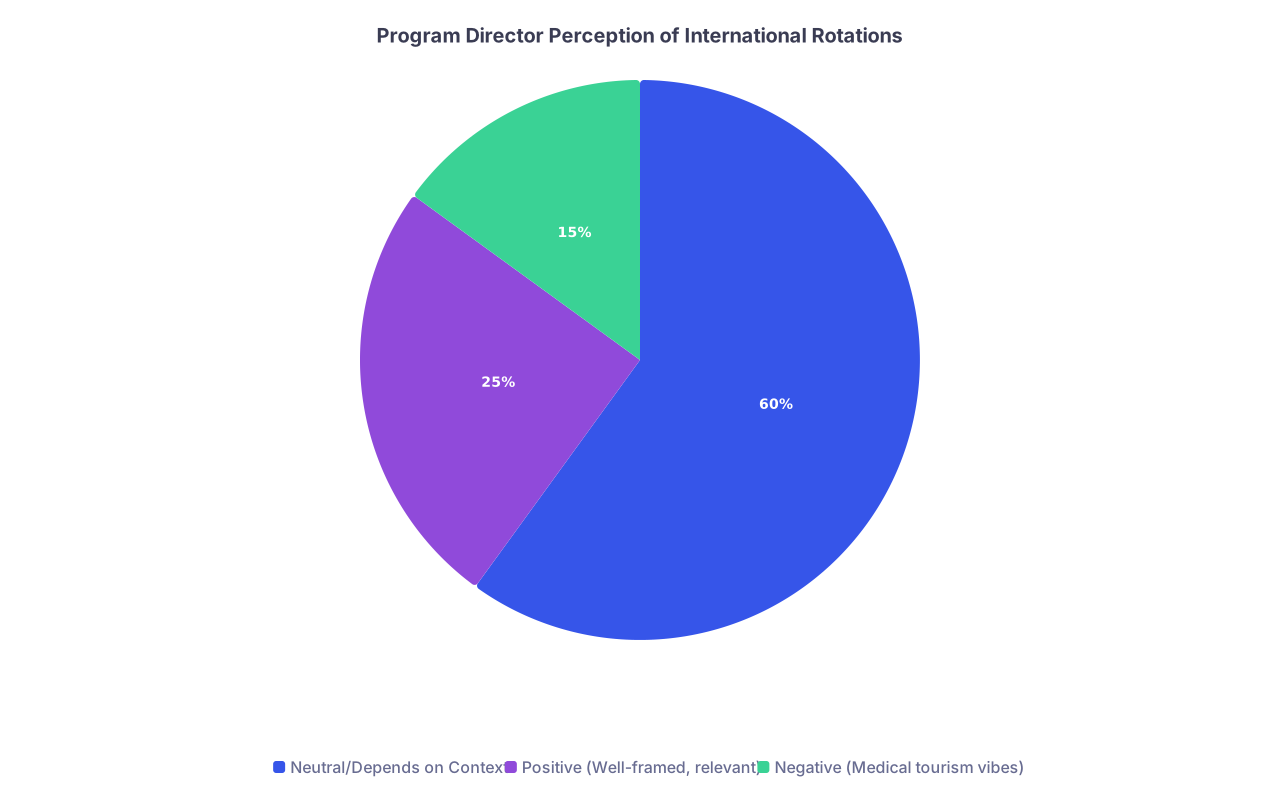
| Category | Value |
|---|---|
| Neutral/Depends on Context | 60 |
| Positive (Well-framed, relevant) | 25 |
| Negative (Medical tourism vibes) | 15 |
What shifts you into the positive group:
- Continual interest: prior work with similar populations, language skills, related activities.
- Real responsibility within appropriate limits and supervision.
- Thoughtful reflection: talk about systems, ethics, and humility, not “saving people.”
What pushes you into the negative:
- Wild claims about procedures you “did” with no supervision described.
- Hero narratives.
- Social-media-trip style descriptions: “Life-changing mission,” “helped so many grateful patients.”
- No other evidence in your file that you care about this kind of work.
Your goal is simple: make the experience look like another serious, structured piece of your medical training—not a one-off adventure.
Step 6: If It’s in a Different Language or Non-US-System, Explain Just Enough
If you worked in a system that’s truly different from US training environments (e.g., Cuban polyclinics, NHS in the UK, district hospitals in India), give the bare minimum context.
Don’t write an essay on health policy. Two sentences is plenty.
Example in the Experience description:
“4-week elective in a public teaching hospital serving as the main tertiary referral center for ~3 million people, with limited subspecialty coverage and constrained imaging access.”
This answers:
- Scope of the hospital.
- Resource level.
- Why pathology and practice might look different.
If language was involved and you actually functioned in that language:
“Conducted basic histories in Spanish and presented to attendings in English; improved medical Spanish through daily patient encounters.”
Do not say:
- “Fluent in Spanish” if you aren’t actually charting and staffing fluently. That will get exposed on day one of residency.
Consider aligning this with your ERAS “Languages” section so you’re consistent.
Step 7: Tie It to the Specialty You’re Applying To
You must answer the silent question in every PD’s mind: “Why does this matter for our residency?”
Some examples by specialty:
Internal Medicine / Family Medicine
Easy alignment:
- Chronic disease in limited systems
- Team-based care
- Continuity challenges
- Cultural humility, communication
Example line in PS:
“Working in a clinic where insulin supplies were inconsistent forced me to think about adherence, affordability, and backup plans—skills directly relevant to managing complex, underserved patients in any US primary care setting.”
Emergency Medicine
Focus on:
- Triage
- Managing with limited diagnostics
- Risk tolerance and communication
Surgery / OB-GYN
Careful here. US programs do not love hearing that you did unsupervised major procedures overseas as a student.
Safe framing:
- Exposure to different surgical case mix
- Respectful assistance under clear supervision
- Systems and perioperative care differences
- Professionalism and ethics in resource allocation
Never say:
“I independently performed C-sections in [country].”
If you did anything significant technically, be very explicit that it was supervised and within scope. And frankly, if it sounds questionable ethically, leave it out.
Psych, Neuro, others
Angle:
- Cultural constructs of mental illness
- Stigma differences
- Access to care
- Neurologic pathology that’s more common in low- and middle-income countries (neurocysticercosis, TB meningitis, etc.)
Step 8: If It Led to a Project, Paper, or Presentation
This is where the rotation can start paying dividends.
If your international rotation led to:
- A QI project
- A research abstract or poster
- A curricular product
- A community health initiative
Then you have a nice chain:
Clinical elective → Identified problem → Project → Output
In ERAS:
- List the project under Experiences if substantial.
- List the output under “Publications/Presentations.”
- Briefly connect the dots in one place (not everywhere).

| Step | Description |
|---|---|
| Step 1 | International Clinical Elective |
| Step 2 | Identify Clinical/Systems Problem |
| Step 3 | QI or Research Project |
| Step 4 | Poster/Presentation |
| Step 5 | Experience & Publication Entries in ERAS |
Don’t double-count with bloated descriptions; just make the progression clear.
Step 9: Timing and Red Flags
If your international rotation was:
- The only thing you did during a long leave of absence
- Done at a non-accredited, random clinic with no affiliation
- Heavily religious/mission-branded and your CV doesn’t show any pattern of this before/after
Programs will have questions. You should be ready to answer:
- “How did you set up this rotation?”
- “How was it supervised?”
- “What did your school require for approval?”
- “What would you do differently, knowing what you know now?”
Have calm, non-defensive answers. The fastest way to raise red flags is to look defensive or overly romantic about something that, frankly, has ethical gray zones.
Example: Putting It All Together in ERAS
Let’s build a concrete ERAS “Experience” entry.
Title:
Visiting Clinical Student – Internal Medicine
Organization:
Moi Teaching and Referral Hospital – Eldoret, Kenya
Experience Type:
Volunteer – Clinical / Educational
Dates:
07/2024 – 08/2024, 40 hrs/week
Description (keep it tight and focused):
4-week 4th-year medicine elective under supervision of local consultants and registrars at a 900-bed public teaching hospital and tertiary referral center. Performed focused histories and physicals on new admissions, presented on rounds, and assisted with daily management of patients with HIV/TB co-infection, rheumatic heart disease, and advanced heart failure. Participated in weekly case conferences; presented a case on decompensated rheumatic mitral stenosis with limited access to advanced interventional therapies, emphasizing guideline adaptation to resource constraints.
That’s the level of detail that hits all the right notes.
Quick Visual: Where To Talk About What
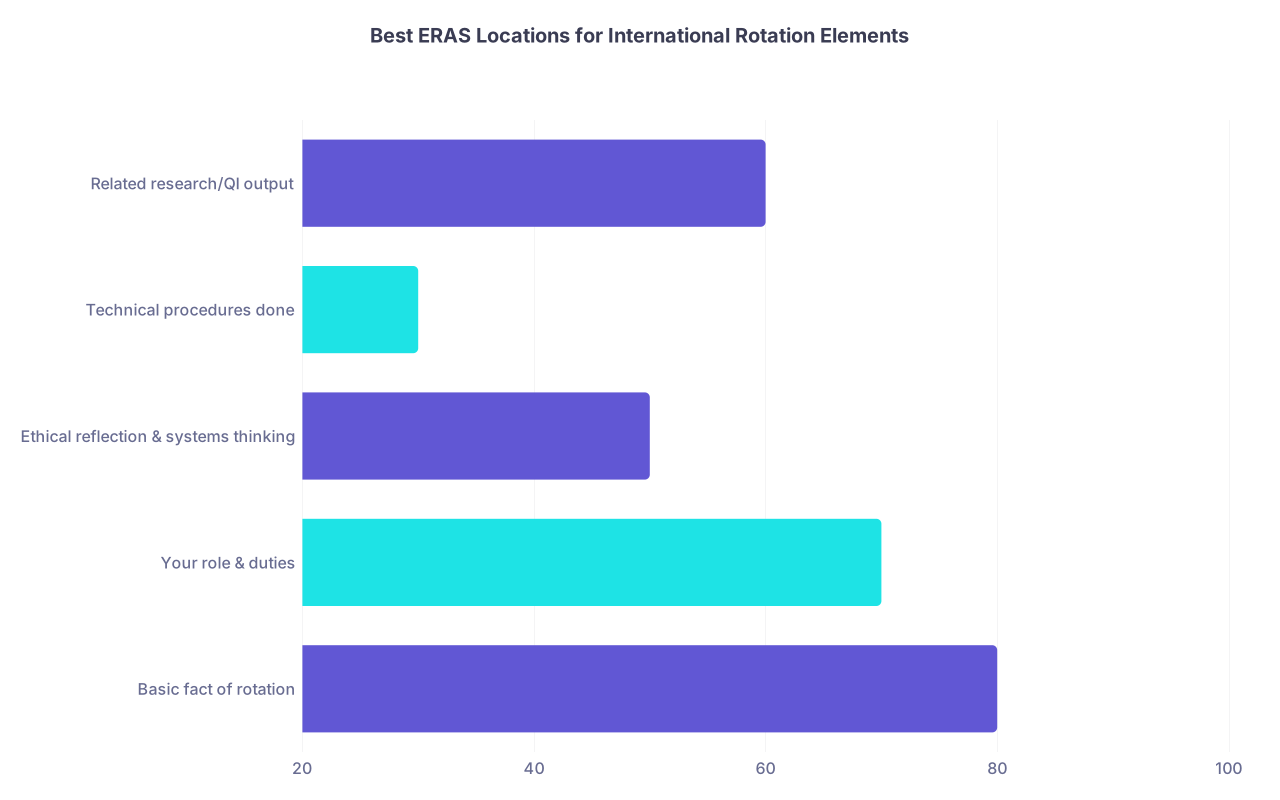
| Category | Value |
|---|---|
| Basic fact of rotation | 80 |
| Your role & duties | 70 |
| Ethical reflection & systems thinking | 50 |
| Technical procedures done | 30 |
| Related research/QI output | 60 |
Interpretation:
- “Basic fact of rotation” – mostly transcript/MSPE + brief Experience entry.
- “Role & duties” – Experience + interview.
- “Ethical reflection & systems thinking” – personal statement + interview.
- “Technical procedures” – mention cautiously, mostly by implication.
- “Research/QI output” – Experiences + Publications.
FAQs
1. My international rotation was mostly shadowing. Should I still include it?
Yes, but be honest about what you did. Call it “Clinical Observer” or “International Observership” if you weren’t writing notes, presenting formally, or being evaluated like a standard clerkship. Then focus your description on:
- What you observed about systems of care
- How it informed your understanding of resource use, cultural factors, communication
- Any structured teaching you received (lectures, case conferences)
Do not inflate your role. Programs can smell that, and it hurts you more than leaving it as a modest but thoughtful entry.
2. I want to go into fellowship and hope to do global health long-term. How loud should I make that in ERAS?
Moderate volume, backed by evidence. If your application shows multiple global health–related experiences (language skills, prior work with underserved populations, research in global health, maybe an MPH or certificate), then yes, say clearly that you’re interested in global or resource-limited health work long-term.
But remember: programs are primarily hiring you to take care of their patients for 3–7 years. Always connect global health interest back to skills that will make you a better resident in their hospital—systems thinking, adaptability, managing complex pathology, working across cultures—not just “I want to work abroad later.”
3. I’m worried my international rotation will be seen as unethical “medical tourism.” Should I leave it out?
If what you did was clearly outside your scope (unsupervised major procedures, prescribing independently without proper credentials), you’re right to be cautious talking about specifics. But completely erasing the experience can also look strange if it appears in your transcript or MSPE.
What I recommend:
- Keep the entry, but frame your role conservatively and accurately.
- Emphasize supervision, teaching, and what you learned about ethics and systems.
- If asked directly in an interview, you can say: “Looking back, I’m more aware of the ethical concerns about short-term international electives. I made sure to stay within the role of a medical student and have since sought out more longitudinal, partnership-based ways to work with underserved populations locally.”
That kind of reflection calms a lot of program directors. You’re showing growth, not doubling down on questionable choices.
Key points:
- Treat your international away rotation like a serious, supervised educational experience—not an adventure story.
- Be precise in ERAS: clear title, concrete duties, realistic scope, and concise, systems-aware reflection.
- In your statement and interviews, connect the experience directly to residency-relevant skills and avoid savior narratives or exaggerated technical claims.