You are here
It is 48 hours before the NRMP rank list deadline.
Your list exists. Technically. But your gut is not settled.
You keep opening the NRMP screen. Moving one program up, then back down. Remembering something a chief said on interview day. Wondering what that one slightly weird faculty comment “really meant.”
This is the window where people make their worst mistakes:
- They panic and overvalue prestige in the final hour.
- They change their list based on someone else’s preferences.
- Or they freeze, do nothing, and never actually check for basic errors.
You have 2 days. That is enough time—if you use it deliberately. Here is how to structure the last 48 hours before rank list lock so that when you hit “Certify,” you are calm, not nauseated.
T-minus 48–36 hours: Big-picture alignment and hard constraints
At this point you should stop tinkering with individual swaps and step back. First pass is about direction, not details.
Step 1 (at 48 hours): Lock in your non‑negotiables
Sit down somewhere quiet with:
- Your tentative rank list
- Your interview notes (or whatever passes for them—screenshots, texts to friends, scribbles)
- A blank sheet of paper
Write, in order, your top 5 non‑negotiables. Not 20. Five.
Examples I have seen actually help people:
- Must be within driving distance of aging parents
- Need strong categorical IM → cardiology pipeline
- Cannot afford COL like Manhattan or SF on PGY‑1 salary
- Need a program where I will not be the only URiM resident in the class
- Prioritize surgical volume and autonomy over location
Now, for each program in your top 5–7, quickly label whether it:
- Clearly meets your non‑negotiables
- Questionably meets them
- Clearly fails
Do not overcomplicate this with a score yet. You want simple red / yellow / green.
| Program | Location Fit | Career Fit | Financial Fit | Gut Color |
|---|---|---|---|---|
| A | Yes | Yes | Yes | Green |
| B | Yes | Maybe | No | Yellow |
| C | No | Yes | Yes | Red |
| D | Yes | Yes | Maybe | Green |
| E | Maybe | Maybe | Yes | Yellow |
Anything that is “red” on a true non‑negotiable has no business in your top cluster. If one is still sitting at #1–3, highlight it. That is a red flag you will re-evaluate later.
Step 2 (by ~44 hours): Separate ego from reality
This is where people lie to themselves. Do this explicitly:
On a second sheet, create two columns:
- Column 1: “Things I say I care about”
- Column 2: “Things my behavior actually shows I care about”
Examples:
Column 1: “I care most about research.”
Column 2: You have not done a single research elective and keep ranking the program with the best call schedule higher than the NIH machine.Column 1: “I really want to be in this prestigious name-brand program.”
Column 2: Every time you talk about your favorite interview, it is the community program where residents seemed happy and attendings knew their names.
Now look at your top 3 programs and ask, out loud if you have to:
“If no one else ever saw my match result, and there were no program names on my badge, would I still want this as #1?”
If the honest answer for your current #1 is “probably not,” circle it. That program is riding on ego. You do not need to drop it to #10, but you should not pretend it is your clear first choice.
T-minus 36–24 hours: Structured comparison and scenario testing
At this point you should stop hand‑waving. You are going to explicitly compare the top of your list against each other.
Step 3 (midpoint, ~36 hours): Score your top 5–7 programs
You are not building a fantasy algorithm to spit out “the answer.” You are using structure to expose your own thinking.
Pick 4–6 domains that actually matter to you. Typical useful ones:
- Training quality / case volume
- Fellowship or job placement in your desired path
- Resident culture / wellness
- Location and support system
- Cost of living and salary
- Personal “fit” / gut
Create a simple 1–5 scale for each (1 = terrible, 5 = excellent for you, not for the abstract world).
Do this quickly for your top 5–7 programs. First pass, no overthinking.
| Program | Training | Culture | Location | COL/Salary | Gut Fit |
|---|---|---|---|---|---|
| A | 5 | 4 | 3 | 3 | 5 |
| B | 4 | 3 | 5 | 2 | 4 |
| C | 3 | 5 | 4 | 4 | 4 |
| D | 5 | 2 | 2 | 5 | 3 |
| E | 4 | 4 | 4 | 3 | 4 |
Now, before summing, mark the one or two domains that are genuinely highest priority. For many:
- Career path (training + fellowship placement)
- Location / support system
- Culture
Give those “weight” in your mind. A point in a high‑priority domain should matter more than a point in something you barely care about.
Finally, look at the patterns—not just totals:
- Is there a program that is never the worst in any category?
- Is your current #1 actually middle of the pack except for prestige or location?
- Is there a consistent “quietly good at everything” program you have been underrating?
If your present ranking completely contradicts this structured view, you need to justify that contradiction explicitly. Sometimes the justification is valid (“My partner’s job is only possible in one city”). Sometimes it is not (“But my classmate said this place is elite”).
Step 4 (~32 hours): Run head‑to‑head matchups
At this point, you should not be deciding “full list vs. full list.” You should be comparing pairs.
Take your current #1–4. For each pair, ask:
“If on Match Day, envelope says Program X instead of Program Y, would I feel relieved or disappointed?”
Work through these:
- #1 vs #2
- #1 vs #3
- #1 vs #4
- #2 vs #3
- #2 vs #4
Write “prefer X” or “prefer Y” for each pair.
You are looking for inconsistency. If your list says:
- #1 = A
- #2 = B
- #3 = C
…but your pairwise answers are:
- Prefer B over A
- Prefer C over B
Then your internal ranking is actually C > B > A, and your NRMP list is backwards. I have watched people discover they are literally ranking in the opposite order of their feelings because they got used to seeing names in a certain order on a spreadsheet.
At this stage, reorder the top cluster to mirror your head‑to‑head truth, unless you have a clear, written, non‑emotional reason not to.
T-minus 24–12 hours: Reality checks and external input (carefully used)
Now the list is roughly shaped. Next, you pressure test it—without letting other people hijack it.
Step 5 (~24 hours): Sanity check with someone who knows you, not “the system”
Pick one or two people max:
- A partner or close family member who understands your life constraints
- A mentor who actually knows you, not a random attending from a single away rotation
At this point you should not ask, “What should I rank #1?” Instead, send them:
- Your non‑negotiables list
- Your top 3–5 programs with a one‑line summary each
- Your current order
Then ask two specific questions:
- “Does anything about this order surprise you, given what you know about me?”
- “Do you see me being unhappy at any of these places for reasons I am missing?”
Listen. Take notes. But remember: their job is to surface blind spots, not to pick your life.
Bad sign: you feel pressured to put their alma mater higher “because it opens doors.”
Good sign: they point out something consistent, like “Every time you talk about Program C, you light up. That is not how you talk about Program A.”
If their feedback aligns with what you already felt, you are on the right track. If it conflicts, sit with it for a few hours before reacting.
Step 6 (~20 hours): Strip out superstition and misinformation
At this point you should clear out the mental junk. Common myths that distort the last 24 hours:
“If I rank a reach program #1, I might not match at my safer options.”
Wrong. The algorithm favors your preferences. Ranking a reach first does not hurt your chances at lower programs.“Programs will be offended if I rank them low or not at all.”
Also wrong. They will never see your list.“I should rank based on where I think I am most likely to match.”
Wrong again. You rank by desirability. The algorithm handles probability.
Take 10 minutes and write a short sentence to yourself:
“My responsibility is to rank programs in the exact order I want to attend them, from most to least.”
Everything else is noise.
If you catch yourself saying “But will I get in there?” when looking at your list, you are mixing program behavior into applicant side. Stop. The NRMP match is literally built to prevent that mistake.
T-minus 12–4 hours: Final ordering, lower-list cleanup, and risk management
This is where you stop re‑evaluating who you are and start cleaning up the actual list.
Step 7 (~12 hours): Lock your top tier
Your top 3–5 should now be:
- Consistent with your non‑negotiables
- Consistent with your head‑to‑head preferences
- Free from major ego or myth distortion
At this point you should decide: “Barring some catastrophic realization, I will not change the order of my top tier again.”
Why? Because constant micro‑swapping in the final hours is pure anxiety behavior. It does not add wisdom.
Instead, do a pass for:
- Spelling of program names and tracks (categorical vs advanced)
- Correct specialty if you applied to more than one
- No missing programs you would actually be willing to attend
You are not done. But your top tier is now “hands off.”
Step 8 (~10 hours): Optimize the middle and lower tiers
This is where people get lazy. That is a problem, because when things go sideways, these ranks are what save you from SOAP.
At this point you should:
Include all programs you interviewed at where you would be willing to go. If you truly would rather go unmatched than attend a program, do not rank it. But be honest—“rather SOAP at random” is a bigger risk than you think.
Order mid and lower programs by true preference, not:
- “They seemed very interested in me.”
- “They sent the nicest follow-up email.”
- “My friend matched there.”
Group them mentally:
- “Would be pretty happy here” bucket
- “Neutral / acceptable” bucket
- “Only if needed to avoid SOAP” bucket
Within each bucket, do quick head‑to‑heads like before. If you cannot care enough to decide between #12 and #13, that is fine. But do not let total randomness decide #6 vs #7 when you clearly like one city more.
Now confirm there is no logical break like:
- A program ranked higher that you actually described earlier as a “red” on your non‑negotiables
- A place you swore you would only attend as a last resort sitting in the middle of your list
T-minus 4–1 hour: Technical checks and emotional cooling
You are almost there. At this point you should stop deep thinking entirely. Your brain is not reliable on low sleep and high cortisol.
Step 9 (~4 hours): Run a mechanical checklist
Make this boring. That is the point.
Go line by line:
- NRMP ID and login working
- Specialty tracks correct:
- Categorical vs preliminary vs advanced
- Transitional year positions where needed
- No duplicate or missing programs you meant to rank
- Order exactly matches your final written list (print it or save a PDF beforehand)
If you applied to advanced programs (e.g., anesthesia, radiology), confirm:
- You have adequate prelim / TY programs ranked
- They are in the appropriate linked list (if using supplemental rank lists)
- You are not accidentally ranking something you did not actually interview for
This is the moment to catch dumb errors, not to have existential crises.
Step 10 (~2 hours): Decide your “no more changes” moment
Set a personal lock time at least 60 minutes before the NRMP deadline in your time zone. Not negotiable.
At that point you should:
- Do one last read‑through of the entire list
- Confirm you understand and accept every ranking decision
- Hit “Certify” and watch for confirmation
Do not plan to keep editing until the literal deadline minute. Servers slow. Logins glitch. I have watched people panic because ERAS or NRMP lagged with 3 minutes left.
Once you have a certified list:
- Take screenshots or save a PDF of the confirmation
- Log out
Then walk away from the computer. If you re‑open the screen just to stare at it, you will invent reasons to doubt yourself.
What you should not be doing in the last 48 hours
Quick but necessary section. Things I have actually seen blow up people’s sanity in this window:
- Asking group chats “What are you ranking #1?” and changing your own list based on the loudest voice
- Reading anonymous forum threads about “toxic” programs you interviewed at, written by people who may not have set foot there
- Cold‑emailing PDs with “I ranked you highly” notes in the final 24 hours (awkward at best, meaningless at worst)
- Reinterpreting every small interview memory as a giant red flag
- Trying to reverse‑engineer where you “stand” at each program and ranking accordingly
If you catch yourself doing any of that, stop and go back to your own notes and your own non‑negotiables. That is the only data that is guaranteed to be about you.
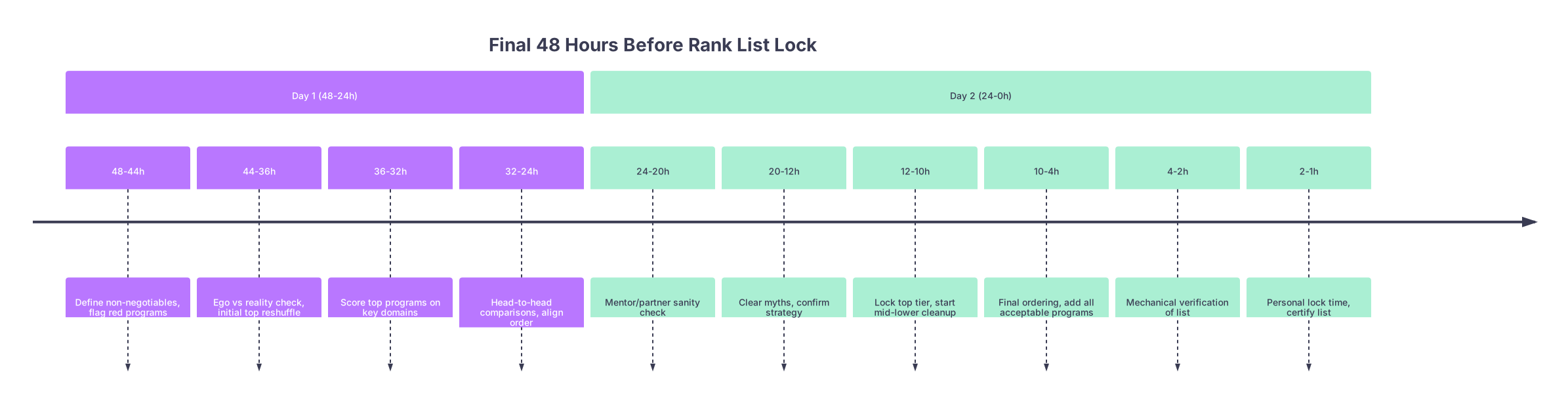
| Period | Event |
|---|---|
| Day 1 (48-24h) - 48-44h | Define non-negotiables, flag red programs |
| Day 1 (48-24h) - 44-36h | Ego vs reality check, initial top reshuffle |
| Day 1 (48-24h) - 36-32h | Score top programs on key domains |
| Day 1 (48-24h) - 32-24h | Head-to-head comparisons, align order |
| Day 2 (24-0h) - 24-20h | Mentor/partner sanity check |
| Day 2 (24-0h) - 20-12h | Clear myths, confirm strategy |
| Day 2 (24-0h) - 12-10h | Lock top tier, start mid-lower cleanup |
| Day 2 (24-0h) - 10-4h | Final ordering, add all acceptable programs |
| Day 2 (24-0h) - 4-2h | Mechanical verification of list |
| Day 2 (24-0h) - 2-1h | Personal lock time, certify list |
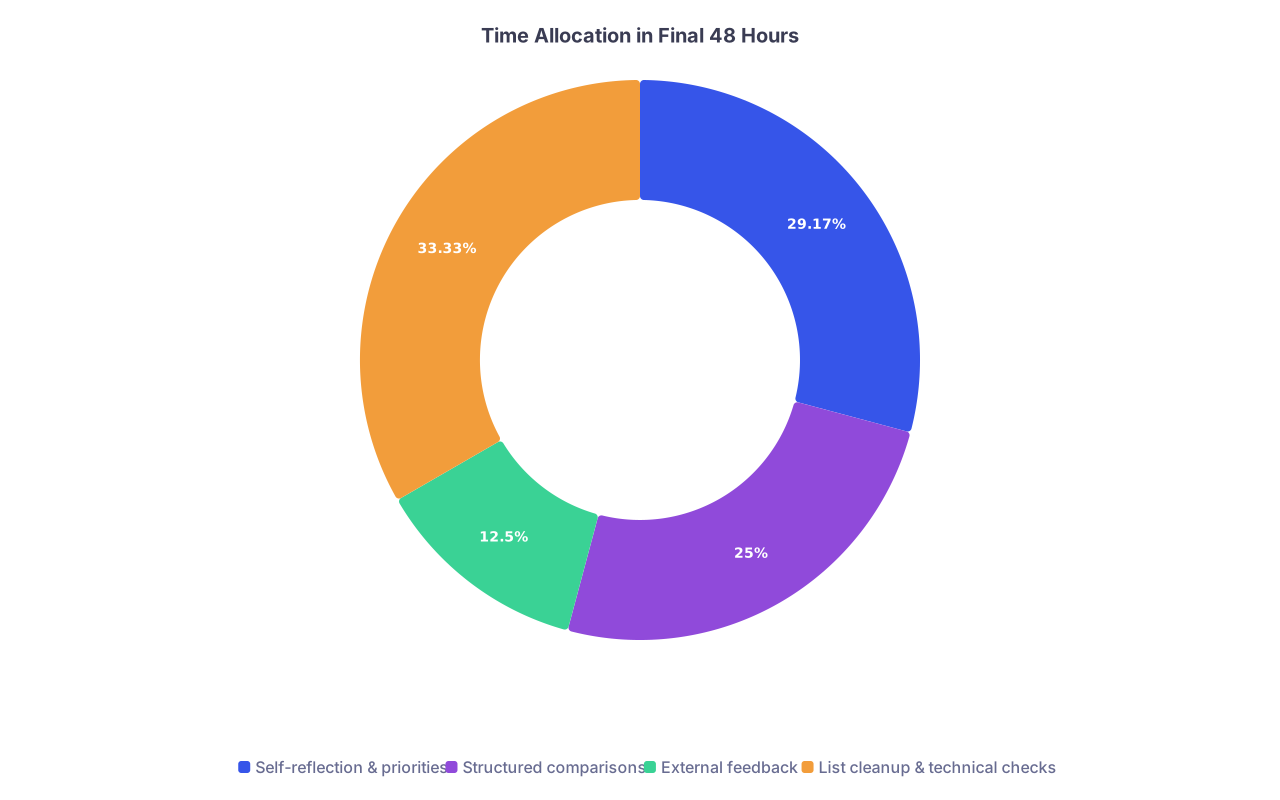
| Category | Value |
|---|---|
| Self-reflection & priorities | 14 |
| Structured comparisons | 12 |
| External feedback | 6 |
| List cleanup & technical checks | 16 |
Last 60 minutes: Your internal script
When the clock hits your personal lock time, you should be able to tell yourself three things clearly:
- “This list reflects my true preferences, not my classmates’, not Reddit’s, not my ego’s.”
- “My top choices match my actual values and constraints, not myths about the algorithm.”
- “I have checked the mechanics. If I match anywhere on this list, I can live with it—and build a good career from there.”
If you can say those honestly, you are done. You will still feel nervous. That is normal.
But you will not wake up in three weeks thinking, “I panicked and betrayed what I actually wanted.”
Key points to carry out of this
- Use the last 48 hours for structured reflection, not last‑minute crowd‑sourcing.
- Rank programs in the exact order you want to attend them; do not “game” the algorithm.
- Set a personal cutoff time before the deadline, certify your list, and walk away.