Winging your first residency interview is how good applications die. Two weeks out, you need a schedule—not vibes.
You’re close enough that every day matters, but not so close that panic should be running the show. This is the window where structure beats anxiety. If you follow a clear practice and logistics schedule for these 14 days, you’ll walk into that first interview calm, rehearsed, and not hunting for a tie at 6:45 a.m.
Let’s walk through it chronologically.
14–11 Days Before: Lock the Foundation
At this point you should stop “thinking about” preparing and start doing it on a clock.
Day -14: Confirm and Map Everything
Today is about zero surprises.
-
- Time and time zone
- In-person vs virtual
- Platform (Zoom, Thalamus, Webex, proprietary portal)
- Exact address or login link
- Schedule: pre-interview dinner, morning sign-in, interviews, breaks, wrap-up
Create a one-page “Program Snapshot” For this first interview, build a template you’ll reuse:
- Program name, city, hospital affiliates
- Number of residents/year
- Key strengths (e.g., trauma volume, global health track, research year)
- Red flags / questions (e.g., recent leadership turnover)
- Names of PD, APDs, chief residents
-
- Protect the 2 weeks leading up to interview mornings as much as possible
- Block the full day before your first interview—no call, no big exams if you can avoid it
- Set alarms for:
- T-7 days: logistics double-check
- T-2 days: dress rehearsal
- T-12 hours: tech / travel check
You’re building guardrails. Future you will be tired and distracted; this structure will save you.
Day -13: Script Your Story (Then Stop Overwriting)
Today is about who you are and how you sound, not what the program is.
At this point you should draft and tighten:
- “Tell me about yourself” (60–90 seconds)
- “Why this specialty?”
- “Why our program?” (use rough template, you’ll finalize later)
- 2–3 patient stories that show:
- clinical reasoning
- teamwork
- resilience or growth
Write bullet points, not full paragraphs. Over-scripting is how people sound robotic.
Target structure for “Tell me about yourself”:
- Snapshot: where you’re from / med school
- Academic / clinical focus
- Strengths and identity as a future intern
- One line that links to this specialty
Say it out loud 3–4 times. Not 30. You’re aiming for natural, not memorized.
Day -12: Build Your Answer Bank
Today you’re creating reusable ammunition for almost any question.
Make a document with these sections and fill 2–3 bullets each:
- Leadership challenge you faced
- Conflict with a colleague or team
- Feedback you received and how you used it
- Biggest failure / mistake and what changed after
- Time you advocated for a patient
- Time you were overwhelmed and how you handled it
Then add 3–4 bullet points each for:
- Strengths (with examples)
- Weaknesses (real, but safe + growth demonstrated)
- Long-term goals (academic vs community, fellowship interests)
You’re not writing monologues. You’re building LEGO pieces you can snap together during any behavioral question.

| Period | Event |
|---|---|
| Week 1 - Day -14 | Confirm details, block calendar |
| Week 1 - Day -13 | Draft core answers |
| Week 1 - Day -12 | Build answer bank |
| Week 1 - Day -11 | Program and faculty research |
| Week 1 - Day -10 | First full mock interview |
| Week 1 - Day -9 | Debrief and revision |
| Week 1 - Day -8 | Virtual/in-person logistics check |
| Week 2 - Day -7 | Second mock + focused drills |
| Week 2 - Day -6 | Question list, social prep |
| Week 2 - Day -5 | Light review, refine stories |
| Week 2 - Day -4 | Attire and packing |
| Week 2 - Day -3 | Final program research |
| Week 2 - Day -2 | Full dress rehearsal |
| Week 2 - Day -1 | Rest, light touch-ups, early night |
10–8 Days Before: Deep Research and First Reps
Day -11: Research the Program Properly (Not Just the Homepage)
At this point you should understand the program well enough that your “Why us?” doesn’t sound like everyone else’s.
Dig into:
- Program website: rotation structure, call schedule, electives, tracks
- Recent news: expansions, new fellowships, leadership changes
- Current residents: bios, med school representation, fellowships obtained
Make a one-page sheet for this specific program:
- 3 genuinely specific reasons you like it
- 3–5 smart questions that aren’t answerable from the website:
- “How has the program supported residents interested in X fellowship?”
- “What recent changes are you most proud of in the curriculum?”
- “How does the program respond when residents are struggling?”
Print or save as PDF. This becomes your quick-reference.
Day -10: First Full Mock Interview
This is where you stop “preparing” and actually simulate.
At this point you should schedule and complete a 30–45 minute mock with:
- A faculty mentor
- Chief resident
- Career office / OSA
- Or worst case, a brutally honest friend
Ask them to cover:
- Basic personal questions
- Behavioral questions (“Tell me about a time…”)
- Specialty-specific questions
- Program-fit questions
Record it (audio at least).
Afterwards, get specific feedback:
- Rambling?
- Overusing filler words?
- Weak answers for conflict / weakness / failure?
- Off-putting body language (eye contact, fidgeting, pacing)?
Write 3 things to change. Just three. Then adjust your answer bank accordingly.
Day -9: Fix Problems, Not Everything
At this point you should be editing, not rebuilding.
Focus on the clear weaknesses from your mock:
- If you rambled → practice 60–90 second caps; set a timer and cut yourself off
- If your stories were vague → sharpen them with:
- Situation
- Your specific role
- Concrete actions
- Outcome + what changed afterward
Run:
- 3–4 reps of “Tell me about yourself”
- 3–4 reps each of your worst-performing answers from the mock
Not a full interview. Just targeted drills.
Day -8: Logistics Check #1 – Tech and Travel
This is where people either get calm or stay in denial.
If virtual:
- Download/update the platform (Zoom, Webex, etc.)
- Log in from:
- the device you’ll actually use
- the actual location (home, library room)
Run a test call:
- Camera framing (head and upper torso, neutral background)
- Mic quality and background noise
- Internet stability (turn off unnecessary devices on Wi-Fi)
If in-person:
- Map the route:
- Exact building entrance
- Parking or public transit
- Backup route in case of traffic
- Choose your travel mode and time of departure:
- Aim to arrive 30–45 minutes early
- If flying: verify flights, hotel address, transport to the hospital
Create a mini “Interview Logistics” doc:
- Time, location, contacts
- Transportation details
- Hotel info (if applicable)
- What time you need to wake up, leave, and arrive
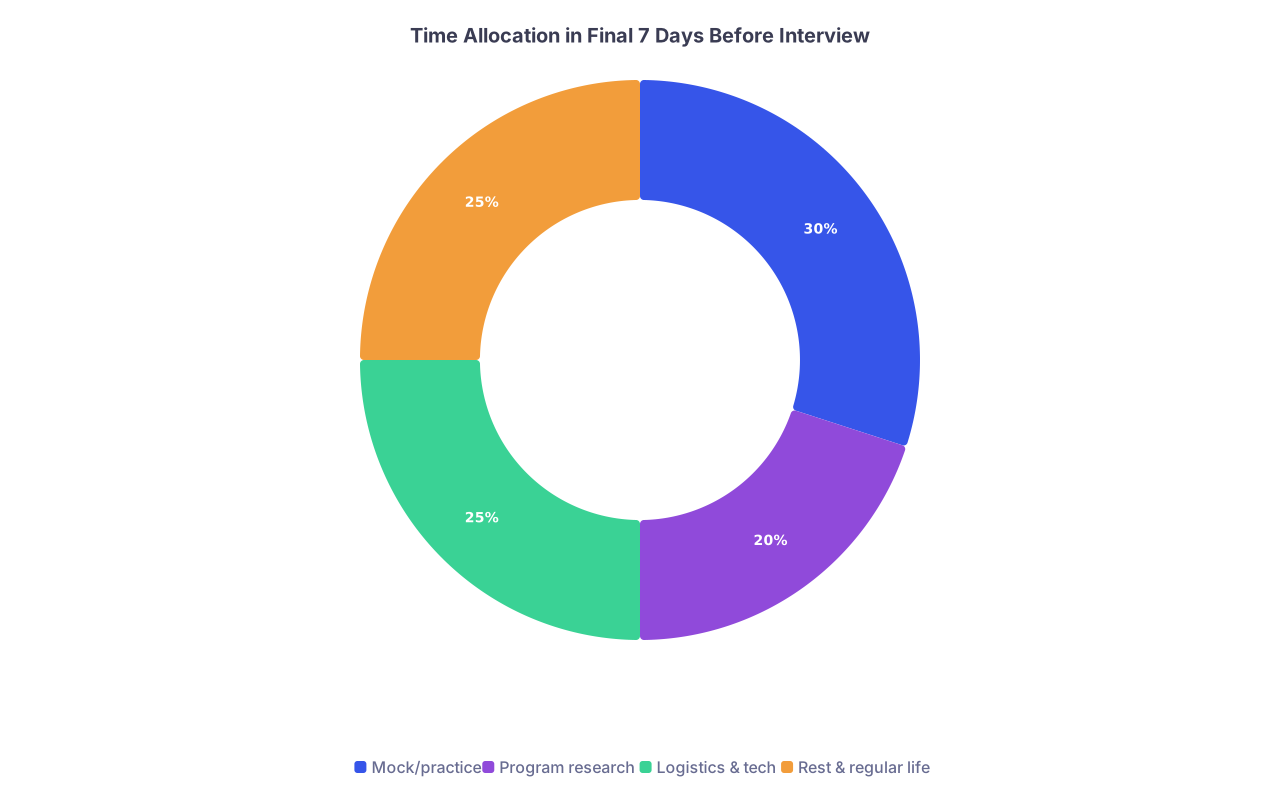
| Category | Value |
|---|---|
| Mock/practice | 30 |
| Program research | 20 |
| Logistics & tech | 25 |
| Rest & regular life | 25 |
7–5 Days Before: Second Mock, Questions, and Social Layer
Day -7: Second Mock Interview (Shorter, Sharper)
At this point you should demonstrate improvement, not just repeat.
Do a 25–30 minute focused mock:
- 10 minutes: common questions (tell me about yourself, why this specialty, why our program)
- 10–15 minutes: behavioral and challenging questions:
- “Tell me about a time you made a mistake.”
- “Describe a conflict with a nurse/attending and how it was resolved.”
- “What would your co-residents complain about?”
Again, ask for blunt feedback. Edit 2–3 answers that still feel shaky.
Day -6: Prepare Your Questions and Social Answers
By now, your “answer side” should be decent. Today is about the other half of the interview: what you ask and how you come across in informal settings.
Question sets Make 3 separate sections:
For PD / APDs:
- “How have graduates been doing with matching into X fellowship?”
- “What changes do you anticipate in the program over the next few years?”
For residents:
- “What’s something you’d change if you could?”
- “How does the program respond when someone’s seriously burnt out?”
For faculty:
- “How do you see residents getting meaningful teaching on busy services?”
- “What role do residents play in QI or research projects with you?”
Pre-interview dinner / social prep (if applicable) At this point you should have 2–3 light, human answers ready:
- “So what do you do for fun?”
- “What are you looking for in a city?”
- “How are interviews going so far?”
Keep it honest but not heavy. Nobody wants to hear how miserable you are with ERAS.
Day -5: Light Content Review and Story Polishing
Don’t cram. This isn’t Step 1.
At this point you should:
- Review your personal statement and ERAS application
- Highlight 4–5 experiences you can talk about in detail
- Tighten your 2–3 key stories:
- One patient-care focused
- One teamwork/conflict
- One growth/resilience
Run each story out loud once or twice. Make sure:
- You’re not over-explaining medical minutiae
- You’re clearly naming your own role vs “the team”
- You end with what changed in your behavior or perspective
Stop there. Over-rehearsal is obvious.
4–2 Days Before: Clothes, Packing, and Dress Rehearsal
Day -4: Attire and Appearance Setup
You should not be trying on your suit the night before.
Outfit check
- Full suit or equivalent professional attire
- Shirt/blouse pressed, no stains, buttons all intact
- Shoes clean and comfortable
- Belt/socks matching and non-distracting
- Jewelry simple, badge lanyard neutral
Camera check in full attire (for virtual)
- Sit in your actual interview spot
- Confirm lighting:
- Light in front of you, not behind
- No heavy shadows or blown-out brightness
Grooming
- Haircut planned (not the day before; 3–5 days gives it time to settle)
- Nails clean and trimmed
- Facial hair neat or clean-shaven
Lay the outfit out somewhere you won’t mess it up.
Day -3: Final Program Pass and “Why Us” Rehearsal
At this point you should sound like you actually care about this specific program.
- Re-read your Program Snapshot
- Check for any recent updates (leadership news, expansion, merger)
- Refine your “Why our program?” to 3 specific points:
- Something about training structure or volume
- Something about culture or resident support
- Something about your interests aligning with their strengths
Say that answer out loud 3–4 times. It must sound conversational, not like you memorized a brochure.
Then, run 2–3 reps of:
- “What are you looking for in a residency program?”
- “Where do you see yourself in 5–10 years?”
Day -2: Full Dress Rehearsal
This is your final controlled simulation.
For virtual interviews
At this point you should do a complete run-through:
- Wear your full outfit
- Sit in your exact spot with:
- laptop plugged in
- notifications silenced
- phone on Do Not Disturb
Run a 20–30 minute solo mock:
- “Tell me about yourself”
- Why specialty
- Why this program
- One behavioral question (conflict, failure, etc.)
Record video. Watch 5 minutes at 1.25x speed to check:
- Posture
- Eye contact (look at camera, not yourself)
- Fidgeting
Fix one thing. Just one.
For in-person interviews
Do a travel mini-drill:
Pack your bag:
- Folder with copies of CV and personal statement
- Notebook + pen
- Small snack and water bottle
- Printed interview schedule and directions
Try on full outfit + shoes:
- Can you comfortably walk / sit / climb stairs?
- Does anything ride up, pull weird, or shine too much in photos?
Set:
- Wake-up time
- Departure time
- Backup plan if your primary transportation fails
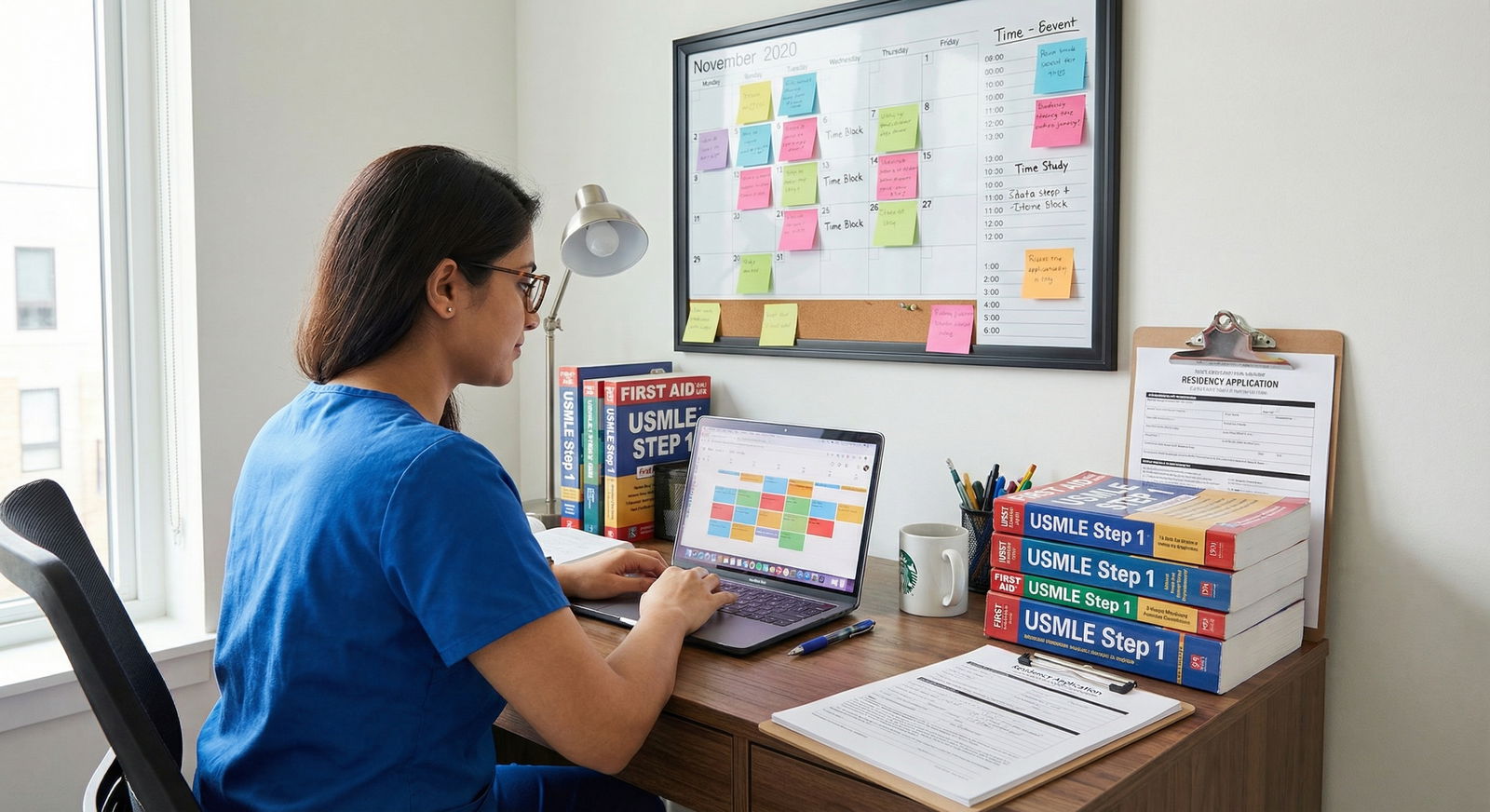
Day -1: Calm Execution Mode
You are not learning anything new today. You’re locking in.
Morning
At this point you should:
- Skim your:
- Program Snapshot
- Question lists for PD/residents
- Highlighted ERAS activities
Run one rep each:
- “Tell me about yourself”
- “Why this specialty?”
- “Why this program?”
Stop after that. Do not re-record, re-edit, or rewrite anything.
Afternoon
If traveling in-person:
- Travel to interview city
- Check into hotel
- Walk to the interview site if possible so you know the route and exact entrance
If virtual:
- Re-check:
- Device updates off/autoupdates paused
- All needed links and backup phone number bookmarked
- Background tidy
Prepare your space:
- Water within reach
- Tissues
- Notepad open to one discreet page for quick notes
Evening
At this point you should wind down, not ramp up.
- Lay out all clothes and materials
- Charge:
- Laptop
- Phone
- Backup device if you have one
Set:
- 2 alarms (phone + backup device)
- If in-person, schedule:
- Wake-up
- Breakfast
- Travel start time
Then do something non-medical for at least an hour. Show, book, walk. Anything.
Aim for bed early. You won’t sleep perfectly; nobody does. You just need enough.
Quick Reference Timeline Table
| Day Range | Primary Focus | Key Outputs |
|---|---|---|
| -14 to -11 | Confirm, calendar, core answers, answer bank | Program snapshot, answer bank doc |
| -10 to -8 | Mock #1, fix issues, tech/travel check | Mock feedback notes, logistics doc |
| -7 to -5 | Mock #2, questions list, story polish | Question sets, refined stories |
| -4 to -3 | Attire, grooming, final program research | Outfit ready, sharpened “Why us?” |
| -2 | Dress rehearsal, bag packed | Final video check, travel/tech ready |
| -1 | Light review, rest, routine | Laid-out clothes, alarms set |
FAQ (Exactly 2 Questions)
1. How many full mock interviews do I actually need before my first residency interview?
Two solid mocks are enough for most people. One long, comprehensive mock around day -10 to expose problems, and one shorter, sharper mock around day -7 to confirm improvement. More than that and you risk rehearsed, robotic answers. If you’re clearly struggling—rambling, freezing, or giving disorganized stories—add targeted 10–15 minute drills on your weak spots rather than another full mock.
2. Should I keep updating my answers and stories as I get closer, or lock them in?
Lock the structure by about 3–4 days before and stop rewriting. Tweak phrasing if something feels clunky, but don’t keep swapping stories or changing your “Why this specialty?” the night before. That’s how you walk in confused and hesitant. By the final 72 hours, your job is to reinforce familiarity and calm, not to optimize every sentence. Solid and confident beats fancy and unstable.
Key points: two weeks out, you need a schedule, not improvisation; your first priority is core answers and logistics, not obsessing over niche questions; and in the last 3–4 days, you win by stopping the rewrites and protecting your sleep and focus.