
Most applicants with “geographic constraints” rank too timidly and then act surprised when the Match algorithm punishes them.
Let me be blunt: the algorithm does not care about your partner, your kids, your visa, your sick parent, or your lease. It only cares about your rank list. If your list does not mathematically reflect your real constraints and preferences, you are gambling with your life for the next 3–7 years.
Let me break this down specifically.
1. How the Match Algorithm Treats Your Constraints (Spoiler: It Ignores Them)
The NRMP algorithm is applicant-proposing. That is good for you. But it is also brutally literal.
It “knows” only three things about you:
- Your rank order list (ROL)
- Which programs ranked you
- The lists of other applicants those programs ranked
Everything else—your partner’s job, dependent kids, disabled parent, immigration status, medical condition—is invisible.
What that actually means
If you say:
- “I absolutely must be within 1 hour of City X,”
but - You rank programs in other states above your City X programs “because they’re more prestigious,”
then the algorithm logically concludes:
You prefer leaving City X to staying.
And it will honor that. Every time.
I have seen couples “accidentally” match 1000 miles apart because one of them decided to “just throw in” a dream program far away, ranked too high “in case it works out.” It “worked out.” And then they spent PGY1 doing long-distance and begging for transfers.
The algorithm will:
- Start with your first choice program.
- Try to tentatively place you there if the program ranked you and has capacity.
- If it cannot, it moves to your second choice.
- It keeps going down your list.
The key word: your list. There is no separate geographic weighting. No “soft filter” for distance. No checkbox that says “only if within X miles.”
If a far-away program is ranked #3 and a perfect local program is ranked #7, the algorithm interprets:
#3 > #7. Full stop.
So your entire geographic strategy lives or dies in a very unromantic place: the exact numerical order on your rank list.
2. Step Zero: Get Honest About What “Constraint” Really Means
Most people misuse the word “constraint.”
A true geographic constraint is something that, if violated, you either:
- Cannot do the residency (legal/visa barrier, child custody order, active medical limitation), or
- Would be devastated in a way that does not realistically “work out later.”
Everything else is a preference.
You have to sort this out before you touch your rank list.
Common categories of geographic constraints
Let’s divide things the way I do with residents when we sit down and map this out.
| Constraint Type | Usually True Constraint? | Needs Program Disclosure? |
|---|---|---|
| Spouse/partner job | Often | Usually |
| Child custody | Yes | Sometimes |
| Sick/elderly parent | Often | Sometimes |
| Visa / immigration | Yes | Yes |
| Health/medical needs | Yes | Sometimes |
| Financial / housing | Sometimes | No |
Now let’s be more concrete.
Spouse or partner constraints
- Partner has a non-mobile career (e.g., law firm partner, tenured professor, active duty military stationed in one city).
- Dual physician couples in the Match (we will talk about Couples Match separately).
This is usually a strong constraint, but there is often a radius (e.g., “must be within 60–90 minutes”).
Child and custody constraints
- Shared custody where a court order or agreement locks you into a certain geography or school system.
- Child with specialized medical needs tied to a specific children’s hospital or care team.
These are non-negotiable constraints. Treat them like iron.
Elderly or ill parent
- Dialysis, chemo, advanced dementia, or no other local caregiver.
This is not a “I love my parents” issue. It is a concrete caregiving and safety question.
Sometimes these are radius-based; sometimes city-specific.
- Dialysis, chemo, advanced dementia, or no other local caregiver.
Visa and immigration constraints (IMGs and citizens)
- Visa type (J‑1 vs H‑1B)
- State licensing rules for IMGs
- ECFMG timing issues
This is a hard legal constraint. A program that cannot sponsor your needed visa might as well not exist.
Medical constraints for you
- Chronic illness with specialists in one city
- Functional limitations where public transit, climate, or accessibility really matter
You are not weak for treating this as non-negotiable. You are sane.
Financial / housing constraints
- Needing to live with family for financial reasons
- Needing an area with much lower cost of living
These can be semi-flexible, but you must define them concretely.
Put numbers on it
Vague statements like “need to be close to my partner” are useless for strategy.
You want something like:
- “I must be within a 60-minute door-to-door commute of downtown Chicago by public transit or car.”
- “I can do anywhere in New England, but I strongly prefer within 45 minutes of Providence.”
- “I must match in a program that can sponsor H‑1B; J‑1 is not acceptable.”
- “I cannot live more than 30 minutes away from my mother’s nursing home because I am her medical proxy and primary contact.”
This level of specificity is what lets you build a rational rank list.
3. Build Your Universe: Programs You Should and Should Not Rank
Applicants with constraints often make a fatal error: they leave too many “fantasy” programs on the list because they “might work it out.”
If a program being your only option in March would be a disaster, it does not belong on your rank list. Period.
Three buckets for programs
When I coach someone through this, we build three lists:
Green list – Fully compatible with constraints
Examples:- Inside your required metro radius
- Correct visa type with documented history of sponsorship
- Within your “emotionally survivable” distance from key people
Yellow list – Technically possible but would be a real strain
- 90–180 minutes away from partner/family
- Slightly outside ideal region but still logistically workable
- Visa sponsorship theoretically possible but not historical
Red list – If this is your only match, you would be miserable or stuck
- Across the country from partner with no relocation option
- Wrong visa type or no sponsorship
- Completely incompatible with custody or caregiving
Then we do the painful, grown-up step: delete every red program from the rank list, even if it is “a top place.”
Yes, that includes the shiny academic program 2000 miles away if your child’s life is centered where you are now. Matching to a place you cannot or should not attend is worse than not matching and reapplying strategically.
4. Translating Constraints into Actual Rank Order
This is the part people get wrong consistently. They categorize correctly, then rank emotionally.
You do not just “mix in” programs based on overall vibe. With geographic constraints, the ranking should follow a simple logic:
- First: All the programs that meet your hard constraints
- Next: Programs that are slightly outside, but realistically tolerable if you had to
- Only then: Programs that break your preferred geography but would be “OK” for 3–5 years
Within each tier, you can sort by program quality, fit, and career goals.
Concrete examples
Example 1: Single parent with shared custody in Minneapolis
Constraints:
- Must remain within 90-minute drive of Minneapolis due to custody agreement
- Could consider Duluth, Rochester, Eau Claire, maybe Fargo, but nothing beyond
Rank logic:
- Rank all Minneapolis / immediate suburbs programs first.
- Then rank Duluth, Rochester, Eau Claire, Fargo in order of program preference.
- Do not rank anything outside that radius. Not even “dream coastal academic” programs.
If you put “Mass General Internal Medicine” at #3 “just in case,” and they rank you and Minnesota programs do not? You have now traded your custody stability for a brand name. That is not an algorithm error. That is your list choice.
Example 2: Dual-physician couple, both in Couples Match, want to be in the Bay Area but can tolerate all of California
Constraints:
- Strong preference for Bay Area
- Acceptable: Sacramento, Central Valley, LA, San Diego
- Unacceptable: Any state outside CA
Rank logic as a couple:
- Pair all Bay Area combinations (both in Bay, or one in Bay and one in Sacramento if commutable) at the top.
- Next: other in-state combinations that are livable (e.g., one LA, one Orange County; one San Diego, one Riverside).
- Do not pair any combination that includes a program outside California. At all.
I have seen couples accidentally include “random Midwest” programs as low “safeties.” They matched there. Then they realized that “we will not go there” needed to be decided before rank submission, not on Match Day.
5. Special Scenarios: How Strategy Changes With Specific Constraint Types
Let me drill into the most common and most mismanaged situations.
A. Couples Match with geographic constraints
Couples Match already multiplies complexity. Add geography and you are doing 3D chess.
Core rules:
Decide your true geographic boundary first
- Are you willing to be in different cities within 2–3 hours’ drive?
- Or must you be in the same metro?
Do not fudge this. You cannot renegotiate it with the algorithm later.
Construct your pairings in tiers:
Tier 1: Both in same city / same metro
Tier 2: Both in same state or 2–3 hour commute that you could rationally sustain for a year or two
Tier 3: Only if you are truly willing to live apart (most couples should skip this tier entirely)Never create low-rank pairings that you would not actually accept.
People do this “to avoid going unmatched.” Then they go matched to a pairing they hate and start emailing PDs on Match Day to beg for waivers and transfers. Programs do not love this.
B. Visa and IMG geographic constraints
For IMGs and visa-dependent applicants, your geography is sometimes defined by law, not preference.
Key rules:
- If a program cannot or does not sponsor your required visa type (e.g., you must have H‑1B, they only do J‑1), do not rank them.
- If a program says “H‑1B considered for exceptional applicants only” and you are applying with a very average profile, treat that as “no H‑1B.”
- Check historical visa patterns, not just website blurbs. Ask current residents.
If your constraint is: “I must be in a state where my spouse can also work on their visa,” you have a more complex map. You may have entire states functionally off-limits. Be ruthless about that.
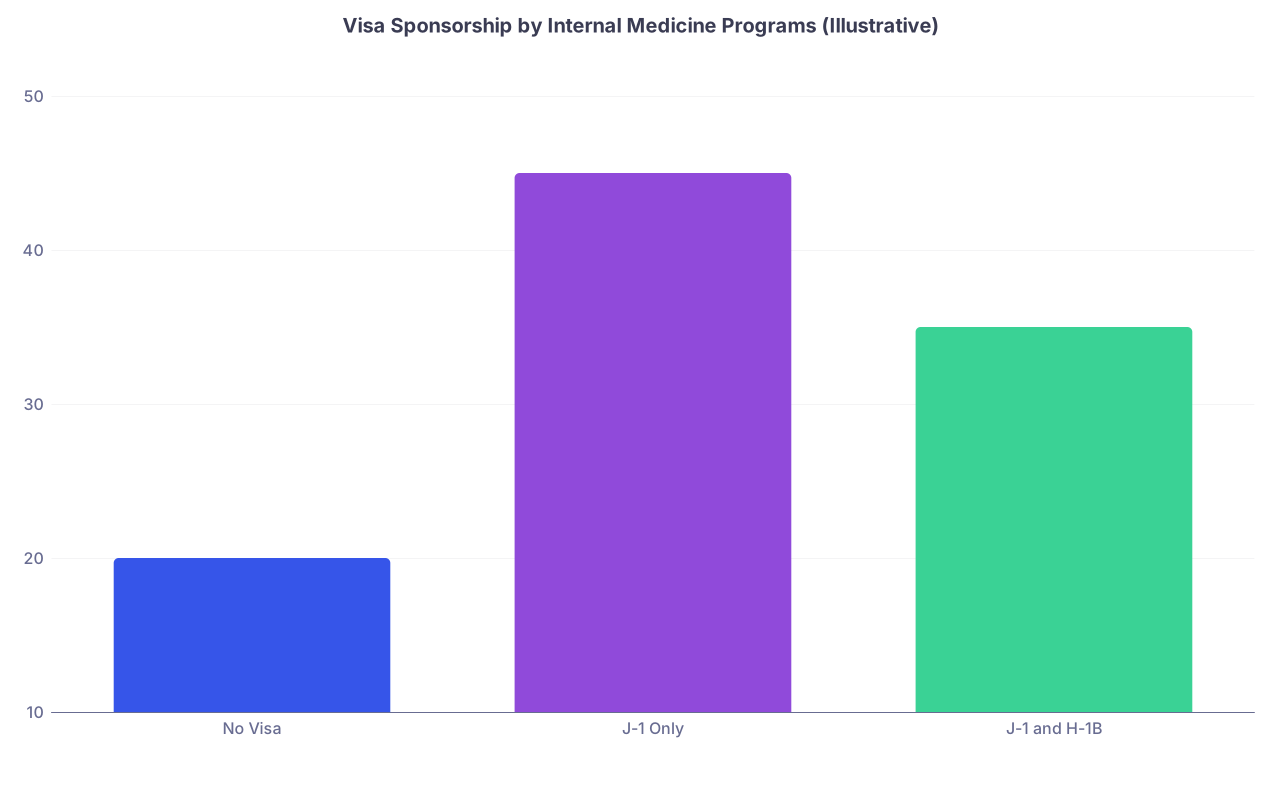
| Category | Value |
|---|---|
| No Visa | 20 |
| J-1 Only | 45 |
| J-1 and H-1B | 35 |
If you need H‑1B and only 35% of programs in your specialty sponsor H‑1B, your effective geography is already constrained. Ranking a J‑1-only program makes no sense for you unless your constraints change.
C. Caring for a sick or elderly parent
Here the constraint often has zones:
- Zone A: Within 20–30 minutes – can be present several times a week
- Zone B: Within 60–90 minutes – weekly meaningful presence
- Zone C: Beyond that – you are essentially remote
Your rank logic might look like:
- Zone A programs first, ranked by quality and fit
- Then Zone B programs as “only if I must” options
- Zone C programs omitted completely if caregiving is truly essential
You also need to be realistic about the intensity of residency. If you match to a very malignant surgical program 90 minutes away and tell yourself you will be there “all the time” for your parent, you may be lying to yourself.
6. Balancing Program Quality vs Geography Without Deluding Yourself
This is the classic trade-off:
“Do I take a strong program in a bad location for my life, or a weaker program in the perfect city?”
Let me be clear:
For most people with serious geographic constraints, the correct answer is: pick the location that keeps your life intact, as long as the program is competent and accredited.
Residency is not a 1-year fellowship. It is 3–7 years of your actual life.
Here is the sanity check I use with residents:
Question 1:
If you match to Program X (far away), would you actually move and go?
If the honest answer is: “I would try to scramble or SOAP or transfer,” then X does not belong on your list.
Question 2:
If you match to Program Y (local but less prestigious), can you still reach your core career goals coming from there if you work hard (fellowship, job type, etc.)?
Most of the time, the answer is yes. Prestige is overrated. Your letters, performance, and networking matter more.
A quick comparison table
| Factor | Choose Prestige Far Away | Choose Geographic Fit Local |
|---|---|---|
| Family stability | Often poor | Strong |
| Fellowship chances | Marginally better in some fields | Achievable with more hustle |
| Burnout risk | Higher (less support) | Lower (support network nearby) |
| Marital stress | Often higher | Usually lower |
| Overall life regret | Common if constraints serious | Rare if program is solid |
If your constraint is genuinely “I must stay near X,” stop romanticizing the out-of-state brand name. You are not a failure for choosing your real life.
7. Communication Strategy: What To Tell Programs About Your Constraints
You do not need to write a monograph on your personal life to every PD. But silence is also not always smart.
When you should disclose constraints
You should consider sharing geography-related constraints when:
- The program is in your target city/region
- You are ranking them highly
- Your constraint explains your intense interest and commitment to that area
For example:
- “My partner is a PhD student at [local university] and is tied to this area for the next 4 years. This makes [City] my clear top geographic choice for residency and I would be committed to completing residency here.”
- “My child receives ongoing specialty care at [Children’s Hospital in city]. Remaining in this metro area is non-negotiable for my family, and your program is therefore my top priority.”
Program directors are human. They like residents who actually want to be there and are likely to stay for 3+ years.
How not to use this
Do not:
- Send a mass email to every program in a 500-mile radius explaining your entire family history.
- Use constraints as emotional pressure (“I have a sick parent, please rank me higher”).
- Lie about your level of commitment to an area.
Keep it concise, honest, and specific. Use it to reinforce your genuine interest, not to manipulate.
8. Checklist: Building a Rational Rank List with Geographic Constraints
I am going to give you a structured, no-nonsense sequence. Use this and you will avoid 90% of disasters.

| Step | Description |
|---|---|
| Step 1 | Define hard constraints |
| Step 2 | Map acceptable regions |
| Step 3 | Classify programs: Green/Yellow/Red |
| Step 4 | Delete all Red programs |
| Step 5 | Rank all Green programs by preference |
| Step 6 | Decide if any Yellow belong at bottom |
| Step 7 | Check for any would not go programs |
| Step 8 | Finalize rank list and stop editing |
Step-by-step summary:
- Write down your hard constraints in one or two clear sentences.
- Translate those into actual map boundaries (cities, commute times, visa types).
- Go through every program you interviewed at and label it: Green, Yellow, or Red.
- Remove all Red programs from your draft ROL. Yes, really.
- Rank all Green programs from most to least preferred.
- Decide if you want any Yellow programs as true “only if I must” backup—if yes, place them strictly below all Green.
- Re-read your final list and ask: “If I match to my last-ranked program, would I 100% go?”
- If the answer is no, delete that last program and re-evaluate.
Then stop. Stop reordering your list daily based on random forum posts.
FAQ (Exactly 6 Questions)
1. Should I rank a great program far away “just in case” even if I am not sure I would go?
No. If you will not actually move there and complete the residency if that is your only match, do not rank it. A match you refuse to honor is usually worse than no match. The rank list is not for fantasy options. It is a binding preference list.
2. How many local programs do I need to rank to feel “safe” if I have strong constraints?
There is no magic number, but as a rule of thumb you want to rank every program within your acceptable geography where you could realistically function, as long as they are accredited and not truly toxic. Applicants with constraints often under-rank “less shiny” local programs, then regret it. Quantity within your geographic window matters more than prestige when constraints are hard.
3. What if my partner insists we include programs I know I could not realistically attend?
You have to resolve that before rank submission, not after Match Day. That means a very blunt conversation: “If we match to X, are we actually moving and doing this for 3–7 years?” If the answer is anything less than a clear yes, that program does not belong on the list. In Couples Match, both of you must own the consequences of each pairing.
4. I have a sick parent but I am afraid to mention this to programs. Will it hurt my chances?
Mentioning a brief, factual version of your situation to signal strong geographic commitment usually does not hurt you and often helps. You do not need to share intimate details. A single sentence in a post-interview thank you or update letter is enough: “Due to a close family member’s serious health condition, remaining in [City] is essential for me, which is a major reason your program is my top choice geographically.” That is usually seen as maturity, not weakness.
5. How do I handle geographic constraints if I am an IMG with very few interviews?
You still need to be honest about your boundaries. If you have only 3–4 interviews and one of them is in a location you truly cannot go due to visa or legal custody issues, do not rank it. If a location is simply “not ideal” but not impossible, then yes, you probably should rank it—because not matching at all carries its own cost. The difference is between “inconvenient” and “unworkable.” Only you can define that honestly.
6. Does ranking more programs outside my preferred area ever “hurt” my chances in my target area?
No. The algorithm always tries to place you in the highest-ranked program that also wants you. Adding more programs lower on your list cannot bump you out of a higher-ranked local spot. The danger is not mathematical; it is psychological. The risk is that you include programs so incompatible with your life that, if matched there, you would be miserable or unable to attend. That is why the hard work is defining where your bottom boundary actually lies.
With this level of clarity, your rank list stops being wishful thinking and starts being an honest map of the life you are willing—and able—to live for the next several years. Once you submit that final list, your job is not to keep tinkering. Your job is to prepare for the reality you have chosen.
And once the Match dust settles, the next tactical problem appears: how to shape your early residency years so your constraints stay manageable and your career still moves forward. But that is a battle plan for another day.