
The reflex to trauma-dump in residency personal statements is ruining otherwise strong applications.
Let me be blunt: you do not get extra points in ERAS for having suffered. You get points for judgment, insight, and professionalism. Your hardships are relevant only to the extent that they show those three things.
Here’s how to decide if you should talk about personal hardships in your ERAS personal statement—and how to do it without torpedoing your application.
The Core Question: Should You Talk About Hardships At All?
You should only address personal hardships in your ERAS personal statement if they clearly do at least one of these:
- Explain a specific red flag in your application
- Demonstrate resilience and growth that’s directly relevant to residency
- Show authentic motivation for your specialty or career path
If you can’t tie your hardship to one of those in a clean, obvious way, you’re probably better off leaving it out or moving it to an “additional comments” section, disability disclosure, or a separate communication.
Programs aren’t reading your essay as a therapy note. They’re asking:
“Who is this person, and what kind of resident will they be at 2 a.m. on a bad call night?”
If your hardship story helps them answer that in a positive way, it belongs.
If it mainly makes them worry about your stability, boundaries, or stamina, it doesn’t.
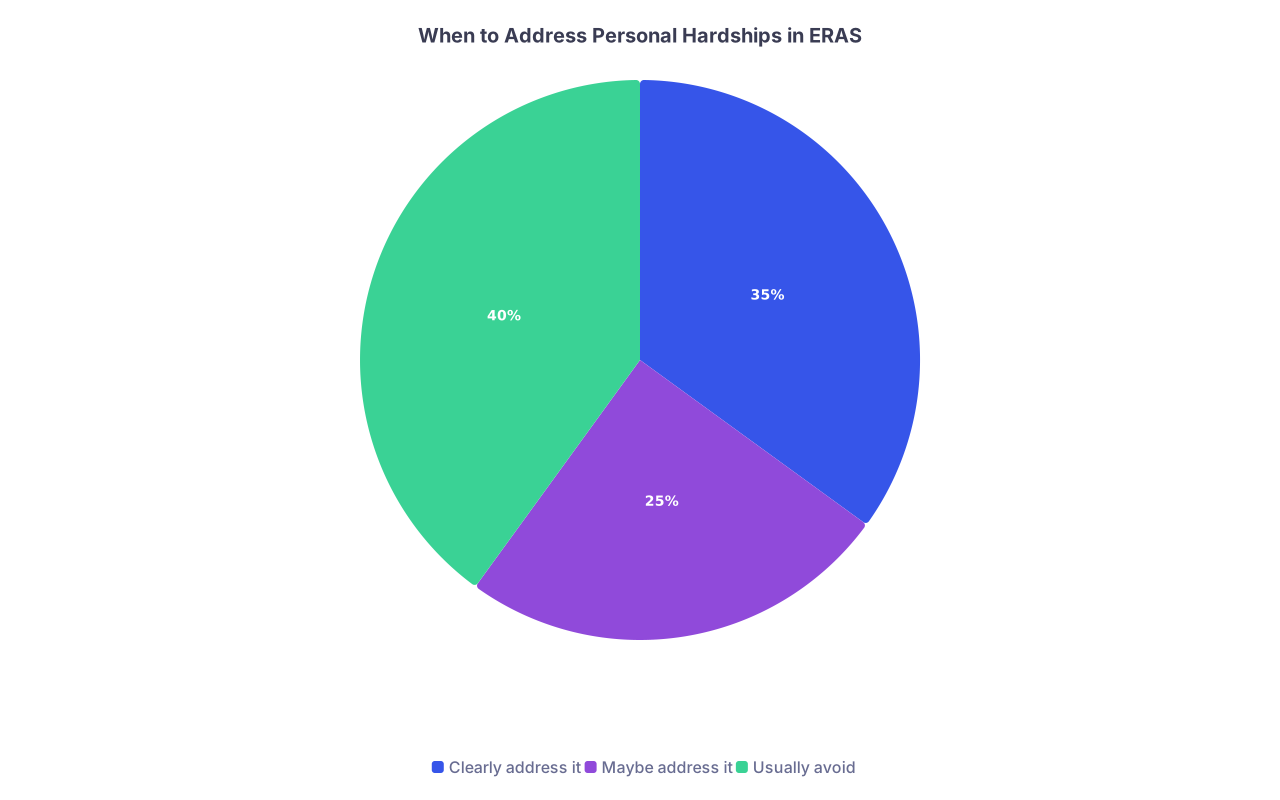
| Category | Value |
|---|---|
| Clearly address it | 35 |
| Maybe address it | 25 |
| Usually avoid | 40 |
When You Should Address Hardships (and How To Do It Well)
1. When it explains a clear blemish
Examples:
- A failed Step exam followed by strong improvement
- A semester of poor grades during a family crisis
- A leave of absence for health or caregiving reasons
In these cases, silence looks worse than a brief, mature explanation.
How to write it:
- Be short and specific: what happened, when, and how it affected your record
- Take ownership where appropriate
- End with evidence of recovery, not just “I learned a lot”
Bad approach:
“I was dealing with a lot of personal issues and my grades dropped.”
Better approach:
“During my second year, my mother was diagnosed with advanced cancer. I took on significant caregiving responsibilities, and my coursework and Step 1 preparation suffered, resulting in a failure on my first attempt. After arranging more structured support for her care and working with student affairs, I retook the exam and improved from a 198 to a 233. The experience forced me to develop realistic limits, ask for help, and build systems to maintain performance during personal stress—skills I now use deliberately on demanding rotations.”
Notice: clear, specific, ends in competence. Not pity.
2. When it clearly shapes your motivation or perspective
Some hardships truly do explain why you’re drawn to a field or how you show up for patients.
Examples:
- Growing up with unstable housing and now passionate about community EM or primary care
- Long-term caregiver for a disabled sibling, shaping your interest in PM&R or neurology
- Personally navigating mental illness and using that to connect with psych patients (carefully done)
But here’s the key: the hardship is not the point. The point is your professional identity.
You’re not saying “feel bad for me.”
You’re saying “this is why I care about this work, and here’s how it shows up in my behavior.”
If you can’t name concrete, observable ways your experience changes how you act as a medical student, it’s not ready for the statement.
3. When you can show real distance and stability
Programs don’t just care about what happened. They care about:
- Are you stable now?
- Are you functional under high demand?
- Are you self-aware about your limits?
I’ve seen strong essays about:
- Past substance use in remission for years with ongoing support
- Major depressive episodes that are now well-managed with treatment, with no recent impairment
- Serious family issues that are resolved or in a “steady state” with supports in place
These work only when the writer shows:
- Clear timeline (“this was 4 years ago…”)
- Evidence of sustained functioning since
- Concrete strategies they use now to maintain wellness
If you’re still in the middle of the crisis, your personal statement is probably not the place to unpack it. You can disclose relevant functional limitations separately, and you should get one-on-one guidance from a trusted dean or mentor before writing about it for programs.
When You Should Not Put Hardships in Your PS
Let’s be honest. There are a few patterns that scare program directors. They won’t always say it out loud, but you can hear it in rank meeting rooms.
Here are common “don’t do this” situations:
1. Graphic or unprocessed trauma
If you’re still clearly emotionally raw, it comes through in the writing. Markers include:
- Intense, vivid sensory detail of traumatic events
- Anger at specific people/institutions taking center stage
- No real movement in the story from pain → insight → professional focus
That doesn’t make your experience less valid. It just makes your ERAS essay the wrong container.
2. Stories that make you look like a victim, not an agent
Red flags:
- Everyone else is to blame for your academic issues
- Multiple “unfair” situations with no ownership
- No tangible actions you took to adapt, get support, or improve
Programs worry: “What happens when this person hits inevitable residency friction? Are we getting drama or problem-solving?”
3. Hardships not connected to anything in your application
If you had a rough childhood but your record is clean and there’s no obvious question to answer, ask yourself honestly:
Is this in here to:
- Explain something?
- Or…to make them feel bad for me / make my story more dramatic?
If it’s the second, cut it. Your clinical stories, interests, and strengths should carry the essay. You’re not competing to have the most tragic backstory.
How to Decide: A Simple Framework
Here’s the decision tree I’d actually use with a student in my office.

| Step | Description |
|---|---|
| Step 1 | Thinking about including hardship |
| Step 2 | Include briefly and concretely |
| Step 3 | Talk to dean/mentor first |
| Step 4 | Probably leave it out |
| Step 5 | Include, focus on growth |
| Step 6 | Does it explain a red flag? |
| Step 7 | Can you show clear recovery and stability? |
| Step 8 | Does it clearly shape your motivation or perspective? |
| Step 9 | Can you write about it with distance and insight? |
If you land in the “talk to a dean/mentor” or “probably leave it out” branches, don’t force it into the essay just because everyone told you “you have such a powerful story.”
Remember: residency selection is conservative by nature. They’re picking people to do real patient care at 3 a.m. They want competence and predictability first, then all the other nice things.
How to Write About Hardship Without Making Readers Nervous
Assuming you’ve decided your hardship belongs, here’s how to do it in a way that reads as mature, not messy.
1. Keep it brief
Usually 1 short paragraph. Maybe 2 if it’s explaining a big gap or leave of absence.
Red flag is when your hardship backstory is half the essay. That shifts the focus from “resident you’ll be” to “things that happened to me.”
2. Go light on details, heavy on consequences
Bad:
“I watched my father slowly deteriorate over 8 months, losing 40 pounds, spiking fevers almost every night, his skin turning so yellow it looked fluorescent…”
Better:
“In my third year, my father had a prolonged ICU stay. I spent months at his bedside, watching multiple teams coordinate his care.”
You’re not writing creative nonfiction. You’re establishing context.
3. Name concrete changes in you
Don’t just say you “learned resilience” or “gained empathy.” That’s empty.
Say things like:
- “I started asking patients one more question about who takes care of them at home.”
- “I now proactively build backup plans for my responsibilities when family crises emerge.”
- “I became comfortable telling attendings when I was reaching my limit and needed help prioritizing tasks.”
Those sound like someone I’d actually want on my team.

4. Time-box it
Signal that the intense part is past and you’re on stable ground now.
Examples of good wording:
- “Since returning from my leave in 2022, I’ve completed all rotations on time and without additional accommodations.”
- “My depression has been in remission for 3 years, and I’ve maintained regular care with my psychiatrist and therapist.”
- “My mother’s care is now supported by home health aides and extended family, allowing me to maintain full clinical responsibilities.”
That tells programs: yes, there was a storm. No, you’re not still in the eye of it.
Where To Put Hardships: Personal Statement vs Other Spaces
Your ERAS personal statement isn’t the only place you can address this stuff. Sometimes it’s the wrong place.
Here’s how I’d divvy it up.
| Situation | Best Location |
|---|---|
| Explaining poor grades/failed Step | Personal statement or Add’l Info |
| Medical leave of absence | MSPE + brief note in PS |
| Disability needing accommodations | Separate disability disclosure route |
| Ongoing major family responsibility | PS if it affects schedule; else MSPE |
| Sensitive mental health history | One-on-one with dean + selected apps |
Rule of thumb:
If it directly impacts how you’ll function as a resident or helps explain your record, it can belong in ERAS materials.
If it’s more about your inner life than your performance, think twice.
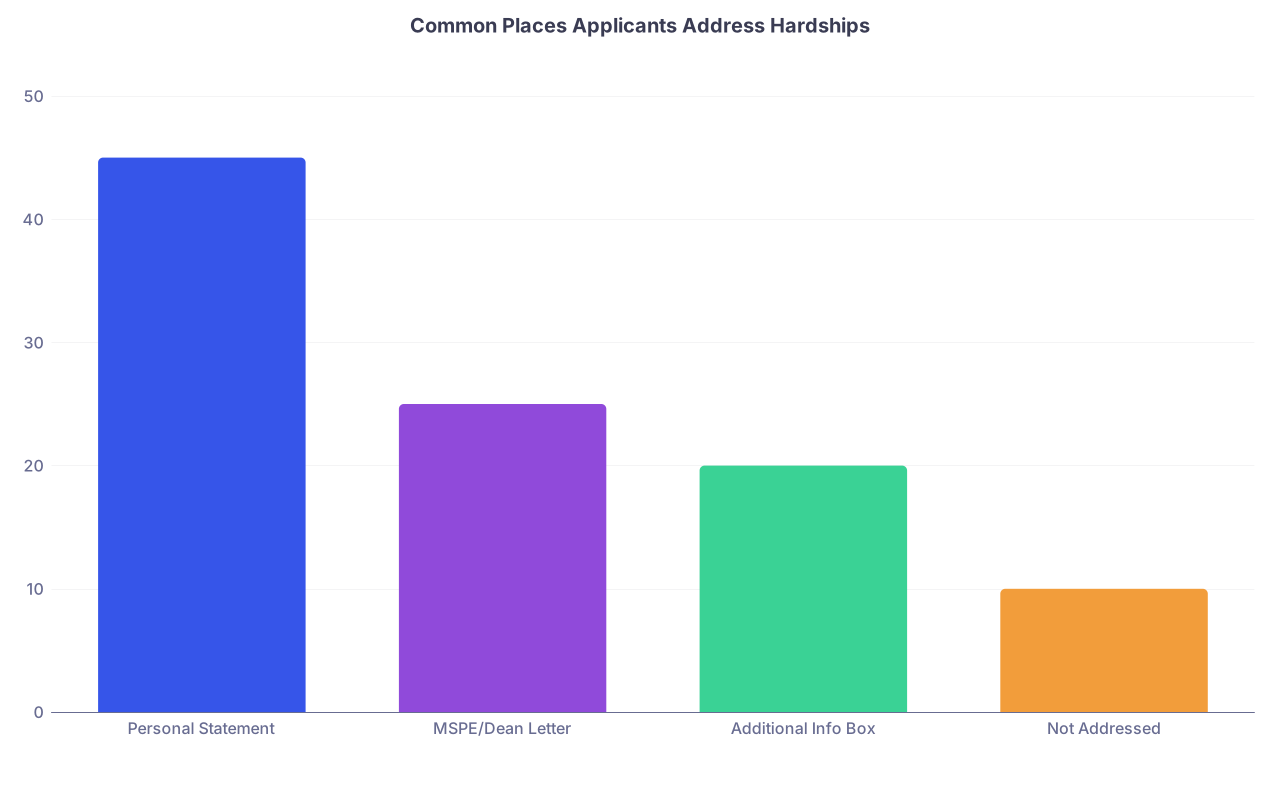
| Category | Value |
|---|---|
| Personal Statement | 45 |
| MSPE/Dean Letter | 25 |
| Additional Info Box | 20 |
| Not Addressed | 10 |
Sample Structures That Actually Work
You don’t need to copy these, but notice the ratios: brief hardship, longer on who you are now.
Example A: Explaining an academic dip
“One week into my second year, my younger brother survived a serious car accident that left him with a traumatic brain injury. As the only family member living nearby, I took on coordinating his care and legal issues. During that semester, I failed one course and scored below my usual performance on two others.
With the support of the school’s counseling and student affairs offices, I repeated the course the following term and improved my grades across the board. Since then, I’ve passed all clerkships on the first attempt and received honors in Internal Medicine and Surgery. I also learned how easily caregivers can be overwhelmed by medical systems, which now shapes the way I communicate with families on the wards.”
Hardship: 3 sentences.
Recovery and professional growth: the rest.
Example B: Hardship that shapes motivation
“I didn’t see a primary care doctor regularly until I was 17. My family moved frequently, often staying with relatives when we couldn’t afford rent. By the time we finally landed stable housing and Medicaid, my father’s uncontrolled hypertension had already led to a stroke.
Those experiences are why I’m drawn to family medicine. I’m comfortable in crowded waiting rooms, aware of how many crises compete with taking your meds, and used to translating between medical and non-medical worlds. On my FM sub-I, I started calling pharmacies directly to price out alternatives when patients couldn’t afford their prescriptions. My goal as a resident is to bring that same persistence and pragmatism to caring for underserved communities.”
Here, the hardship cleanly explains the “why” of the specialty and ties to concrete behavior.

Quick Gut Check Before You Hit Submit
Read your hardship section and ask yourself:
- Does this make me look more ready for residency, or less?
- Would I be comfortable with an interview panel asking, “So tell me more about this”?
- Is there at least as much space spent on what I did with it as on what happened to me?
- If I removed this paragraph, would the program have an unanswered question about my record or motivation?
If you’re not sure, get one trusted attending, advisor, or resident to read just that section and tell you honestly how it lands.
FAQ: Personal Hardships in ERAS Personal Statements
1. Do program directors actually care about my personal hardships?
They care only as far as it helps them answer: “Can this person do the job, and what kind of colleague will they be?” Some directors value grit and diverse life experience; others are risk-averse. None are assigning “sympathy points.” If your hardship doesn’t clarify your readiness, motivation, or resilience, it’s not helping.
2. Is it okay to talk about mental health struggles in my personal statement?
Sometimes, yes—but be strategic. If it explains a gap or shapes your interest in psychiatry or wellness work, you can mention it briefly. You must show clear stability (time since episode, treatment, functioning) and focus on what you’ve learned about managing your own health. If your symptoms are recent or active, talk privately with a dean/mentor first before putting it in writing to programs.
3. Should I mention childhood trauma or abuse?
Usually no, unless it’s absolutely central to your professional identity and you can discuss it with distance, without graphic details, and with clear relevance. Many people with such histories succeed in medicine without ever disclosing them in ERAS. You don’t owe programs your trauma story. Protect your privacy unless sharing it clearly serves your goals and doesn’t undermine perceptions of your stability.
4. How do I explain a failed Step score due to a personal crisis?
One concise paragraph: name the event and its timing, link it directly to the performance dip, briefly describe what changed (support, treatment, study approach), and point to objective evidence of improvement (retake score, clerkship performance). Avoid long narratives or blaming language. Your goal is to turn “red flag” into “contained, understood past problem with clear resolution.”
5. What if my hardship is ongoing, like caring for a disabled family member?
Then you need to show you have a sustainable plan for residency. You can briefly state the responsibility, acknowledge its impact, and explain the support systems you’ve built (other caregivers, financial resources, legal arrangements) that will allow you to meet residency demands. Programs don’t need every detail—just enough to believe you’ve thought pragmatically about call schedules, relocations, and bandwidth.
Bottom line: Only include hardships that (1) clearly explain your record or motivations, (2) you can discuss with distance and maturity, and (3) end in stability, growth, and concrete professional behaviors. If it doesn’t make you look more ready to be a resident, it doesn’t belong in your ERAS personal statement.