
It’s mid-September. You’ve got your ERAS list built, your personal statement is done, and you’re staring at one last unused program signal. The dilemma is simple and brutal: do you spend it on that ultra-competitive “dream” program that’s probably out of reach… or shore up your odds by signaling a more realistic, safer option?
Here’s the answer: signaling a pure fantasy reach is usually a waste. Signaling an “aspirational but plausible” program can be smart. And if you’re clearly below the bar, your signal is almost always better spent where you’re actually in the game.
Let’s walk through how to decide—step by step—without kidding yourself.
1. What Program Signaling Really Does (and Doesn’t Do)
Program signals aren’t magic keys. They do three things in most specialties:
- Get your app pulled out of the pile for a closer look
- Nudge you from “maybe” to “interview” if you’re on the bubble
- Tell them: “I would strongly consider coming here”
What they don’t do:
- They don’t erase weak board scores or a disastrous transcript.
- They don’t overcome zero ties or obvious misfit with the program’s focus.
- They don’t turn you into a top-tier applicant overnight.
For most mid-competitive programs, signals matter. For ultra-elite programs, they help only if you’re already in the ballpark. That’s the key distinction.
2. Define What “Reach” Actually Means For You
“Reach” gets thrown around constantly and used badly. Let’s make it precise.
A program is a reasonable reach if:
- Your stats (Step 2, class rank, etc.) are slightly below their typical range
- You don’t have strong geographic/ties, but
- You have at least one meaningful offset: strong research, great away rotation, strong home institution, or niche fit with their focus
A program is a fantasy reach if:
- You’re well below their usual metrics and
- You have no ties, no research fit, no rotation there, and your school isn’t one they regularly pull from
I’ve watched students in EM signal places like UCSF or MGH with 220s and no research and then wonder why nothing happened. That’s not ambition. That’s wishful thinking.
You want to use signals on reasonable reaches and realistic targets, not fantasy.
3. Quick Self-Check: Are You Competitive Enough to Signal a Reach?
Here’s the blunt framework I use with students.
Step 1: Compare yourself to program type, not your classmates
Look by tier, not feelings.
| Tier | Typical Applicant Profile* |
|---|---|
| Top 10 academic | Step 2 often 250+, heavy research, strong home institution, AOA/near-top of class |
| Strong academic | Step 2 ~240–250, some research, solid letters, at least average grades |
| Mid-tier academic / strong community | Step 2 ~230–245, okay research or strong clinical, solid letters |
| Community-heavy | Step 2 ~220–235, solid clinical, fewer research expectations |
*This is directional, not a hard cutoff. Specialty and year will change specifics.
Where do you honestly sit?
- If you’re mid-tier community level trying to signal top-10 research programs: fantasy reach.
- If you’re “strong academic” tier trying to signal a top 10–20 program: reasonable reach.
Step 2: Ask 4 harsh questions
For the program you’re thinking about signaling:
- Do they routinely match people from your med school?
- Do your Step 2 score and transcript look at least close to their usual?
- Do you bring something that matches their brand? (research-heavy, underserved, global health, etc.)
- Could you imagine them making a case for you on rank day without sounding insane?
If you’re “no” on 3–4 of those, that’s not a good place to drop a precious signal.
4. When You Should Signal a Reach Program
There are clear scenarios where a reach signal is not only okay but smart.
Scenario A: You’re slightly below their typical profile, but still credible
Example: You’re applying Internal Medicine.
- Step 2: 238
- No AOA, but strong letters and solid clerkship narrative
- 2–3 decent publications, maybe one in a recognizable journal
- You’re at a mid/upper-tier school, no huge red flags
You’re eyeing a place like University of Michigan or UW.
Are they reaches? Yes.
Are you absurd for signaling them? No. You’re in the outer orbit of their usual applicant pool. A signal might be what gets your file read seriously.
Scenario B: You did an away rotation and impressed them
If you rotated there and got:
- Strong written evaluation
- At least one solid letter
- Explicit encouragement like “we’d love to see your application”
Signaling a slightly reachy program you rotated at is one of the highest-yield uses of a signal. It tells them: “I’m not just being polite. I’m actually prioritizing you.”
Scenario C: They’re your top choice and you’re in the gray zone
Programs know some students will love them even if they’re not perfectly matched on paper. If you:
- Are slightly below their typical scores
- But have a compelling, specific rationale you’ll explain in your secondary or interview
- And would absolutely rank them #1 if offered
Then one signal here is defensible. But do not do this for three different “top choices” that are all fantasy.
5. When You Should Skip the Reach and Signal Safer Options
Here’s where people tank their overall application strategy: blowing signals on programs that were never going to look twice.
You should not signal a reach when:
You’re well below their numbers and you have no offset
- Example: 218 on Step 2, multiple repeats, no significant research, and you’re signaling UCSF IM. That signal is better used almost anywhere else.
You’re heavily below-tier for the specialty as a whole
- If you barely passed Step 2 and you’re trying for Derm, Ortho, ENT, Plastics… the signal isn’t your main problem. You should be re-evaluating your entire strategy.
You don’t meet explicit program filters
- They state “we require Step 2 ≥ 230” and you have a 221. Signal will not override their hard screens.
You’re geographically incompatible and have no story
- Zero ties, no regional interest, generic application, and you want to signal a hyper-local, insular program? That’s weak.
In these cases, signaling a “safer” but realistic option absolutely gives you more return. Not because you’re “settling,” but because you’re playing the game that actually exists.
6. How to Prioritize: Reach vs Safer Options (Concrete Framework)
Let’s put some actual numbers on this.
Assume your specialty gives you 5 signals.
Broadly, I like this distribution for a normal applicant (not superstar, not disaster):
- 1–2 signals: reasonable reaches
- 2–3 signals: realistic targets / upper-mid programs
- 0–1 signals: true safeties (only if you have safeties that still screen hard)
If you’re a stronger applicant: shift a bit more toward reaches.
If you’re a weaker applicant: shift more toward realistic targets and strong safeties.
Step-by-step sorting method
Make three columns for your programs:
- “Strong Fit / On-Par” – your stats and profile match their usual
- “Mild Reach” – you’re a bit below, but still plausible
- “Fantasy / Extreme Reach” – famous places or those obviously out of your league
Then:
- Only consider columns 1 and 2 for signals.
- In column 2, sort by where you actually have angles: rotations, research overlap, school pipeline, ties.
- In column 1, sort by where interviews are not automatic—i.e., mid-to-upper programs that get flooded.
That will usually give you a top 5 list that makes sense.
7. Specialty-Specific Realities (Because It’s Not the Same Everywhere)
Some specialties treat signals like gold. Others treat them like a minor nudge.
Very competitive specialties (Derm, Ortho, ENT, Plastics, Uro, etc.)
Reality: Everyone is good on paper. Programs are drowning in “strong” applications.
- Signals matter a lot for getting read at all.
- But in hyper-elite programs, your baseline still has to be strong.
- Using a signal on a program where you have no realistic shot is brutal opportunity cost.
Here, I usually recommend:
- Aim more at “strong but not top 3 programs” where you’re competitive.
- Use at most one signal on a real reach—if and only if your overall profile is solid for the specialty.
Moderately competitive specialties (IM, EM, Anesthesia, OB/Gyn, Gen Surg)
Signals help more in the crowded middle.
- Programs that get 2–3k apps will use signals to prioritize invites.
- Many mid-to-upper options are realistically in play for borderline applicants if signaled.
Here, a balanced strategy (1–2 reaches, 2–3 realistic) makes sense for most people.
Less competitive specialties or very strong applicants
If you’re clearly above average for the specialty, you have more freedom to use signals on higher-reach options. They’re not as “expensive” because you’ve got a wide safety net.
8. Ties, Rotations, and Fit: Where a Reach Signal Becomes High Yield
Signals are strongest when they confirm a pre-existing connection.
Top situations where signaling a reach can actually tip the scale:
- You rotated there and they know your name
- Your PI collaborates with their faculty and can reach out
- You’ve got strong geographic/family ties and can articulate them clearly
- Your CV mirrors their program “type” (eg, heavy QI focus, global health, underserved, academic research)
In those cases, a 5–10 point gap in Step 2 is not fatal. The signal plus your connection pulls you out of the “anonymous” bucket.
On the flip side: if you have none of these, that same 5–10 point gap can be deadly at top places.
9. A Simple Decision Tree: Should You Signal This Reach?
Use this as a quick gut-check:

| Step | Description |
|---|---|
| Step 1 | Thinking about signaling a reach |
| Step 2 | Do NOT signal. Use on realistic program. |
| Step 3 | Probably skip. Use on strong mid/upper program. |
| Step 4 | Okay to signal as mild reach. |
| Step 5 | Good candidate to signal. |
| Step 6 | Are you at least near their usual stats? |
| Step 7 | Any real connection? Rotation, ties, research fit? |
| Step 8 | Hyper-elite or famous program? |
If you end up at C or F, that’s your answer: focus on safer or more realistic options.
10. Example Profiles: Where Should the Signal Go?
Let me give you three quick composite examples.
Applicant 1: Mid-range IM applicant
- Step 2: 233
- No AOA, average preclinical, solid clinical
- 1 poster, no big research
- Wants big academic name
Should they signal: UCSF, MGH, Hopkins?
No. That’s wasted. Those programs may not even see your file.
Better use: signal strong academic and upper-mid programs where 233 is low but not crazy—think Ohio State, Iowa, Colorado, UAB (depending on ties), etc.
Applicant 2: Strong EM applicant
- Step 2: 248
- Honors in EM, strong SLOEs
- Rotated at a top-20 EM program and got great comments
Here, signaling your away rotation program (even if it’s a stretch) is smart. Then use the remaining signals on upper-mid EM programs that actually read your file and will be impressed by your SLOEs and score.
Applicant 3: Borderline Orthopedics applicant
- Step 2: 234 (low for Ortho)
- One ortho publication, average clinical comments
- No big-name school or rotation
This person shouldn’t be spending signals on HSS or Rush. They should be signaling any program where they have genuine ties or where DO/IMGs or lower-score MDs have matched recently. Safer options, not fantasy.
11. Bottom Line: So… Reach or Safer?
If you want the rule boiled down:
- Signal a reach only if you’re at least plausible on paper and have something concrete that connects you to the program.
- Do not burn signals trying to brute-force your way into places where your app would otherwise be auto-screened or instantly dismissed.
- The more average or below-average your application is for your specialty, the more your signals should concentrate on realistic and slightly-reach programs—not dream ones.
Ambition is fine. Delusion costs you interviews.
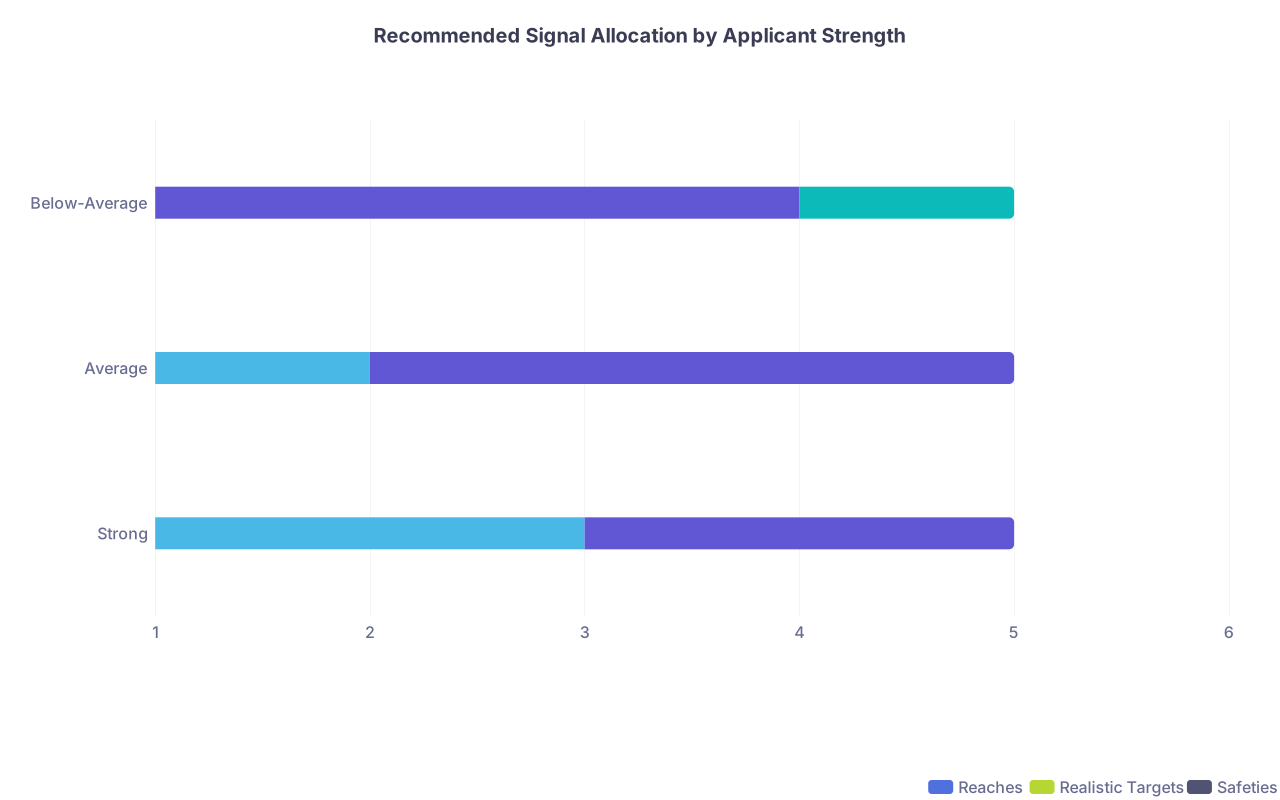
| Category | Reaches | Realistic Targets | Safeties |
|---|---|---|---|
| Strong | 3 | 2 | 0 |
| Average | 2 | 3 | 0 |
| Below-Average | 1 | 3 | 1 |
FAQ: Signaling Reach vs Safer Programs
If I don’t signal a reach program, does that mean I have no chance there?
No. You can still get interviews without signaling, especially if you have strong stats, a great letter, or a rotation there. Signals increase odds at the margin; they’re not a hard gate.Should I signal my absolute dream program even if it’s a fantasy reach?
Usually no. If you’re clearly far below their typical applicant pool and have no ties or fit, the signal is almost certainly better used elsewhere. “Dream” doesn’t change their filters.How many reach programs is too many to signal?
For an average applicant, more than 1–2 reaches is excessive. Once you’re spending 3+ signals on longshots, you’re sacrificing real interview opportunities at programs that would genuinely consider you.What if my school advisor says I should ‘shoot my shot’ and signal a big-name place?
One “shoot your shot” signal is fine if you have a somewhat plausible profile. Just don’t let that become your whole strategy. Advisors sometimes overestimate how much weight a signal carries at elite places.Is it better to signal a mid-tier program where I’m strong, or a high-tier program where I’m a reach?
If your goal is maximizing interviews, it’s usually better to signal the mid/upper-mid program where you’re competitive. One exception: if the high-tier program is your away rotation or you have strong ties, that can justify a reach signal.Do community programs care about signals as much as academic ones?
Many do not rely on signals as heavily, but this varies. Some community-heavy or hybrid programs will still use signals to prioritize interviews from a giant pile. In general, signals buy you more at busy academic and popular mid-tier programs than at small, under-applied-to community programs.
Key points to walk away with: signals amplify realistic opportunities; they do not resurrect dead ones. Use them where you are in the conversation—not where you’re trying to magically get invited to the table.