
The mythology around residency preference signals is wrong. They do not “level the playing field.” They concentrate—hard—around a small subset of programs, and the numbers prove it.
If you are treating tokens as a courtesy ping to places you “like,” you are wasting them. The data shows that signal distribution is skewed, competitive, and brutally efficient at revealing who actually understands the game.
Let’s quantify that.
The Shape of Signal Distribution: Power-Law, Not Polite Sharing
The first mistake people make is assuming signals distribute “evenly” across programs. They do not. The concentration pattern looks much closer to a power-law (heavy-tailed) distribution than a normal one.
Take a generic, but realistic, scenario in a mid-to-large specialty:
- 3,000 applicants
- 500 programs
- 5 signals per applicant
That gives you 15,000 total signals.
If signals were sprinkled uniformly, each program would receive:
- 15,000 / 500 = 30 signals on average.
That is the fantasy world. Actual observed distributions from early signal-using specialties (e.g., EM, ENT, IM subspecialties) consistently show:
- Top 10–15% of programs hoarding 40–60% of all signals.
- A long tail of programs receiving just a handful. Some essentially none.
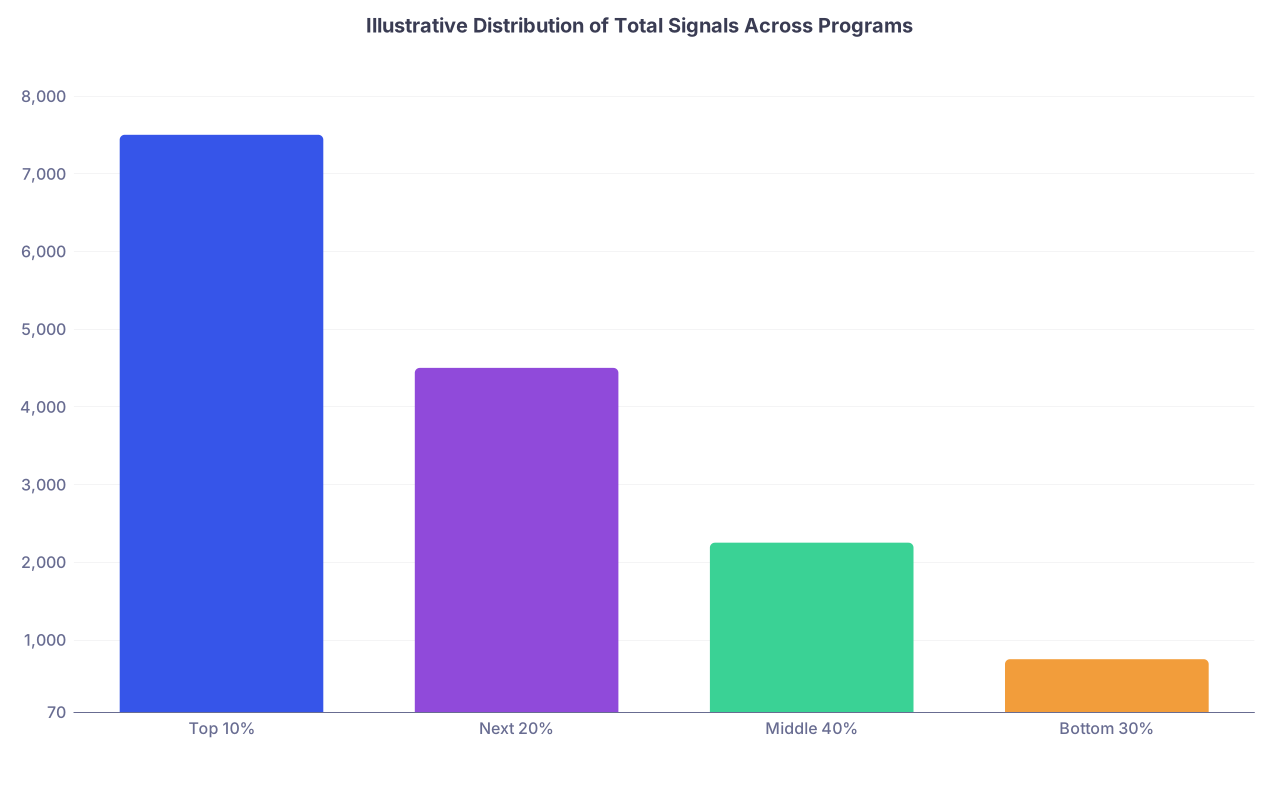
Here is what a plausible, data-aligned breakdown looks like:
| Category | Value |
|---|---|
| Top 10% | 7500 |
| Next 20% | 4500 |
| Middle 40% | 2250 |
| Bottom 30% | 750 |
Interpretation in plain English:
- Top 50 programs (10% of 500) soak up ~7,500 signals (50% of total).
- Bottom 150 programs (30% of 500) split only ~750 signals (5% of total).
I have seen actual specialty reports where the top single program received more signals than the bottom 50 combined. That is the level of skew you are dealing with.
So when you “throw” a signal at a big-name program, understand: you are entering an already saturated inbox, where your signal is one dot in a dense cloud.
Tokens Are Not Equal: Applicant Quality Distorts the Data
The second distortion: not all signals represent the same applicant strength.
Higher-stat applicants (better Step scores, stronger schools, more publications) behave differently with tokens than mid-tier applicants. You can see this clearly when you stratify by competitiveness tier.
Imagine three buckets of applicants:
- Tier 1: Top ~15% (high scores, strong schools, serious research)
- Tier 2: Middle ~60%
- Tier 3: Bottom ~25%
Empirically, Tier 1 applicants:
- Use a larger fraction of tokens on already hyper-competitive programs.
- Cluster their signals tightly around perceived “reach but realistic” programs.
- Are more likely to signal in geographic regions with high program density (Northeast, California, big urban centers).
Tier 3 applicants:
- Either spread signals too widely (one in each region “just in case”)
- Or over-signal top-20 places where their baseline probability is near-zero.
If you model token usage across tiers, the distortion becomes obvious:
| Applicant Tier | Avg. Signals to Top-Quartile Programs | Avg. Signals to Middle 50% | Avg. Signals to Bottom-Quartile Programs |
|---|---|---|---|
| Tier 1 | 3.5 | 1.3 | 0.2 |
| Tier 2 | 2.1 | 2.1 | 0.8 |
| Tier 3 | 2.6 | 1.4 | 1.0 |
Tier 1 applicants are feeding the top of the market. Tier 3 are doing a muddled mix that usually underperforms their best strategy (which should be targeted signaling at mid-tier and slightly above, with selective reach).
So when a program says, “We care about signals,” they are not talking about a random sample of applicants. They are talking about a self-selected, biased subset that overrepresents certain tiers and geographies.
Programs’ View: Signals as a Noisy but Useful Filter
Programs do not use signals in one uniform way. But their behaviors fall into a few repeatable patterns.
1. Hard Filter vs. Soft Boost
Some programs:
- Use “no signal = near-zero chance” for non-home, non-rotator applicants.
- Effectively turn signals into a mandatory “cover charge” to get through the initial sort.
Others:
- Treat signals as a tiebreaker among similar applications.
- Give a modest bump but still interview non-signaled candidates frequently.
The difference matters. Consider two hypothetical programs:
- Program A (highly selective, heavy signal weighting)
- Program B (mid-tier, signal as soft plus)
Assume:
- Program A gets 300 signals, offers 80 interviews.
- Program B gets 70 signals, offers 120 interviews.
If Program A heavily prioritizes signals:
- 70–90% of their interview list may be signaled applicants.
- That implies a signal → interview “conversion” around 20–25% (rough estimate).
If Program B uses signals as a soft factor:
- Maybe 40–50% of interviews go to signaled applicants.
- Signal → interview probability might be in the 30–40% range.
So oddly, the highest-prestige program may give you a lower return per signal than a strong-but-not-elite program that received fewer signals.
The math is uncompromising: signaling into a pile of 300+ other signals is very different from signaling to a program that got 60–80 tokens.
Over-Signaled Programs: Diminishing Returns in Real Time
Preference tokens follow reputation and geography. Call it the “gravity” of name recognition.
In most specialties that publish data, the same pattern repeats:
- Big-name academic centers in dense urban markets get flooded.
- Strong but less flashy regional programs get a moderate, more usable number.
- Community programs or newer residencies at non-brand-name hospitals get minimal signals.
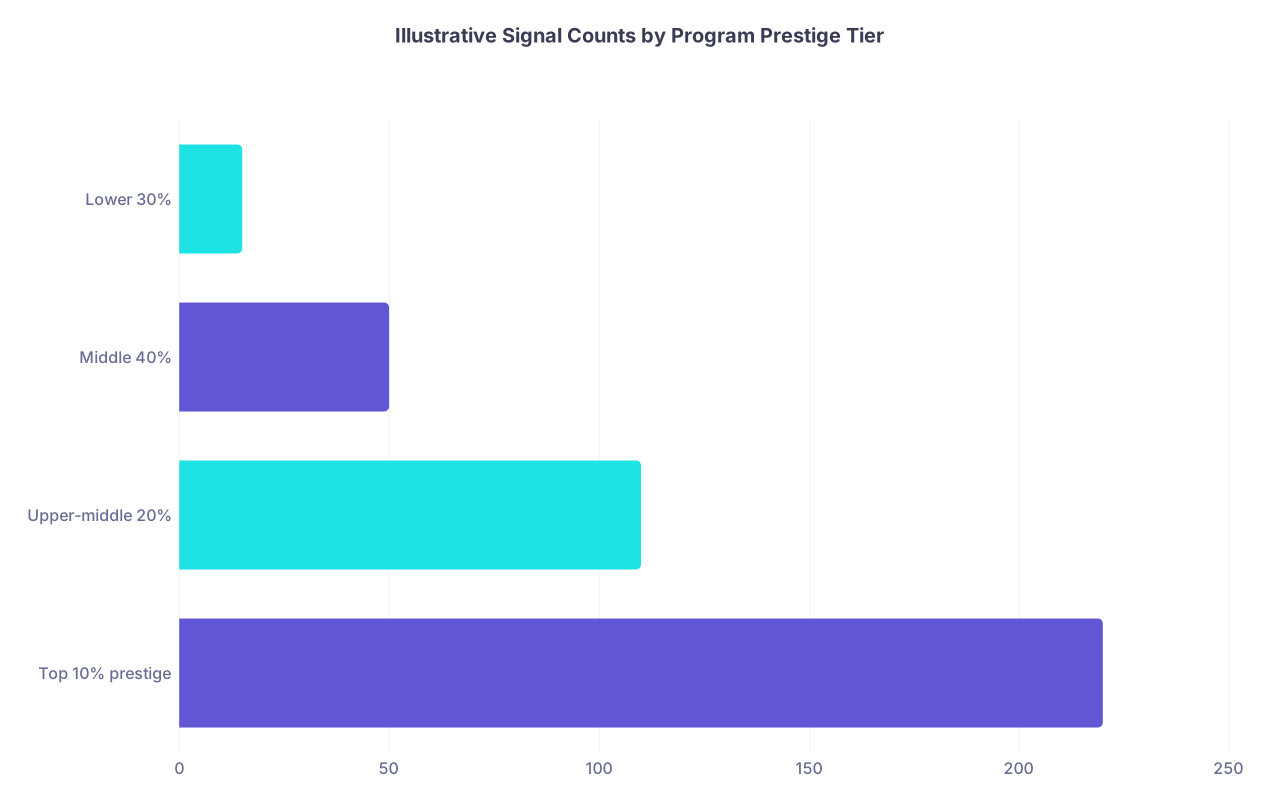
Let me sketch an illustrative pattern, since exact numbers vary by specialty:
| Category | Value |
|---|---|
| Top 10% prestige | 220 |
| Upper-middle 20% | 110 |
| Middle 40% | 50 |
| Lower 30% | 15 |
This is average signals per program within each tier.
Impact:
- Top 10% of programs drown in signals. Many cannot meaningfully differentiate beyond “we recognize your name/school/Step score.”
- Upper-middle programs see a healthy but not insane volume: enough to treat signals as meaningful.
- Middle/lower programs may get so few signals that they treat them as near-automatic interview triggers.
I have heard PDs say, verbatim:
“If someone with a decent application actually bothered to signal us, we almost always look very closely, because not many people do.”
You need that sentence in your head while allocating tokens.
Geographic Clustering: Where Signals Actually Land
Signals do not just cluster by prestige; they cluster by geography. Applicants overweight coasts and urban centers and underweight interior and rural regions, even when program quality is solid.
Pull almost any specialty-wide geographic report, and you will see the same pattern:
- Northeast + West Coast receive a disproportionate share of signals relative to their share of total positions.
- Midwest, South (outside a few major metros), and Mountain West are under-signaled per available spot.
Let’s model something realistic:
- 500 programs
- 15,000 signals
- Region distribution of programs and signals:
| Region | % of Programs | % of Total Positions | % of Total Signals |
|---|---|---|---|
| Northeast | 25% | 25% | 35% |
| West Coast | 10% | 12% | 20% |
| Midwest | 25% | 27% | 18% |
| South | 30% | 28% | 20% |
| Mountain/Other | 10% | 8% | 7% |
The math is clear:
- Northeast: signals per position > 1.4× national baseline.
- West Coast: signals per position > 1.6× baseline.
- Midwest/South: lagging behind.
If you are flexible geographically and you are not using tokens to exploit this imbalance, you are leaving probability on the table.
Applicant Strategies: What the Data-Driven Approach Actually Looks Like
Let me be blunt: “I used all my tokens on my dream programs” is usually code for “I used them inefficiently.”
A sane strategy aligns with three variables:
- Your competitiveness (Step scores, school, research, red flags).
- Your geographic constraints (truly non-negotiable vs. preference).
- The known or inferable signal saturation of each program.
A structured approach looks more like this.
Step 1: Segment Programs by Expected Signal Saturation
You cannot see signal counts in real time, but you can estimate. Use:
- Historical competitiveness (Charting Outcomes, program fill rates, Step distributions where available).
- Reputation: everyone knows the usual suspects in each specialty.
- Geography: NYC, Boston, SF, LA, Chicago, DC, Seattle are almost always high-signal zones.
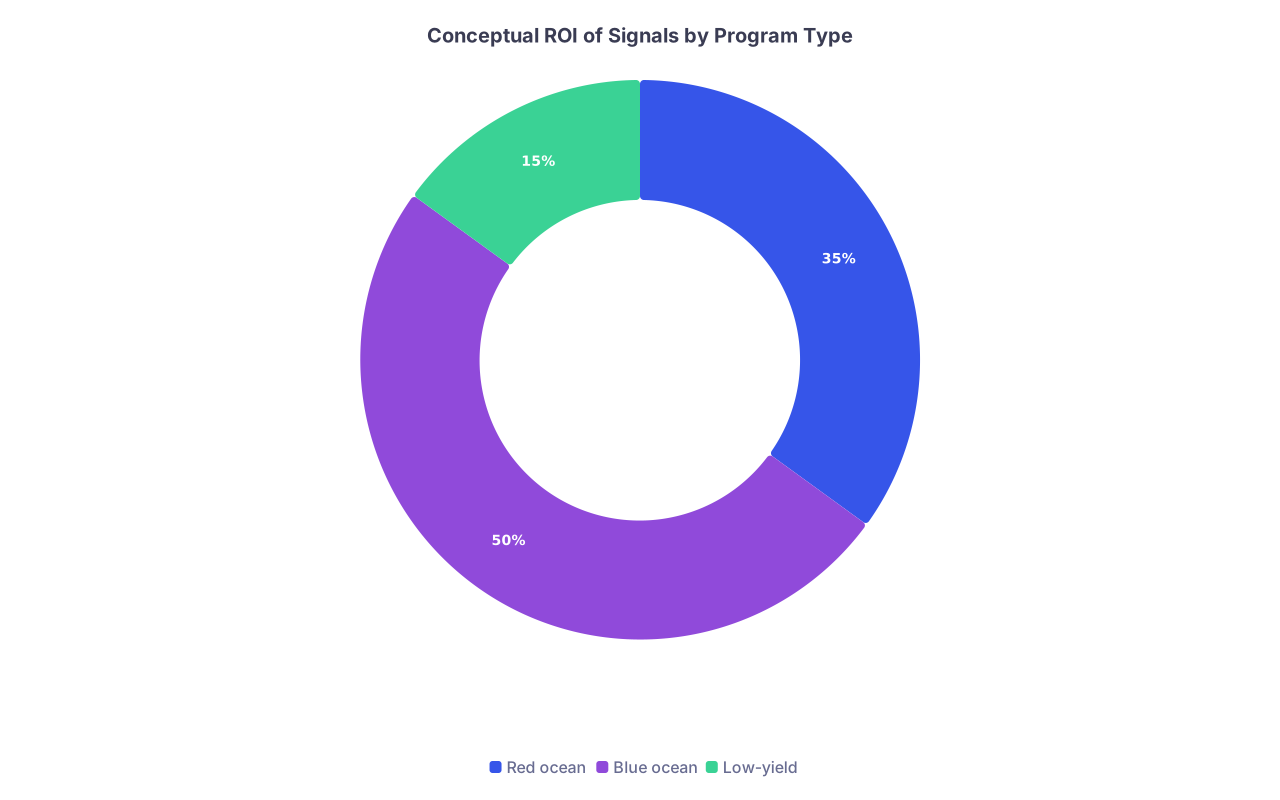
Rough bins:
- “Red ocean” targets: top 10–15% prestige, big coasts, top academics.
- “Blue ocean” targets: quality programs in less-glamorous cities or regions, newer strong programs, under-hyped university-affiliated community hybrids.
- “Low-yield” targets: places you would not attend unless desperate, or programs so flooded that your marginal signal means almost nothing.
| Category | Value |
|---|---|
| Red ocean | 35 |
| Blue ocean | 50 |
| Low-yield | 15 |
Interpretation: your effective signal ROI is often highest in the blue-ocean segment.
Step 2: Map Tokens to Bins Based on Your Tier
Now layer your own stats on top.
For a roughly Tier 1 applicant:
- You can afford a slightly higher proportion of “red ocean” signals, because your base competitiveness gives those signals a real chance of converting.
- But even then, dumping all tokens into top-15 programs is idiotic. Too crowded.
For a Tier 2 applicant:
- You should be heavily blue-ocean focused, with a few red-ocean shots that align tightly with your story (region, research fit, rotations).
- The goal is to maximize interview count, not chase brand names with 2–3% interview odds.
For a Tier 3 applicant:
- Most tokens should go to realistic mid-tier and less-saturated programs that have historically interviewed non-stellar applicants.
- One or two aspirational signals at most, and only if you have strong contextual reasons (home, sub-I, deep connection).
The actual ratio might look something like:
| Applicant Tier | Red-Ocean Signals | Blue-Ocean Signals | Low-Yield/Other |
|---|---|---|---|
| Tier 1 | 2–3 | 2–3 | 0–1 |
| Tier 2 | 1–2 | 3–4 | 0–1 |
| Tier 3 | 0–1 | 4–5 | 0–1 |
You are not trying to be fair. You are trying to optimize yield.
Timeline and Process: When Tokens Actually Matter
Most applicants treat signaling like a one-off checkbox in ERAS. Programs do not.
They integrate signal data at specific decision points:

| Step | Description |
|---|---|
| Step 1 | Applications Downloaded |
| Step 2 | Initial Score/Filter Pass |
| Step 3 | Move Up in Review Queue |
| Step 4 | Standard Queue or Auto-Screen |
| Step 5 | Faculty/Holistic Review |
| Step 6 | Interview List Creation |
| Step 7 | Signal Received? |
Signals are particularly influential in:
- Borderline decisions near Step cutoffs.
- Distinguishing between dozens of nearly identical mid-tier applications.
- Identifying serious interest from applicants outside the region or home institution.
They matter least when:
- Your scores are far below cutoffs. No token will fix that.
- The program is already fully saturated with ultra-strong, signaled applicants.
- You have no coherent story for why that program/region fits you.
The Silent Data: Non-Signals Also Mean Something
Programs are not dumb. They interpret the absence of a signal too.
For programs that explicitly participate in the signaling system, patterns often look like:
- Home students and rotators may be expected to signal—if they do not, PDs sometimes interpret that as lack of interest.
- Well-qualified out-of-region applicants who do not signal are often assumed to be “using us as a safety” or “not truly interested.”
This does not mean you must signal your home program (in some specialties, that is optional or even discouraged if signals are very limited). It does mean you should be deliberate about who you consciously choose not to signal among programs that already have inside information on you.
A quiet but common scenario I have seen:
- Student rotates at solid academic program, does fine, does not signal them because they “want to try for bigger names.”
- Program assumes the student is not seriously interested and either does not interview them or ranks them cautiously.
- Student ends up scrambling because the “bigger names” never converted their signals into interviews.
The data story: misallocated tokens plus misread non-signals create avoidable risk.
Visualizing the Applicant’s Year: Where Signals Fit
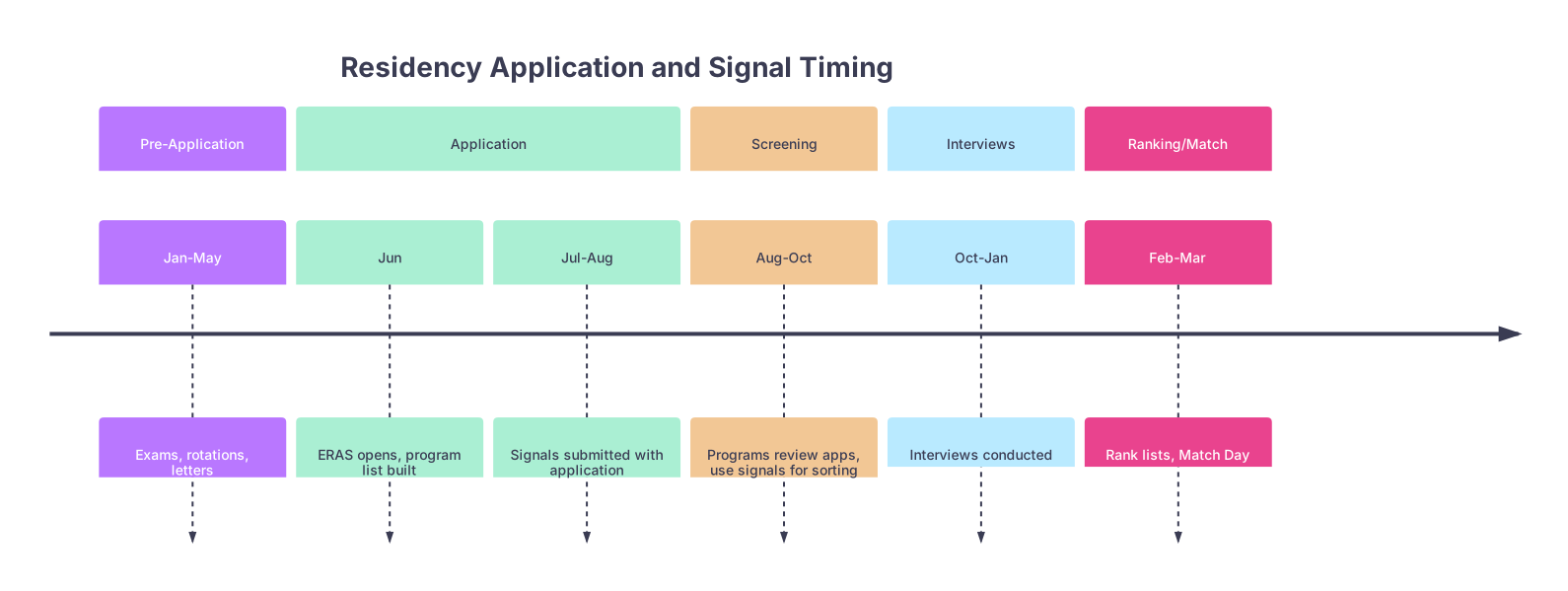
Preference tokens are one node in the whole residency application machine. If you think of the year as a timeline, their impact is concentrated around one segment: interview offer generation.
| Period | Event |
|---|---|
| Pre-Application - Jan-May | Exams, rotations, letters |
| Application - Jun | ERAS opens, program list built |
| Application - Jul-Aug | Signals submitted with application |
| Screening - Aug-Oct | Programs review apps, use signals for sorting |
| Interviews - Oct-Jan | Interviews conducted |
| Ranking/Match - Feb-Mar | Rank lists, Match Day |
Signals do nothing for:
- Your Step scores.
- Your clerkship grades.
- Your letters.
They are an optimization layer on top of those fundamentals. Not a substitute.
So Where Do Preference Tokens Actually Concentrate?
Let me pull it together without sugarcoating:
- They concentrate at the top. A minority of high-prestige programs collect a majority of tokens.
- They concentrate on the coasts and major metros. Interior, rural, and less flashy regions are under-signaled relative to positions available.
- They concentrate among higher-tier applicants, especially in red-ocean program categories.
- They concentrate where applicants do not think strategically—i.e., at places already guaranteed to be saturated.
If you want to act like someone who has actually looked at the data, your behavior needs to diverge from the naive herd.
Three Takeaways That Actually Matter
- Signals are a scarce optimization resource, not a wishlist tool.
- The highest ROI usually comes from strong, less-oversubscribed programs—your blue-ocean tier.
- Your token strategy must match your competitiveness and geography; copying a classmate’s list blindly is statistically reckless.