
Programs do not automatically reject every applicant with a probation history. But they absolutely will reject applicants who handle it badly.
That’s the real myth here: not “probation is fine” (it’s not), and not “probation = automatic death sentence” (also wrong). The truth is more uncomfortable: probation is a serious red flag that magnifies everything else in your file—good and bad—and forces programs to do extra work. Some will not bother. Others will, if you give them a coherent story, evidence of change, and minimal additional risk.
Let me break down how this actually plays out behind the scenes instead of the fear-based folklore you hear on Reddit.
What Program Directors Really See When They Read “Probation”
Most students imagine a binary: “probation” means your ERAS goes straight into the trash. That’s not how it works.
Here’s what happens in reality at most programs:
Initial screen:
A coordinator or PD skims Step scores, school, visa status, repeated years, and obvious red flags (probation, professionalism violations, dismissals). Some programs do have hard filters (e.g., any professionalism probation = no interview). Many do not. They just flag you as “needs review.”Context review:
If you’re otherwise strong, the PD reads for context: What happened? Academic vs professionalism vs misconduct? One-time or pattern? Early or late in training?Risk calculation:
The PD asks:- “If this behavior repeats during internship, how bad is the damage?”
- “If I bring this applicant to the CCC (clinical competency committee) in a year, will my faculty say ‘You should have seen this coming’?”
Programs fear predictable headaches more than low scores.
Competing applicant comparison:
They compare you to others at your tier. If you’re a borderline candidate with probation, easy rejection. If you’re top of their pool with a clean, believable explanation and strong current performance, you’re in the discussion.
So no, there’s no giant red “AUTO-REJECT” button that fires the moment “probation” appears. But there is a brutal risk-benefit calculation, and you start from behind.
Not All Probation Is Created Equal
“Probation” is treated like a single word. Programs see at least four different categories, and they are not equivalent.
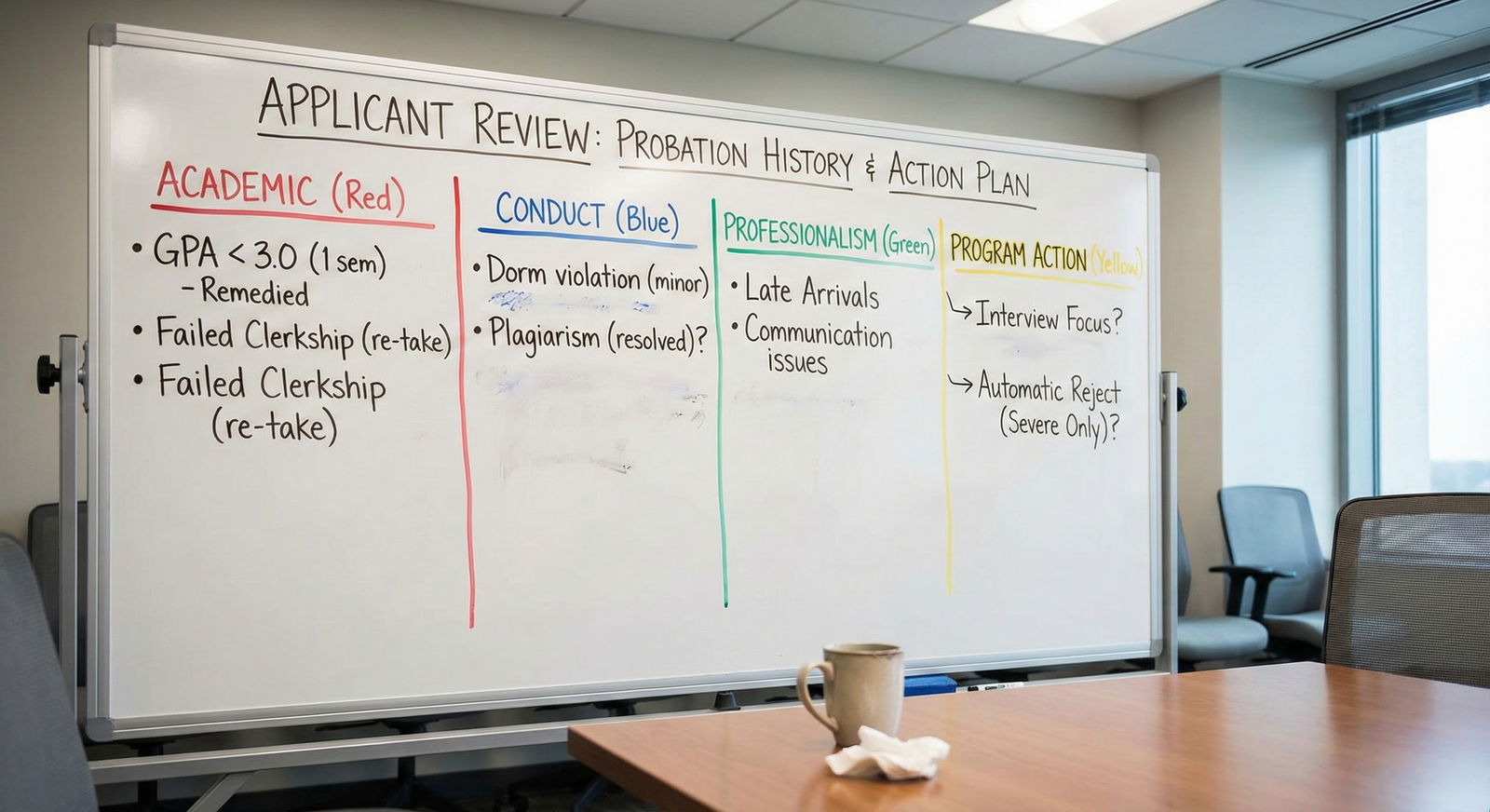
1. Purely Academic Probation (Early, Limited)
Example:
MS1, failed anatomy and biochem in first semester, placed on academic probation. Remediated over the summer, passed everything since, honors in clerkships, strong Step 2.
How PDs often see it:
- “Transition issues.” Maybe underprepared college, illness, bad study strategy.
- If it’s early, one-time, and followed by a long clean track with strong Step 2, many PDs will discount it—especially in less competitive specialties.
This is not fatal if documented and clearly improved.
2. Repeated Academic Problems
Example:
MS1–MS2 with multiple course failures over multiple terms. Step failures. Repeated clerkships. Multiple terms of probation.
This is harder to rescue. You’ve now raised doubts about:
- Consistency
- Ability to handle volume and pace
- Test-taking at scale
Programs in high-intensity specialties (EM, surgery, anesthesia) will be especially wary. Some primary care or community programs may still consider you if Step 2 and recent performance are solid. But you’ll need an airtight upward trend and strong letters that specifically say: “This student can handle residency workload.”
3. Professionalism / Conduct Probation
This is the big one.
Examples PDs read and immediately tense up:
- Disrespectful to staff or patients
- Repeated tardiness/no-shows
- Cheating, plagiarism, exam rule violations
- Harassment, boundary violations, serious unprofessional emails
- Dishonesty during prior remediation
Professionalism probation is a different beast. Programs know skills can be taught; character problems break teams.
Some programs have de facto “no” rules for professionalism probation, especially anything involving dishonesty or harassment. Others will consider it if:
- It was early
- The student shows sustained changed behavior
- Multiple faculty explicitly vouch for their professionalism now
But if your probation involved dishonesty plus later inconsistencies in your explanation? That’s done. You’re finished at most places.
4. Conduct-Related to Health / Personal Crisis
Gray zone. Example:
Depression, substance misuse, or a major personal crisis leads to absences, dropping performance, or behavior that triggered probation. Then the student received treatment, took a leave, returned with clean performance.
Here PDs split:
- Some see any association with substance misuse or major mental health crisis as too risky.
- Others—especially where wellness actually means something—will consider the trajectory: Did you get help? Has there been a stable period of good performance? Are letters describing reliability now?
So no, these cases are not automatically dead in the water, but they’re heavily dependent on evidence of sustained stability.
How Often Does Probation Kill an Application?
We do not have a giant national database labeled “probation outcomes.” But we do have enough indirect data and PD surveys to say this:
- Red flags (failures, probations, professionalism issues) dramatically decrease interview likelihood.
- They do not reduce the odds to zero when the rest of the application is strong and the flag is truly isolated.
Here’s a rough, reality-based view of how PDs weigh different red flags.
| Red Flag Type | Typical PD Reaction |
|---|---|
| Early, single academic probation | Hesitation, context-dependent |
| Multiple academic probations | Major concern |
| Step 1 fail (now pass/fail legacy) | Moderate–major, mitigatable |
| Step 2 CK fail | Major, often interview-killer |
| Professionalism probation | Major, sometimes absolute no |
| Dismissal + re-admission | Very high barrier |
Is this perfectly quantified? No. But in conversation after conversation, PDs repeat the theme: professionalism issues and repeated problems are more toxic than a single early academic stumble.
The Bigger Myth: “If I Mention It, I’m Dead”
I hear this constantly: “If I bring up my probation, I’ll be rejected. So maybe they won’t see it.”
They will see it.
MSPE (Dean’s Letter). Transcripts. Internal school narratives. Some schools use euphemisms, but most PDs can read between the lines because they’ve seen dozens from your school.
Trying to hide probation is not “strategic.” It is suicidal. The fastest way to guarantee rejection is to let the PD discover it without your framing, your accountability, or your growth story.
What works better:
Consistent story in all venues
- Application: brief mention.
- Personal statement: only if central and you can show growth; not a confessional essay.
- Interview: same facts, same tone, no drama.
Own the mistake without self-immolation
The worst answers:- “It was blown out of proportion.”
- “It wasn’t my fault, the faculty had it out for me.”
- “I don’t really remember the details.” (They do. In writing.)
What PDs want to hear:
- Clear description of what happened (no slippery language)
- What you learned specifically
- Concrete changes you’ve made that have held up over time
Show—not claim—growth
Claims: “I matured a lot.” Everyone says that.
Evidence: Two years of on-time rotations, strong evaluations, leadership roles, faculty saying “dependable, professional, well-liked by staff.”
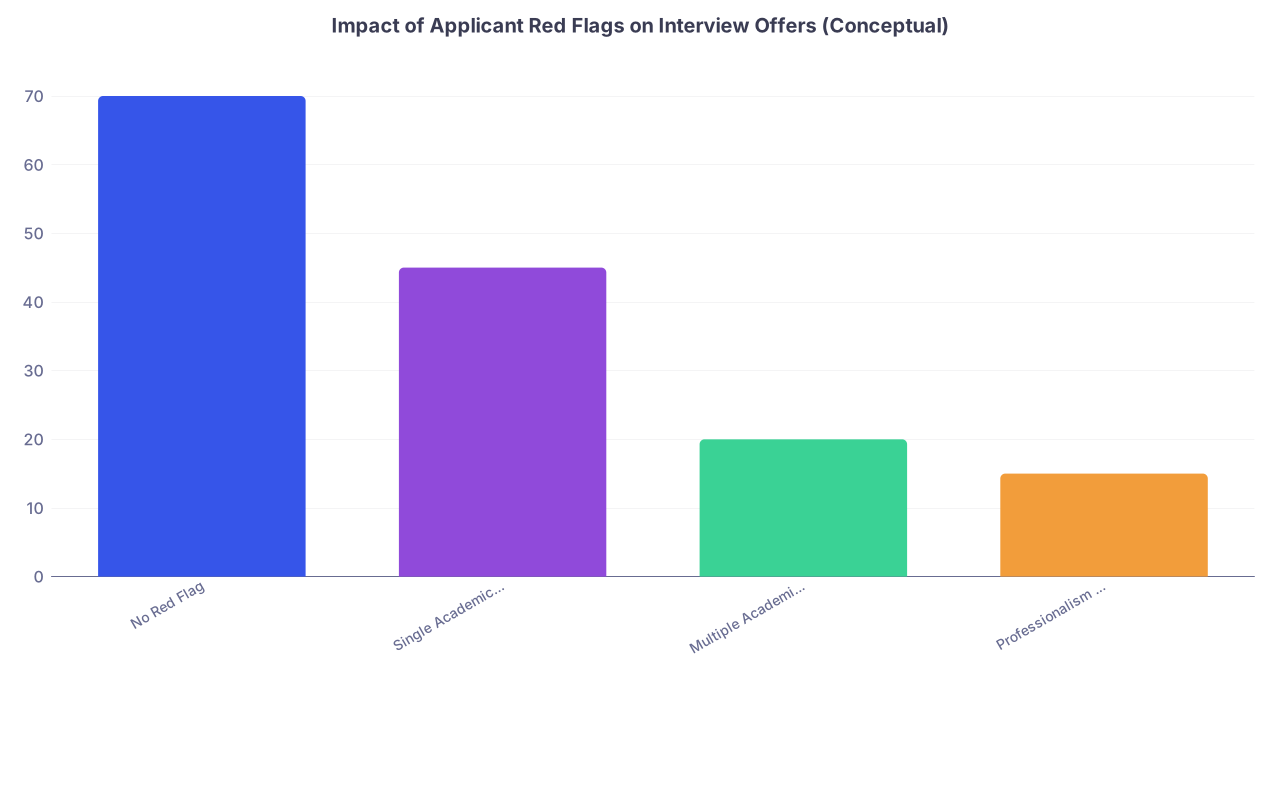
| Category | Value |
|---|---|
| No Red Flag | 70 |
| Single Academic Probation | 45 |
| Multiple Academic/Step Failures | 20 |
| Professionalism Probation | 15 |
Those numbers are conceptual, but the pattern is correct: the more severe/character-based the issue, the steeper the drop—but not to zero in every context.
Specialty and Program Type: Where Probation Hurts More (or Less)
Not all specialties, and not all programs, treat risk the same.

Here’s the pattern I’ve actually seen:
Highly competitive specialties (Derm, Ortho, Plastics, ENT, Rad Onc, some EM, some Anesthesia)
You’re competing with spotless, high-scoring applicants. Many of these programs will effectively auto-reject for any serious red flag, because they don’t have to tolerate risk. Probation here is usually fatal unless the rest of your file is truly exceptional and the probation is ancient and minor.Moderately competitive (IM at big-name places, Gen Surg at mid-high tier, Anesthesia, EM, Radiology)
They still have choices. A professionalism probation? Often a non-starter. A single early academic probation with great Step 2 and strong clerkship performance? Possible, but you’re not matching at the very top places.Primary care / community / less competitive programs
These programs are more heterogeneous. Some have strict risk filters. Others are run by people who’ve seen non-linear trajectories and are willing to take a chance if:- You’ve been solid for years now.
- Your letters are strong and specific.
- You present with maturity, not defensiveness.
Do not misread this as “Just apply FM, they’ll all take me.” They won’t. But you’re more likely to find a PD who sees probation as data, not destiny.
How To Talk About Probation Without Torching Yourself
You do not need a four-page confession. You do need a disciplined narrative.
Here’s the structure that consistently works better than the rambling guilt-trip essays I see:
State the fact cleanly and briefly.
“During my first year of medical school, I was placed on academic probation after failing two courses.”Name the cause with honesty and specificity.
Good: “I underestimated the volume of content, clung to ineffective study methods, and didn’t seek help early.”
Weak: “Things were just really stressful and it was a tough time.”Describe the concrete actions you took.
- Met weekly with learning specialist
- Changed note-taking and review schedule
- Joined structured study group
- Built new test-taking strategies
Show the results over time.
- All subsequent coursework passed on first attempt
- Strong clinical evals (“consistently prepared and reliable”)
- Step 2: solid or strong score
Connect it briefly to residency readiness.
“That experience forced me to build systems for time management and accountability that I’ve carried into my clerkships. My attendings now describe me as organized, dependable, and prepared for busy inpatient services.”
For professionalism probation, the bar is higher and the language must be even more precise. Example outline:
- “I made an unprofessional comment about a team member during a stressful call night.”
- “I did not appreciate at the time how my words affected the team and the trust others placed in me.”
- “I met with faculty, completed a professionalism remediation program, and sought feedback intentionally during subsequent clerkships.”
- “Since then, my evaluations consistently describe me as respectful and team-oriented. A senior nurse on my medicine service described me as ‘always supportive and professional under pressure.’”
If you cannot say something like that truthfully, you have a bigger problem than ERAS wording.
Letters: The Hidden Decider
One thing applicants underestimate: what your letter writers know and say about your probation can save or sink you.
I’ve seen two scenarios play out:
The “we all know, but we trust them now” scenario
The PD calls your school’s dean. They say:
“Yes, they were on probation MS1. They had some maturity issues. But the last two years? Completely solid. I’d rank them for my own program.”
This kind of backchannel endorsement dramatically softens the red flag.The “quiet concern” scenario
The dean or faculty says:
“They improved some, but there were still concerns about reliability,” or worse, “we’d be cautious.”
Translation: PD rejects you and feels vindicated.
You can’t fully control this, but you can choose letter writers who:
- Worked with you after your probation episode
- Saw your “new” behavior in action
- Are willing to comment positively on your professionalism and reliability, not just your medical knowledge
If your letters say nothing about reliability, teamwork, or professionalism after a professionalism probation? PDs notice that silence.
The Reality: Probation Is a Multiplier, Not a Switch
Let’s be blunt.
Probation makes everything else in your application matter more:
- Low Step 2 + probation? Programs think, “Ongoing issues.”
- Mediocre clerkship comments + probation? “Pattern.”
- Strong Step 2, excellent clinical comments, glowing letters, clear narrative? “Maybe one bad year, they got it together.”
And the myth that “programs automatically reject anyone with probation” is comforting in a twisted way—it lets you pretend the outcome is out of your hands. The truth is more demanding: your choices now still matter.

| Step | Description |
|---|---|
| Step 1 | Application Submitted |
| Step 2 | Standard Screen |
| Step 3 | Flag for Review |
| Step 4 | Reject |
| Step 5 | Consider Interview |
| Step 6 | Probation History? |
| Step 7 | Strong Recent Performance? |
| Step 8 | Clear, Honest Explanation? |
| Step 9 | Letters Support Growth? |
That’s closer to how most programs actually function.
Bottom Line: Three Things You Need to Accept
No, you are not automatically rejected everywhere.
But some programs and specialties will effectively auto-reject, especially for professionalism issues. You cannot change that.Your handling of the probation matters as much as the event itself.
Honest, concise, consistent explanation + strong current performance + supportive letters can convert “absolutely not” into “maybe” and sometimes “yes.”Probation is a severe disadvantage, not a death sentence.
It narrows your options, demands more from your post-probation record, and forces you to be more strategic about specialty and program selection. But it does not erase your chance to match—unless you ignore it, minimize it, or repeat the same behavior.
Own it. Fix what led to it. Then build a record that makes a reasonable PD say, “They stumbled. Then they did the work. I can live with that risk.”
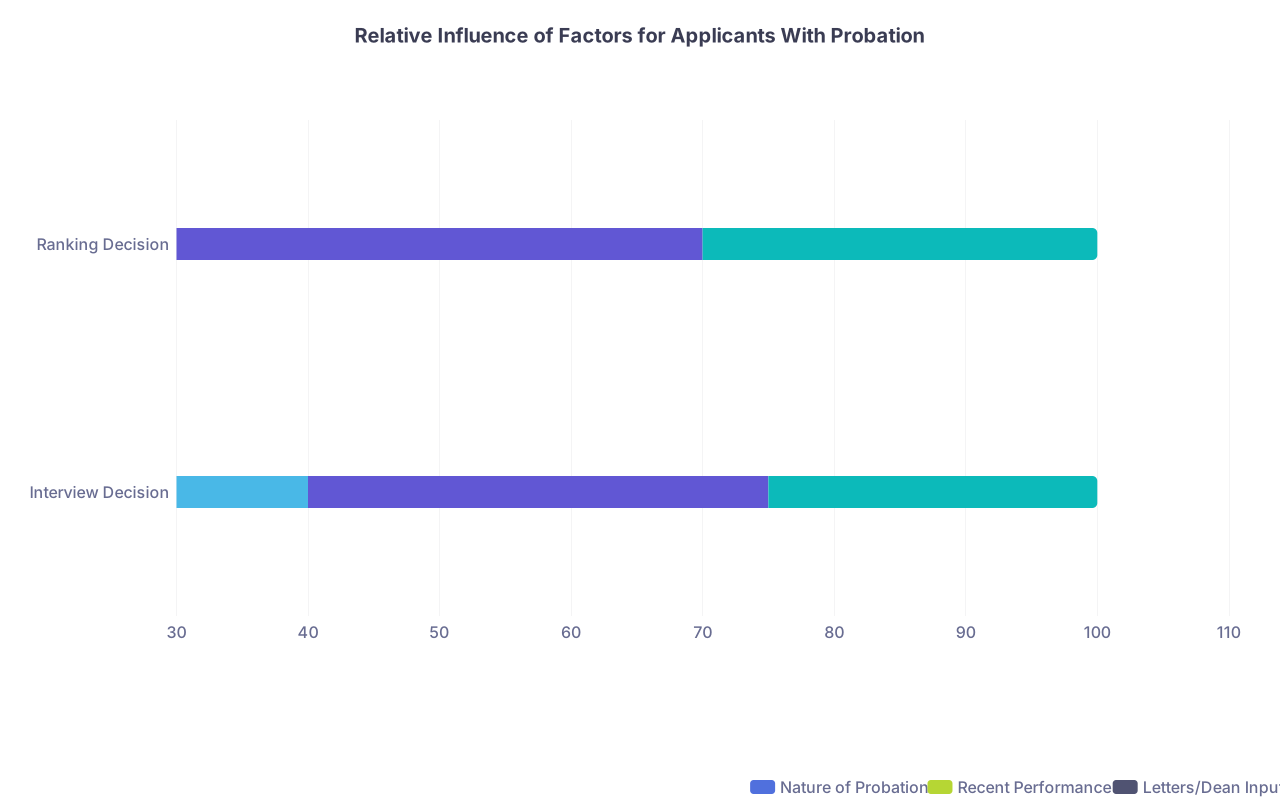
| Category | Nature of Probation | Recent Performance | Letters/Dean Input |
|---|---|---|---|
| Interview Decision | 40 | 35 | 25 |
| Ranking Decision | 30 | 40 | 30 |