
Most applicants explain academic probation in a way that quietly kills their application.
Not because they had probation. Because of how they talk about it.
I’ve watched people with serious academic issues still match solid programs. I’ve also watched people with minor, fixable missteps get tanked because their explanation set off every red-flag alarm in the room.
If you had academic probation, read this like your match depends on it. Because it might.
The Biggest Myth About Academic Probation
The dangerous myth:
“If I just downplay it or give a vague explanation, it’ll be fine.”
No. That’s exactly how you turn a manageable concern into a trust problem.
Here’s how most applicants think:
- “If I just say ‘personal reasons’ and move on, they won’t dig deeper.”
- “If I blame the school’s system or an unfair policy, I’ll look justified.”
- “If I over-explain every detail, they’ll see it wasn’t my fault.”
What programs actually hear:
- Vague = Hiding something worse.
- Blame = Not coachable. Not accountable.
- Over-defensive = Still raw. Not processed. Might crack under stress.
Your academic probation is not the automatic red flag.
Your explanation can be.
The 7 Ways People Botch Their Explanation

1. The “It Wasn’t a Big Deal” Minimizer
This is the fastest way to make it a big deal.
What it sounds like:
- “It was just one semester; it really wasn’t that serious.”
- “Honestly, I don’t even think I should have been placed on probation.”
- “It was more of a technical thing than a performance problem.”
Why this backfires:
- Programs know probation is a big deal for your school. Whether you agree or not doesn’t matter.
- Minimizing tells them you still don’t fully grasp the seriousness.
- They worry you’ll also minimize clinical errors, feedback, or professionalism issues.
Better frame:
You acknowledge it was serious, you understand why, and you can show proof of change.
If the interviewer understands it better than you do, you’re in trouble.
2. The Blame-Game Historian
Blaming your school, course director, grading system, “unfair exam,” or “personality conflict” is poison.
Common versions:
- “The school was going through curriculum changes, and a lot of people failed.”
- “The exam was poorly written and most of us did badly.”
- “The clerkship director just didn’t like me.”
- “It was a pass/fail system and the bar was arbitrary.”
What the interviewer hears:
- “When things go wrong, this person blames the system.”
- “This resident will blame nursing, the EMR, scheduling, everyone but themselves.”
- “This is going to be a headache when there’s a bad patient outcome.”
Even if the system was unfair, you cannot lead with that. At all.
You can mention context briefly. But if the word “unfair” comes out of your mouth, you’ve probably already lost the room.
3. The Laundry-List Oversharer
On the other side is the applicant who gives a full autobiography of suffering.
What it sounds like:
- “So my grandmother got sick, then my partner and I broke up, then my landlord…”
- “I was dealing with anxiety, then depression, then insomnia, then financial issues…”
- “It was a really dark time—I was having trouble getting out of bed most days.”
Problems:
- Oversharing emotional detail can make programs worry about current stability.
- If 90% of your answer is storytelling and 10% is repair/growth, your priorities look off.
- You risk sounding like you’re asking for sympathy instead of trust.
Programs are not therapy. They’re trying to predict how you’ll do on nights, during codes, with stress piled on top of more stress.
You can acknowledge real hardship. But keep it clinical, contained, and directly linked to:
- what went wrong,
- what you changed,
- why it will not repeat.
4. The Medical-Details Minefield
Academic probation related to mental health or medical issues is common. But many people explain it poorly.
Bad patterns:
- Giving a specific diagnosis when you don’t need to.
- Going deep into medications, side effects, suicidal ideation timelines.
- Sounding like your condition is still unstable or barely managed.
You do not need to:
- Recite your DSM diagnosis.
- Reveal every hospitalization.
- List your medication trials.
You do need to:
- Make it crystal clear you’re now stable.
- Show that you have ongoing support and a mature plan.
- Demonstrate academic/clinical success afterward.
The red flag is not the depression, ADHD, or anxiety itself.
The red flag is: “Will this resurface when they’re my only intern on call?”
If your explanation leaves that question even half-open, you did it wrong.
5. The “Fixed Overnight” Fairy Tale
Another mistake: pretending your turnaround was instant and effortless.
You’ll hear people say:
- “After probation, I just decided to work harder and everything was fine.”
- “I realized I needed to be more disciplined, and my grades shot up.”
- “I just buckled down and that was the end of it.”
Sounds inspirational. Also sounds fake.
Programs know behavior change is rarely that clean. They’re looking for:
- Specific structural changes (study methods, schedules, support systems).
- Objective evidence of sustained improvement.
- Insight into how you think under pressure.
If your story sounds like a motivational poster instead of a real human process, they don’t trust it. And if they don’t trust it, they don’t rank you.
6. The Defensive Body Language Saboteur
You can get the words technically right and still fail the question just with your nonverbals.
Red-flag behaviors I’ve seen across the table:
- Arms crossed, leaning back, chin slightly raised.
- Tight jaw, forced smile when the topic comes up.
- Talking faster, rambling, or cutting off the interviewer.
- Eyes darting away when they ask a follow-up.
Interviewers may not articulate it, but they feel it: “Something’s off here.”
If your body language says:
- “I’m still mad about this.”
- “I feel attacked.”
- “I don’t want to talk about this.”
They’ll assume the issue is still emotionally hot. That means not fully resolved. That means risk.
7. The Essay Version: What Destroys You in Writing
Personal statements and ERAS essays magnify these mistakes because there’s no tone of voice to help you.
The worst written patterns:
- Entire paragraphs about “how unfair” the situation was.
- Overly dramatic language: “devastating,” “shattered,” “crushed my dreams.”
- Making probation the centerpiece of your narrative, instead of a chapter.
If your personal statement’s main storyline is:
“I had a setback, then I overcame it, and now I’m stronger,”
you’ve just made your weakest moment the anchor of your application.
You can address probation in:
- The “Additional Information” section.
- A supplemental essay if asked.
- Rarely, a small, surgical mention in your personal statement if it’s central to your path.
But do not build your entire brand around surviving academic probation. You are more than that. Programs need to see that.
What Programs Actually Want To Hear (But Won’t Spell Out)

No one will tell you this straight, so I will.
When they ask about academic probation, they’re not looking for:
- A perfectly tragic story
or - Proof that you’re a superhero now
They’re screening for:
- Insight – Do you actually understand what went wrong?
- Accountability – Do you own your part without self-destruction or self-pity?
- Stability – Are the underlying issues now treated, structured, or contained?
- Evidence – Does your record after probation back up your story?
- Predictability – Are they comfortable predicting you’ll function at 3 a.m. in the ICU?
If your explanation doesn’t hit all five, it’s incomplete.
A Safer Structure: What To Avoid Screwing Up
Let me be clear: this is not some template to memorize. That’s how you end up sounding robotic.
But there is a structure that avoids 90% of the common landmines.
For Interviews: The 4-Part Spine (Do Not Deviate Wildly)
Brief, factual description of what happened
- 1–2 sentences.
- No drama. No blame. Just the facts.
- Bad: “I was unfairly placed on probation because…”
- Better: “During my second year, I was placed on academic probation due to failing X course.”
Clear, specific reasons – focused on your controllable factors
- Talk about what you misjudged or handled poorly.
- You can mention context (illness, family issues), but your own miscalculations must be front and center.
- Avoid: “Everything happened at once.”
- Use: “I underestimated how much independent study was needed and didn’t seek help early.”
Concrete changes you made
- This is the heart of your answer. It should be the longest part.
- Talk systems: tutoring, schedules, study methods, counseling, time management.
- Name results: shelf scores, clinical evaluations, Step scores, leadership roles after.
Evidence it’s over, not ongoing
- Point to multiple semesters/rotations of strong performance.
- Emphasize consistency, not one heroic rebound.
- End on a calm, matter-of-fact note: “I’m grateful it forced me to build systems I still rely on now.”
What not to do:
- Do not open with your feelings.
- Do not end on a dramatic “and now I’m stronger than ever” line. They’re not buying it.
The Quiet Red Flags Hidden In Your “Context”
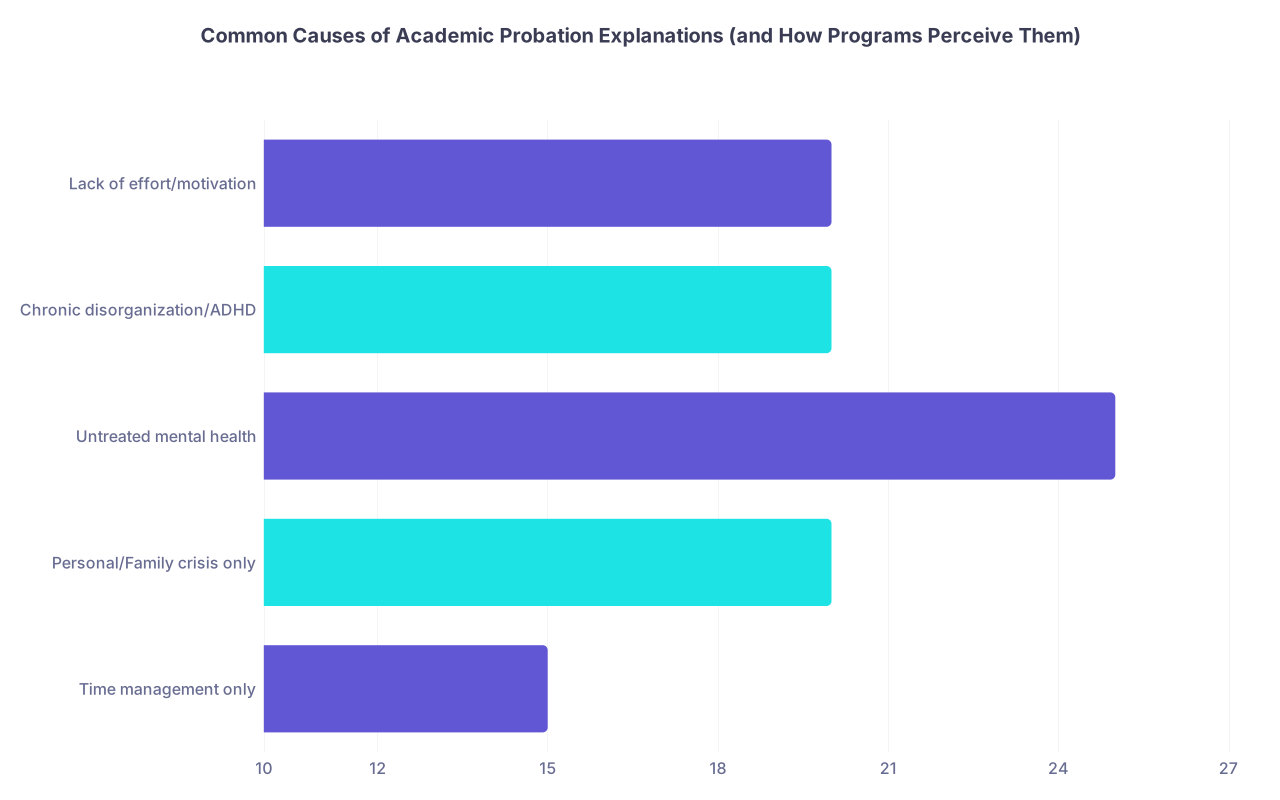
| Category | Value |
|---|---|
| Time management only | 15 |
| Personal/Family crisis only | 20 |
| Untreated mental health | 25 |
| Chronic disorganization/ADHD | 20 |
| Lack of effort/motivation | 20 |
Some “context” you think is neutral actually sets off alarms.
Examples:
1. “I had multiple family deaths that year.”
If you don’t follow this with clear boundaries and current emotional stability, they worry you’re still fragile in the face of loss.
2. “I was working a lot to support myself.”
Admirable, sure. But if you frame it as “I had no choice and the school wasn’t supportive,” it becomes a blame issue.
3. “I realized medicine might not be for me at that time.”
This one is deadly. It plants doubt about your commitment. If you say this, you’d better have an extremely compelling arc back to medicine with multiple years of proof.
4. “I was burned out.”
Programs hear: “Will they burn out again when residency actually turns the fire up to maximum?”
If you use those phrases, you must:
- Show distance between then and now.
- Show concrete changes, not just emotional maturity.
- Show time – quick turnarounds don’t feel believable.
How Not To Talk About Probation in Essays

In writing, your mistakes are frozen on the page. People re-read them. They show your thought process more than you think.
Don’t Make These Essay Errors
Turning your personal statement into a probation memoir
- A brief mention, if necessary, is fine.
- A whole narrative arc around it? No.
- You’re applying to be a doctor, not for a hardship scholarship.
Using “resilience” as a glittery cover
- If your essay sounds like: “I’m resilient because… probation,” the faculty roll their eyes.
- Everyone is “resilient” in these essays. It stopped meaning anything years ago.
Copy-pasting your Student Affairs letter tone
- Those letters are often defensive, legalistic, or awkwardly phrased.
- If your essay sounds like a policy memo, it reads as insincere and coached.
Over-explaining with no data
- Three paragraphs of “it was a hard time” with zero concrete post-probation metrics looks like you never truly recovered.
Where to put the explanation instead:
- Use the ERAS “Additional Information” box.
- Be short, factual, and point to improvement.
- Save the richer, more human story for interview questions—if they ask.
Common Scenarios – And How People Mishandle Them

| Step | Description |
|---|---|
| Step 1 | Interviewer sees probation |
| Step 2 | Applicant explains clearly |
| Step 3 | Applicant says nothing |
| Step 4 | Concern reduced |
| Step 5 | Red flag increases |
| Step 6 | Program infers from MSPE/letters |
| Step 7 | Ask directly? |
| Step 8 | Shows accountability? |
| Step 9 | Story consistent? |
Scenario 1: Preclinical Failure, Then Strong Clinical Years
What people wrongly emphasize:
- “I was adjusting to medical school.”
- “The testing style was very different for me.”
- “Everyone was struggling with the new curriculum.”
What they should emphasize:
- Exactly what they changed in study strategy.
- How their later shelf scores/Step 1/Step 2 show they can handle high-stakes exams now.
- One clear insight: “I learned to treat med school like a full-time job with structured hours and accountability.”
Scenario 2: Probation During a Clinical Rotation
Common bad moves:
- Blaming a specific attending.
- Saying, “It was just personality differences.”
- Complaining about feedback being inconsistent.
Better angle:
- Show how you were initially underprepared for the pace/complexity.
- Explain how you solicited targeted feedback from multiple sources after.
- Point to later clinical evals that describe you as reliable, prepared, responsive to feedback.
Scenario 3: Mental Health–Related Probation
Where people go wrong:
- Either hiding all mention of mental health (then the story makes no sense).
- Or oversharing deeply personal content that raises current-stability concerns.
Safer path:
- Name it in general terms: “I was dealing with untreated anxiety/depression at the time.”
- Emphasize concrete treatment and continuing care.
- Focus on functioning: attendance, studying, clinical performance after treatment.
A Quick Comparison: Bad vs Better Framing
| Aspect | Weak Explanation | Stronger Explanation |
|---|---|---|
| Tone | Emotional, defensive, or minimizing | Calm, factual, accountable |
| Cause | External focus (“unfair,” “bad exam”) | Mix of context + clear personal missteps |
| Change | Vague (“I worked harder”) | Specific (“I used spaced repetition, weekly tutoring…”) |
| Evidence | “I learned a lot” | “Since then, all clerkships Honors/High Pass, Step 2 245” |
| Future risk | Left implied (“I’m stronger now”) | Directly addressed (“Systems in place, years of stability”) |
If You’ve Already Written It Poorly
Don’t panic. But don’t leave it as is.
Today, do this:
- Pull up anything you’ve written about probation (personal statement, ERAS, emails).
- Highlight every sentence that:
- blames someone,
- focuses mainly on emotion,
- or uses more than one line to explain what went wrong.
- Now look: is the “what I changed and how I proved it” section at least twice as long as the “what happened” section?
If not, it needs surgery.
FAQ (Exactly 5 Questions)
1. Do I have to bring up academic probation if they don’t ask?
No. You do not volunteer it in the interview if it’s already clearly documented in your application and they don’t raise it. They’ve seen it. If they’re concerned, they’ll ask. You do need a coherent, honest explanation ready for the moment they do.
2. Should I explain academic probation in my personal statement?
Usually no. Use the ERAS “Additional Information” section or program-specific prompts if they ask about academic challenges. Only put it in your personal statement if that event fundamentally shaped your path into your specialty—and even then, keep it short, factual, and heavily weighted toward growth and later performance.
3. How long should my probation explanation be in an interview?
Aim for 60–90 seconds. Long enough to show insight and concrete change, short enough that you don’t look obsessed with it. If they want more, they’ll ask follow-up questions. If you’re talking for three minutes straight, you’re probably oversharing or defending.
4. Will academic probation automatically keep me from matching?
No. I’ve seen applicants with probation match well, including into competitive specialties. What kills people isn’t the probation itself—it’s a pattern: weak Step scores, mediocre clinical evals, vague letters plus a bad explanation. If your performance after probation is strong and your explanation is solid, many programs will accept it and move on.
5. Can I say my school handled it poorly if that’s true?
You can briefly acknowledge structural issues, but only after you’ve clearly owned your part. One neutral line is plenty: “There were also some changes in the curriculum that year, but ultimately I didn’t adapt quickly enough, and that’s on me.” If you dwell on how the school messed up, you’ve just shifted from “insightful” to “blames systems when stressed.”
Open the last version of your probation explanation—essay or practice answer—and do this right now:
Circle every sentence that describes the problem, and underline every sentence that describes your specific, sustained changes and results.
If there aren’t at least twice as many underlines as circles, you’re still explaining it the wrong way. Fix that today.