
The late specialty switch is not what kills applicants. How you explain it in ERAS is what kills applicants.
If you’re reading this, you’re probably in one of these boats:
- You’re an MS4 who decided in August that derm wasn’t it and now you’re applying IM.
- You spent half of third year telling everyone you were “definitely surgery” and now your ERAS says anesthesia.
- You started a prelim year in one specialty and are reapplying to another.
Programs do not automatically reject you for switching specialties late. They reject people who look unfocused, flaky, or like a bad bet. Your job is to make your application say: “I changed course for clear, grounded reasons, and I’m now all‑in on this specialty.”
Let’s walk through exactly how to do that.
Step 1: Diagnose Your Actual Risk Level
Not all “late switches” are equally alarming. You need to know how spicy your red flag actually is.
| Scenario Type | Risk Level | Why Programs Worry |
|---|---|---|
| MS4, no prior apps, switch before ERAS submission | Low | Looks like normal exploration |
| MS4, switch after home/audition rotations in another specialty | Moderate | Confusing narrative, letters mismatch |
| Reapplying after unmatched in a different specialty | High | Concern about performance or judgment |
| Completed/prelim in one field, reapplying to another | High | Fear you’ll switch again or be dissatisfied |
If you’re low risk, your job is mostly to be clear and straightforward. If you’re high risk, you need a clean, coherent story backed by letters and concrete actions.
Either way, stop hand‑waving. If you pretend this isn’t an issue, programs will write their own (usually worse) story about you.
Step 2: Get Your Story Straight (Before Touching ERAS)
You need one clear, honest narrative about:
- What changed.
- When it changed.
- What you did about it.
- Why this new specialty now makes sense.
Write this out in ugly bullet form first. Do not start with flowery language. Start with facts.
Example: “Surgery → Anesthesia” switch:
- MS3: Always thought surgery. Loved OR, liked procedures.
- Sub‑I in July: Realized I liked the physiology and peri‑op planning more than operating itself.
- Noticed I was more interested in hemodynamics, vent settings, pain control than the actual cutting.
- Spent 2‑week elective with anesthesia in August; felt like the right fit: acute care, procedures, physiology.
- Met with surgery mentor and anesthesia PD; both agreed anesthesia fits my strengths (calm in crises, detailed with meds).
- Decided to apply anesthesia only and did extra reading + case logs to fill knowledge gaps.
Now condense that into 4–6 sentences you can reuse (with slight tweaks) in:
- Your personal statement
- The “why this specialty” parts of interviews
- Any supplemental questions about career changes or red flags
What your story must NOT sound like:
- “I didn’t match so I’ll just do IM.”
- “I realized lifestyle mattered a lot.”
- “I like variety and keeping my options open.”
- “I didn’t like scutwork in X so I changed.”
Those scream: “I will probably be unhappy here too.”
Your narrative goal: show evolution, not flailing.
Step 3: Fix the Personal Statement (This Is Where Most People Blow It)
The worst move is pretending you never considered another specialty. Programs talk to each other. They see your LoRs. Faculty remember what you told them last spring.
You do not need to write a confessional essay. But you must briefly and confidently own the switch.
Use a simple structure:
- A present‑focused opening about why this specialty is right for you now.
- A short, factual paragraph acknowledging your earlier interest in another field and what you learned.
- A “proof” section: specific experiences, cases, or feedback that show you fit this specialty.
- Forward‑looking close: how you see yourself training and practicing in this field.
Concrete example: Switching from OB/GYN to Internal Medicine.
Bad version:
“I have always wanted to be an internist…”
They will not believe you.
Better version:
“Early in medical school I was certain I would become an OB/GYN. I loved continuity with patients and the intensity of inpatient care. During my third‑year rotations, however, I found myself more engaged by the complex medical decision‑making on our internal medicine consults than by the procedures themselves. After dedicated time on the wards and a fourth‑year sub‑internship in medicine, it became clear that I’m most energized managing multi‑problem patients over time, coordinating care, and working through diagnostic uncertainty. For that reason, I’ve committed fully to a career in internal medicine.”
Short. Clean. No over‑apology. You show growth and alignment without begging.
Two traps to avoid:
- Over‑explaining with a long saga about how tormented the decision was.
- Bashing the old specialty (“I didn’t like surgeons” / “the lifestyle was bad”).
Both make you look dramatic or immature.
Step 4: Align Everything Else in ERAS With Your New Specialty
If your narrative says “I’m all in on EM” but your ERAS looks 80% ortho, that disconnect is what hurts you.
You fix this three ways: activities, letters, and signaling.
A. Activities: Rewrite and Re‑frame
You can’t change what you did in med school. You can change how you describe it.
Look at each experience and ask: “How does this connect to the specialty I’m applying to now?”
Example: You did a big surgery research project but are switching to anesthesia.
Original description:
“Retrospective cohort study on outcomes after laparoscopic colectomy. Collected data, assisted with IRB, and presented at regional surgery research day.”
Reworked for anesthesia:
“Retrospective outcomes study on patients undergoing laparoscopic colectomy, focusing on perioperative complications and recovery. Reviewed anesthetic and surgical records, helped design data collection tools, and presented findings at a regional research day.”
Same project. Different lens. Now it shows you understand peri‑op care and interdisciplinary work.
Do this for:
- Work/volunteer experiences
- Research
- Teaching/leadership
You’re not lying. You’re highlighting the angles that matter for your chosen field.
B. Letters: Stop Using the Wrong Champions
Letters are where late switches crash hardest. Programs hate seeing:
- 3 strong ortho letters → applicant now claims to love FM.
- 2 letters from PD/Chair of another specialty endorsing you… for that other specialty.
Your ideal mix:
| Situation | Best Letter Setup |
|---|---|
| MS4 switching before ERAS | 2 letters from new specialty, 1 from any core clerkship |
| MS4 switching after auditions | At least 1 solid letter in new specialty, 1 from old specialty that emphasizes general strengths, 1 core |
| Reapplying after no match | 1–2 from current year supervisors (any specialty) + 1–2 from target specialty |
| Prelim/TY switching | 1 from current PD + 1–2 from attendings in target specialty |
Do not panic if you can only get one letter in your new field. That’s common. Just be strategic:
- Ask old‑specialty letter writers to focus on work ethic, teamwork, clinical skills, teachability.
- If they mention your prior interest, make sure they also validate your current choice: “I originally knew Alex as a prospective surgeon, but after working closely with our critical care team, it was clear that anesthesiology aligns well with his strengths.”
If you suspect an old letter screams “This person is born to be a surgeon,” maybe you do not use that letter.
Step 5: Handle the “Why the Switch?” Question Without Sounding Shaky
You will be asked this. Over and over. If your answer is rambling or emotional, you are cooked.
You need a tight 30–60 second answer. Here’s a simple skeleton:
- Brief acknowledgment of original plan.
- Specific experiences that shifted your perspective.
- The match you see between your strengths and the new specialty.
- Clear commitment moving forward.
Example: Psych → IM
“For most of medical school I expected to go into psychiatry. I was drawn to hearing patients’ stories and working through long‑term treatment plans. During my medicine and ICU rotations, though, I found I was more engaged by managing multiple interacting medical problems and coordinating care across teams. I still value the communication skills I built in psych, but I’ve realized my strengths—attention to detail, comfort with complex data, and satisfaction from stabilizing acutely ill patients—fit better in internal medicine. Since that realization I’ve done an IM sub‑I and joined a QI project on heart failure readmissions, and I’m fully committed to a career as a general internist with a focus on high‑risk populations.”
Notice what this does:
- Owns the old interest without apologizing.
- Points to specific rotations and tasks.
- Talks in terms of strengths, not “I want more money” or “better lifestyle.”
- Ends with concrete actions that show commitment.
Practice this out loud until you’re bored of hearing yourself. The “uhhh well it was complicated” version that comes out when you’re unprepared? That’s death.
Step 6: If You’re Reapplying or Switching After PGY‑1
This is a different level of scrutiny. Programs will worry about:
- Performance problems.
- Professionalism issues.
- You leaving them mid‑residency if you get unhappy.
Here’s the honest breakdown.
A. Be Direct About Performance
If you:
- Passed everything
- Got decent evaluations
- Just changed your mind
…then say that cleanly.
Example:
“I completed a prelim year in general surgery with strong clinical evaluations and passed all required rotations. Over that year I realized my favorite parts of patient care involved peri‑operative medicine and ICU management rather than the operative aspects themselves, which led me to pursue anesthesiology.”
If you had issues (remediation, failed Step, bad evals), you need to:
- Acknowledge them.
- Show what changed.
- Have at least one strong letter from your current PD or attending saying you’re ready for the new field.
Programs are surprisingly forgiving when the story is coherent and supported.
B. Get Your PD On Board (Or At Least Not Against You)
A hostile PD sinks applications. A neutral PD is survivable. A supportive PD is gold.
Have the hard conversation early:
- Explain your reasoning clearly, not emotionally.
- Emphasize you’re committed to doing excellent work until you leave.
- Ask directly if they’d be comfortable writing a letter.
If they say no, you still apply—but you line up strong letters from attendings who directly supervised you and can vouch for your growth.
Step 7: Show You’re Now All‑In (Receipts Matter)
Programs do not just want to hear “I’m committed.” They want to see it.
Concrete ways to show commitment to your new specialty, even on a tight timeline:
- Swap an elective to your new field, even if it’s short.
- Join an ongoing research or QI project in that department (even at a basic level).
- Attend resident conferences or grand rounds and mention that in interviews.
- Seek a mentor in the new specialty and actually meet them more than once.
- Update your ERAS with any new experiences (mid‑season update emails are fine, especially for reapplicants).
This effort matters more than perfect alignment over four years. Programs know people grow. They just want to know you’re not defaulting into their field as a backup plan.
Step 8: How Programs Actually Read This Situation
Let me translate what PDs are really thinking when they see a late switch.
Common program reactions:
- “Does this person actually understand what we do day‑to‑day?”
- “Are they going to change their mind again in PGY‑2?”
- “Are they here because we’re easier to match into than their dream specialty?”
- “If they couldn’t commit before, will they commit to our patients?”
You counter that by making the application say:
- “I’ve seen this field up close, including the less glamorous parts.”
- “My decision was driven by fit and strengths, not fear or convenience.”
- “I’ve taken concrete steps to build skills relevant to this specialty.”
- “Faculty in both my old and new specialties think this is a good move.”
That’s what removes the “indecisive” label and replaces it with “maturing judgment.”
Step 9: Common Mistakes You Should Avoid Immediately
A quick hit list of what not to do:
- Pretending the prior specialty interest never existed.
- Letting your mom/partner/friends be your main explanation in interviews (“My partner matched in X…”).
- Blaming the other specialty or a toxic environment too heavily.
- Sending no signals of engagement with your new specialty beyond one elective.
- Having a personal statement that contradicts what your letters clearly state.
- Giving three different versions of your reasoning to three different interviewers on the same day.
You don’t have to be perfect. You do have to be consistent, grounded, and adult about it.
A Quick Visual: How Your Time Might Shift After a Late Switch
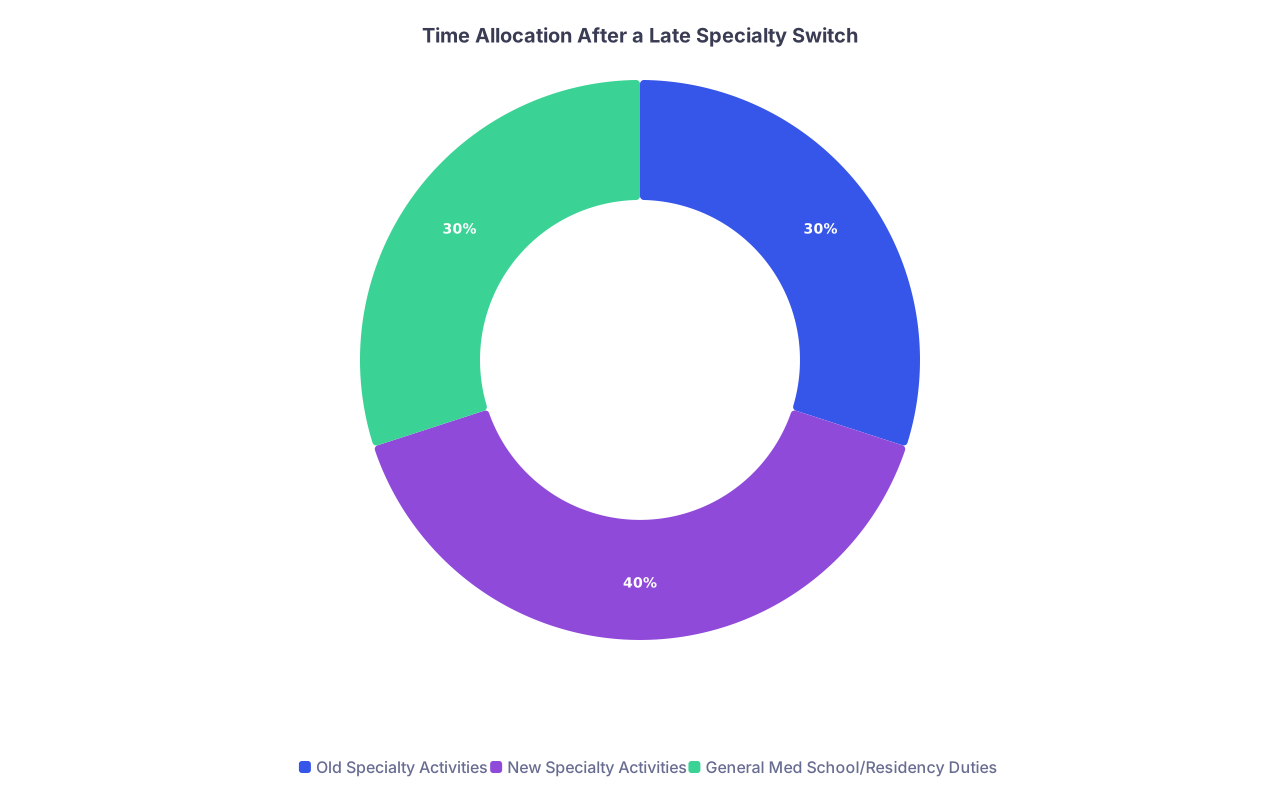
| Category | Value |
|---|---|
| Old Specialty Activities | 30 |
| New Specialty Activities | 40 |
| General Med School/Residency Duties | 30 |
Your goal is not to erase the past. It’s to make sure a meaningful chunk of your recent effort is clearly pointed at where you’re going.
Example: Putting It All Together in Your Application Flow
Here’s what a coherent flow looks like when you’ve switched late:

| Step | Description |
|---|---|
| Step 1 | Realize Misalignment With Old Specialty |
| Step 2 | Shadow/Rotate in New Specialty |
| Step 3 | Meet With Mentors in Both Fields |
| Step 4 | Decide and Commit to New Specialty |
| Step 5 | Update ERAS Activities Descriptions |
| Step 6 | Secure Letters in New and Old Fields |
| Step 7 | Rewrite Personal Statement |
| Step 8 | Submit ERAS |
| Step 9 | Prepare Consistent Interview Answer |
If some of these steps are already past, do them retroactively as much as you can (especially mentor conversations and activity descriptions).
FAQ (Exactly 5 Questions)
1. Do I have to explicitly mention my previous specialty in my personal statement?
If your previous interest is obvious from letters, research, or your school’s gossip network (which is basically all U.S. med schools), yes, you should briefly acknowledge it. One or two sentences is enough. Trying to hide it makes you look dishonest or self‑unaware when they inevitably notice.
2. Is it better to apply to both the old and new specialties “to keep options open”?
Generally, no. Dual‑applying screams indecision unless it’s a very specific, accepted pairing (like neurology/PM&R or anesthesia/prelim medicine) and you have a clear, strategic reason. If you truly want the new specialty, commit. Programs can smell “backup plan” applicants and they rank them accordingly.
3. What if I can’t get any letters from the new specialty because I decided so late?
Then you lean hard on what you can control: strong letters from supervisors who know you well (any specialty), clear explanation of your switch, and evidence that you understand and are preparing for the new field (shadowing, conferences, independent reading, QI). You should still try aggressively for at least one brief elective or shadowing experience that can generate even a short letter.
4. How do I handle the supplemental ERAS questions about red flags or challenges?
If there’s a prompt that fits, that’s actually a good place to handle your switch in a controlled way. Keep it factual and concise: what your original plan was, what you learned, why you changed, and what you’ve done since. Do not write a long emotional diary entry. Show reflection and forward momentum.
5. I switched late and still didn’t match. Should I switch again or reapply to the same specialty?
Switching again is a major red flag unless something truly serious changed (health issue, family obligations, major insight about your own limitations). Usually, it’s better to stick with the specialty you chose, strengthen your application with a dedicated research year, prelim/TY, or improved exams, and reapply with a stronger, more consistent story. Multiple switches start to look like a pattern of poor judgment rather than growth.
Open your personal statement draft right now and find the part where you talk about “always” wanting this specialty. Replace it with two honest sentences that acknowledge your actual path and show why this field is the right fit for you now. That small change alone will make your ERAS read more mature and less indecisive.