
The harsh truth: sometimes your advisor is right when they say, “Do not apply this cycle.” But the bigger mistake is wasting that forced gap year drifting, over-working randomly, and then reappearing with an application that looks… basically the same.
You’re in a high‑stakes situation. You’ve just been told you should not apply this year—or reapply this year—and your brain is doing that mix of panic, shame, and anger. I’ve seen this more times than I can count. Some people use that year to completely flip their trajectory. Others waste it and come back one cycle older with the same red flags plus one more: “What did you do with your gap year?” and no good answer.
Let’s make sure you’re in the first group.
1. First: Why Your Advisor Is Saying “Don’t Apply”
Before you plan the year, you have to be brutally honest about why you were told to sit out. Advisors almost never say this lightly. There’s usually a clear risk/benefit calculation behind it.
Here are the usual reasons, translated into real language:
| Reason Category | Typical Red Flag |
|---|---|
| Academics | Step 2 CK < 220 or multiple failures |
| Clinical Performance | Fails or marginal passes on rotations, weak narrative comments |
| Professionalism | Lapse, remediation, or dean's letter concern |
| Fit/Competitiveness | Aiming too high for scores/portfolio |
| Application Timing | Late exams, late letters, or no time to fix weaknesses |
If your advisor didn’t spell it out clearly, you need to force the issue. Not with vague “how can I improve?” but with pointed questions:
- “If I applied this year, where do you realistically see me matching, if at all?”
- “What specifically in my file would make programs hesitate?”
- “If I fix one thing in the next 12 months that changes my odds the most, what is it?”
- “Which specialties do you think are out of reach this cycle but might become realistic after a year of improvement?”
You want ranked priorities, not a generic list.
And if they dance around it? Push again:
“Is my biggest issue (a) scores, (b) clinical performance, (c) professionalism, or (d) lack of commitment to the specialty?”
You cannot design a good gap year plan without a diagnosis of your application.
2. Decide Your Primary Mission for the Year
You do not have twelve missions. You have one primary and maybe one secondary goal. Anything more than that usually becomes watered-down noise on your ERAS.
Here’s how you set that mission based on your main red flag.
If your problem is scores (Step 1/COMLEX 1 failure, weak Step 2 CK, etc.)
Your mission: Repair your testing narrative.
That means:
- A clear plan for retaking (if allowed) or taking higher-level exams (Step 2 if not done, or strong shelf performance if still in school).
- Documented, structured study (not “I studied on my own”). Think: dedicated tutoring, formal prep programs, or longitudinal practice with score documentation.
- A new score that is clearly better, not just “a little less bad.”
If your problem is clinical performance or weak letters
Your mission: Prove you can function on a team and care for patients at a high level.
That usually looks like:
- A structured clinical job: prelim/TY spot, research fellow with heavy clinical component, full-time hospitalist scribe, or clinical associate role.
- New letters from people who’ve seen you work closely and will go to bat for you.
If your problem is professionalism / dean’s letter concerns
Your mission: Show stability, reliability, and maturity over time.
You’re not going to erase the past. You’re going to dilute it with a new, stronger pattern.
- A clean year (or more) in a demanding, supervised role.
- Supervisor letters that specifically praise reliability, teamwork, and judgment.
- No new incidents. None. Not even close calls.
If your problem is lack of specialty fit / weak portfolio
Your mission: Build an undeniable story that you are committed and useful in that field.
- Consistent work or research in that specialty.
- Conferences, posters, quality improvement projects.
- Mentors in the field who know you and will vouch for you.
Write your mission down as one sentence:
“In my gap year, my primary goal is to ___ so that programs will no longer see ___ as a red flag.”
Tape that above your desk. Every big decision goes through that filter.
3. Build a Real Plan: Month-by-Month, Not Vibes
Gap years go wrong when people “see what comes up.” Then 8 months pass and they have a scattered list of part-time gigs, half-finished research, and no clear story.
You need structure.
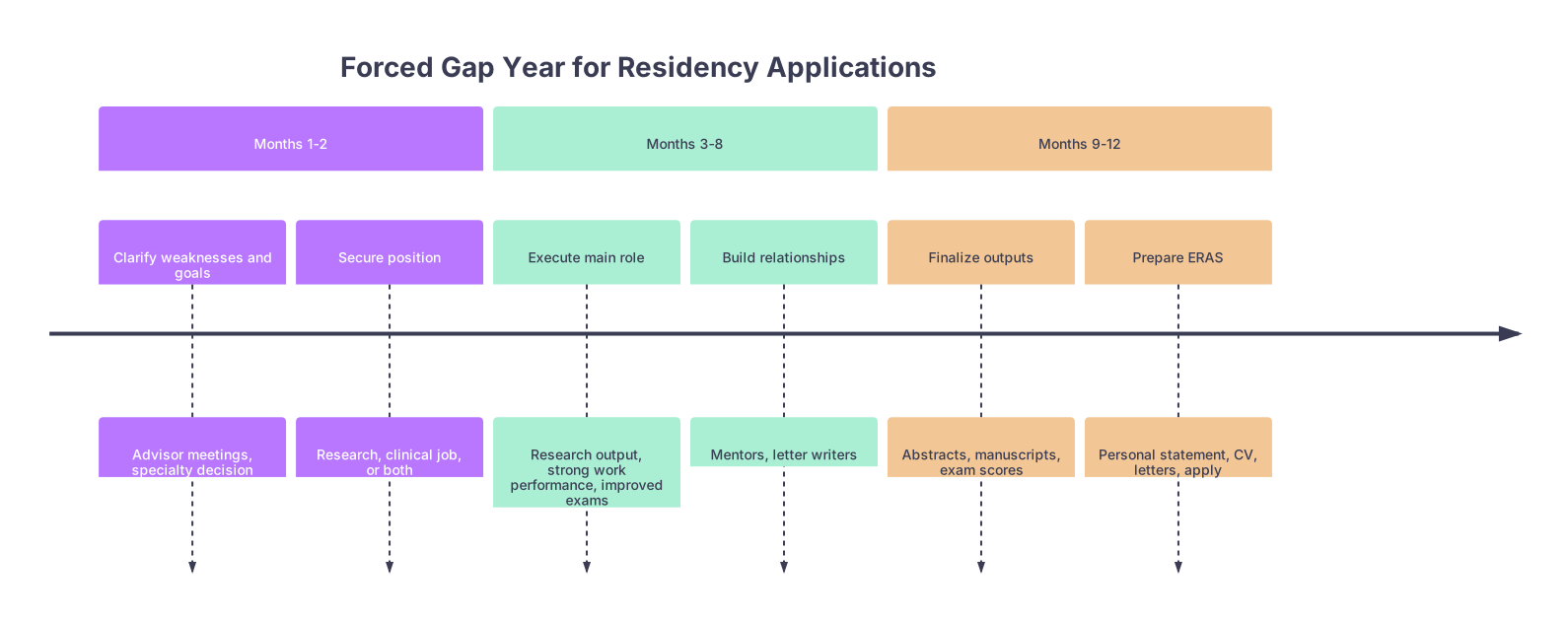
Basic timeline framework
| Period | Event |
|---|---|
| Months 1-2 - Clarify weaknesses and goals | Advisor meetings, specialty decision |
| Months 1-2 - Secure position | Research, clinical job, or both |
| Months 3-8 - Execute main role | Research output, strong work performance, improved exams |
| Months 3-8 - Build relationships | Mentors, letter writers |
| Months 9-12 - Finalize outputs | Abstracts, manuscripts, exam scores |
| Months 9-12 - Prepare ERAS | Personal statement, CV, letters, apply |
Now let’s talk concrete options.
4. Common Gap Year Paths: What Actually Helps and What Just Sounds Good
Here’s a blunt comparison of what I’ve seen help vs what looks nice but doesn’t move the needle much.
| Path | Best For | Impact on Application |
|---|---|---|
| Full-time research fellow | Specialty portfolio, networking | High if produces letters + output |
| Clinical job (scribe, assistant, fellow) | Clinical performance doubts, professionalism | High for letters + “can function on a team” proof |
| Dedicated exam year | Low scores, failures | High only if score jumps significantly |
| Random non-clinical job | Financial needs only | Low unless framed very well |
| Additional degree (MPH, etc.) | Long-term goals, research interest | Medium unless tied to strong output |
Now I’ll break these down the way your PD will secretly see them.
1. Research fellow / research year
Best used for:
– Competitive specialties (derm, ortho, ENT, plastics, rad onc)
– People with weak specialty exposure but solid baseline academics
– Anyone who needs new strong letters from within that field
What it should look like:
- Full-time or nearly full-time position with clear responsibilities.
- At least 1–2 concrete outputs by application time: abstract, poster, manuscript submitted, QI project implemented.
- A mentor who:
- is known in the field OR
- cares enough to write a detailed, personal letter.
What is not impressive:
“One year in a lab” with no output, generic letter, and you were basically an overqualified data-entry person who never spoke up.
2. Clinical job (hospital assistant, scribe, research coordinator with patient contact)
Best used for:
- Marginal clinical evaluations in med school.
- Concerns you “don’t function well on wards.”
- International grads who need US clinical experience.
What programs want to see:
- You show up. Early, not barely-on-time.
- You take feedback and improve.
- Someone in that setting writes: “This person acts like an intern already.”
If you failed a rotation or had professionalism issues, this is often more powerful than research. A year of being the rockstar employee in a busy ED or inpatient service goes a long way.
3. Dedicated exam improvement year
Best used for:
- Step 1/COMLEX 1 fail, Step 2 CK < ~220–225 (or below your specialty norms).
- People who genuinely never had dedicated time due to major life events.
Warning: A “study year” where your new score is only slightly better is a disaster. It tells programs your ceiling is low, not your time.
If you choose this path:
- Treat it like a full-time job.
- Consider professional tutoring or a structured program—yes, they’re expensive; yes, this is high ROI if done right.
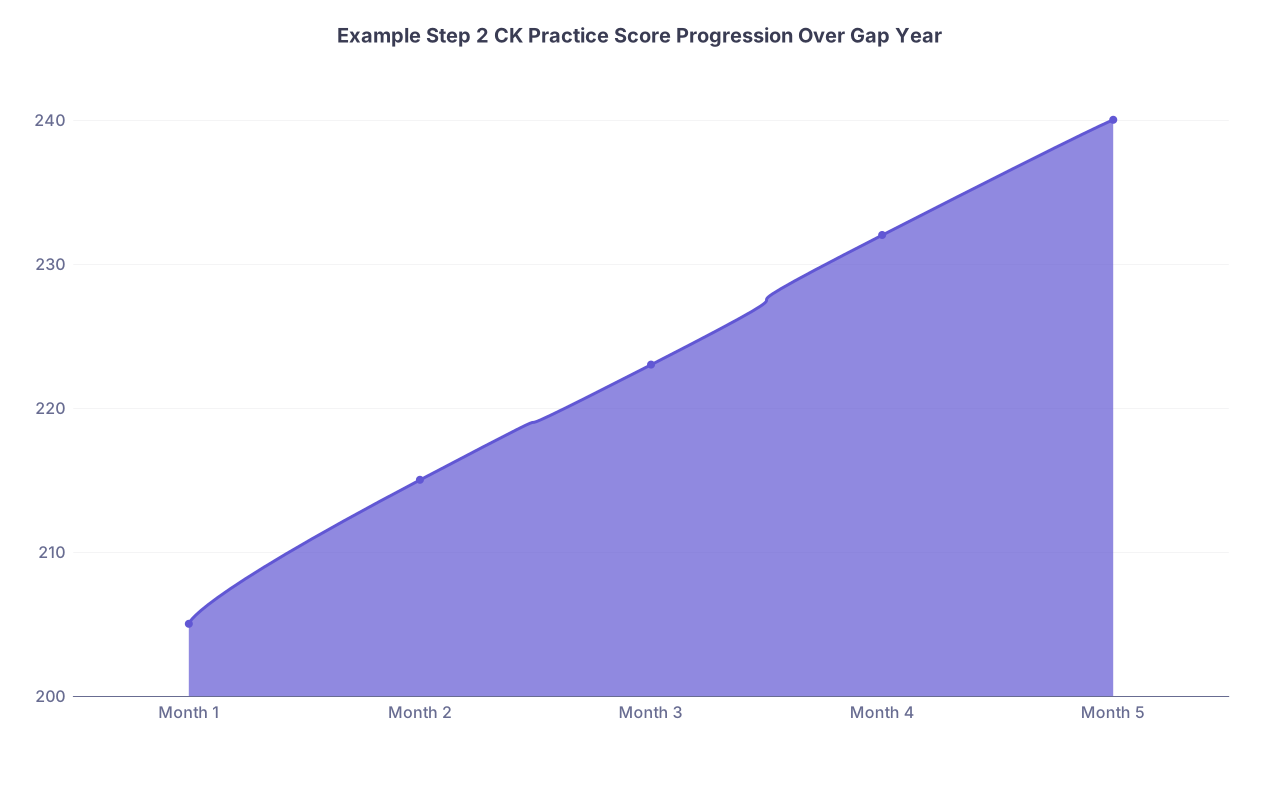
- Track NBME/UWSA/COMSAE progression and document it in your own notes. You don’t show that on ERAS, but it will inform your personal statement and how you talk about your turnaround.
| Category | Value |
|---|---|
| Month 1 | 205 |
| Month 2 | 215 |
| Month 3 | 223 |
| Month 4 | 232 |
| Month 5 | 240 |
That kind of upward trend—if real and reflected in your final score—changes how PDs see a previous failure.
4. Extra degree (MPH, MS, MBA)
Let me be frank: degrees are overrated as gap-year fixes.
They help when:
- They’re tightly linked to your specialty/story (e.g., MPH for someone serious about primary care, global health, or academic medicine).
- You actually do meaningful research or projects during the program.
- Your prior metrics are not catastrophic. An MPH does not erase a Step 1 failure.
They don’t help when:
- You’re using them to hide from clinical work.
- You’re hoping the letters will compensate for poor clinical evals. They won’t.
- You end up with more debt and no better narrative.
Use degrees strategically, not as a default.
5. How to Frame the Gap Year So It Becomes a Strength
Programs will absolutely ask:
“So you didn’t apply that cycle—what did you do with that time?”
Your answer cannot be:
“I took some time to figure things out and did some research.”
You’re aiming for something like this:
“My advisor and I agreed that my initial application wasn’t ready, mainly because my Step 2 score and my early evaluations didn’t reflect the physician I want to be. I spent that year working full-time as a research fellow in cardiology and as a per-diem ED scribe.
In the ED I learned to function as part of a high-volume team, and my supervising physician wrote a letter about how I’d essentially been operating at an intern level by the end. At the same time, I worked on two QI projects that turned into abstracts—one accepted to ACC. That year forced me to grow up fast, and it confirmed that internal medicine, especially cardiology, is where I belong.”
Notice what’s happening there:
- Acknowledges the gap year without sounding vague.
- Names the prior weakness.
- Clearly describes what they did to fix it.
- Draws a line from the year → specialty choice → readiness now.
Your goal: make the gap year look intentional, even if it started as a forced pause.
6. Money, Visas, and Reality Constraints
You might be thinking, “This all sounds nice, but I have rent. And loans. And maybe a visa clock.”
Reality matters. Here’s how to be practical without sabotaging your application.
If you must prioritize income
- Choose a clinical job with overtime options rather than a random high-paying non-clinical gig.
- ED scribe + extra shifts.
- Inpatient unit coordinator.
- Medical assistant in a high-volume clinic.
- Stack a part-time research role if you can, but not at the cost of doing both badly.
If you’re an IMG with visa issues
- Research and clinical roles at teaching hospitals often have more familiarity with visas.
- Make sure whatever you do is clearly documented and verifiable—PDs want to see structure, not informal shadowing.
- Target programs that historically take IMGs and see if they have pre-residency fellow roles.
If your mental health is fried
Burnout and depression make studying, working, and being “high performing” brutal. Ignoring that is how people end up with another red flag.
In that case, your mission may need to be:
“Stabilize my mental health while maintaining some professional engagement and then ramp up.”
So maybe:
- Half-time clinical or research job.
- Weekly therapy, possible medication, real sleep.
- Then, 4–6 months before application, you increase your professional intensity once you’re steadier.
What you cannot do is disappear completely and then write, “I took a year off for my mental health,” with zero structure, evidence, or growth to point to. Programs are sympathetic, but they also worry about reliability. You have to meet both realities.
7. Building the Letters You Didn’t Have Before
Gap years are letter-building years. Do not finish 12 months with “one new letter from a PI who barely knows me.”
Here’s how to do it correctly:
- Start strong: Treat month 1 like an extended interview. Be early, be prepared, ask good questions, take initiative without overstepping.
- Ask for feedback early: “Is there anything I can do to contribute more effectively?” Then actually fix what they mention.
- After 3–4 months: If things are going well, say, “I’m planning to reapply to residency next cycle. If things continue like this, would you feel comfortable writing me a strong, detailed letter?”
That word—strong—matters. It gives them an out if they can’t. - Give them material: a 1-page summary of your work with them, your CV, your personal statement draft.
Good gap year letters often read like:
“I supervised Dr. X for 10 months in the cardiology research unit, where they took on more responsibility than any prior fellow we’ve had…”
That kind of long-term, comparative praise is gold.
8. Don’t Forget the Paper Trail: What Needs to Exist by September
By the time ERAS opens and you apply, you want the gap year to have produced visible artifacts, not just “plans.”
At minimum, aim for:
- 2–3 strong new letters tied directly to your gap year work.
- At least one tangible output: abstract, poster, manuscript under review, implemented QI project, teaching evaluation, etc.
- A clear line on your CV showing full-time or structured engagement (not vague freelancing).
- If applicable: a new exam score that is objectively better.
If your entire gap year boils down to, “Worked in Dr. Smith’s lab, manuscript in preparation,” you underused that year.
9. A Quick Reality Check: When “Don’t Apply” Means “Change Something Bigger”
Sometimes, advisors say “don’t apply this cycle” but what they really mean is “this specialty might not work for you—ever.”
You need to listen for that subtext.
Clues:
- They keep nudging you toward prelim/TY or less competitive specialties.
- They talk a lot about “keeping doors open” and “being realistic.”
- They will not commit to writing you a strong letter in that specialty.
If multiple honest mentors are saying, “I don’t see you matching in derm/ortho/neurosurgery with your current record, even after a research year,” you have two real choices:
- Spend 1–2 years going absolutely all-in on that field and accept that you might still not match.
- Pivot to a specialty more aligned with your strengths and use the gap year to become a great candidate there.
Neither is “wrong.” But pretending the choice doesn’t exist is how people end up SOAPing into something they hate or not matching repeatedly.
FAQ (Exactly 4 Questions)
1. How bad do things have to be for me to not apply at all this cycle?
You should strongly consider not applying if:
- You have a major exam failure (Step/COMLEX) with no retake yet scheduled or completed.
- You have no strong specialty-specific letters and no realistic way to get them before September.
- Your advisor says you’re unlikely to get interviews in your target specialty and your backup plan (e.g., prelim) is also shaky.
- You’re barely holding it together mentally and know you would submit a rushed, weak application.
In those cases, a well-used year often creates far better odds than a desperate, half-ready attempt.
2. What if I already applied once and didn’t match—should I still take a gap year?
For reapplicants, a “gap year” is almost mandatory unless your first cycle was clearly undermined by one fixable thing (like a very late Step 2 result). Programs will expect to see substantive change: new letters, new work, better scores, more targeted specialty alignment. Reapplying with essentially the same file and one extra poster is usually a waste of money and time. If you cannot articulate in one sentence how your new application is clearly stronger, you probably need another year of work.
3. Can I do something non-medical (e.g., software job, family business) and still match later?
Yes—but only if you frame it well and pair it with at least some clinical or academic engagement. If you disappear completely into a non-medical world for a year or two, PDs start asking, “Are they still committed to medicine? Will they burn out and leave?” If you need the money or the family obligation, keep one foot in medicine: per-diem clinical work, volunteering, research, or teaching. Then tell a coherent story: what you learned, how you grew, and why you’re choosing to come back now with more clarity.
4. How do I explain my forced gap year in my personal statement without sounding defensive?
You keep it short, factual, and growth-focused. One or two sentences acknowledging the gap and why it happened (“My initial application cycle revealed weaknesses in X and Y…”), then a few lines on what you did concretely to address them (research, clinical work, improved exam performance). End by tying that experience to how it made you a better, more prepared future resident. Do not over-apologize, do not blame others, and do not write an essay about your disappointment. Show insight, ownership, and forward movement.
Key points:
Use the forced gap year with a clear primary mission tied directly to your biggest red flag.
Choose structured, documentable roles (research, clinical work, exam overhaul) that produce letters and tangible output.
By September, your file should look meaningfully different, not just one year older.