
5–10% of MSPE (Dean’s Letter) narratives contain explicit “concerns” or “areas for improvement” language that materially affects interview offers.
That number should scare you a little. Not because a flagged MSPE automatically kills your chances. It does not. But because most students with “concerns” mentioned have no idea how program directors actually read those lines—or how aggressively you must manage the fallout.
Let me break this down specifically.
How Program Directors Actually Read MSPE “Concerns”
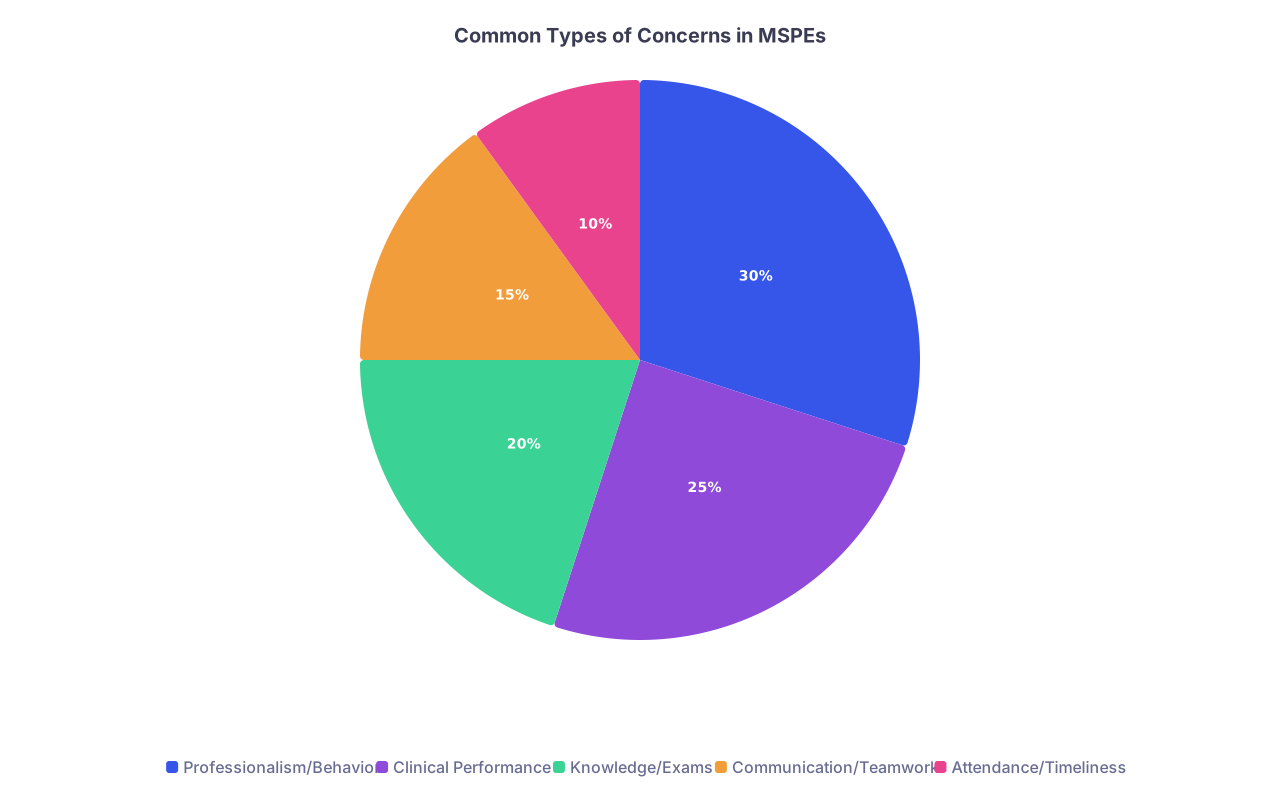
| Category | Value |
|---|---|
| Professionalism/Behavior | 30 |
| Clinical Performance | 25 |
| Knowledge/Exams | 20 |
| Communication/Teamwork | 15 |
| Attendance/Timeliness | 10 |
First reality check: PDs do not read your MSPE like a sentimental biography. They scan it like a risk assessment.
They are asking three questions:
- Can this person safely take care of patients at 2 a.m. as an intern?
- Will this person be a problem—professionalism, reliability, toxicity?
- Is this person going to fail in-service exams or need remediation?
Any mention of “concerns” drops straight into that risk filter.
You will see different flavors of language. Roughly:
- Soft flags: “required additional guidance,” “initially struggled,” “benefited from close supervision”
- Moderate flags: “formal feedback,” “required remediation,” “professionalism concern,” “concern was addressed”
- Hard flags: “formal disciplinary action,” “On Academic Probation,” “Required to repeat the clerkship,” “Reported to the promotions committee”
Programs do not treat these equivalently. A single shelf failure that was remediated with clear improvement is noise at many places. A pattern of professionalism problems? Different ballgame.
How much weight do they really place on “concerns”?
Let’s be blunt. In competitive specialties (Derm, Ortho, ENT, Plastics, Integrated Vascular): any professionalism-tinged language is radioactive unless there is a stellar, well-documented redemption story.
In large community IM or FM programs: a single academic misstep, remediated, often becomes a non-issue if you are otherwise solid and you handle it like an adult.
Rough heuristic I have seen across programs:
| Type of Concern | Competitiveness Impact | Salvageable With Strong Response? |
|---|---|---|
| Single shelf failure | Low–Moderate | Yes |
| Repeated exam failures | Moderate–High | Sometimes |
| One professionalism event | High | Sometimes |
| Pattern of professionalism | Very High | Rarely |
| Attendance / tardiness | Moderate | Often |
If your Dean’s Letter explicitly uses any of the following strings: “professionalism,” “honesty,” “probation,” “remediation,” “disciplinary,” assume the PD will zoom in on that before they look at your Step 2 score.
Step One: Precisely Parse the Language in Your MSPE
Most students read their MSPE once, panic generally, and then just “hope” interviewers do not fixate on the bad paragraph.
That is stupid. You need a forensic reading.
Print the MSPE. Three highlighters:
- Yellow: Factual events (leave of absence, failed exam, repeated clerkship)
- Blue: Value-laden adjectives (e.g., “struggled,” “concerning,” “not meeting expectations”)
- Green: Redemption/improvement language (“improved significantly,” “demonstrated growth,” “no further issues”)
Now map what you actually have.
Common concerning phrases and what they usually signal

Here is how program directors often interpret certain phrases (yes, they really read between the lines):
“Initially struggled with time management”
Translation: Late notes, tardy, maybe disorganized. They want to know if this persists.“Required close supervision to meet expectations”
Translation: Borderline performance. Could be knowledge, efficiency, or judgment.“Received formal feedback regarding professionalism”
Translation: Something real happened. Could be disrespect, boundary issue, dishonesty, HIPAA, something.“Was placed on academic probation”
Translation: Institutional-level concern. Needs direct explanation.“Repeated the [X] clerkship to demonstrate competence”
Translation: Failed or clearly underperformed. But repetition can be spun as perseverance if you show real change.“Concerns were addressed and did not recur”
Translation: Lifeline. PDs like this. It shows finite damage with closure.
Your job is to extract:
- What exactly happened (the fact pattern).
- When it happened (MS1, MS2, early vs late clerkships).
- Whether the letter explicitly declares resolution and improvement.
If your MSPE does not include any redemption line (e.g., it just states the concern with no “and then” improvement), you have more work to do in your application and interviews. You will need to supply the arc yourself.
Distinguishing the Type of Red Flag: Academic vs Professionalism vs “Noise”
Not all “concerns” are created equal, and program directors are not idiots. They differentiate.
1. Purely academic concerns
Examples:
- Step 1 failure (before it went pass/fail) or failed a basic science course.
- Shelf exam failures.
- Required extra time for clerkships due to knowledge gaps.
These are seen as fixable. Programs want to see:
- Clear upward trend (stronger Step 2 CK, later shelves improved).
- Concrete behavior change (better study structure, earlier seeking of help).
- No evidence that academics interfered with patient safety.
For academic flags, the PD’s main question: “Is this person going to struggle with in-training exams and board certification?”
If you can show: early failure, later strong performance, plus a coherent explanation, academic red flags are the most forgiving category.
2. Pure professionalism concerns
This is the one that makes PDs nervous.
Situations like:
- Disrespect toward staff or patients.
- Dishonesty (charting, documentation, exam behavior).
- Boundary issues (social media, inappropriate comments).
- Repeated tardiness / no-shows / unresponsiveness that triggered formal action.
These go directly to, “Will this person be dangerous or toxic on my team?”
A single professionalism event that is clearly minor, distant in time, and followed by 18–24 months of clean, strong performance can still be salvageable—if you handle it clinically, not defensively.
But repeated notes like “ongoing concerns about reliability” or “continued issues with communication despite feedback” are exactly what scare PDs at 2 a.m.
3. Contextual or “noise” concerns
Some “concerns” are real but not fatal:
- Taking a leave of absence for health, family, or personal reasons.
- Needing to repeat a year for non-professional causes (illness, pregnancy, financial).
- A single failed course in the preclinical years with otherwise clean transcript.
Here PDs are asking: “Is this likely to recur during residency?” If you show stability since the event, they move on.
Strategic Response: Where and How to Address the Concern

| Step | Description |
|---|---|
| Step 1 | Read MSPE Carefully |
| Step 2 | Focus on Step 2 & narrative |
| Step 3 | Formal Explanation Needed |
| Step 4 | Holistic Damage Control |
| Step 5 | Personal Statement Brief Mention |
| Step 6 | Advisor Email to Key Programs |
| Step 7 | Dedicated ERAS Explanation |
| Step 8 | Preempt in Interviews |
| Step 9 | School Letter of Support |
| Step 10 | Target Less Competitive Programs |
| Step 11 | Type of Concern? |
You have four main levers:
- ERAS application text (experiences, “extra information” box if used by your specialty).
- Personal statement.
- Letters of recommendation.
- How you talk about it in interviews.
You do not need to write a full confessional essay for every soft flag. Over-explaining minor concerns is a rookie mistake. The art is proportional response.
A. When to explicitly address it in writing
You should give a clear, deliberate explanation if:
- There was formal probation or remediation.
- A clerkship had to be repeated.
- The MSPE uses the word “professionalism” in a clearly negative context.
- You failed Step 1 or Step 2 CK.
Where to address it:
- Personal statement: 1–2 short paragraphs near the middle. Not the opening, not the closing.
- A separate “additional information” section if your specialty/programs invite it.
- Very rarely as a primary focus of a LOR—but that usually requires a faculty champion who can speak to your growth after the event.
What you should not do: 3 pages about your feelings, childhood trauma, or vague “I learned a lot about myself” with no behavioral specifics.
B. Structure of a strong written explanation
Think in three parts. Tight.
Brief factual description (1–2 sentences)
- No drama. No self-pity. Just what happened.
Example:
“During my third-year internal medicine clerkship, I received formal feedback regarding repeated tardiness and incomplete notes, and the clerkship was extended two weeks for remediation.”
- No drama. No self-pity. Just what happened.
Ownership and insight (2–3 sentences)
- Clear “I” statements. No blaming schedules, rotations, or other people.
Example:
“This feedback reflected poor time management and difficulty prioritizing tasks on a busy ward team. I did not seek help early enough and underestimated how my delays affected residents and nursing staff.”
- Clear “I” statements. No blaming schedules, rotations, or other people.
Concrete changes and evidence of improvement (3–4 sentences)
- Specific actions, not vague “I worked harder.”
Example:
“I met with my clerkship director and a learning specialist to design a daily planning system, including early-morning task lists, protected note-writing blocks, and check-ins with the senior resident. Over the following year, I completed all subsequent clerkships on time with strong clinical evaluations, and I was later selected as a sub-intern on the same internal medicine service, where my evaluations consistently commented on reliability and organization.”
- Specific actions, not vague “I worked harder.”
This structure turns a dead weight into a “growth narrative” without sounding like spin.
The Role of Your School: Advocate, Saboteur, or Neutral?
Some deans and student affairs offices are excellent at helping students phrase and contextualize concerns. Others… are not. I have seen Dean’s Letters that lean into drama and refuse to highlight remediation, effectively kneecapping the student.
You need to involve the school strategically.
1. Ask for a meeting specifically about MSPE impact
Not a generic check-in. Say this:
“I would like to discuss how the language in my MSPE regarding [X] is likely to be perceived by program directors and what supporting documentation or context we can offer to demonstrate my improvement since then.”
Bring:
- Your transcript.
- Clerkship and sub-I evaluations after the event.
- Any professionalism committee letters showing closure or completion.
2. Request an explicit “closure” sentence if appropriate
If your MSPE currently says:
“He was placed on academic probation in MS2 due to failing [course].”
Ask if they can add:
“He successfully remediated the course, returned to good standing, and has had no further academic or professionalism issues since that time.”
Deans often will, if the record supports it.
3. Ask for a separate letter of support when needed
For more serious flags (probation, repeated remediation, professionalism concerns), a separate letter from:
- Dean of Student Affairs, or
- Clerkship director directly involved
…can help. Content should:
- Briefly restate the event.
- Emphasize your subsequent performance.
- Make a clear statement: “In my judgment, [Name] is ready to perform effectively as a resident in [specialty].”
This is not magic. But PDs do read these letters carefully when they are deciding whether to “take a chance.”
Specialty-Specific Realities: How Much Does a Flag Matter?
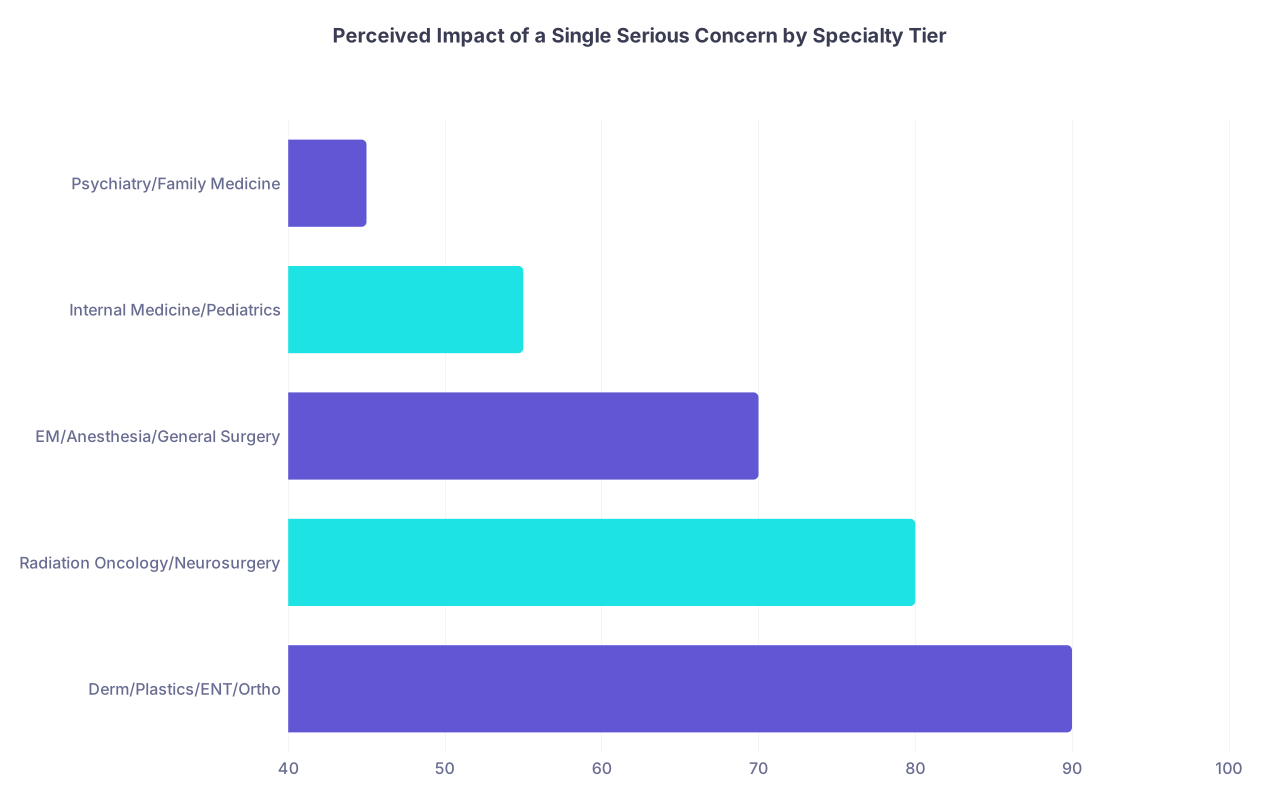
| Category | Value |
|---|---|
| Derm/Plastics/ENT/Ortho | 90 |
| Radiation Oncology/Neurosurgery | 80 |
| EM/Anesthesia/General Surgery | 70 |
| Internal Medicine/Pediatrics | 55 |
| Psychiatry/Family Medicine | 45 |
Percentages here are my rough estimate of how often a single serious professionalism/academic concern will significantly reduce interview offers at mid-to-top tier programs in that bucket.
General rules:
Ultra-competitive surgical subspecialties: Any serious concern often moves you from “maybe” to “no,” unless your application is otherwise spectacular and the concern is early / clearly resolved.
Core hospital-based specialties (EM, Anesthesia, Gen Surg): Professionalism flags matter a lot. They do not want drama in the OR or ED.
IM and Peds: More forgiving of academic struggles if you show later strength. Less forgiving of ongoing unprofessional behavior.
Psych and FM: Sometimes surprisingly willing to hear a story, especially for contextual concerns (illness, burnout, life circumstances), if you now present as mature and stable.
You must align your application strategy to reality. If your MSPE includes a major professionalism event, going all-in on Neurosurgery is not “believing in yourself.” It is self-sabotage.
Interview Strategy: How to Talk About “The Concern” Without Making It Worse

If your MSPE mentions concerns in any noticeable way, assume at least some interviewers have circled that paragraph and are deciding whether you are a risk.
Your goal in the room:
- Remove surprise.
- Show full ownership.
- Demonstrate behavioral change with evidence.
- Project stability and insight.
When they ask directly
Common versions:
- “I see there was some concern mentioned in your Dean’s Letter about [X]. Can you tell me about that?”
- “You had an issue on your [X] clerkship—what happened, and what did you learn from it?”
- “You were on probation at one point. Where do you feel you are now compared to then?”
Use a spoken version of the 3-part structure above, but shorter and more conversational.
Example answer framework (academic issue):
Factual:
“During my second year, I failed the renal block and was placed on academic probation for that semester.”Ownership/insight:
“I had tried to manage research, tutoring, and full-time study the same way I handled undergrad, and that simply did not work with our curriculum. I underestimated how much spaced repetition and early question practice mattered and waited too long to ask for help.”Change and evidence:
“I met with the course director and a learning specialist, cut back my extracurricular time, and shifted to daily question blocks with weekly review. Since then I have passed all subsequent courses and clerkships, scored [XX] on Step 2, and my later evaluations consistently mention strong fund of knowledge. It was a painful lesson in humility, but it completely changed how I approach my work.”
Your tone matters as much as content. Calm. Direct. No anger toward the school. No hints of “I was treated unfairly” unless you want PDs to visualize you filing grievances as an intern.
When they do not bring it up
If the concern is minor or well contextualized in the MSPE, you do not need to volunteer a monologue in every interview. But for major flags (probation, repeat year, formal professionalism sanction), I recommend addressing it once if there is an open-ended “tell me about a challenge / failure” or “anything else you want us to know” question.
You want your version of the story on the table at least once per program.
Application-Level Strategy: Damage Control and Targeting
You cannot “spin” away a real concern. But you can change how much oxygen it gets.
Broader, safer list
If your Dean’s Letter has a meaningful flag, you do not get to apply like a clean application.
Tactics:
- Apply more broadly, and to a lower average competitiveness tier.
- Heavily include programs that have a history of taking “non-traditional” or “second-chance” applicants (often community-based, sometimes newer university-affiliated programs).
- Use signals/priority tokens (in specialties that use them) on programs that are realistic but somewhat above your safety tier where a good story might tip you into an interview.
Control the rest of the narrative
Everything else in your application should shout: “Stable. Reliable. Mature. Hardworking.”
This means:
- Strong, recent clinical letters that emphasize work ethic, reliability, and collegiality.
- No new “soft” flags—no typos, no late submissions, no half-completed ERAS sections.
- Experiences section that emphasizes longitudinal commitments, follow-through, and patient-centered roles.
You are trying to make your red flag look like a contained, past event against a background of obvious growth.
Quick Case Sketches: What Is and Is Not Salvageable
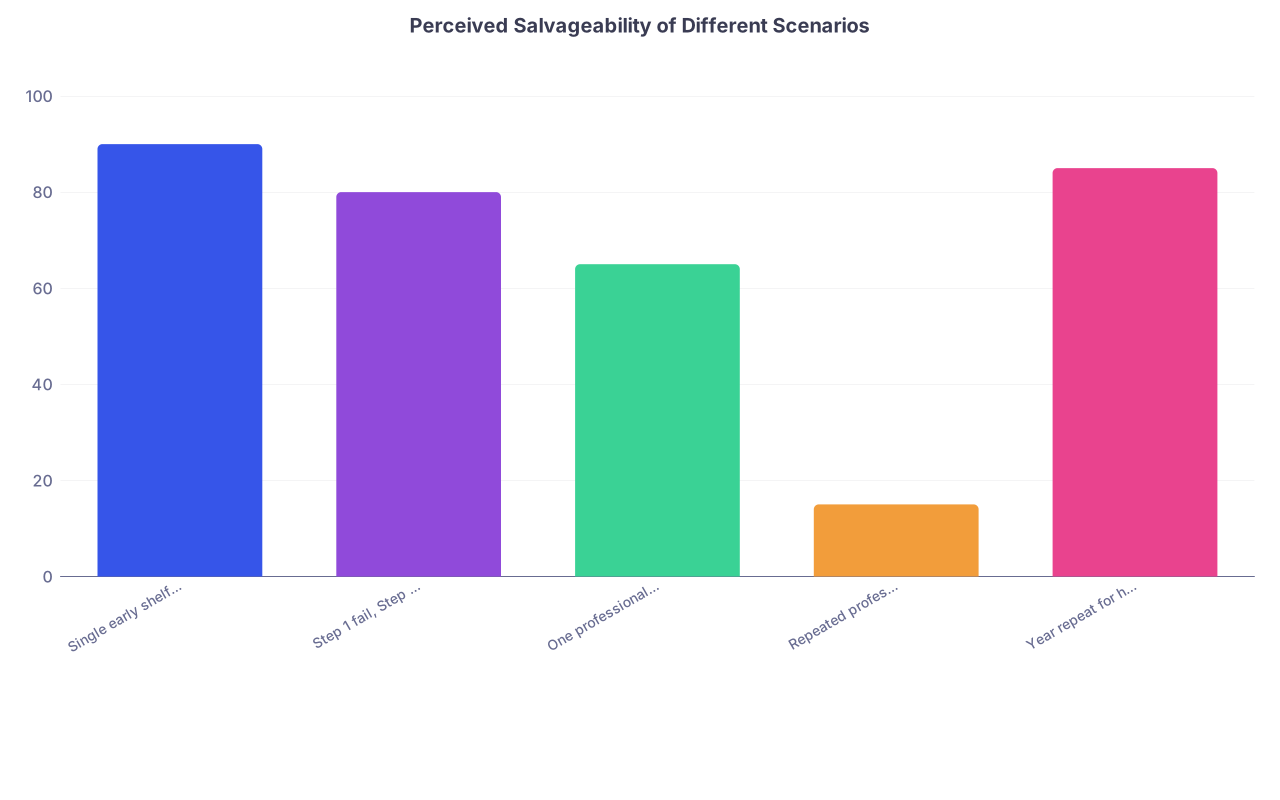
| Category | Value |
|---|---|
| Single early shelf failure, then strong | 90 |
| Step 1 fail, Step 2 245+ | 80 |
| One professionalism event, clean 2 years | 65 |
| Repeated professionalism issues | 15 |
| Year repeat for health, now stable | 85 |
These percentages represent how often, roughly, I have seen students in these categories still match into some program in their intended or closely related specialty, when they handled things correctly.
MS3 shelf failure, remediated, later shelves mid-high, Step 2 solid, MSPE: “initial struggle, improved.”
- Salvageable: Yes, very. Many PDs barely care after a good Step 2 and strong letters.
Step 1 fail (before P/F), Step 2 CK 250+, no other flags.
- Salvageable: Often yes, including at solid academic programs if rest of file is strong.
One unprofessional email to staff, formal write-up, MSPE mentions formal professionalism concern but also notes “no recurrence,” 2 years of strong evals.
- Salvageable: Mixed, but I have seen these match in IM, Peds, Psych, FM when addressed well.
Repeated tardiness across multiple clerkships, extended IM and Surgery, professionalism committee involvement, vague MSPE language without clear closure.
- Salvageable: Difficult. Some lower-competition programs still might offer interviews if your last 12–18 months are squeaky clean and you present convincingly.
Year repeat for cancer treatment or major illness, subsequent clean performance and good scores.
- Salvageable: Yes. Many PDs are humane. They are mainly concerned about current stability, not punishing illness.
What Comes Next in Your Process
If your MSPE already mentions “concerns,” you are not in the ideal lane. But you also are not doomed.
Your immediate next steps, concretely:
- Forensically annotate your Dean’s Letter and classify the concern(s).
- Meet with your dean or advisor to clarify institutional language and options for support letters.
- Draft a tight, three-part written explanation if the flag is serious enough to warrant one.
- Align your specialty choices and program list with reality, not wishful thinking.
- Practice out-loud, 2–3 times, your 60–90 second explanation for interviews until it is calm, direct, and free of defensiveness.
With those pieces in place, you stop being the applicant hoping no one reads that paragraph. You become the applicant who knows exactly what PDs will see, and already has a better answer ready.
You are not just surviving a red flag; you are demonstrating the exact maturity residency demands.
With that foundation, your next challenge is different: turning interviews into a rank list that actually matches. But that is a story for another day.
FAQ (Exactly 6 Questions)
1. Do program directors always see the “concerns” section in my MSPE, or can I hide it somehow?
You cannot hide it. Programs receive the full MSPE from your school. Some PDs skim, but any bolded, italicized, or clearly negative language tends to draw their eyes. Your only control is how you contextualize it elsewhere and how compelling the rest of your file looks.
2. Should I ask my dean to remove or soften the concern in the MSPE?
You can and should ask about clarifying language, especially adding redemption or closure sentences. But outright removal of factual concerns is almost never allowed and can raise institutional integrity issues. Focus on accuracy and context rather than trying to erase the event.
3. Is it better to address the concern in my personal statement or in a separate explanation?
For most applicants, a brief, targeted paragraph in the personal statement works best, especially for academic issues. For more serious professionalism or probation events, a distinct “additional information” section or dean’s letter of support plus a short personal mention is ideal. You want clarity without turning your entire PS into a confessional.
4. Will a single professionalism concern completely block me from all competitive specialties?
In many ultra-competitive fields, yes, it will significantly limit your chances unless the event was minor, early, and followed by an exceptional, well-documented record. I have seen rare exceptions, but they required near-perfect everything else and a compelling story. Most students are better served by recalibrating to a specialty where programs are more willing to consider a redemption arc.
5. How much does time since the event matter?
A lot. A professionalism concern from early MS2 followed by 2–3 years of spotless, strong clinical performance is much easier to forgive than something that occurred during MS4 or, worse, during a sub-internship. PDs like long, boring stretches of stability. The more calendar distance plus clean evaluations you can show, the better.
6. Should I have a letter writer directly address my red flag?
Only if the writer can credibly speak to your performance after the event and explicitly attest to your growth. A vague, apologetic letter that rehashes the issue without clear endorsement can hurt more than help. The ideal letter acknowledges the past briefly and then strongly endorses your current readiness and reliability, backed by specific examples.