Professionalism red flags sink more residency applications than low Step scores. And they are almost always preventable.
Let me be blunt. Late notes, chronic tardiness, and no-shows are not “little things.” PDs read them as: “I will create more work for you, for nursing, and for GME.” In an oversupplied market, that is enough to move you from “maybe” to “no” in under ten seconds.
You want to match well despite these landmines? Then you have to understand exactly how they are perceived, how they appear in your file, and how to manage the damage with surgical precision.
This is not about vague “professionalism.” This is about the specific behaviors that get quoted in MSPEs, whispered on phone calls, and dissected in rank meetings.
Let me break this down.
How Programs Actually View Professionalism Red Flags
Forget the glossy brochures. In real rank meetings, people say things like:
- “Good scores, but the dean’s letter basically screams professionalism issues.”
- “I do not want to chase a resident for notes on a busy service.”
- “If this person no-showed to a mandatory session as a student, what happens on nights?”
Programs care about three things above almost everything else:
- Will you show up?
- Will you do the work on time?
- Will you create extra problems?
Late notes, tardiness, and no-shows hit all three.
Why these flags are more toxic than a mediocre Step 2
A 225 on Step 2 says “needs work on test-taking.”
A string of late notes says “unreliable and disorganized in patient care.”
Residency directors can remediate clinical reasoning. They run didactics, simulation, board review. There is infrastructure for that.
There is almost no infrastructure for “this person routinely does not show up or finish required work.” That becomes everyone’s daily headache: nursing, co-residents, attendings, GME.
So the mental math in a PD’s head is simple:
“I would rather have someone who is average on paper but rock-solid dependable, than a high-scorer who disappears when it matters.”
Where These Red Flags Actually Show Up In Your File
You cannot strategize around professionalism problems unless you know where they live on paper.

Here is where late notes, tardiness, and no-shows appear and how bad they look.
1. MSPE (Dean’s Letter)
This is the big one. Programs read the narrative sections carefully. Especially for:
- Internal medicine sub-I
- Surgery, OB, EM, ICU rotations
- Any “Professionalism” or “Summary” paragraphs
“Required closer supervision for timely completion of documentation.”
→ Late notes. Often recurrent.“Had difficulty arriving on time and required reminders regarding punctuality.”
→ Tardiness. It was noticeable enough to document.“Missed mandatory session without appropriate notification.”
→ No-show. This is serious.“Responded to feedback and improved timeliness as the rotation progressed.”
→ There was a problem, but some remediation occurred. PDs actually like seeing this trajectory better than silence.
If your med school does a “Professionalism Concern” checkbox, this is even more glaring. Many PDs jump straight to that section.
2. Individual Clinical Evaluations
Programs rarely see the raw forms, but their content gets distilled into the MSPE. However, if something was egregious, it often leads to:
- A separate professionalism letter in your file
- Required meeting with student affairs / professionalism committee, which sometimes gets summarized in the MSPE
Comments that trigger this include:
- “Repeated late notes despite feedback.”
- “Frequently late to sign-out.”
- “No-show to team rounds without prior notice.”
3. Narrative Letters of Recommendation
Most attendings are conflict-avoidant. They will not torch you unless they feel obligated. But they will sprinkle soft warnings.
Watch for phrases like:
- “With continued development of time management and documentation efficiency, I believe they will succeed in residency.”
- “Benefited from direct reminders to complete notes before the end of the workday.”
- “Improved significantly after initial concerns about punctuality were addressed.”
Those are not neutral.
Strong red flag phrases (rare, but fatal if present):
- “Due to concerns about reliability, I cannot give my strongest recommendation.”
- “Notable concerns about professionalism.”
Your goal: identify if any of your letters might be doing this to you.
4. Clerkship Grades and Notations
A rotation grade like “Pass with Professionalism Concern” is a neon sign. Same with:
- Required remediation rotation
- Notation of “Incomplete until documentation finished”
- Asterisks with footnotes about performance
These often generate questions on the interview trail, and if unaddressed, they look worse.
Late Notes: Why Programs Hate Them And How To Fix The Story
Late notes are not just “admin stuff.” They hit patient care, billing, and risk management. That is why institutions care. That is why PDs care.
How late notes are perceived
When an attending or PD hears “chronic late notes,” they infer:
- Poor situational awareness (“doesn’t realize notes are not optional”)
- Poor time management
- Risk of lost clinical data, miscommunication, and billing problems
- Extra work falling on co-residents and staff who cannot close charts
They also know this: if you were late as a student, with relatively fewer patients and more supervision, residency will expose that ten times over.
What late notes look like in real life
I have seen this pattern repeatedly:
- Student stays late “helping” with tasks but never sits down to write
- Procrastinates because writing notes feels uncomfortable and slow
- Thinks: “I will do them from home later” → gets home exhausted → notes done at 1 AM or next day
- Attending gets reminder emails from the hospital about incomplete documentation
- Evaluations mention “late notes” or “needed repeated reminders”
If this is you, you cannot “explain it away” in an interview. You have to demonstrate that you broke the pattern.
How to reframe late notes in an application (only if it is in your record)
You do not volunteer this out of nowhere. But if asked directly (or if your MSPE plainly mentions it), you respond with a structured, adult answer:
Concrete acknowledgment
“On my early third-year rotations my documentation was often late. That was a real issue and it created extra work for my team.”Link to a specific problem
“I was slow with the EMR, tried to ‘help’ with everything else first, and pushed notes to the end of the day. Which meant they spilled over into the evening.”What you did to fix it
“Mid-year I sat down with my attending and our chief to reorganize my workflow: writing problem-based templates, blocking a specific hour mid-day that was non-negotiable for documentation, and using dot phrases. On my medicine sub-I I made it a rule that all notes were done before sign-out, and I stuck to it.”Evidence of change
“On my sub-I evaluations the faculty specifically commented that documentation was timely and complete. That change did not happen by accident; it was intentional.”
That is the kind of answer a PD can live with. You took a systems-level problem (your workflow), owned it, and showed data that you actually improved.
Tardiness: Why “5 Minutes Late” Is Not What You Think It Is
Students chronically underestimate how much attendings and residents notice lateness. Five minutes once in a while is life. Five minutes several times a week is a pattern. And people absolutely talk about it.
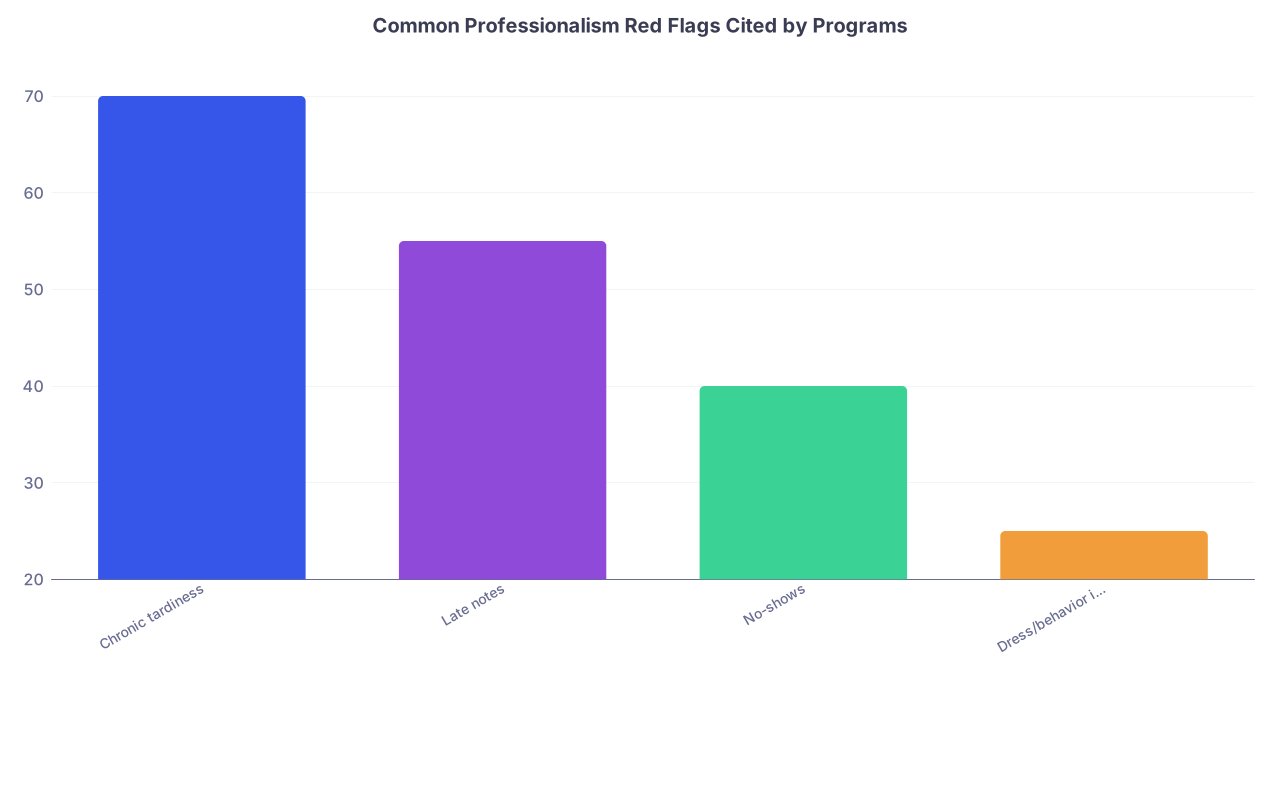
| Category | Value |
|---|---|
| Chronic tardiness | 70 |
| Late notes | 55 |
| No-shows | 40 |
| Dress/behavior issues | 25 |
(Those percentages are representative of what PDs informally cite in meetings and survey data: tardiness and notes are the big two.)
How tardiness plays out on the team
What your senior sees when you stroll into sign-out 8 minutes late:
- The night intern has to stay longer.
- They have to re-run the list because you missed the first half.
- Nurses are waiting to give bedside reports.
- The service day starts behind.
And they remember. The same way you remember who always volunteered to see the sick admit.
Clerkship directors see patterns:
- Labeled “often late to rounds”
- “Required repeated reminders about punctuality”
- “Improved somewhat after feedback, but still struggled”
Once it makes it into writing, your job in the application is not to deny it. It is to show you are not that person anymore.
Crafting a credible “I fixed my lateness” story
Again, you do not bring this up unless asked or unless your MSPE highlights it. But if it is in black and white, hiding is worse.
Good structure:
Owning the behavior, not the excuse
“On my surgery rotation I was repeatedly late to pre-rounds and sign-out. That was unprofessional; I did not manage my mornings properly.”(Not: “Traffic was bad” or “Scrub line was long.” Everyone has bad traffic. They still show up.)
Show insight
“I underestimated how much prep time I needed. I tried to do too much in the morning and was not realistic about how long it took to pre-round, see labs, and be in the right place on time.”Show a system-level fix
- Moved wake-up 30–45 minutes earlier
- Packed bag / meals / scrubs the night before
- Set multiple alarms and used a phone across the room
- Committed to arriving 15 minutes early instead of “right on time”
Document improvement
“On my medicine sub-I and my ICU elective I was consistently early. My seniors commented positively about my reliability in pre-rounding and sign-out; there were no further concerns documented about lateness.”
PDs are not asking you to be perfect. They are asking whether you respond like a grown professional when something is pointed out.
No-Shows: The Nuclear Professionalism Event
No-shows are a different beast. Late notes and tardiness can be chronic but low-grade. A true no-show—especially for patient care or mandatory sessions—hits different.
| Issue Type | How PDs Generally Rank It | Typical Response Needed |
|---|---|---|
| Occasional late notes | Mild–moderate | Fix workflow, show improvement |
| Chronic late notes | Moderate–severe | Strong remediation, explicit plan |
| Occasional tardiness | Mild | Adjust schedule, acknowledge |
| Chronic tardiness | Moderate–severe | Major concern, needs strong narrative |
| Single clear no-show | Severe | Full ownership + remediation |
| Repeated no-shows | Very severe, near-fatal | Often application-killing |
What counts as a “no-show” in PD-land
- Missing a clinical shift without notifying anyone
- Not appearing for rounds, sign-out, or call when you are assigned
- Skipping a mandatory session (simulation, OSCE, orientation) without prior communication or a true emergency
One no-show with a credible, documented emergency is salvageable. Repeated no-shows or flimsy excuses are not.
How this usually appears in the MSPE
Phrases you really do not want:
- “Unexcused absence from required clinical activity.”
- “Failed to notify team when unable to attend.”
- “Missed a required orientation session without prior communication.”
If this is in your MSPE, you must be ready with a direct, structured answer. Anything evasive will be read as “has not learned a thing.”
How to talk about a no-show without sinking yourself
You cannot be cute here. The bar is higher.
Direct, uncushioned ownership
“During my neurology rotation I missed a scheduled clinic session without notifying my attending ahead of time. That was unprofessional, full stop.”Clarify context without making excuses
You can explain, but do not hide behind it.Example: “I had mixed up my clinic days after a schedule change and realized the error only when the clinic coordinator called. The mistake was mine; I should have double-checked the updated schedule and set clearer calendar reminders.”
Show what you did immediately after
- Called or emailed attending / coordinator as soon as you realized
- Met with clerkship director / student affairs to own the error
- Accepted any consequences (remediation, write-up, professionalism meeting)
Show sustained behavioral change
“After that, I implemented a strict system: all assignments logged into a single calendar, daily night-before review of the next day’s schedule, multiple phone alerts. Over the next 18 months, I did not miss a single shift, rounds, or required session. My sub-I and EM attendings specifically commented on my reliability.”
If you try to gloss over or blame the system, PDs hear “this will happen again.”
Strategic Damage Control Before You Submit ERAS
If you already know your file has these landmines, you do not have the luxury of a passive application. You need a plan.

| Step | Description |
|---|---|
| Step 1 | Identify Issues in File |
| Step 2 | Meet with Dean/Advisor |
| Step 3 | Standard Strategy |
| Step 4 | Clarify What Is In MSPE |
| Step 5 | Document Remediation Efforts |
| Step 6 | Select Letter Writers Who Saw Improvement |
| Step 7 | Prepare Interview Explanations |
| Step 8 | Apply Broadly & Strategically |
| Step 9 | Late notes? Tardiness? No-shows? |
Step 1: Know exactly what is written
Too many students operate on rumor: “I think my attending was mad about my notes but not sure it went anywhere.”
Get concrete.
- Request to review the narrative portion of your MSPE with student affairs if your school allows it.
- Ask directly: “Were any professionalism concerns related to documentation / punctuality / absences included?”
You cannot fix what you refuse to see.
Step 2: Get a clear remediation narrative in your home institution
PDs trust institutional remediation more than personal promises.
If you had late notes, tardiness, or a no-show, you want to be able to say:
- “I met with the clerkship director / dean.”
- “We set specific expectations and a monitoring plan.”
- “I successfully completed X without further incidents.”
If your school has any formal documentation of “satisfactory remediation / no ongoing concerns,” that is pure gold. It may even get a line in the MSPE like:
- “After early concerns about punctuality, the student completed subsequent rotations without further issues.”
That one sentence lowers the perceived risk enormously.
Step 3: Choose letter writers who saw you after the problem
If your surgery rotation flagged tardiness, your medicine sub-I attending who saw you be consistently early all month is the person you want writing a letter.
Ask explicitly for feedback before you ask for a letter:
- “On this rotation, were there any concerns about my professionalism, punctuality, or documentation?”
- “If not, and if you feel comfortable, would you be willing to comment on my reliability and responsiveness to feedback in a letter?”
You want at least one letter that quietly counters the earlier narrative with specific praise:
- “He consistently arrived early, completed notes promptly, and was completely reliable with follow-up tasks.”
That does more work than any personal statement confession ever will.
Step 4: Calibrate your program list realistically
If you have:
- Strong scores
- Solid clinical grades
- But clear professionalism flags
You are not out of the game. But you do need to:
- Apply more broadly, including community and mid-tier academic programs
- Include several programs in regions where your school has sent past students with similar issues
- De-prioritize ultra-competitive academic programs in saturated markets unless your home PD is making very strong phone calls for you
Program directors are risk managers, not saints. Give them an application where the improvement is obvious and the risk looks contained.
How To Talk About These Issues On Interview Day
This is where people either rehabilitate their image or confirm the worst fears.
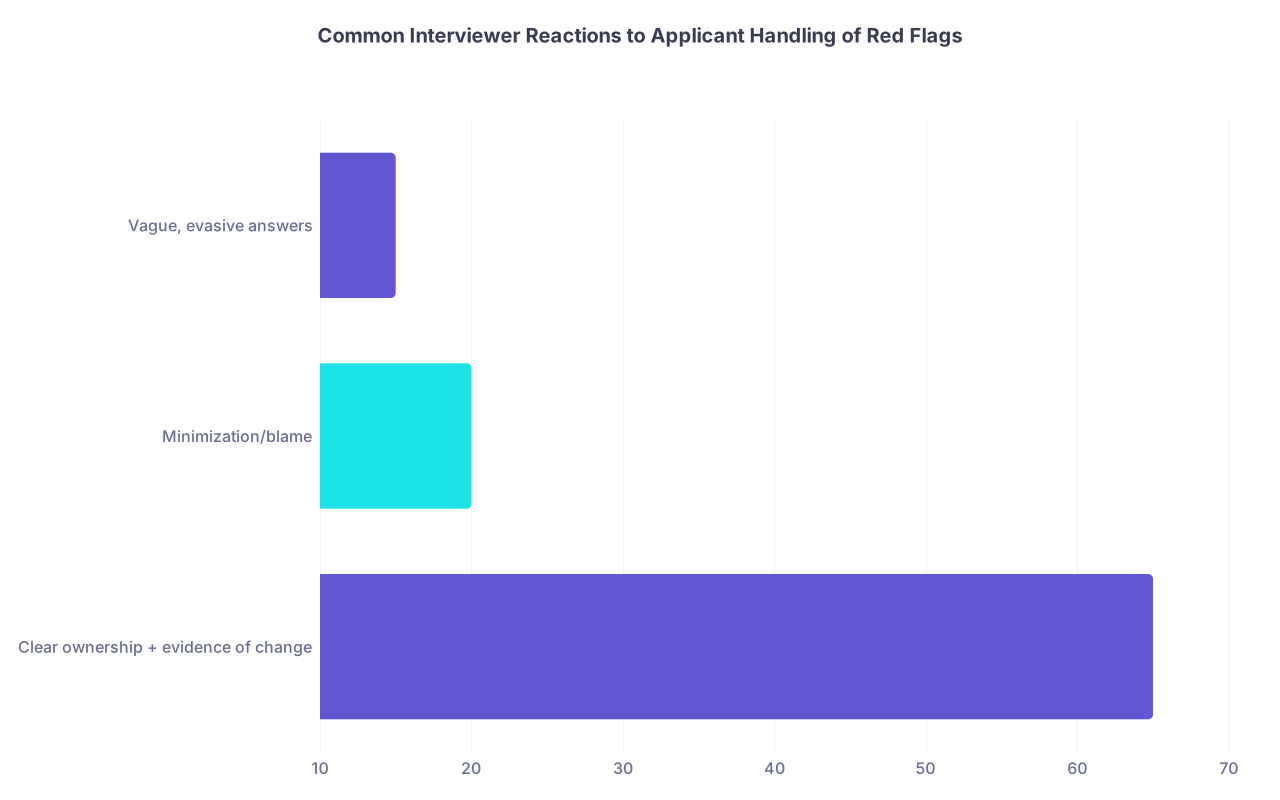
| Category | Value |
|---|---|
| Clear ownership + evidence of change | 65 |
| Minimization/blame | 20 |
| Vague, evasive answers | 15 |
Interviewers are mostly looking for one thing: Are you teachable and trustworthy now?
What you should never do
- Blame the EMR, traffic, or “communication issues” as your main point
- Say “I do not really agree with that evaluation” as your lead
- Get defensive or visibly irritated about the question
- Over-talk and drown the issue in irrelevant details
A good template answer (plug in your specific behavior)
Question: “I see a note in your MSPE about timeliness of documentation. Can you tell me about that?”
Response:
“On my early third-year inpatient rotation, my documentation was consistently late. I was slow with the EMR, I tried to finish every task before sitting down to write, and I pushed notes to the end of the day. That was not acceptable; it created extra work and frustration for my team.
After that feedback, I met with my clerkship director to restructure my day. I built templates, carved out protected time during the afternoon specifically for notes, and set a hard rule for myself that all documentation had to be complete before sign-out. On my sub-internship and ICU elective, I received explicit positive feedback about timely notes, and there were no further concerns documented.
I am glad I learned that lesson as a student rather than as an intern. It forced me to build systems that I still use.”
That answer does four crucial things: owns the problem, shows insight, demonstrates concrete process changes, and provides evidence that it worked.
Prevention: If You Have Not Been Flagged Yet, Keep It That Way
If you are still in clinical training, consider this your warning shot. You do not need a philosophy seminar. You need a few non-negotiable habits.
For notes
- Write a rough outline as you see the patient. Do not trust memory.
- Start your first note within 30 minutes of morning rounds ending.
- Block an hour mid-day specifically for documentation. Guard it.
- Make it a personal rule: no sign-out with unfinished notes unless there is an actual emergency.
For punctuality
- Plan to be 15 minutes early to sign-out, OR, OR cases, clinics.
- Do a “T minus 12 hours” check: the night before, look at where you must be, at what time, with what materials.
- Use a single calendar that integrates your schedule. Color-code high-stakes events (OR, call shifts, simulation, OSCEs).
For avoiding no-shows
- Triple redundancy: digital calendar, paper copy, and at least one weekly email review from the clerkship or chief.
- When in doubt about where you’re supposed to be, ask early, not on the morning of.
- If something happens (illness, emergency), notify in this order: chief or senior → attending / coordinator → clerkship office. And document the communication.
These are not profound. They are the difference between “solid resident” and “problem file.”
FAQs
1. Should I mention my professionalism issue in my personal statement?
Usually, no. The personal statement is not the place to lead with your worst moment unless it was truly life-altering and the centerpiece of your growth story. If your MSPE contains a brief mention of late notes or mild tardiness that was remediated, handle it in interviews when asked. Do not turn your statement into a confessional unless your dean or advisor explicitly recommends it.
2. How much will one documented no-show hurt my chances of matching?
A single no-show with documented remediation and a clean record afterward is serious but not automatically fatal. Programs will look closely at the context, your explanation, and whether your later rotations and letters clearly describe you as reliable. You will need to apply more broadly and be prepared with a strong, honest narrative. Multiple no-shows are much more damaging and can be application-killing at many programs.
3. Can a strong Step 2 score “cancel out” professionalism red flags?
No. Strong scores can keep doors open that might otherwise close, but they do not erase a pattern of unprofessional behavior. At best, they make a PD think, “This person is smart; if their professionalism really improved, they might be worth the risk.” Your improvement story, your letters, and your interview answers do far more work on professionalism than your scores ever will.
4. What if I genuinely disagree with how my professionalism issue was documented?
You can disagree privately, but publicly, in applications and interviews, you must be disciplined. Acknowledge what is written, own any part of it that is reasonable, and carefully explain context without attacking the evaluator or your school. Something like: “The way it is written in the MSPE focuses on X; from my perspective, the situation also involved Y. Regardless, I took it seriously and made the following changes…” If you spend most of your answer arguing with the record, you will look defensive, not wronged.
Key points to walk away with:
- Late notes, tardiness, and no-shows are not minor; they are interpreted as core reliability problems.
- Programs are willing to forgive documented improvement backed by specific behaviors and strong later evaluations.
- Your job is to know exactly what is in your file, remediate ruthlessly, and talk about it like a professional who has already done the hard work of changing.