
Most applicants have no idea what their MSPE is really saying—and that ignorance gets them filtered before interviews.
Let me break this down very specifically: program directors read your MSPE first, not your personal statement. They know the code words. They know when “pleasant” means “bare minimum,” when “solid team player” really means “not trusted independently,” and when “improved over the rotation” is code for “started off badly enough that we had to mention it.”
If you are worried about red flags in your MSPE, you are not being paranoid. You are finally waking up to the document that quietly kills applications every year.
We are going to go through:
- How the MSPE is actually read and weighted
- The specific code words and phrases that signal trouble
- How different categories of red flags typically appear
- What you should do before the MSPE is finalized
- How to respond in your application, emails, and interviews if the damage is already done
By the end, you will know what your “pleasant” really means—and what to do about it.
How Program Directors Actually Use the MSPE
Program directors do not read your MSPE like a narrative. They scan it like a radiologist scans a CT brain for a bleed.
They go to:
- Academic history (fails, repeats, LOAs, pattern of marginal performance)
- Professionalism / conduct issues
- Clinical clerkship narratives and “summary adjectives”
- Comparative statements (“above / below expectations,” “top / bottom third”)
- Any “unusual” leaves, gaps, or timing differences
Then they look for any signal that says: “This person will be a headache.”
The MSPE is especially powerful for:
- Internal medicine, pediatrics, and psychiatry—where narrative feedback and professionalism matter a lot
- Highly competitive specialties—where they need a reason to cut the list quickly
- Programs with past bad experiences—if they got burned on a prior resident with professionalism issues, they will be hyper‑sensitive
Scores and grades get you on the table. The MSPE keeps you there or knocks you off.
The Codebook: Phrases That Mean “Red Flag”
You will not see “this student is unprofessional and lazy” in an MSPE. You will see carefully modulated academic language that any experienced PD reads fluently. Let’s decode it.
1. Weakness and Concern Language
These are universal tells. They rarely appear by accident.
“Requires closer supervision than expected for level of training.”
Translation: We did not trust this student. Could be clinical judgment or professionalism.“Would benefit from continued development in…”
If followed by “clinical reasoning,” “initiative,” “reliability,” or “communication with staff,” this is not gentle growth language. It is a warning.“With additional experience, will develop into a competent clinician.”
Translation: Not competent now. Marginal performance.“At times struggled with…”
When what follows is “punctuality,” “timely documentation,” “communication with the team,” or “accepting feedback,” this is professionalism.“Performance was variable.”
Translation: Inconsistent, occasionally poor, possibly unsafe.
2. Professionalism / Behavior Signals
These are taken very seriously. They are heavily weighted, especially post–COVID when burnout and psych issues are common but still must be managed safely.
“Needed frequent reminders about…”
Usually about documentation, dress code, attendance, or policies. This screams reliability problems.“Required feedback about appropriate professional boundaries / interactions.”
Major concern. Could be sexual, verbal, or social boundary issues.“After meeting with the clerkship director, performance improved.”
There was a significant problem that required intervention.“Ultimately met expectations for the rotation.”
Translation: did not meet expectations initially; needed remediation or heavy coaching.“Was held to a professionalism remediation plan.”
Self‑explanatory. PDs will absolutely want to know details.
3. Competence and Clinical Judgment
These phrases flag baseline ability and safety.
“Relies heavily on team for management decisions.”
Somewhat normal early MS3, but by late MS4 this can signal poor independence.“Struggled to organize and prioritize tasks.”
Could mean poor executive function, disorganization, unsafe on busy services.“Medical knowledge is developing.”
For an MS3: fine. For an MS4, especially on a sub‑I or advanced elective: weak.“Did best with specific direction.”
Translation: cannot function with uncertainty or higher‑level reasoning.
4. Attitude and Team Dynamics
These are the subtle daggers.
“Pleasant to work with” as the only compliment.
Translation: Nice but unremarkable, maybe passive, added little to the team.“Quiet member of the team.”
Often means disengaged, did not speak up, possibly disinterested.“Got along with peers and staff.”
If this is the highlight, it often means the clinical performance was mediocre.“Demonstrated growth after receiving feedback.”
Translation: performance or behavior required significant feedback.“May benefit from increased confidence / assertiveness.”
If repeated in multiple rotations, this can mean difficulty taking ownership or speaking up.
5. Explicit or Implied Rank Comparisons
These are often hidden in phrases that sound positive.
“Performed at the expected level for a student at this stage.”
That is not a compliment. It means: exactly average. In a competitive pool, that can be interpreted as “nothing special.”“Strong team member” vs “outstanding” or “exceptional.”
Most schools use a soft hierarchy of adjectives. “Strong” is often second or third tier.“Among the many students we have worked with, X was a solid contributor.”
“Solid contributor” is usually middle of the pack.“One of our dependable students.”
Better than “pleasant,” but still not “one of the best,” “top tier,” or “top 10%.”
Common Categories of MSPE Red Flags and How They Show Up
Let’s walk through the usual trouble spots and what they look like specifically inside an MSPE.
1. Course or Clerkship Failures / Repeats
How it appears:
- “Student required to repeat [clerkship/course] due to not meeting passing standards on [clinical performance / exam].”
- “Initially received a grade of Conditional Pass / Fail, later remediated to Pass after completing additional [work/exam].”
- “After repeating the [rotation], student demonstrated improvement and successfully met expectations.”
Program directors will immediately ask:
- Was this knowledge or professionalism?
- One failure or a pattern?
- Early MS3 versus late MS4?
- Any impact on readiness for internship?
2. LOAs, Gaps, or Extended Time
How it appears:
- “Student took a leave of absence from [dates] for personal reasons.”
- “Completed the curriculum over 5 years instead of the standard 4.”
- “Took a research year between third and fourth year.” (This one can be benign or positive, depending on context.)
The problem is vagueness. “Personal reasons” with no explanation invites speculation about mental health, professionalism, or disciplinary issues.
3. Professionalism / Conduct Issues
How it appears:
- Dedicated “Professionalism” section describing an incident.
- “Student participated in a professionalism remediation plan after concerns were raised about [timeliness / communication / behavior].”
- “Following a concerning incident on the [service], the student worked closely with the dean’s office and showed improvement.”
If your school is transparent, you may see explicit description. If your school is protective, you may see sanitized language that still clearly flags “there was something serious here.”
4. Pattern of Marginal Clinical Evaluations
How it appears:
- Repetitive phrases across clerkships: “quiet,” “needs more confidence,” “benefit from additional reading,” “requires direction,” “knowledge is developing.”
- Lack of any “outstanding,” “top,” or “exceptional” comments across all core rotations.
- Many “met expectations” and very few “exceeded expectations.”
This is the quiet red flag: not a single bomb, just a pattern of “barely enough” that looks risky in a high‑pressure residency.
5. USMLE / COMLEX Irregularities
How it appears:
- “Student required multiple attempts to pass USMLE Step 1 / Step 2 CK.”
- “Took USMLE Step 1 later than typical due to [reason].”
- “Score improved significantly on retake, reflecting increased effort.” (Harsh reality: PDs still see the fail.)
Decoding Your Own MSPE: How to Read Between the Lines
If you are serious about managing red flags, you must stop guessing and start reading.
Here is how to approach your own MSPE:
Read it like a PD, not like a proud parent.
Circle every phrase that is: faint praise, developmental language, or mentions “growth,” “improvement,” or “after feedback.”Make a quick map:
- Academic issues? (fails, repeats, LOA, exam struggles)
- Professionalism hints? (reminders, boundaries, timeliness)
- Competence concerns? (needs supervision, knowledge “developing,” “variable performance”)
- Personality / team concerns? (“quiet,” “unassertive,” poor communication)
Compare to what you know actually happened.
If you had a major event that is totally absent, that is a different problem: PDs may get suspicious if there is a gap where there should be an explanation (especially if there is a known NRMP violation, dismissal, or probation in your past).Ask a trusted faculty advisor who has been on a resident selection committee to read it and translate.
Not a random mentor. Not your classmate. Someone who has actually sat in PD meetings and sifted through ERAS.
What To Do Before the MSPE Is Finalized
If your school allows MSPE review or input (many do, some do not), this is where you have a bit of leverage. Use it smartly.
Step 1: Know Your School’s MSPE Culture
Every school has a style:
- Some schools are very standardized, narrative‑light, and neutral.
- Others are more descriptive with lots of adjectives and comparative language.
- A few are brutally honest and will document every incident.
- Some are extremely protective and will soften or omit unless required.
Ask: recent grads, your Student Affairs dean, or advisors who read MSPEs.
Step 2: Correct Factual Errors—Not Opinions
You are unlikely to change subjective language, but you can and should push back on facts.
Examples of what to request:
- Wrong dates (LOA, remediation, exam attempts).
- Incorrect course names, credits, or timeline.
- Mischaracterization of the type of issue (knowledge vs professionalism).
- Missing documentation of remediation completion or outcome.
You can say:
“I want to make sure this is factually accurate. The narrative states that I had ‘ongoing’ issues with timeliness, but my remediation plan was completed in December 2023 and there have been no additional concerns documented since then. Could that be reflected to avoid implying the problem persisted into fourth year?”
You are not arguing that the problem never existed. You are clarifying that it resolved.
Step 3: Ask for Context Where Needed
For certain red flags, context helps.
For example:
- A LOA for illness that is now resolved and cleared by occupational health.
- A Step 1 failure that then turned into a very strong Step 2 score.
- A professionalism incident clearly limited to one event with good remediation.
You might request language like:
“Student took a leave of absence from January–June 2023 for health reasons, subsequently returned to full‑time study, and has had no further interruptions in training.”
Some schools will accommodate this. Some will not. But you should at least ask.
If the Damage Is Done: How To Respond Strategically
Let us say your MSPE is out. Red flags are baked in. What now?
You cannot erase them. You can blunt them, contextualize them, and demonstrate that they are not predictive of future failure.
There are three battlefields:
- Your ERAS written materials
- Program communications (emails, signaling, advisor outreach)
- The interview
1. ERAS: Where and How To Address MSPE Red Flags
You have a few tools:
- “Additional Information” / “Disadvantaged” / “Education interruption” sections
- Personal statement (only sometimes—do not turn it into a confession letter)
- Experiences section (showing sustained growth after the incident)
General rule:
If the red flag is minor and easily inferred (e.g., a single borderline rotation, mild language about confidence), do not over‑explain. You risk drawing more attention than PDs would have given it.
If the red flag is major or obvious (failures, LOA, professionalism remediation, multiple attempts), you must address it. Briefly. Directly. Without excuses.
Example structure for a Step 1 fail:
Brief acknowledgment:
“I failed Step 1 on my first attempt in January 2022.”One‑sentence cause (no drama, no victimhood):
“I underestimated the exam’s demands and relied too heavily on passive studying.”Concrete corrective actions:
“I overhauled my approach by building a daily question‑based schedule, seeking faculty tutoring, and using spaced repetition. I treated this as a full‑time job.”Outcome + sustained change:
“I passed on my second attempt and later scored [XXX] on Step 2 CK, reflecting the new habits I have kept throughout my clinical years.”
Same for a professionalism incident:
Acknowledge:
“During my third‑year internal medicine rotation, I was placed on a professionalism remediation plan for repeatedly late notes.”Cause but also ownership:
“I struggled to balance data gathering, reading, and documentation, and I did not seek help early enough.”Corrective steps:
“With my clerkship director, I developed a concrete workflow, used checklists, and incorporated protected time after rounds for note completion.”Outcome:
“I successfully completed the plan in December 2023 and have not had further concerns. Several subsequent evaluations specifically cite timely and thorough documentation.”
No blame. No long backstory. Clinical, factual, grown‑up.
2. Communication Outside ERAS
If you have a heavy red flag, leaning on your network matters.
What actually helps:
A frank letter from a trusted faculty member who explicitly addresses the concern (“I am aware of the professionalism incident described in the MSPE. I supervised this student on a later sub‑internship and saw no evidence of ongoing issues. Their performance was at or above the level expected of an incoming intern.”)
Advisor‑to‑PD emails for programs where you are a good fit geographically or academically, acknowledging the concern and vouching for current performance.
What does not help:
- You emailing PDs a paragraph defending yourself preemptively.
- Long justifications about mental health, unfair evaluations, or “toxic attendings.”
If mental health or serious life circumstances contributed, they can be mentioned briefly if relevant. But residency selection is fundamentally risk management. You want to signal stability now, not fragility.
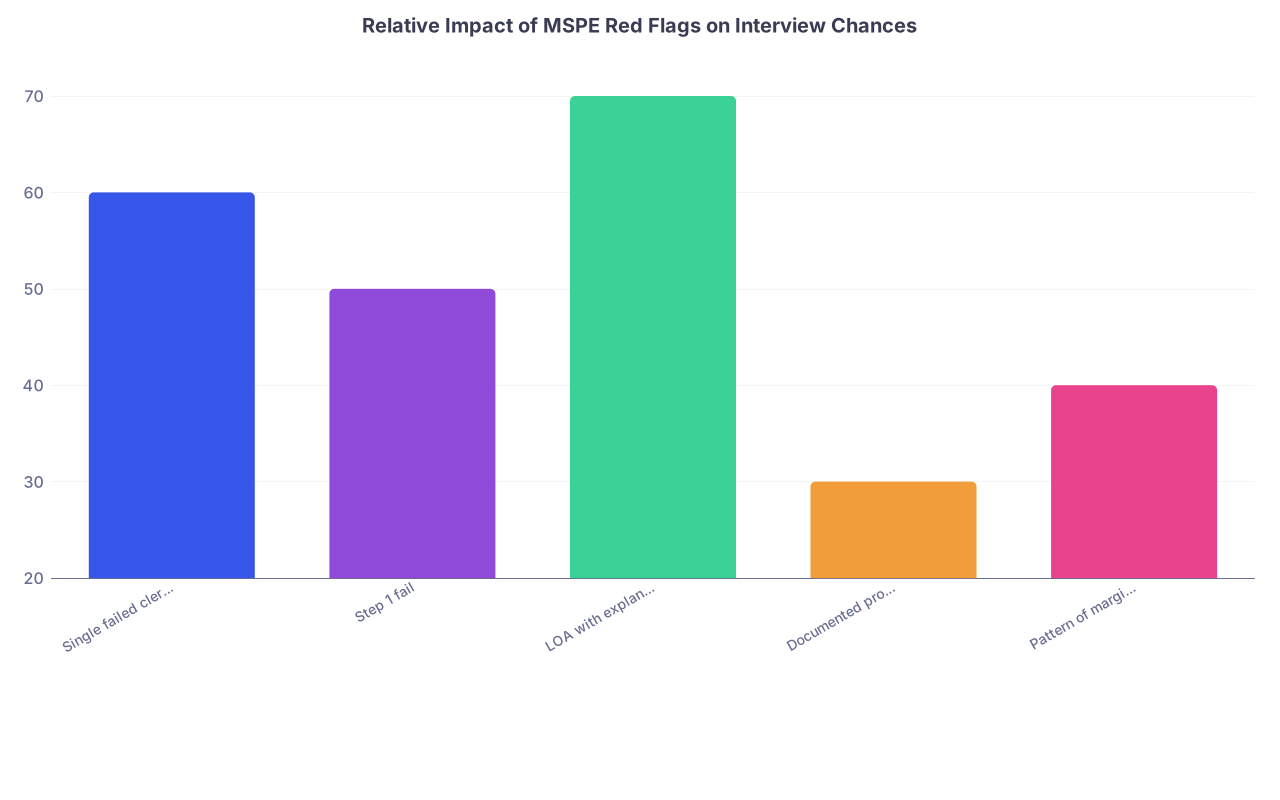
| Category | Value |
|---|---|
| Single failed clerkship | 60 |
| Step 1 fail | 50 |
| LOA with explanation | 70 |
| Documented professionalism remediation | 30 |
| Pattern of marginal evals | 40 |
Illustrative relative impact scores (0–100) showing how PDs often weight severity: professionalism issues and sustained marginal performance tend to hurt the most.
3. Interview: Answering the “Tell Me About…” Question
If you have a visible red flag in the MSPE, smart interviewers will ask about it. Some will be blunt:
“I see you repeated surgery. What happened?”
Others will be vague:
“Tell me about a time you received critical feedback or had to overcome an academic setback.”
Either way, the structure of your answer should be the same.
Use a modified “ACE” approach:
- Acknowledge
- Cause + Correction
- Evidence
Example: professionalism remediation for talking dismissively to a nurse.
Acknowledge (don’t sugarcoat):
“During my third year, I was placed on a professionalism remediation plan after I reacted poorly to feedback from a nurse on the wards.”
Cause + Correction:
“I was behind on tasks and felt overwhelmed. When she questioned my plan in front of the team, I became defensive and curt. I realized later that I had put my stress above basic respect. As part of remediation, I met with our professionalism officer, reviewed our institution’s expectations, and practiced de‑escalation and feedback‑receiving strategies. I also shadowed our charge nurse for several shifts to better understand their perspective.”
Evidence (this is the part most candidates skip):
“Since then, my evaluations consistently mention collegiality and communication with staff. On my sub‑I in medicine, the head nurse specifically told my attending that I was one of the easiest students for their team to work with. I am grateful it was addressed as a student rather than as a resident, when the stakes would be much higher.”
Notice what is missing: bitterness, blame, oversharing about personal struggles as justification.
Specialty‑Specific Nuances in How Red Flags Land
Not all programs weigh MSPE red flags the same way. Briefly:
Surgical fields (Gen Surg, Ortho, ENT):
Hyper‑sensitive to professionalism, work ethic, and team behavior. A surgery failure or negative narrative is rough but not impossible if you have strong non‑surgery letters and clear growth elsewhere.Internal Medicine, Peds:
Read narratives very closely. “Reliable,” “thoughtful,” “excellent communicator” can partially offset a past academic stumble. Professionalism red flags stick heavily.Emergency Medicine:
Will fixate on teamwork, communication, and performance under pressure. A marginal EM rotation narrative is a major problem; you will need a strong away rotation letter that says the opposite.Psychiatry:
Less obsessed with raw speed, more concerned about interpersonal skills, boundaries, and mental stability. Vague LOAs without explanation can be particularly damaging here.Competitive road specialties (Derm, Rad Onc, Plastics):
Any major red flag is amplified because of applicant volume. You may need to recalibrate specialty choice if your MSPE is heavily marked in multiple dimensions.

Practical Triage: How Bad Is Your MSPE Red Flag, Really?
You want a rough severity scale. Here is a simplified one.
| Tier | Example Issue | Typical Impact |
|---|---|---|
| Mild | Single clerkship with lukewarm comments, “quiet,” “needs confidence” | Often manageable without explicit explanation |
| Moderate | Single course/clerkship fail remediated, Step 1 fail with strong Step 2, brief LOA with clear reason | Needs concise explanation; still can match broadly |
| Significant | Documented professionalism remediation, multiple attempts at key exams, multiple marginal narratives | Requires strategy, strong advocacy, thoughtful specialty targeting |
| Severe | Pattern of professionalism problems, multiple failures across years, extended unexplained LOAs | Heavily limits options; may need extra years, research, or backup specialty |
| Critical | Dismissal and readmission, NRMP violation, ongoing unresolved issues | Very high risk; requires intensive dean-level support and realistic expectations |
Be honest with yourself about where you fall. Mild and moderate issues are survivable with decent scores and strong letters. Significant and above require deliberate planning, not hope.

| Step | Description |
|---|---|
| Step 1 | Review MSPE Carefully |
| Step 2 | Focus on strength signaling |
| Step 3 | Classify severity |
| Step 4 | Do not over-explain in PS |
| Step 5 | Brief explanation in ERAS |
| Step 6 | Meet with dean/advisor |
| Step 7 | Target programs & backup specialty |
| Step 8 | Prepare interview narrative |
| Step 9 | Red flag present? |
| Step 10 | Mild/Moderate? |
| Step 11 | Significant+? |
Final Perspective: What PDs Actually Want to See
Program directors are not hunting for perfection. They are hunting for risk.
The question in their heads is not “Has this person ever messed up?” It is: “When they messed up, what did they do next—and should I trust them with a pager at 2 a.m.?”
The MSPE is the written record of your mess‑ups and your recoveries. If it shows a single bad chapter with a clear resolution, you are fine. If it shows a pattern of denial, blame, or minimal change, you are in trouble.
Your job now:
- Read your MSPE like a skeptic. Translate the code.
- Fix what can be fixed on paper: factual corrections, added context, structured explanations.
- Show, through your subsequent performance and your narrative, that the red flag was an episode, not your identity.
Do that well, and you stop being “the applicant with the professionalism issue” and become “the applicant who matured early and will not repeat that mistake on my service.”
FAQ (Exactly 5 Questions)
1. Should I ask my dean to remove or soften a professionalism comment in my MSPE?
You can ask for factual precision and for inclusion of remediation outcomes, but outright removal of a serious professionalism issue is rarely ethical or allowed. Frame your request around accuracy and completeness: dates, resolution, and lack of recurrence. Trying to erase it entirely usually backfires and can damage how strongly the dean is willing to advocate for you to programs.
2. Do I need to mention my LOA or Step 1 fail in my personal statement?
Not necessarily. The personal statement should not be a damage‑control document. Use dedicated ERAS fields (education history, interruptions, additional info) for concise explanations. Reserve the personal statement for your motivation, fit for the specialty, and strengths. The only exception: if the LOA is tightly tied to your story (e.g., major illness that directly shaped your career goals) and you can discuss it in a composed, forward‑looking way.
3. How many programs should I apply to if I have a significant MSPE red flag?
More than the average for your specialty, and in a wider geographic spread. For many core specialties, that means 1.5–2× the typical number of applications. You should also include a realistic backup specialty if your red flag is substantial (repeated failures, serious professionalism issues). This is a conversation you should have with an advisor who has actual match data from your school.
4. Can strong letters of recommendation override a negative MSPE?
They can mitigate, but not erase. A glowing sub‑I letter that explicitly addresses your reliability, communication, and improvement carries real weight, especially if it comes after the problematic episode described in the MSPE. However, a documented pattern of problems across multiple rotations cannot be neutralized by a single great letter. PDs look at the whole trajectory.
5. What if my school does not let me see or edit my MSPE before it is sent?
You are not powerless. Request a meeting with Student Affairs or your dean to at least verbally review any concerns they have and ask directly: “Is there anything in my MSPE that you believe programs will see as a red flag?” Use their answer to shape your ERAS explanations and interview prep. Also, talk to recent graduates; they can tell you how your school typically phrases concerns and how that played out in their match.